Español
 Português (Brasil)
 Français
 Deutsch
 Italiano
 Nederlands
 Polski
 Svenska
 Türkçe
 Русский
 日本語
日本語 한국어
한국어 Tiếng Việt
 Bahasa Indonesia
 繁體中文
繁體中文 Čeština
 Dansk
Dansk Suomi
Suomi Ελληνικά
 Română
 Magyar
 Українська
 ไทย
ไทย हिन्दी
 العربية
 עברית
עבריתWhat Happened to Yahoo Gemini? What Replaced It in 2026
Yahoo Gemini was retired in 2023, and Yahoo native didn't die with it: demand moved to the Yahoo DSP and the supply is now run exclusively by Taboola, so here's the timeline and how to spy on live Yahoo creatives today.

If you came here looking for a way to log into Yahoo Gemini in 2026, stop. The platform is gone. The login does not exist, and most of the advice still telling you to "set up a Gemini campaign" was written by people who never noticed it disappeared.
Here is what actually happened. Gemini, the self-serve marketplace Yahoo used to sell native and search ads, was dismantled. The native ads themselves did not vanish. They got handed off, rebranded, and absorbed into a supply chain run by a partner most media buyers already know by name.
This guide traces exactly what happened, where Yahoo native lives now, and the part nearly every other article skips: how to actually see which advertisers are running on Yahoo today.
What happened to Yahoo Gemini?#
Yahoo shut down Gemini in 2023. During a company-wide restructuring that cut roughly 20% of staff, Yahoo retired the standalone Gemini platform and its supply-side platform in the same move. Native demand shifted to the Yahoo DSP (the buy-side platform branded Yahoo Advertising). The native inventory across Yahoo's properties is now sold and served exclusively by Taboola under a 30-year commercial agreement.
So there was no clean successor. Gemini got broken into pieces and the pieces went to two different homes: one for demand, one for supply.
From Gemini to Yahoo DSP plus Taboola#
Gemini launched in 2014 as Yahoo's unified marketplace for native and mobile search ads. One auction, where advertisers bid on placements across Yahoo Finance, Yahoo News, Yahoo Mail, and the wider Yahoo network. For a few years it was a real alternative to Outbrain and Taboola, with its own bidding model, audience targeting, and a self-serve UI that direct-response and affiliate buyers leaned on hard.
Two moves ended that era.
November 2022: the Taboola deal. Yahoo and Taboola signed a 30-year exclusive commercial agreement. Taboola would power native advertising across all of Yahoo's digital properties, reaching close to 900 million monthly active users, with the supply buyable through the Yahoo DSP. Yahoo took just under 25% of Taboola's equity in the process. Translated into plain English: Yahoo stopped running its own native marketplace and outsourced it.
February 2023: the restructuring. Yahoo confirmed deep ad-tech layoffs and wound down the platforms it no longer wanted to operate, Gemini and its SSP included. The company chose to bet on the buy side, the Yahoo DSP, instead of maintaining a full-stack native business.
The shutdown was not a failure of Yahoo native demand. It was a decision to stop being a marketplace and start being a buyer's platform, while letting Taboola own the supply.
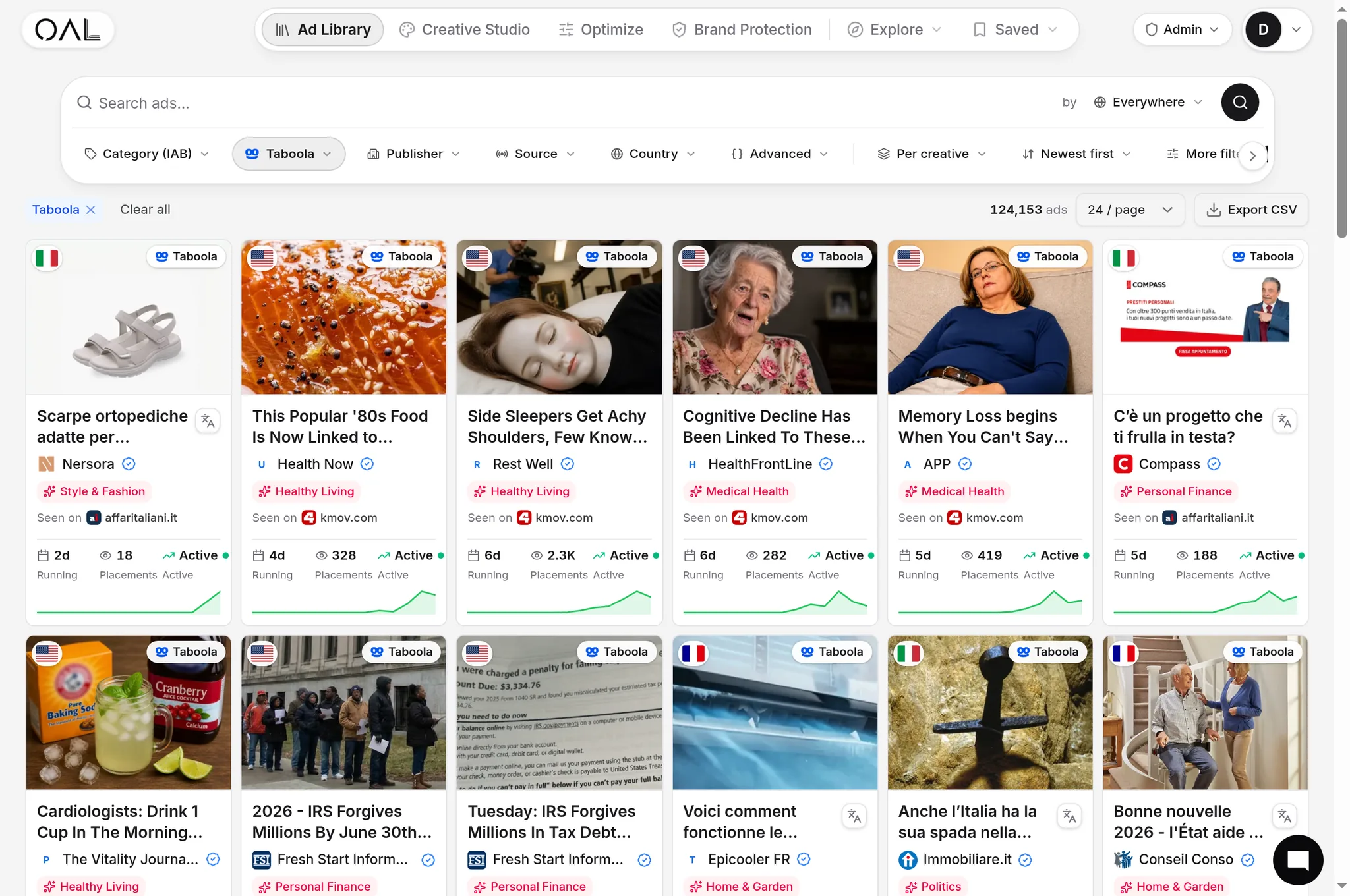
That last word, supply, is the whole story. Because Taboola now powers Yahoo native, the ads you see on Yahoo Finance today look exactly like the ads you see across the rest of the Taboola feed. Same advertisers, same angles, same clickbait DNA. Here is a live one we captured running in finance, the single biggest native vertical:

Finance is the most crowded native vertical we track, with 17,232 active creatives across all networks (OpenAdLibrary index, June 2026). On Taboola specifically, finance is the number two vertical with 5,558 creatives, behind only health at 6,048. If you advertise on Yahoo properties now, that is the company you are keeping.
Where Yahoo native ads live now#
Here is the cleanest way to hold the split in your head.
| Old Gemini function | Where it lives in 2026 |
|---|---|
| Native ad marketplace / supply | Taboola (exclusive, across all Yahoo O&O properties) |
| Buying native programmatically | Yahoo DSP (formerly Yahoo Advertising) |
| Self-serve native campaign UI | Retired. Buy via Yahoo DSP or Taboola's platform |
| Search ads | Handled separately via Yahoo's search partnership |
| Supply-side platform (SSP) | Shut down |
What that means in practice:
- You can still reach Yahoo audiences. Yahoo Finance, Yahoo News, Yahoo Mail, Yahoo Sports, and the rest still carry native ad placements. That inventory just runs through Taboola and the Yahoo DSP now.
- There is no Gemini login anymore. Any 2026 guide referencing the Gemini dashboard, Gemini campaign types, or Gemini bid strategies is stale. If it tells you to build a Gemini campaign, it has not been touched in three years.
- If you already run Taboola, you may already be on Yahoo. Since Taboola exclusively powers Yahoo native, your Taboola campaigns can serve into Yahoo's premium supply. Learning how Taboola ads work is now the same conversation as learning Yahoo native.
Health is the other vertical you will see everywhere on this supply. It is the third-largest native category we track at 14,895 creatives, and on Taboola it is the single biggest. The aesthetic is consistent: a slightly alarming claim, a numbered list, a "doctors found out" hook. Like this one:

For the wider picture, how discovery feeds, content recommendation widgets, and the supply chain behind them fit together, our native advertising guide covers the full landscape.
What this means for media buyers in 2026#
The Gemini shutdown was not a one-off. It is part of a consolidation wave across native. Outbrain bought Teads and rebranded the combined company under the Teads name, which rhymes with the Yahoo and Taboola tie-up: fewer independent marketplaces, more scale piling up in a handful of players. If you are sizing up the field, read how Outbrain works now that it's part of Teads and what Teads actually is next to this. The same forces that killed Gemini are reshaping everything around it.
A few concrete implications:
- Targeting and reporting changed. Gemini's interface, audience controls, and conversion reporting are gone. Buying Yahoo audiences now means learning the Yahoo DSP's programmatic workflow or Taboola's campaign tools, not porting over old Gemini settings.
- The DSP is going agentic. In January 2026 Yahoo DSP rolled out agentic AI capabilities, including an Agent Network and a "Yours, Mine, and Ours" framework that lets advertisers bring their own AI, use Yahoo's native agents, or connect via open MCPs and APIs. The buying experience is drifting toward automation, away from the manual self-serve dashboard Gemini buyers remember.
- Competitive research got harder. With native sold programmatically through the DSP and Taboola, there is no public Yahoo ad library to browse. The advertiser behind a placement, the creative, and the landing page are all opaque unless you capture them yourself.
That last point is where the real pain sits. When the marketplace was Yahoo's own, you had cleaner visibility. Now the supply runs through Taboola, the demand through the DSP, and the actual advertiser is buried behind tracking redirects.
How to research live Yahoo native ads today#
You cannot ask Gemini who is advertising on Yahoo Finance anymore. The platform that would have answered the question is gone. The reliable approach is to watch the live, public placements directly.
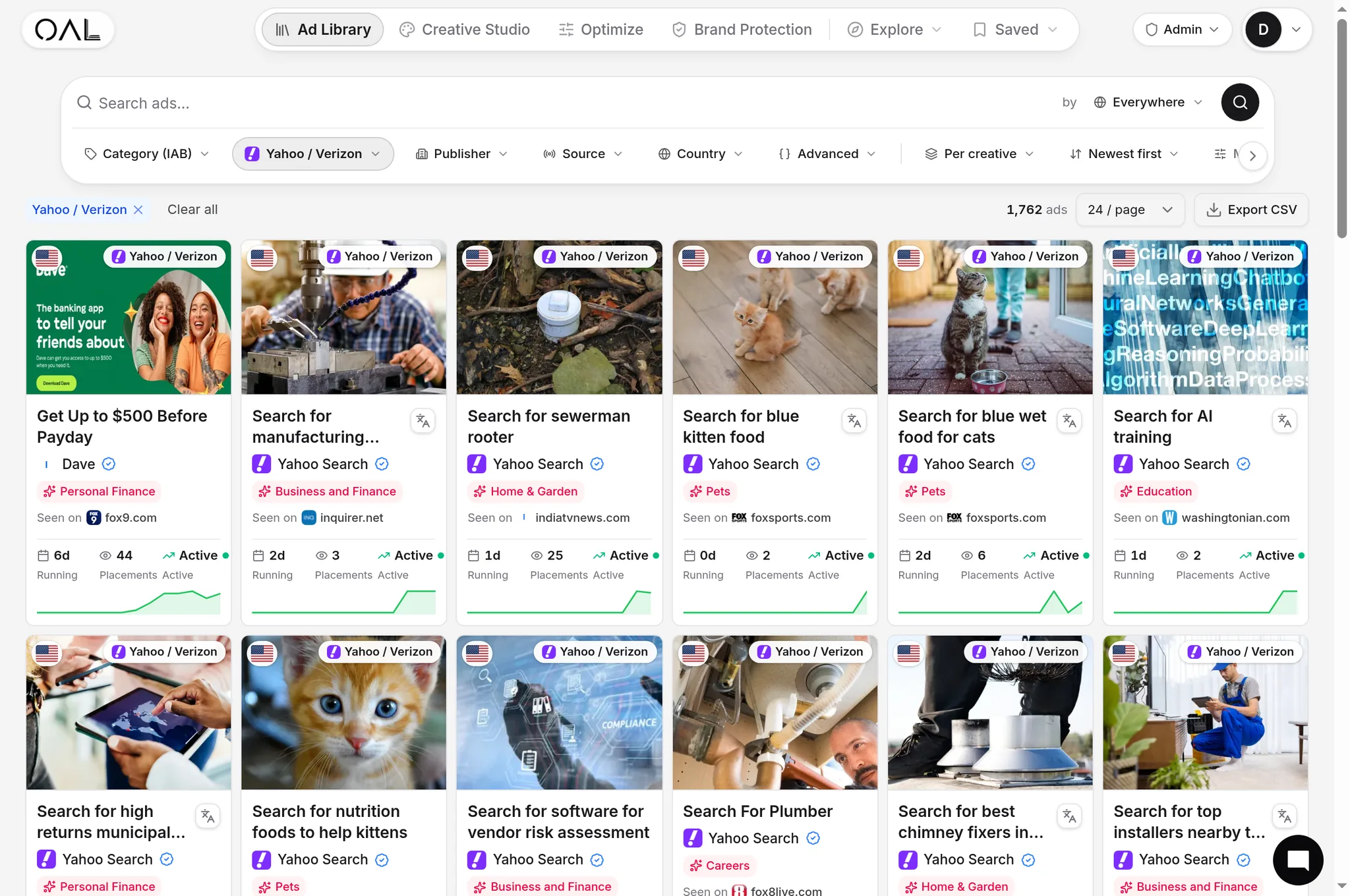
That is the model OpenAdLibrary runs on. It continuously captures real native ads as they serve across Yahoo and Taboola supply (the full-quality creative image, not a thumbnail), classifies the ad-tech supply chain behind each one, and follows the click to the advertiser's landing page without ever clicking the live ad. Across the index we are now holding 589,036 creatives from 25,933 advertisers, 5.4 million ad observations, and 926,259 landing-page captures across 42 networks. Taboola alone, the engine behind Yahoo native, accounts for 157,727 of those creatives (OpenAdLibrary index, June 2026).
For a platform like Yahoo native, where the buyer hides behind programmatic plumbing, that lets you see:
- The real advertiser behind a placement, not just the redirect domain.
- The landing page or pre-lander the click resolves to: the offer, the angle, the funnel.
- Longevity and spread signals, the clearest tell that something is working.
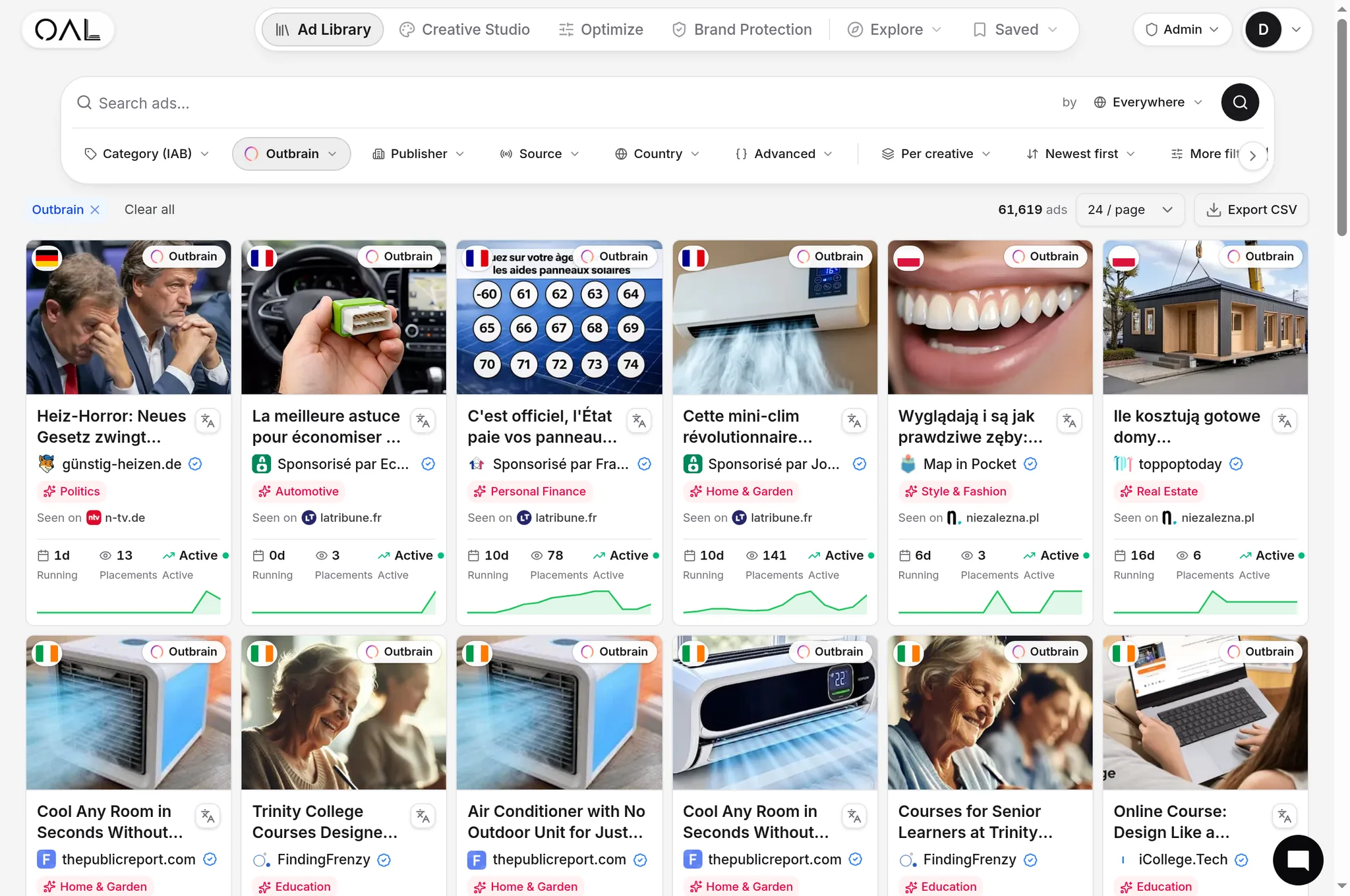
That third signal deserves a caveat, because a lot of "spy tool" lore is fuzzy here. You will read that the real winners run 90 days or longer. That is general industry rule-of-thumb, not something we are claiming as our own measurement. What we can show you is observed, continuous runtime, and our index currently spans up to about 28 days of unbroken observation per creative. The ads sitting at that 28-day ceiling are telling. Insurance and lead-gen offers cluster there, like this one still serving after the better part of a month:

Insurance is the second-biggest vertical in our whole index at 15,629 creatives, and on Taboola it sits at 4,303. When you see the same insurance or solar or hearing-aid creative running for weeks across many sites, that persistence is the budget talking. Nobody keeps paying to serve a loser. Here is a home and garden example that had been live for 27 days at capture, right at our observation ceiling:

You can browse a focused view of this supply on the Yahoo native ad spy page. OpenAdLibrary covers the rest of the consolidated native ecosystem too, MGID and Revcontent among them, so you are not stuck with the fragmented, paywalled view the old tools handed you. For a deeper definition of the platform's history, see the Yahoo Gemini / Yahoo Native glossary entry.
Where legacy spy tools charge $80 to $400 a month for a slice of this, OpenAdLibrary is open and runs $29.99/mo, with a free tier that lets you browse 200 ads with no card.
The bottom line#
Yahoo Gemini was retired in 2023. Native advertising on Yahoo did not end. It was split between the Yahoo DSP for demand and Taboola for supply, the result of a 30-year exclusive partnership signed in 2022. To advertise on Yahoo's properties, you go through the DSP or Taboola. To research who is already advertising there, you capture the live placements directly, because no public Yahoo ad library exists.
Stop hunting for a Gemini login that died three years ago. Start free and see the real advertisers, creatives, and landing pages running across Yahoo native right now.