Español
 Português (Brasil)
 Français
 Deutsch
 Italiano
 Nederlands
 Polski
 Svenska
 Türkçe
 Русский
 日本語
日本語 한국어
한국어 简体中文
简体中文 Tiếng Việt
 Bahasa Indonesia
 繁體中文
繁體中文 Čeština
 Dansk
Dansk Suomi
Suomi Ελληνικά
 Română
 Magyar
 Українська
 ไทย
ไทย हिन्दी
 العربية
 עברית
עבריתWhere Do Outbrain Ads Appear? Inside the Publisher Network
From premium news anchors to the long tail: where Outbrain placements actually live, how the Teads merger widened the map, and how to check any site in under a minute.


Outbrain ads appear as sponsored-content recommendations — the "Recommended for you" grids below and inside articles — on thousands of publisher websites worldwide. The anchor supply has historically been major news publishers (CNN, Der Spiegel and Sky News are among partners announced publicly over the years), surrounded by a long tail of mid-size content sites; since the 2025 Teads merger the combined platform also sells in-article video and display placements across the Teads publisher base. Publisher deals rotate constantly, though, so the reliable way to answer "does site X run Outbrain" is to check the page itself — the exact method is below.
The placements you'll actually see#
Outbrain inventory shows up in four recurring shapes:
- Below-article feed. The classic unit: a grid of sponsored and editorial recommendations rendered after the article ends. This is the content recommendation widget format the company built its business on, and it still carries most of the click volume.
- Mid-article units. Smaller recommendation blocks inserted between paragraphs — higher on the page, more interruptive, more impulsive clicks.
- Sidebar and right-rail modules. Persistent recommendation columns on desktop layouts; low CTR, cheap inventory.
- In-article video and display. The formats that arrived with the merger — outstream video players and display units that Teads historically sold into premium editorial. The combined offering is covered in What Is Teads?.
All of them are labeled — "Recommended by Outbrain," "Ads by Outbrain," or a sponsored tag — which is also your first identification tool.
The publisher network: premium anchors plus a long tail#
The publisher side of Outbrain's marketplace has a shape worth understanding before you buy or sell against it.
At the top sit the premium anchors: national and international news brands that embed the feed as a monetization layer under editorial content. These deals are large, negotiated, often exclusive for a contract term — and they rotate. A publisher that runs Outbrain this year may run a competitor's widget after the next renewal, which is why any static "sites that use Outbrain" list you find is already partly wrong. The famous names above are documented partners from public announcements over the years, not a guaranteed current roster.
Below the anchors is a long tail of mid-size and small content sites for which the feed is a meaningful share of revenue per thousand pageviews. Quality here varies from solid niche editorial to arbitrage-driven sites built around the widgets themselves.
For advertisers this tiering is the whole story: your campaign can serve anywhere in that range, and the premium anchors and the long tail behave like different traffic sources that happen to share a dashboard.
The geo footprint#
Outbrain's supply is strongest where its anchor publishers live: the United States and the major English-language markets, plus deep European coverage built through longstanding relationships with continental news brands — its German and French footholds have historically been notable, and the Teads merger deepened the European editorial base further. Beyond Tier-1, inventory exists across most markets but thins out, with quality dispersion widening as it does.
Practical consequences for buyers: Tier-1 campaigns can be picky about sections and still find scale, while Tier-2 and Tier-3 campaigns inherit whatever publishers exist there — often a higher proportion of long-tail supply, priced accordingly. If you are expanding internationally, treat each geo as its own supply market with its own audit, not as the same network at a different CPC.
What kind of experience readers actually get#
It helps to picture the unit from the reader's side, because that experience is what you are buying. A visitor finishes an article on a news site and scrolls into a grid labeled as recommended content: a mix of the publisher's own stories and sponsored items, each a thumbnail plus headline. The sponsored items read like story links, not banners — that is the entire premise of the format. Clicks are deliberate in the sense that the reader chose that headline over several alternatives sitting beside it, which is why native clicks behave more like content choices than ad clicks, and why story-style landing pages dramatically outperform product pages on this traffic.
That same grid mechanic also explains the format's weakness: on dense mobile layouts, some fraction of taps are navigation accidents. The reader experience varies by publisher tier just as much as the traffic does.
How to check whether a specific site runs Outbrain#
Three checks, in increasing order of reliability — under a minute for all of them:
- Read the widget label. Scroll to the recommendation grid and look for "Recommended by Outbrain" or "Ads by Outbrain" branding. Quick, but labels can mislead on resold inventory, where one network fills another's slots.
- Check the network requests. Open browser DevTools, reload the page, and filter network requests for
outbrain. Scripts loading from outbrain.com domains (the widget loader) are the definitive on-page signal. Taboola, MGID and others are equally visible this way. - Read the site's ads.txt. Fetch
example.com/ads.txtand search for Outbrain entries. The ads.txt file lists a site's authorized sellers, catching relationships that only activate programmatically.
The general version of this workflow — for any network, not just Outbrain — is in our guide to identifying the ad network behind any ad. And if your question is the inverse — you have a site and want to know which advertisers are buying its slots — that method is covered in Who Is Buying Ads on a Website?
See the ads without visiting a thousand sites#
Checking pages one at a time answers "does this site run Outbrain." It does not answer the more useful question: what is actually running across the network right now. That requires continuous observation of live placements, which is what an ad library does.
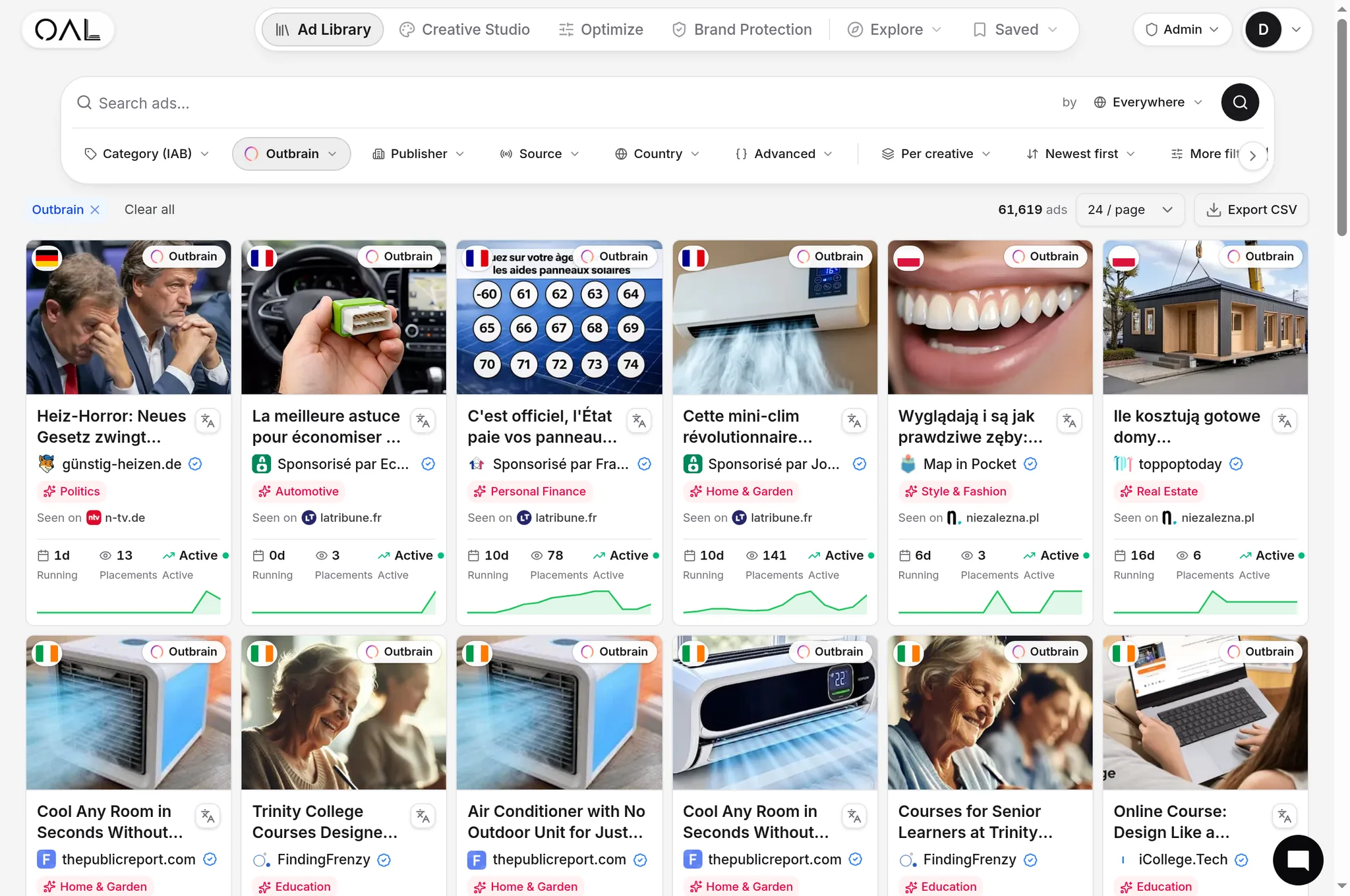
OpenAdLibrary observes Outbrain placements continuously and indexes what it captures: 108,573 live Outbrain creatives as of June 2026, inside a corpus of 725,000+ creatives across 49 networks, each with the advertiser, observed run time, geo and device data, and the traced landing page. You can browse the whole thing at the Outbrain spy tool page, and the library-focused walkthrough — what is captured and how to read it — lives in our Outbrain ad library guide.
Who advertises in these placements#
The demand filling those publisher slots, from the June 2026 index:
| Vertical | Classified live Outbrain creatives |
|---|---|
| Insurance | 4,345 |
| Finance | 3,990 |
| Health | 3,102 |
| Ecommerce | 2,277 |
| Software | 1,932 |
| Home & garden | 1,545 |
Two demand types share the network. Direct-response and lead-gen advertisers dominate volume — the insurance-finance-health trio at the top is the classic performance-marketing mix. Alongside them run brand-content campaigns from corporates using the same feeds for storytelling; SPECTRA by MHI's sustainability series, observed running over a month straight, is a current example. The blend matters to publishers (brand demand raises the floor) and to advertisers (it tells you who you are bidding against on premium sections).
Why the publisher mix should shape your buying#
If you take one thing from the map: Outbrain is not one traffic source. The premium anchors deliver older, desktop-heavy news readers at premium CPCs; the long tail delivers volume at prices that only work with aggressive section-level curation. Campaigns that separate the two — by device split, section blocking, and conversion-based pruning — read clearly. Campaigns that blend them produce averages that flatter neither.
The same logic applies before launch. Spend an hour with the live index looking at which advertisers dominate the sections you want, what formats they run, and how long their creatives have survived there. The publisher map tells you where your ads can appear; the demand map tells you what it will take to win those slots. On this network, where is most of what you are buying — so know it before the first invoice, not after.