 Español
 Français
 Deutsch
 Italiano
 Nederlands
 Polski
 Svenska
 Türkçe
 Русский
 日本語
日本語 한국어
한국어 简体中文
简体中文 Tiếng Việt
 Bahasa Indonesia
 繁體中文
繁體中文 Čeština
 Dansk
Dansk Norsk (bokmål)
 Suomi
Suomi Ελληνικά
 Română
 Magyar
 Українська
 ไทย
ไทย हिन्दी
 العربية
 עברית
עבריתWhat Is Teads? The Outbrain-Teads Platform Explained (2026)
Outbrain bought Teads in 2025 and rebranded the combined company as Teads; here is what the merged native, video, and CTV platform actually looks like, and how to study live inventory before you spend.

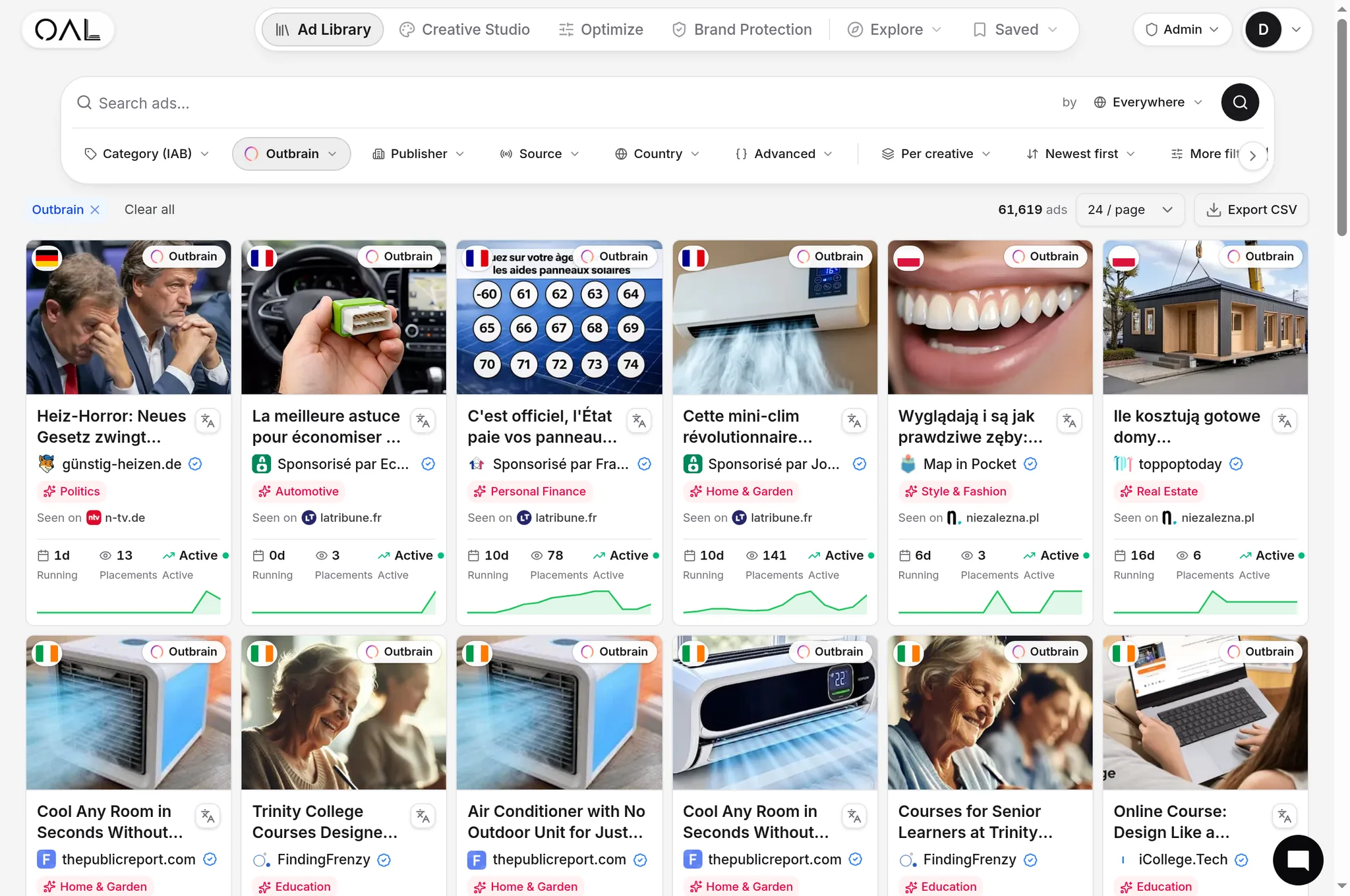
If you have run native campaigns in the last few years, you have already bought through both Outbrain and Teads. As of 2025, they are the same company. Outbrain acquired Teads, the deal closed in February 2025, and the combined business now trades under the Teads name. This is not a logo swap. A content-recommendation network and an outstream-video network folded into one platform, and that changes how you plan, buy, and benchmark across the open web.
Here is what the merged Teads actually is, where native advertising fits inside it, which formats are running right now, and how to study live Teads-Outbrain inventory before you spend a dollar.
What is Teads advertising?#
Teads is the open-internet advertising platform formed when Outbrain acquired Teads in February 2025. The combined company, renamed Teads Holding Co. and trading on Nasdaq as TEAD since June 2025, pairs Outbrain's native content-recommendation feeds with Teads' outstream video and connected-TV inventory. It sells placements across roughly 10,000 publishers and claims a reach of about 2.2 billion consumers.
Plain version: two of the biggest names on the open web (everything outside walled gardens like Meta, Google, and TikTok) are now one company. The platform covers the full funnel, from awareness video at the top to performance-priced native that bids toward conversions at the bottom.
One thing worth saying up front, because nobody else will. In our own index, almost everything carries the Outbrain name, not the Teads name. We have captured 84,252 live Outbrain creatives versus just 55 tagged Teads (OpenAdLibrary index, June 2026). The merger is real on paper, but on the actual publisher page the brand you see serving the recommendation widget is still overwhelmingly Outbrain. Keep that in mind every time a deck tells you the two are now indistinguishable.

How the merger reshaped the platform#
The two companies came from opposite ends of the open web, which is exactly why the combination is interesting.
- Outbrain built its business on content-recommendation widgets, the "Around the Web" and "You May Like" modules that sit below and beside articles on news and publisher sites. That is classic native, optimized for clicks into advertiser content and landing pages. Our Outbrain guide covers the mechanics in depth.
- Teads built its business on outstream (inRead) video, units that load inside the body of an article and play as you scroll instead of living in a separate player. Teads also pushed early into premium publisher direct deals and, more recently, connected TV.
Put together, the combined platform can serve a brand video on CTV, retarget the same audience with an outstream unit mid-article, and close with a performance-priced native ad widget recommending a product page. That "one audience, every screen" story is the merger's whole pitch.
The strategic logic is simple. Walled gardens own social and search, so the open web's best defense is scale. By merging, Teads and Outbrain stopped fighting over the same publisher shelf space and started selling it as one pool, roughly $1.7 billion in combined annual ad spend behind a single sales motion.
Who runs it and what changed for buyers#
Outbrain's leadership runs the combined company, with Teads' former co-CEOs taking commercial president roles across the Americas and international markets. For practical purposes the buying surfaces are converging but have not fully merged. You will still hit legacy Outbrain branding on most publisher widgets and in many DSP supply paths, while video and CTV products carry the Teads name. Expect that to keep consolidating through 2026, slowly.
What the native inventory actually looks like#
Native is no longer the whole story at Teads, but it is still the spine. And the spine is heavily performance-driven, not brand-safe corporate video. Look at what Outbrain creatives are actually pushing in our index. The biggest verticals are Finance (2,640 creatives), Insurance (2,615), and Health (2,016), followed by ecommerce, software, and home and garden (OpenAdLibrary index, June 2026). That is the affiliate and direct-response economy, not a Coca-Cola brand campaign.
The headlines tell the same story. Curiosity-gap health hooks, "doctor recommends" angles, and quiz funnels dominate. Here is a real one we captured running for 16 days straight:

Not every Outbrain ad is a supplement advertorial. The platform still carries plenty of legitimate brand spend, like this Peugeot promotion that ran for over two weeks:

Here is how the major surfaces compare across the merged platform.
| Surface | Origin | What it is | Typical buying goal |
|---|---|---|---|
| Content-recommendation widget | Outbrain | In-feed "recommended" cards below or beside articles | Clicks, conversions, content distribution |
| Outstream / inRead video | Teads | Video that loads inside the article body, plays on scroll | Viewable video reach, brand lift |
| Display | Both | Standard IAB banner units on premium publishers | Reach, retargeting |
| CTV HomeScreen | Teads | Sponsored placement on smart-TV home screens | Awareness at TV scale |
| CTV in-stream | Teads | Video inside streaming or AVOD content | Brand awareness, co-viewing reach |
The content-recommendation widget is the format most affiliates and direct-response buyers know best, because it competes head-to-head with Taboola, MGID, and Revcontent for the same in-feed real estate. If your business is performance (advertorials, lead-gen, ecommerce) native widgets and outstream video are where you will spend most of your time. CTV is where brand budgets are migrating and it is the fastest-growing piece, but it is a different buying discipline with a different team usually attached to it.
Programmatic by default#
Most Teads inventory is bought programmatically rather than through a managed insertion order. The platform runs as both the supply-side platform (SSP) that aggregates publisher inventory and a buying interface that bids on it, and it leans more every quarter on outcome-based optimization. You tell the algorithm to chase conversions or qualified actions instead of raw impressions. That is a real shift from the old "set a CPC, pick your sites" workflow that defined early native.
How long do Teads and Outbrain ads actually run?#
This matters more than buyers expect, so be careful with the numbers you hear. You will read industry lore about "90-day evergreen winners" on native. That is general market talk, not something we can confirm from a single creative.
What we can tell you is what we directly observe. Our index currently spans up to about 28 days of continuous observation per creative, and the longest-running Outbrain ads we track sit right at that 28-day ceiling. The "Dog licks aren't kisses" pet curiosity ad from Cleverst and SmartAsset's "How Can I Avoid Paying Taxes on IRA Withdrawals?" finance hook have both been live for 28 days straight (OpenAdLibrary index, June 2026). When a curiosity or finance angle runs that long without rotating, that is a strong signal it is converting. Nobody pays to keep a losing ad on for a month.

So treat longevity as your best free proxy for performance. A creative that is still up after three or four weeks earned its spot. A creative that vanishes after a day or two was probably a failed test, and you can see plenty of those in the data too, ads with one day live next to ones with twenty.
How Teads stacks up against the rest of the open web#
After the merger the open-web native landscape has two giants and a competitive middle tier.
- Teads (incl. Outbrain). Broadest format range: native widgets plus outstream video plus CTV. Strongest in premium publisher video and the new omnichannel play.
- Taboola. The largest pure content-recommendation network, anchored by exclusive long-term publisher deals. See how Taboola works for the contrast in supply model.
- MGID, Revcontent, and others. Leaner native networks that often clear cheaper traffic and stay popular with aggressive affiliate buyers.
- Yahoo. Runs its own native marketplace through the Yahoo DSP. Our Yahoo native guide explains where it overlaps.
The practical takeaway: Teads and Taboola will usually be your two anchor tests on any open-web plan, with the smaller networks layered in for volume or cheaper traffic. None of them publish a clean public list of who is advertising what, which is exactly the gap competitive research has to fill.
How to research live Teads and Outbrain ads#
Because the merged platform's inventory is bought programmatically and rendered dynamically inside publisher pages, you cannot open a campaign manager and browse what competitors are running. You have to catch the ads in the wild. Three things are worth pulling on any competitor before you build a campaign.
- The real creative. The exact headline, thumbnail, and angle winning impressions right now, not a mockup. In native, small differences in thumbnail and hook drive most of the performance gap.
- The advertiser behind the ad. Native widgets routinely hide the true advertiser behind a brand-ish display name or a tracking-redirect domain. Knowing who is actually buying tells you whether an angle is a one-off test or a funded, scaled campaign.
- The destination. Following the click to its landing page or pre-lander reveals the offer, the funnel, and the monetization model, the part competitors most want hidden.

This is where an ad-transparency tool earns its place. OpenAdLibrary continuously captures live Outbrain (and broader open-web) creatives as they serve. We store the full-resolution image instead of a thumbnail, classify the ad-tech supply chain behind each placement, and trace each click through to the advertiser's landing page, all without ever clicking a live ad. To put scale on it: the index holds 589,036 creatives from 25,933 advertisers across 42 networks, backed by more than 5.4 million ad observations and 926,259 captured landing pages (OpenAdLibrary index, June 2026). Longevity and spread signals then tell you which creatives actually scaled, so you can separate proven winners from short-lived tests.
| Research question | What to look for in captured inventory |
|---|---|
| Is this angle proven? | Days live plus the number of distinct publishers it has run on |
| Who is really buying? | Resolved advertiser identity, not the widget's display name |
| What is the offer? | Traced landing page or pre-lander and its funnel |
| Is the format right? | Whether the winner is a widget, advertorial, or outstream video |
For a buyer entering the merged Teads ecosystem, that visibility saves weeks of guesswork. Instead of launching a campaign just to learn what creative and offer combinations the network rewards, you study the ones already winning and reverse-engineer the pattern.
Start free and browse live captured native ads, no card required, to see exactly what is running across Outbrain and the wider open web today.
The bottom line#
Teads in 2026 is the merged Outbrain-Teads platform: native recommendation widgets, outstream video, and connected TV across roughly 10,000 publishers and 2.2 billion consumers. Native is still the performance spine, video and CTV are where the growth and brand budgets are heading, and almost all of it is bought programmatically toward outcomes. The buying surfaces are still consolidating, so you will keep seeing both brand names in the wild for a while. In our own data, Outbrain branding still dominates the live widget by a wide margin.
If you buy on the open web, treat Teads and Taboola as your two anchor networks, and lean on captured live inventory (the real creative, the real advertiser, the real landing page) to decide what to test before you spend.