Español
 Português (Brasil)
 Français
 Deutsch
 Italiano
 Nederlands
 Polski
 Svenska
 Türkçe
 Русский
 日本語
日本語 한국어
한국어 Tiếng Việt
 Bahasa Indonesia
 繁體中文
繁體中文 Čeština
 Dansk
Dansk Suomi
Suomi Ελληνικά
 Română
 Magyar
 Українська
 ไทย
ไทย हिन्दी
 العربية
 עברית
עבריתNative Advertising: The Complete Guide With Real Examples (2026)
A practitioner's guide to native advertising in 2026: the formats, the networks, how the auction really works, and how to read winning ads straight off the live market.

Native advertising is the biggest slice of the open web's ad economy that most marketers still treat as a black box. Those "Recommended for you" and "From around the web" units under an article are not filler. They are an auction-driven channel that funds a large share of digital publishing and quietly powers a big chunk of the affiliate, e-commerce, and lead-gen worlds.
How big? In our own index alone we have captured 589,036 native and display creatives from 25,933 advertisers across 42 networks, backed by 5.4 million ad observations (OpenAdLibrary, June 2026). That is one crawler's view of the channel, and it is already enormous. This guide explains how native actually works in 2026, names the networks that matter, breaks down the supply chain behind every placement, and shows you how to read live ads off the market instead of guessing.
This is the hub for our native advertising cluster. Wherever a topic earns its own deep dive, a specific network, a piece of jargon, the mechanics of the auction, you will find a link to the dedicated guide.
What is native advertising?#
Native advertising is paid media built to match the form and function of the page it sits on, so it reads as part of the content experience instead of an interruptive banner. On the open web it usually shows up as content-recommendation widgets at the foot of articles, in-feed promoted posts, and in-article units. It sells through an auction on a cost-per-click or viewable-CPM basis, and it carries a sponsored label.
The defining trait is congruence. A display banner announces that it is an ad. A native unit borrows the headline style, the thumbnail format, and the placement of the surrounding editorial. That resemblance is also why native carries a labeling obligation: regulators treat the disguise as the thing that must be disclosed. For the short canonical definition and how it differs from display, see our glossary entry on Native Advertising.
Here is the mental model that trips people up. Native is not a creative style you apply to an ad. It is a distribution channel with its own auction, its own inventory, and its own click economics. The "native look" is a consequence of where the ad runs, not the product you are buying.
The main native ad formats#
Native is an umbrella over several distinct unit types. Knowing which one you are buying changes how you write the creative and what you should expect from it.
- Content recommendation widgets. The classic "you may also like" grid that sits below or beside article content. This is the bread and butter of Taboola, the former Outbrain business (now Teads), MGID, and Revcontent. The mechanics of these grids, how they render and how they get filled, are covered in our explainer on the Native Ad Widget.
- In-feed and in-content ads. Promoted units woven directly into a scrolling feed or dropped between paragraphs, matching the host's typography.
- Promoted listings. Sponsored products inside a marketplace or comparison context.
- In-article video and outstream. Video that expands inside the article body rather than pre-rolling on a player. This is the format Teads built its name on.
- Paid search and promoted recommendations. Sponsored results inside on-site search and discovery surfaces.
The IAB has long kept format taxonomies for these, but the practical takeaway is simpler. A content-recommendation thumbnail is a curiosity-and-headline game. An in-feed unit competes with organic posts on relevance. Write for the surface, not for "native" in the abstract.

Look at that one for a second. "2026 - IRS Forgives Millions By June 30th Tax Deadline." No brand logo, no product shot, no price. It is a deadline, a big number, and an implied "you might qualify." That is a content-recommendation thumbnail doing its only job: earning a click. Finance is the single biggest native vertical in our index with 17,232 creatives, and ads like this are why.
How a native ad reaches a reader#
Every native impression is the output of a short, fast supply chain. Understanding it is what separates a buyer who can diagnose a dead campaign from one who just stares at a dashboard.
- A reader loads a publisher page that has a native widget or in-feed slot reserved for a network.
- The slot fires a request to the network (or to an exchange, in the programmatic case), passing context: the page topic, the reader's geo and device, and whatever audience signals are allowed.
- An auction runs. Eligible creatives bid, and the network scores each bid by expected revenue, which blends your bid with a predicted click-through rate.
- A winner renders as a headline-plus-thumbnail unit styled to match the page.
- The reader clicks, passes through one or more tracking and redirect hops, and lands on the advertiser's landing page or pre-lander.
That auction step is where most of the money and most of the confusion live. A higher bid does not guarantee delivery. A weak creative with a low predicted click-through rate gets throttled no matter what you bid, because the network optimizes for revenue per impression, not for your bid in isolation. We break the mechanics down in the Native Ad Auction glossary entry, and the broader machinery in Programmatic Advertising and Programmatic Native Advertising.
The phrase Native Ad Network refers to the entity that aggregates the publisher inventory and runs that auction. Which brings us to who they actually are.
The major native ad networks in 2026#
A handful of networks account for most open-web native reach. Here is how they line up, with links to the full network guides. The creative counts are from our own index, so they reflect what we have captured rather than each network's total volume.
| Network | Creatives in our index | Best known for | Notes for 2026 |
|---|---|---|---|
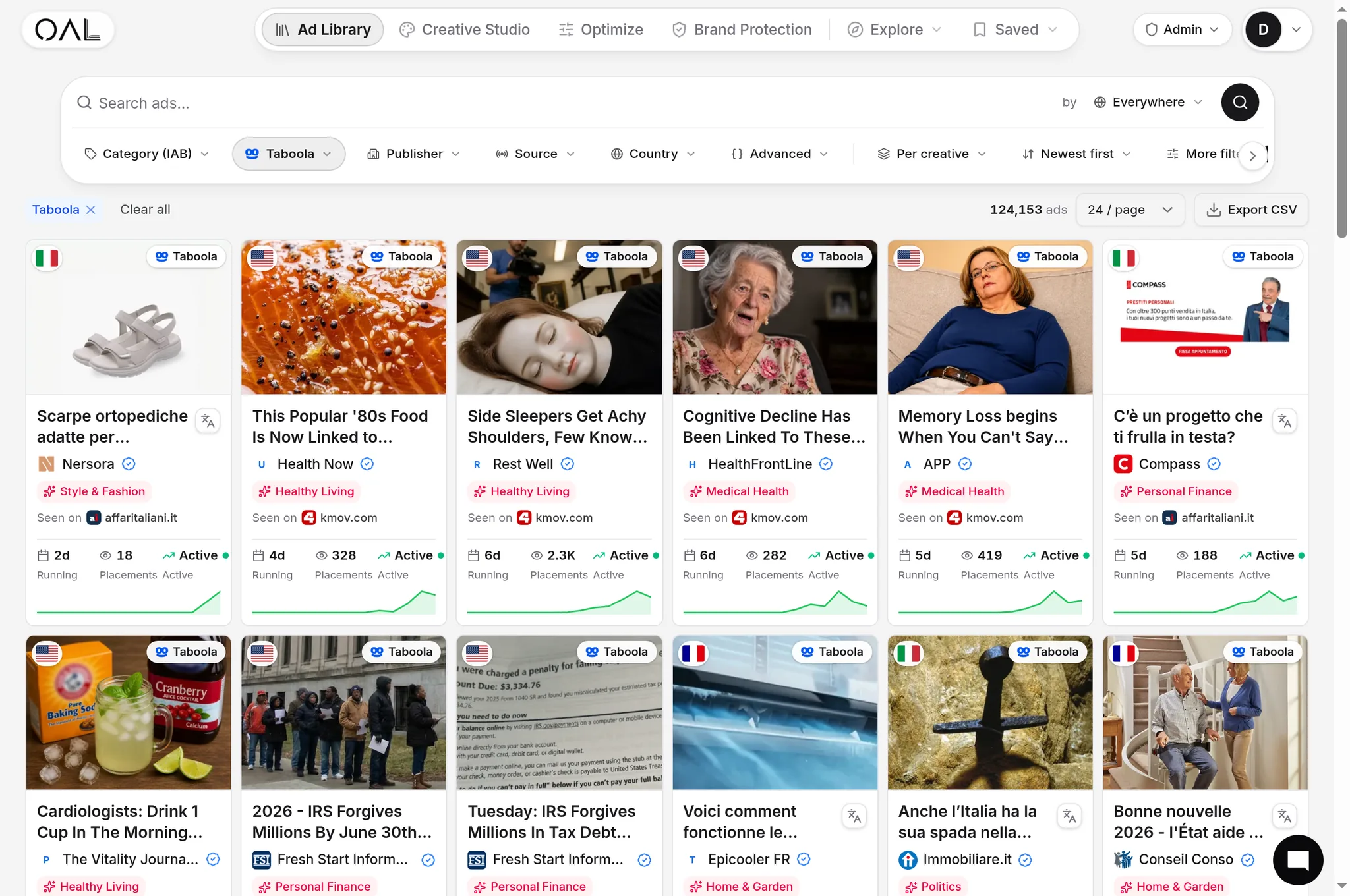
| Taboola | 157,727 | Largest content-recommendation footprint | Scale leader; deep direct publisher integrations |
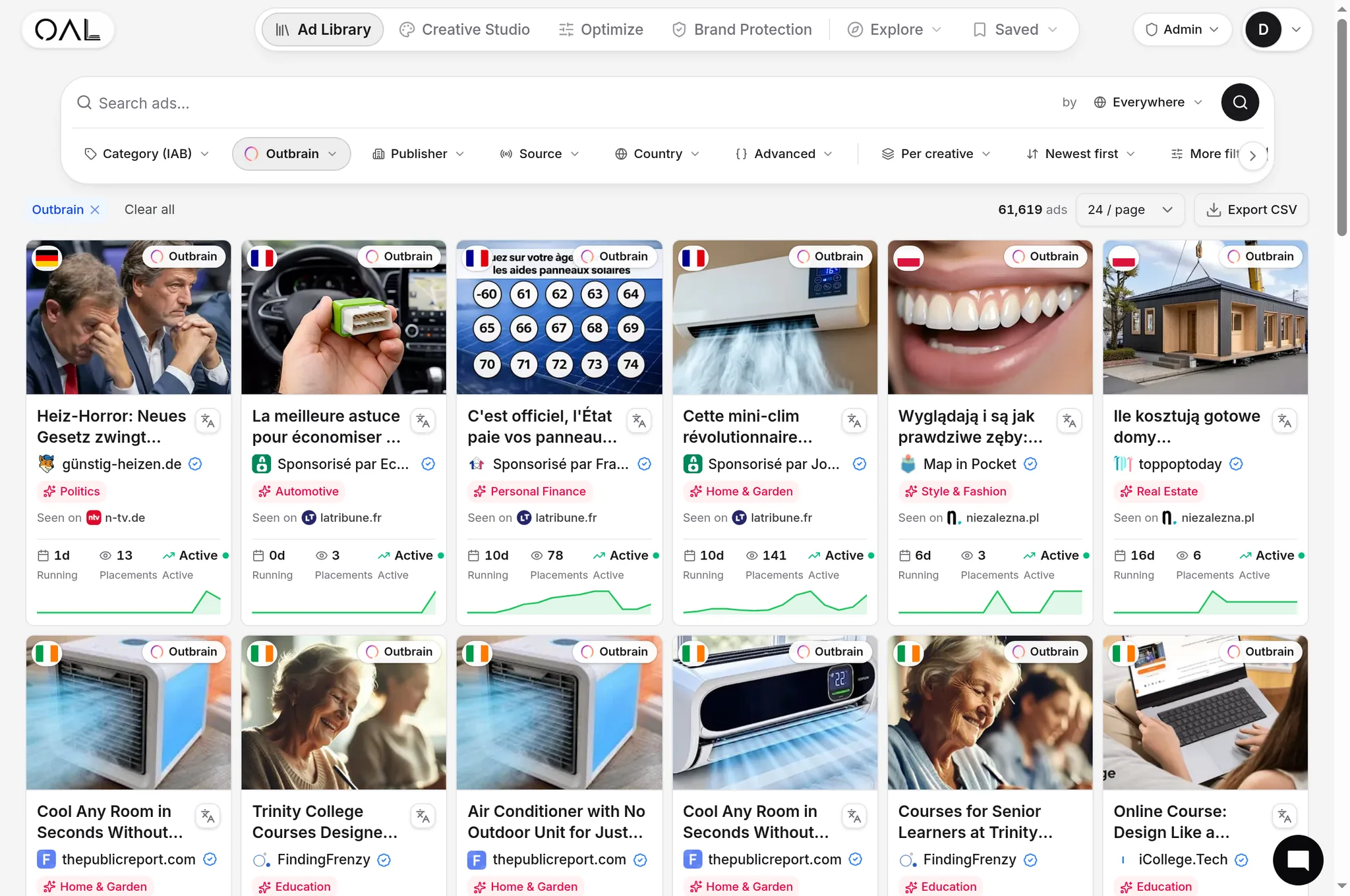
| Teads (incl. former Outbrain) | 84,252 | Premium recommendation + in-article video | Outbrain and Teads merged; the combined company runs under the Teads name |
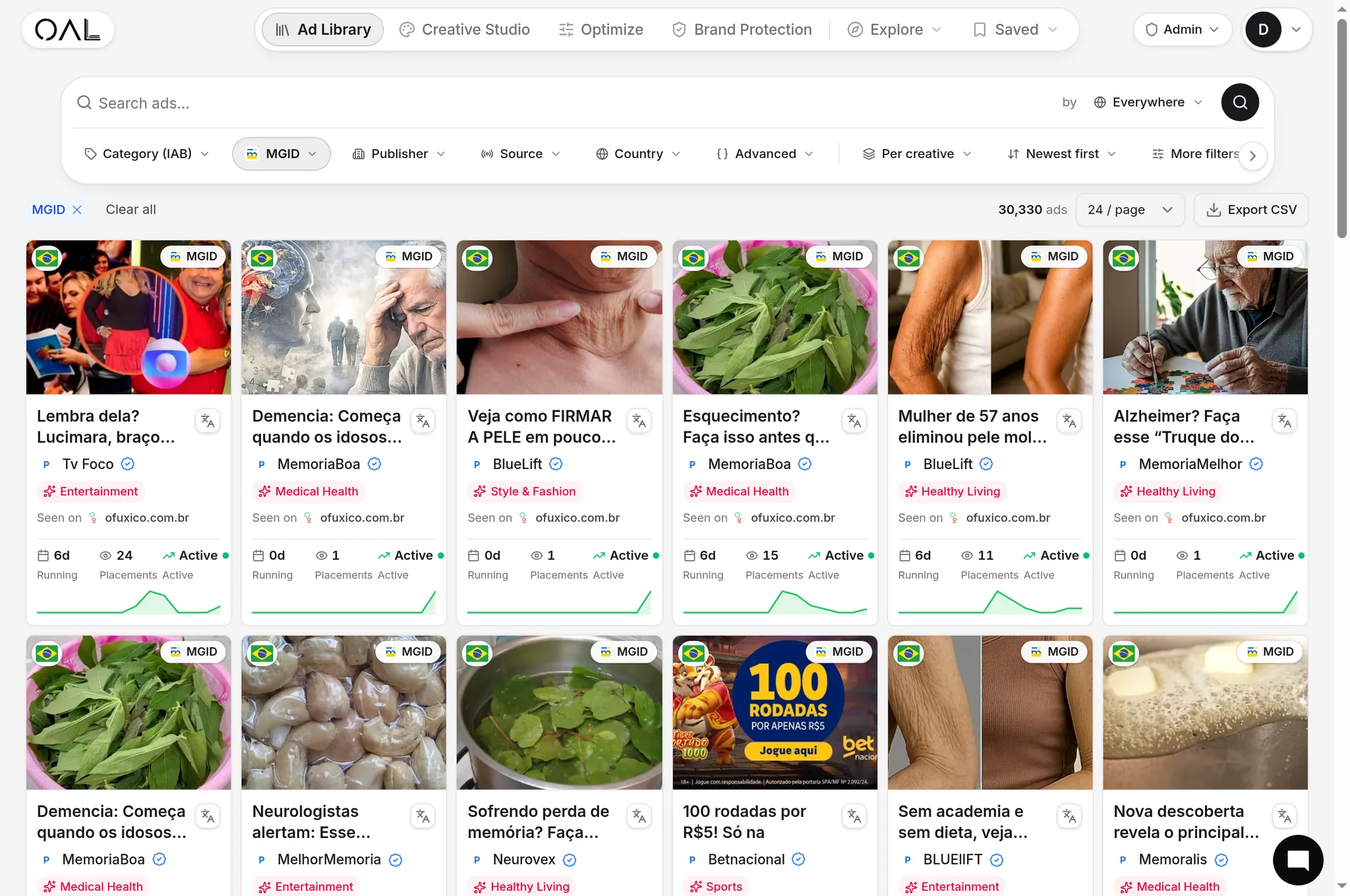
| MGID | 49,689 | Broad reach, affiliate-friendly | Strong in arbitrage and lead-gen verticals |
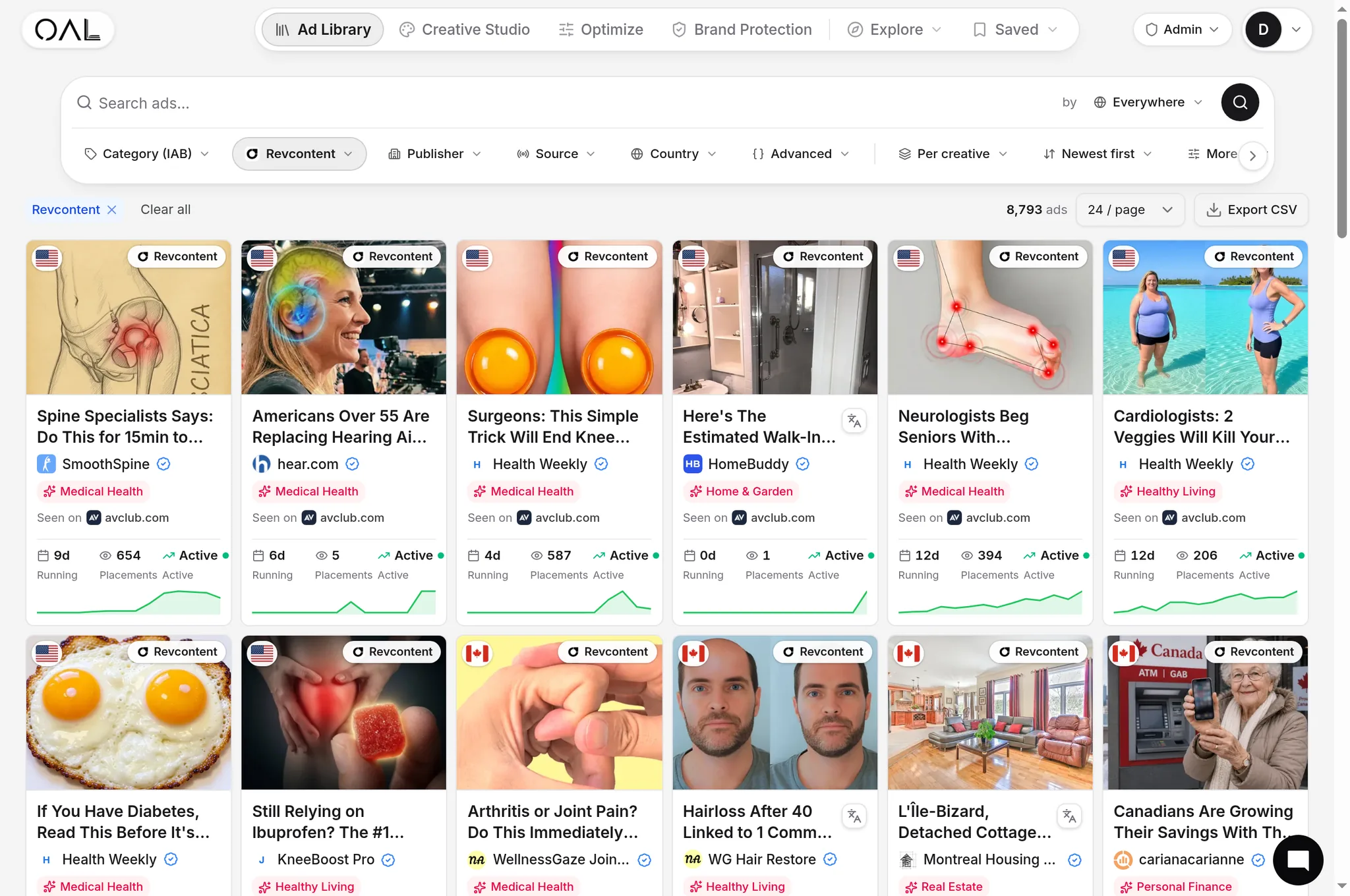
| Revcontent | high-volume widget inventory | Aggressive testing and scale | Popular with performance and affiliate buyers |
| Yahoo Native | search-adjacent demand | Performance | Runs on Yahoo's DSP ecosystem |
| MSN / Microsoft, MediaGo | premium portal + cross-border demand | Brand + performance | Useful for premium and cross-border reach |
Taboola is the scale benchmark. In our data it is by far the most-captured network at 157,727 creatives, more than Outbrain and MGID combined. Its top verticals in our index read like the native channel's whole personality: health (6,048 creatives), finance (5,558), and insurance (4,303) lead the pack. If you want to know how a content-recommendation network actually prices, targets, and reports, start with How Taboola Ads Work.
Outbrain and Teads are now one company. After the merger completed in 2025, the corporate entity renamed to Teads (Teads Holding Co., trading as TEAD on Nasdaq from June 2025), folding Outbrain's content-recommendation business and Teads' in-article video into a single platform. The Outbrain side of our index skews even harder to finance and insurance than Taboola does, with finance (2,640) and insurance (2,615) as its top two verticals. If you have run Outbrain before, the Outbrain-in-2026 guide explains what changed, and What Is Teads? covers the combined platform and its outstream video roots.
MGID and Revcontent are the workhorses of the performance and affiliate side. MGID has a different flavor from the recommendation giants: in our index its single biggest vertical is entertainment with 8,904 creatives, the quizzes, games, and curiosity plays that thrive on cheaper, higher-volume inventory. Its formats, targeting, and pricing are laid out in How MGID Native Ads Work, and Revcontent's high-volume widget model is covered in How Revcontent Works.
What separates winning native creatives from losers#
Native rewards a narrow set of disciplines. After studying live ads at scale, the patterns repeat across every network.
The thumbnail does most of the work. Curiosity-forward, slightly raw imagery routinely beats polished stock. The image earns the click and the headline qualifies it. Health is the third-largest vertical in our index with 14,895 creatives, and the genre has a signature look: a close, slightly clinical product or body shot paired with a "doctors found this" claim.

The headline is a promise, not a description. "MDs Identify 10 Medications Now Attached to Memory Problems In Seniors (See the List)." It names a number, an authority, a gated payoff ("See the List"), and a worried audience. Specificity and an implied benefit beat clever wordplay every time. Numbers, locations, and "this is for you" framing all carry weight.
The pre-lander is where the money is made. Most profitable native funnels route the click through an advisorial or listicle pre-lander that warms the reader before the offer page. Study only the ad and ignore the page behind it and you are missing the half of the funnel that decides whether the campaign prints money.
Longevity is the truth serum. Native creatives that have been running for weeks are running because they are profitable. Recency tells you what is new. Longevity tells you what works. Our index currently spans up to about 28 days of continuous observation per creative, and the ads sitting at that ceiling are revealing. The oldest survivors we are tracking right now include a SmartAsset finance ad ("Ask a Pro: How Can I Avoid Paying Taxes on IRA Withdrawals?") and a Hidden Hearing hearing-aid ad, both at 28 days and counting on Outbrain and the Microsoft Audience Network respectively. A whole cluster of "My IQ" quiz ads has also been live for the full 28 days, which tells you the IQ-quiz arbitrage angle is still very much paying for itself. Separately, industry lore about "90-day winners" floats around the affiliate world; that is general folklore, not our measurement. What we can verify is the up-to-28-day window above.

Notice the geo tell in that insurance creative: "Australians looking for life insurance should read this." Insurance is our second-biggest vertical at 15,629 creatives, and it lives and dies on geo plus a soft "you should read this" frame rather than a hard offer. The winning unit, the angle, the pre-lander, and the days-live count are one system. Reading them together is the entire skill.
How to research native ads instead of guessing#
You can build everything above from first principles, slowly, with your own ad spend. Or you can read it off the market. A good native ad spy tool lets you see what is actually live across the networks right now, which compresses weeks of testing into an afternoon of research.
The quality bar for that research comes down to a few capabilities that most legacy tools handle poorly:
- Real creative capture. You want the actual image at full quality, not a thumbnail screenshot, so you can judge the visual that is earning the click. Every ad in this article is a real captured creative, pulled straight from our index.
- The real advertiser. Networks and trackers obscure who is behind an ad. Resolving the actual advertiser, not just the ad-tech intermediary, is what turns a feed of creatives into competitive intelligence. We have 25,933 advertisers named in the index for exactly this reason.
- The click traced to the landing page. Following each ad to its landing page or pre-lander (without clicking live ads) reveals the funnel, the offer, and the angle. We hold 926,259 landing-page captures.
- Longevity and spread signals. How long has this been running, and across how many publishers? That is your profitability proxy.

That solar-battery ad had been live for 27 days when we grabbed it. On its own it is just a thumbnail. Cross-referenced with its longevity, its advertiser, and the landing page behind it, it is a near-certain winner you can reverse-engineer in your own vertical.
OpenAdLibrary was built around exactly these requirements. It captures live public native ads across Taboola, Outbrain, MGID, Revcontent, Teads, MediaGo, Yahoo, and MSN, records the real creative image, classifies the ad-tech supply chain behind each placement, identifies the actual advertiser, and follows the click through to the landing page, so you see the whole funnel and not a cropped thumbnail. On top of that, Creative Studio, Optimize, Copy DNA, and an API plus MCP endpoint let you go from research to building. It is open and low-cost ($29.99/month, with a free tier to browse 200 ads with no card), an alternative to the $80 to $400/month incumbents like Adbeat, AdPlexity, AdSpy, and Anstrex.
Start free and search live native ads across every major network in minutes.
Native advertising and the rules: labeling and transparency#
Two regulatory realities shape native in 2026, and both work in a researcher's favor.
The first is disclosure. Because native ads resemble editorial content, they have to be clearly identified as advertising. In the US, the FTC's native advertising guidance holds advertisers responsible for making the commercial nature of a unit clear. "Sponsored," "Promoted," and "Ad" labels exist for that reason, not as decoration.
The second is transparency at the platform level. Under the EU's Digital Services Act, very large online platforms must label ads with who is behind them and why a user is seeing them, and they must keep publicly accessible ad repositories. Targeting on sensitive categories is restricted, and targeted advertising to minors is banned. Enforcement is live, and the Commission has already taken action over incomplete ad repositories. The practical effect for marketers is that more of the ad ecosystem is becoming observable by design, which is exactly the ground a transparency platform stands on.
A practical starting workflow#
If you are new to the channel, here is the sequence that wastes the least money.
- Pick one network and one vertical. Do not spread across five networks on day one. Learn one auction's behavior first. If you have no strong opinion, start with Taboola in finance, insurance, or health; that is where the volume and the proven angles concentrate in our data.
- Research before you spend. Pull the live ads in your vertical, sort by longevity, and study the winning thumbnail, headline, and pre-lander triplets.
- Model the funnel, not just the ad. Map the pre-lander and offer page behind the top performers. Your landing page is your real product.
- Launch a creative grid, not a single ad. Native is a test-many, kill-fast game. Five to ten angles beat one "perfect" idea.
- Read the auction's feedback. Low delivery at a fair bid almost always means weak predicted click-through. Fix the creative, do not just raise the bid.
- Scale the survivors. The ads still profitable after a couple of weeks are your real assets. Widen geos and budgets on those.
Where to go next#
This guide is the map; the cluster is the territory. Start with the network you are buying, Taboola, Outbrain, MGID, Revcontent, or Teads, and use the glossary entries on the Native Ad Auction, Programmatic Native Advertising, and the Native Ad Network to fill in the mechanics as you go. Then point a native ad spy tool at your competitors and let the live market teach you the rest.