Español
 Português (Brasil)
 Français
 Deutsch
 Italiano
 Nederlands
 Polski
 Svenska
 Türkçe
 Русский
 日本語
日本語 한국어
한국어 简体中文
简体中文 Tiếng Việt
 Bahasa Indonesia
 繁體中文
繁體中文 Čeština
 Dansk
Dansk Suomi
Suomi Ελληνικά
 Română
 Magyar
 Українська
 ไทย
ไทย हिन्दी
 العربية
 עברית
עבריתTrademark Infringement in Ads: A Brand-Protection Detection Guide
Trademark abuse rarely hides in the ad copy; it hides in the creative, the real advertiser behind the reseller name, and the landing page after the click, so here is how brand teams capture evidence that survives a takedown or a legal review.

Most trademark abuse in advertising gets missed because brand teams look in the wrong place. They search for their name in ad copy, find nothing alarming, and move on. The problem is that the infringement is almost never in the headline a media buyer wrote to pass review. It lives in the creative image, the advertiser identity hidden behind a reseller account, and the landing page that loads after the click. By the time a customer complains, the campaign has been running for weeks and the evidence has already rotated out.
This guide is for brand, legal, and affiliate-compliance teams who need to prove infringement, not just suspect it. Detection and documentation are the same problem. You cannot file a credible takedown or a cease-and-desist on a hunch. You need an auditable chain of evidence, captured before it disappears.
What actually counts as trademark infringement in ads#
Trademark infringement in ads is the unauthorized use of a protected mark, or a confusingly similar one, in advertising that is likely to make consumers believe your brand made, endorsed, sponsored, or is affiliated with the advertised product. Under U.S. law the test is likelihood of confusion, not proof that anyone was actually fooled.
That word likelihood is where practitioners get the law wrong in both directions. Two recent appellate decisions set the boundary. In the Ninth Circuit's Lerner & Rowe v. Brown Engelhardt and the Second Circuit's 1-800 Contacts v. Warby Parker, courts found that simply bidding on a competitor's trademark as a keyword, without showing that mark in the ad, generally does not create a likelihood of confusion. In the Warby Parker case, the court declined to find infringement even though the landing page borrowed the plaintiff's color and layout, because the ad copy itself showed no shared marks.
The practical lesson cuts the other way for brand protection. Keyword bidding alone is a weak case. But the moment your mark shows up in the visible creative, the display name, the headline, or as a claim of authorization on the landing page, the analysis shifts and your evidence has to capture exactly those surfaces. Detection has to follow the click. It cannot stop at the ad slot.
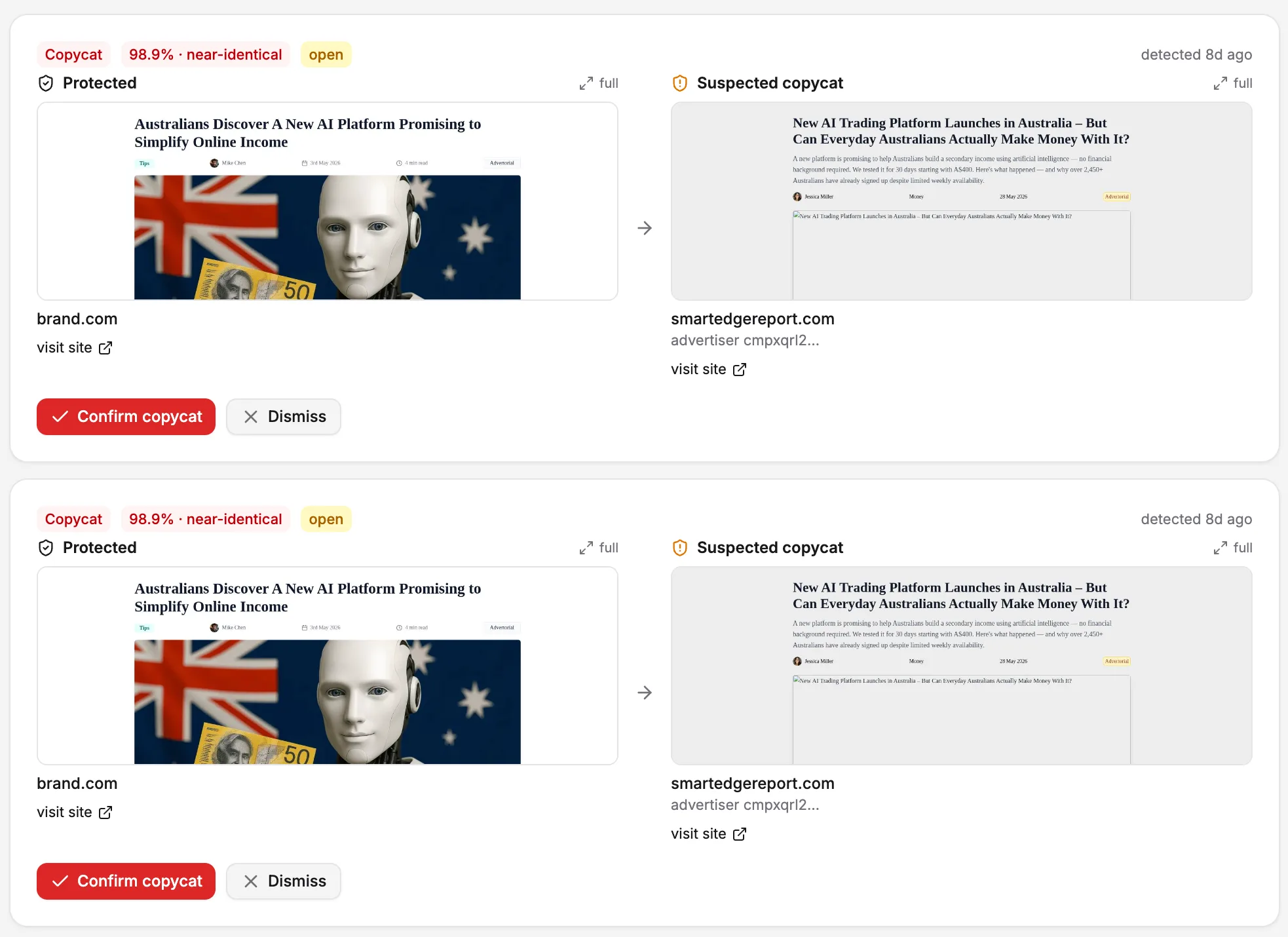
Here is the kind of ad that makes the point. This live finance creative leans hard on a fake-authority frame ("IRS Forgives Millions") under a generic publisher name. Swap "IRS" for a brand's logo and you have textbook impersonation, and a text-only scan would never read it.

The strongest infringement cases are not built from what an advertiser wrote in their copy. They are built from the gap between the brand a consumer thinks they are clicking and the advertiser they actually reach.
For the broader programme this fits into, see our pillar on brand protection in native advertising, and the glossary entry on brand protection in advertising for the foundational definitions.
The four surfaces where infringement hides#
Native ads have far more attack surface than search text ads. The creative is an image, and the supply chain is layered. Treat each surface as a separate evidentiary layer.
| Surface | What infringement looks like | Why teams miss it |
|---|---|---|
| Creative image | Your logo, packaging, mascot, or product shot used without licence; a near-identical look-alike mark | Text-only monitoring never reads the pixels |
| Advertiser / display name | A reseller or arbitrage account posing as your brand or an "official" channel | The name shown often is not the real buyer |
| Ad-tech intermediary | The DSP, SSP, or network serving the placement, which tells you who to notify | Invisible without supply-chain classification |
| Landing page / pre-lander | "Official store," fake endorsement, counterfeit checkout, or a copycat clone | Disappears or cloaks if you only screenshot the ad |
Native advertising and programmatic native make the second and third rows especially slippery. An ad can pass through several intermediaries, and the entity named in the ad unit is frequently an affiliate or arbitrage account, not the merchant fulfilling the order. The same dynamic shows up in programmatic and display advertising, where automated buying detaches the visible brand from the responsible party.
Health and supplement ads are the worst offenders for the first row. They lean on borrowed authority ("MDs Identify...") and stock medical imagery, and a knock-off using your brand's product shot or doctor endorsement looks identical to a legitimate one until you trace it.

The landing page is the surface that converts a weak case into a strong one. A pre-lander that claims "authorized retailer," reproduces your trade dress, or routes to a counterfeit checkout is direct evidence of consumer confusion. That is also exactly where copycat landing pages operate, and where ad cloaking is deployed to show reviewers a clean page while sending real users to the infringing one.
A detection workflow that produces usable evidence#
Detection and documentation are one pipeline. Build it so that every find is already a filing-ready record.
- Define the watchlist. Your exact marks, common misspellings and homoglyphs, product names, "official" and "authorized reseller" phrasings, and the names of legitimate distributors so you can separate authorized use from impersonation.
- Monitor the creative, not just the text. Match against captured ad images, because logo and trade-dress abuse never appears as searchable copy. This is where a native ad spy tool that stores the full-quality creative earns its place.
- Resolve the real advertiser. Identify the buyer behind the display name and the intermediaries in the path. Whether you are dealing with a rogue affiliate, an arbitrage account, or a counterfeiter determines who you notify and how.
- Follow the click without clicking. Capture the landing destination and any pre-lander on the path, without firing a real billed click. That protects you from a cloaked malicious page and avoids spending the infringer's budget on a verification visit.
- Capture longevity and spread. Record first-seen and last-seen dates, every placement, and every geo. A creative running for weeks across many publishers is a deliberate, profitable infringement, not a one-off mistake, and that pattern strengthens both the urgency and the damages narrative.
- Freeze a timestamped record. Lock the creative, advertiser, supply path, destination URL, placements, and dates into one dated artifact before the campaign rotates.
The reason to automate steps two through six is decay. Native creatives rotate fast and infringing campaigns rotate faster, often precisely because the operators expect to be reported. Evidence captured a week late is frequently evidence that no longer exists.
How fast is fast? Across the 589,000+ creatives we have captured (OpenAdLibrary index, June 2026), the longest continuous run we have observed on a single creative tops out around 28 days. The genuinely durable winners are the bland, compliant ones: a SmartAsset IRA-tax explainer on Outbrain, a "Combat Siege" game ad, a string of "My IQ" quiz creatives on the Microsoft Audience Network, each holding for the full 28-day window. Infringing campaigns rarely behave like that. They burn and rotate, which is exactly why a late screenshot is worthless and a same-week capture is gold. (Note: the "90-day winner" rule you hear in affiliate circles is industry lore, not our measurement. Our index currently spans up to about four weeks of continuous observation per creative.)
What a filing-ready evidence package contains#
A single screenshot is the weakest possible filing. Networks, registrars, and platforms triage on completeness, and so do courts. A credible package answers every "and then what" before it is asked.
- The creative at full resolution, showing the infringing mark or trade dress as the consumer saw it.
- The advertiser identity as displayed, plus the resolved buyer where it differs.
- The supply chain: which network and intermediaries served the placement, so the notice reaches the party who can act.
- The destination: the landing page URL and any pre-lander, captured along the real click path.
- Reach and duration: placements, geos, and first/last-seen dates establishing scale and intent.
- Timestamps on every element, so the record is reproducible rather than anecdotal.
This is also the payload that makes a platform report effective. Our companion guide on how to report a scam ad and document the evidence walks through where each item goes in a network or platform complaint, and the brand safety glossary entry frames why this matters beyond legal exposure.
Where should you point your monitoring first? Follow the money. Finance leads our entire index with 17,232 creatives, ahead of insurance (15,629) and health (14,895), out of the ten top verticals (OpenAdLibrary index, June 2026). On Taboola alone, our largest network at 157,727 creatives, health and finance sit at the top of the stack. Those are the categories where impersonation pays best, so they are where a brand-protection watchlist gets the most traction.

How regulation is shifting the evidence burden#
The disclosure environment is moving in brand owners' favour, which makes systematic capture more valuable, not less.
In the EU, the Digital Services Act requires platforms to let users see, for each ad, that it is an ad, who the advertiser is, and who paid for it. Article 39 obliges Very Large Online Platforms to maintain searchable ad repositories including advertiser identity, targeting parameters, and campaign duration. The DSA also requires online marketplaces to verify seller information before listing, and it lets qualified rights-holders act as "trusted flaggers" whose notices get priority. None of this removes the need to capture your own evidence, but it gives a well-documented notice far more leverage.
In the U.S., the FTC's posture against deceptive and impersonation advertising, combined with the Lanham Act confusion standard, means that an organized record of where and how your mark was misused is the difference between a notice that gets actioned and one that sits in a queue. The throughline across both regimes is the same: the party who arrives with auditable, reproducible evidence sets the pace.
Where OpenAdLibrary fits#
The hard parts of this workflow are the parts that decay. Capturing the full-quality creative before it rotates. Resolving the real advertiser behind a reseller name. Classifying the ad-tech supply chain. Following the click to the landing page without spending a live click or tripping a cloaked page.
OpenAdLibrary captures live public native ads across Taboola, Outbrain, MGID, Revcontent, Teads, Yahoo, and MSN, stores the real creative at full quality, labels the supply chain, and traces each click to its landing destination. As of June 2026 that is 589,036 creatives from 25,933 advertisers across 42 networks, with 926,259 landing-page captures and over 5.4 million ad observations behind the longevity and spread signals that separate a stray test from an industrial infringement campaign. It is open and affordable where Adbeat, Anstrex, and AdSpy run $80 to $400 a month, and the API and MCP access let brand teams wire monitoring straight into an existing alerting pipeline.
Start free and browse 200 ads with no card to see what your brand's footprint actually looks like across the native ecosystem.