Español
 Português (Brasil)
 Français
 Deutsch
 Italiano
 Nederlands
 Polski
 Svenska
 Türkçe
 Русский
 日本語
日本語 한국어
한국어 简体中文
简体中文 Tiếng Việt
 Bahasa Indonesia
 繁體中文
繁體中文 Čeština
 Dansk
Dansk Norsk (bokmål)
 Suomi
Suomi Ελληνικά
 Română
 Magyar
 Українська
 ไทย
ไทย हिन्दी
 العربية
 עברית
עבריתHow to Lower Your Taboola CPC Without Killing Volume
Cutting your Taboola bid starves delivery. The levers that actually lower CPC: creative CTR, surgical site-level cuts, honest campaign splits, and Smart Bid fed with real conversion data.


The fastest way to lower your Taboola CPC is to raise your CTR, because the auction prices clicks off expected publisher yield — your bid times your expected click-through rate. A creative that earns twice the clicks can hold the same placement at a meaningfully lower bid. Slashing your base bid, the first thing most buyers try, mostly just starves delivery: you lose the premium placements and keep the junk. The playbook that works runs in order: improve creative CTR first, cut cost surgically with publisher-level bid adjustments and blocks second, split campaigns so the auction can price segments honestly third, and only then hand pricing to Smart Bid with real conversion data. Nine levers, ordered by impact.
Why cutting your base bid backfires#
Your CPC bid on Taboola is a ceiling on what you'll pay, but delivery is allocated by yield: publishers get paid per click, so the auction favors ads that reliably earn them. Drop your bid 40% and the network doesn't hand you the same traffic cheaper — it reallocates your delivery toward placements nobody else wants. Volume collapses, and the remaining clicks often convert worse. Buyers then read the falling volume as "Taboola doesn't scale," when the real story is that they priced themselves out of the good feeds while staying affordable to the bad ones.
Lowering CPC without killing volume means making your clicks cheaper to win, not just offering less for them.
Diagnose before you optimize#
Before pulling any lever, split your reported CPC into its real components: which sites, which devices, which geos and which creatives are producing the expensive clicks. An account-level CPC is an average across wildly different markets, and averages hide the fix. In most accounts we've seen buyers describe, a minority of placements produces the majority of wasted spend — the blended number looks mediocre while half the campaign is actually fine. Pull the site report, the device split and the per-creative numbers first; every lever below targets one of those components specifically, and knowing which component is inflated tells you which levers to pull first.
Levers 1–3: creative CTR is the real price of your click#
1. Rewrite headlines before touching bids. Because yield = bid × CTR, a creative at 0.4% CTR can pay half the bid of a 0.2% competitor for equivalent placement. The compounding effect is enormous. The headline formulas that consistently earn native clicks — first-person discovery, specific warnings, mechanism reveals — are catalogued with live examples in native ad headlines that get clicks.
2. Test thumbnails as a separate variable. The image is processed before the headline and decides whether the headline is read at all. In-situ product shots and close-ups with readable emotion routinely beat studio renders on feeds; native ad creative best practices covers the patterns.
3. Rotate before fatigue, not after. Every creative's CTR decays as its audience saturates, and as CTR decays your effective price rises even with an unchanged bid. Watch trend, not level, and stage replacements early — the decay mechanics are covered under creative fatigue.
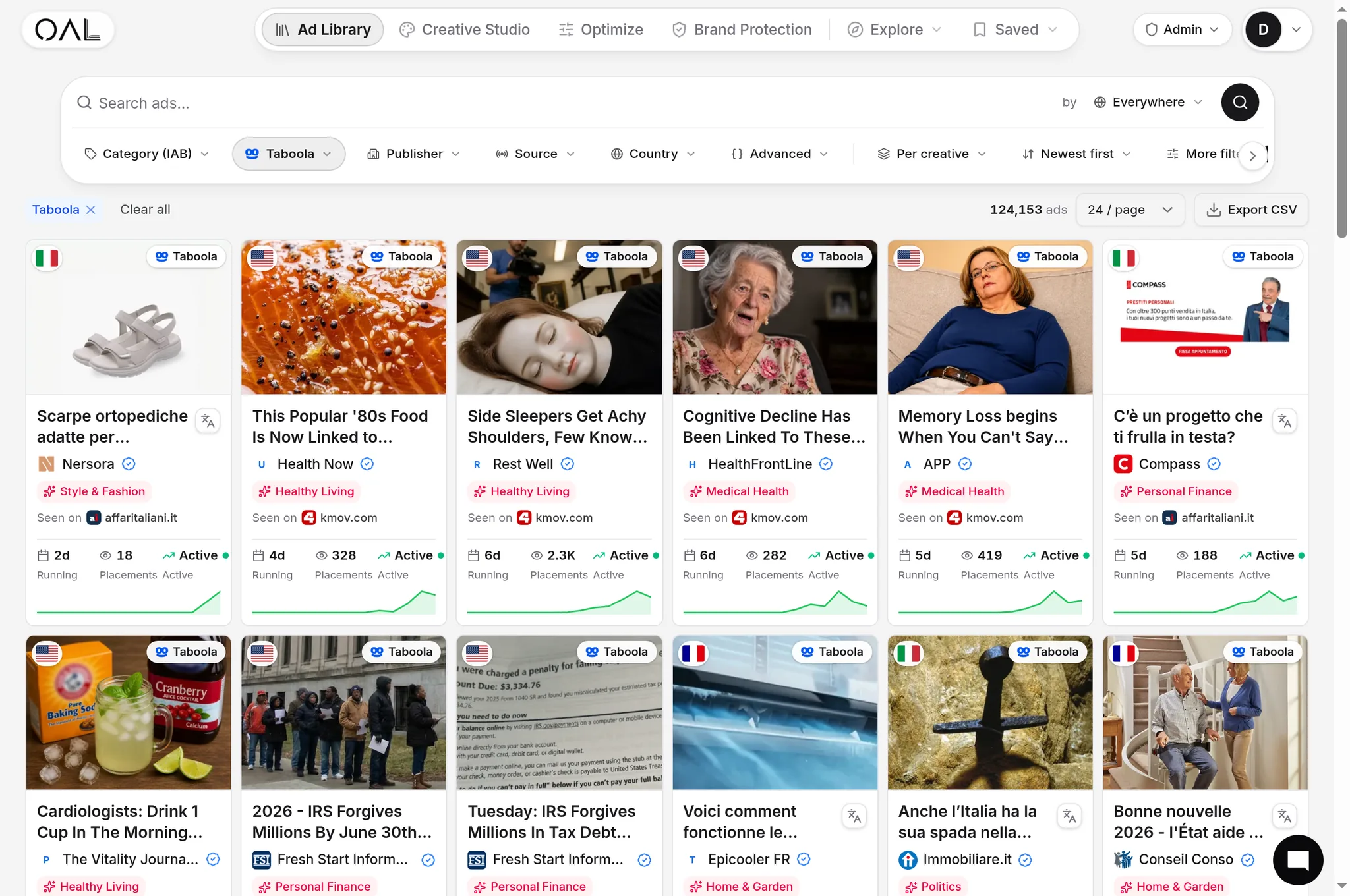
A research shortcut for all three: study competitor creatives in your vertical that have survived 30+ days. On a CPC network, longevity is the closest public signal of profitable click economics — those are the headline and thumbnail patterns already proven to earn cheap clicks. OpenAdLibrary's index tracks first-seen and last-seen dates across 206,000+ live Taboola creatives (June 2026); filter your vertical in the Taboola research tool and mine the survivors.
Levers 4–6: cut spend surgically, not globally#
4. Bid down publishers instead of the campaign. Taboola exposes per-site bid adjustments. Pull your site report weekly, sort by spend, and cut bids on the sites converting below target instead of lowering the campaign bid that also punishes your winners. The site-level identifier is the unit of optimization here — treat each placement as its own little market with its own economics.
5. Block the structural losers. Some placements will never work for your offer regardless of bid: wrong audience, junk engagement, incompatible context. Blocking them raises your account-wide conversion rate, which feeds back into what you can afford to bid everywhere else. The mechanics of block and allow lists are summarized in whitelist vs blacklist targeting.
6. Graduate winners to a whitelist campaign. Once a stable set of sites converts, clone them into a whitelist-only campaign with bids set to their proven economics, and keep the discovery campaign running cheaper and broader behind it. You end up paying premium prices only where premium is earned — and the discovery campaign's job quietly shifts from delivering volume to auditioning new placements for promotion.
Levers 7–8: split so the auction can price honestly#
7. Separate desktop and mobile. CPC dynamics, CTR and conversion behavior all differ by device; a blended campaign hides which side subsidizes the other, and a blended bid overpays one segment by construction. Split them and bid each on its own numbers.
8. Split geos by economics, not geography. Tier-1 markets price very differently from Tier-2 and Tier-3 — grouping them under one bid means overpaying the cheap geos or starving the expensive ones. Group markets with similar CPC-to-value ratios; the standard segmentation is covered in geo tiers. Dayparting belongs in this lever too: if conversions cluster in certain hours, concentrating budget there buys the same conversions with less waste.
Lever 9: let Smart Bid reprice per impression — once it has data#
Taboola's Smart Bid modes shade your bid impression-by-impression against predicted conversion likelihood — bidding up the auctions likely to convert and down the rest. That is exactly the surgical repricing levers 4–8 approximate by hand, which makes it the right end state — but only once real conversion data flows. Fed too few conversions, automated bidding optimizes noise. Practical sequence: run fixed bids until conversions accumulate into the dozens per week per campaign (buyers commonly treat that as the floor; check Taboola's current documentation for its own minimums), verify your postback or pixel fires on the conversion that matters commercially, then switch and give the algorithm a learning window before judging it.
Details of campaign setup, conversion wiring and bid configuration are in how to advertise on Taboola, and Taboola's own help center documents current Smart Bid modes and minimum bids by market.
What "cheap" should look like#
For calibration, not gospel: media buyers commonly report Tier-1 desktop Taboola CPCs from roughly $0.20 to $0.90, with mobile often materially cheaper and Tier-2/3 geos lower still — non-official ranges that vertical, competition and creative quality all move. Cross-network context lives in our native ads CPC benchmarks. The honest target is not a number but a relationship: CPC low enough that CPC divided by funnel conversion rate clears your allowable cost per acquisition. A $0.30 click that never converts is more expensive than a $0.70 click that does.
The weekly routine that keeps CPC drifting down#
- Monday — site report. Sort by spend; bid down or block placements below target; promote consistent converters toward the whitelist.
- Midweek — creative review. Compare CTR trends per creative per device; stage replacements for anything decaying; launch one new angle against the incumbent.
- Friday — segment audit. Check device and geo splits for drift; verify Smart Bid campaigns are still fed clean conversion data; note your blended CPC and cost per acquisition week-over-week.
Keep a simple change log alongside the routine — date, lever pulled, expected effect. CPC moves for many reasons (seasonality, competitor entries, creative decay), and without a log you will credit or blame the wrong change.
None of these steps is dramatic. Compounded over six weeks, they routinely produce large cuts in effective acquisition cost without the volume cliff that a blunt bid reduction causes — because every one of them lowers the price of winning good placements instead of retreating to bad ones.