Español
 Português (Brasil)
 Français
 Deutsch
 Italiano
 Nederlands
 Polski
 Svenska
 Türkçe
 Русский
 日本語
日本語 한국어
한국어 简体中文
简体中文 Tiếng Việt
 Bahasa Indonesia
 繁體中文
繁體中文 Čeština
 Dansk
Dansk Norsk (bokmål)
 Suomi
Suomi Ελληνικά
 Română
 Magyar
 Українська
 ไทย
ไทย हिन्दी
 العربية
 עברית
עבריתIs MGID Legit? Bots, Payouts & the Truth Behind the Reviews
MGID is a real, 18-year-old ad network — not a scam. But the reviews aren't wrong about variance. What the complaints actually describe, and the checklist that keeps your budget safe.


MGID is a legitimate advertising network — a real company operating since 2008, with a genuine publisher base and tens of thousands of real advertisers, including the 62,765 live MGID creatives in OpenAdLibrary's index as of June 2026. It is not a scam. But "legit" is not the same as "easy": MGID is a mid-tier network with a long-tail publisher base, which means traffic quality varies enormously by placement, and the loud complaints you find in reviews mostly trace back to that variance plus a handful of explainable publisher-side disputes. Here is what is actually going on behind the reviews.
What MGID actually is#
MGID has been running native widgets — the "you may also like" content blocks under and beside articles — since 2008, making it one of the oldest dedicated native networks in the business. Its position in the market is mid-tier: where Taboola and Outbrain concentrate on premium news publishers, MGID's reach leans on a much longer tail of content sites worldwide, with particularly deep inventory in Europe, LATAM, and Asia. That translates into lower CPCs, looser creative policies, and wider quality variance than the tier-1 networks — the full mechanics are in how MGID works, and the head-to-head trade-offs in MGID vs Taboola.
That positioning is the single most useful fact for interpreting MGID reviews. Most one-star advertiser reviews and most five-star ones describe the same network — the difference is whether the buyer treated placement-level quality control as their job or the network's.
Why people ask if MGID is a scam#
Search "is MGID legit" and the concerns sort into three buckets:
- Advertiser complaints about traffic quality — "I spent $300 and got zero conversions, the clicks must be bots."
- Publisher complaints about payouts — rejected sites, delayed or reduced payments, banned accounts.
- Guilt by association with the ads themselves — MGID widgets on long-tail sites often carry aggressive nutra and clickbait creatives, and people reasonably wonder about a network that runs them.
Each bucket has a real explanation, and none of them adds up to "scam."
The advertiser side: is the traffic real?#
Mostly, yes — but quality is a placement-level property, not a network-level one. MGID aggregates thousands of publisher widgets. Some send engaged readers who convert; others send accidental mobile taps, low-intent audiences, or — on the worst fringe — traffic no advertiser should pay for. MGID runs fraud filtering on its side, but no network-level filter catches everything on a long tail this size, and the gap between MGID's average and your campaign's reality is exactly the set of placements you did or did not block.
The practical read on "bot" complaints: most of what buyers call bots is actually low-intent human traffic — misclicks and curiosity clicks that will never convert — which costs you money just the same but is fixed by placement management rather than by refund demands. Genuine invalid traffic exists on any open network; the way to handle it is your own tracking evidence, not vibes. Our guide to ad fraud in native advertising covers the taxonomy, and the click fraud glossary entry the mechanics.
What the buyers who profit on MGID do differently:
- Track independently. A tracker with server-to-server postbacks and per-placement tokens, from the first click. Without it you cannot tell a bad offer from bad placements.
- Blacklist fast and relentlessly. Cut placements that spend without converting; graduate proven ones to a whitelist. On MGID this is not an optimization — it is the job.
- Cap budgets while learning. Daily caps keep any single bad placement from eating the test budget overnight.
One more advertiser-side nuance: quality is not evenly distributed across geos either. MGID's inventory runs deepest in Europe, LATAM, and Asia, and buyers consistently report that the same offer can behave completely differently between a curated Tier-1 placement list and broad Tier-3 run-of-network. That is not evidence of dishonesty — it is what buying a long tail means. Budget for a discovery phase in every new geo, and treat the placement whitelist you build as the actual product of your first weeks of spend.
The publisher side: does MGID pay?#
The overwhelming pattern is that MGID pays publishers on its stated schedule once a site is accepted and stays within policy. The complaints cluster where you would expect on any network this size: sites rejected or dropped for content-policy or traffic-quality reasons, earnings clawed back after invalid-traffic audits, and frustration with minimum payout thresholds and net-terms timing. Those disputes are real for the people in them, but they describe enforcement friction, not a company that takes content and disappears. If you are evaluating MGID as a publisher, read the current payout terms and content policy directly — both change, and secondhand summaries age badly.
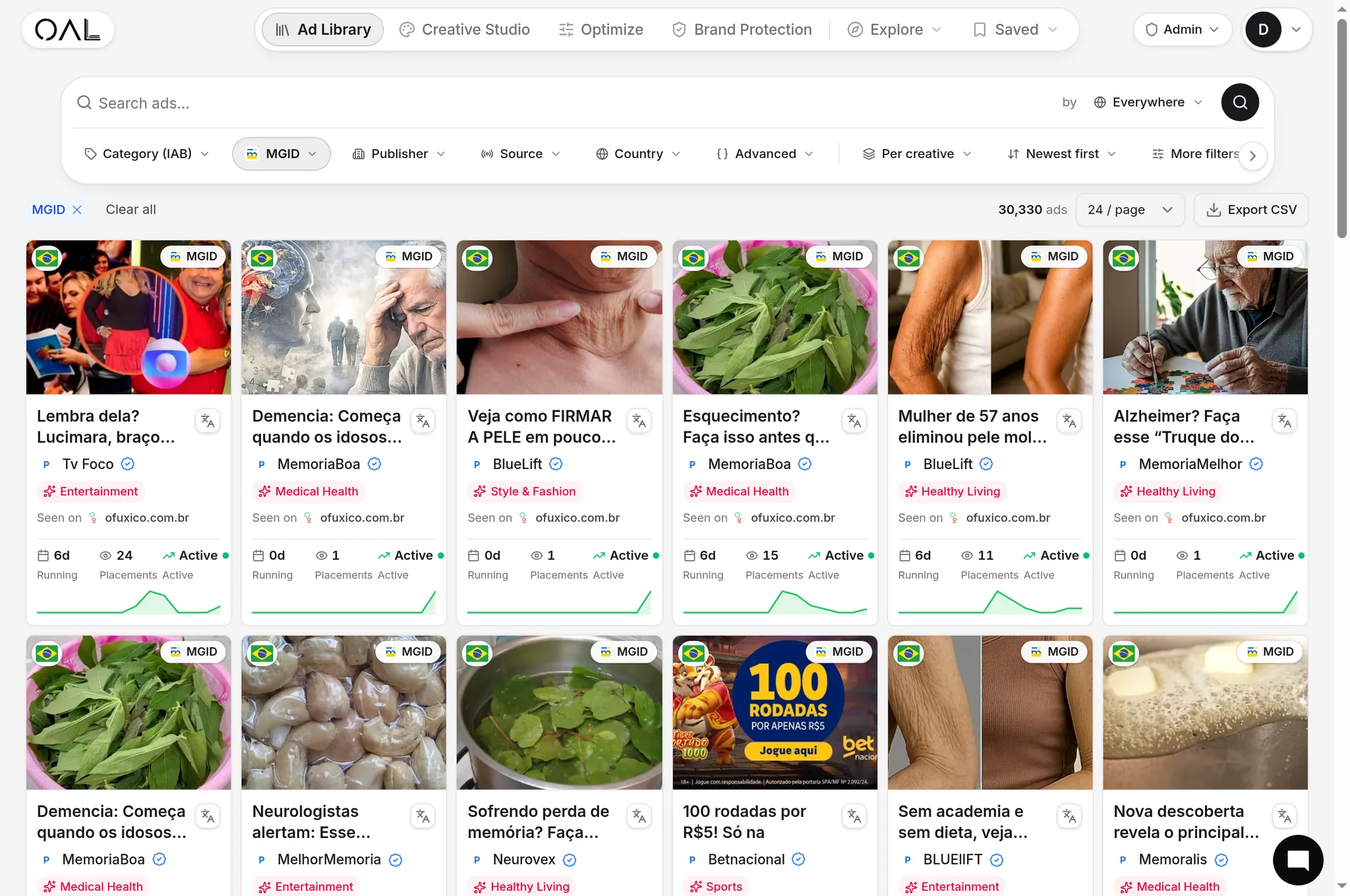
What 62,765 live MGID ads say#
Independent capture data answers the legitimacy question from a different angle: who actually spends money here, and does it work for them?
- Real, sustained advertiser demand. MGID is the third-largest network in OpenAdLibrary's index by creative count (62,765 live creatives, June 2026) — behind only much larger platforms. Failed networks do not sustain that.
- A distinctive vertical mix. Entertainment-style content dominates the classified breakdown (13,987 creatives), with health (1,220) and insurance (663) following — consistent with a network that skews toward content arbitrage and aggressive direct-response alongside a growing B2B and ecommerce fringe.
- Ads that run for weeks. The index shows MGID creatives sustaining multi-week runs — and on a CPC network, an ad that keeps running is probably paying for itself. Somebody is converting this traffic, at scale, every day.
You can inspect this yourself: browse the MGID ad library or the MGID spy tool and look at which advertisers persist, in which geos, with which angles. Persistent spenders are the strongest legitimacy evidence there is.
How to protect yourself on MGID (advertiser checklist)#
If you decide to test the network, make the variance work for you instead of against you:
- Research before depositing. Study what already runs in your vertical and geo in the ad library. If nobody sustains ads for your offer type, that is information.
- Start with one geo and one offer. Variance compounds; isolate it.
- Instrument everything — tracker, s2s postback, per-widget tokens — before the first dollar of spend.
- Set kill rules in advance. Decide the spend threshold at which an unconverting placement gets cut, and automate it if your tracker allows.
- Use your account manager. MGID assigns support at fairly low spend levels; placement-quality escalations with tracking evidence attached get acted on far more often than angry emails.
- Judge at the placement level. Your campaign's verdict is the whitelist you end up with, not the network average you started with.
Verdict: legit network, mid-tier rules#
MGID is a legitimate, long-established native ad network — 18 years of operation and one of the largest live-ad footprints in independent capture data settle that question. It is also a network where the buyer carries more of the quality-control burden than on Taboola or Outbrain, in exchange for cheaper clicks, looser creative rules, and geo reach the tier-1 networks do not match.
Who MGID fits:
- Affiliates and performance buyers comfortable with tracker-driven placement curation, especially in health, sweeps, and ecommerce verticals where MGID's creative policies leave room to work.
- Buyers targeting Europe, LATAM, or Asia, where MGID's supply is deepest and tier-1 alternatives are thin or overpriced.
- Anyone validating offers cheaply before scaling winners onto premium networks.
Who should think twice:
- Brand advertisers who need premium-publisher adjacency and tight brand safety — that is Taboola/Outbrain territory.
- Set-and-forget buyers. MGID without active placement management is a slow leak, and no review score will change that.
Buyers who track at the placement level and cut ruthlessly can do very well here; buyers who deposit, boost, and hope will write another one-star review. The network is legit. The traffic is a job.