Español
 Português (Brasil)
 Français
 Deutsch
 Italiano
 Nederlands
 Polski
 Svenska
 Türkçe
 Русский
 日本語
 한국어
 简体中文
 Tiếng Việt
 Bahasa Indonesia
 繁體中文
 Čeština
 Dansk
 Norsk (bokmål)
 Suomi
 Ελληνικά
 Română
 Magyar
 Українська
 ไทย
 हिन्दी
 العربية
 עברית
Taboola CPC Rates in 2026: What Sets Your Cost per Click and How to Estimate It
Taboola has no rate card: prices are set in an auction. What moves your cost per click by geo, device and vertical, why this guide publishes no typical range, and the math that decides what a click is worth to you.


Taboola has no rate card. Advertisers pay per click (CPC) or per thousand impressions (CPM), and prices are set in an auction, so "what does Taboola cost per click" has no single answer. We don't publish a typical range: figures that circulate online are usually unsourced averages over someone else's mix of geos, devices and verticals, and we have no dataset that measures Taboola CPCs. Your geo, device split, vertical, creative and bid strategy will all move your number. This article breaks down how the auction sets your rate, which variables matter, and how to work out the CPC you can afford before you commit budget.
How Taboola prices a click#
Realize, Taboola's advertiser platform, runs an auction every time an ad placement is available for your campaign. What you pay depends on your bid strategy: with Fixed Bid, the CPC you set is the price you pay; with Enhanced CPC, Taboola's SmartBid algorithm raises or lowers your baseline bid per impression and charges winning bids at the second-highest bid; with Maximize Conversions, Taboola's recommended strategy, the algorithm chooses your CPC within your budget. The auction does not rank purely on bid. Taboola says its algorithm looks at click-through rate as well as CPC when deciding where to recommend your ads, so an ad people click more often can be shown more without a higher bid. That is one reason two advertisers in the same vertical and geo can pay different CPCs for comparable volume.
Two practical consequences follow:
CTR is a pricing lever, not a vanity metric. Taboola says a higher CTR makes your items more competitive and more likely to be recommended, so a creative people click more often can win placements it would otherwise need a higher bid for. There is no fixed exchange rate: doubling CTR does not double what each dollar buys, and on a CPC campaign you pay for every click either way. Whether your bid is your price depends on the strategy. With Fixed Bid you pay the CPC you set; with Enhanced CPC the winning bid is charged at the second-highest bid, and the actual CPC can be higher or lower than your baseline on individual sites. Raising your bid generally buys more clicks because it makes your ads more competitive.
Taboola's automated options are Enhanced CPC, which adjusts your baseline bid per impression based on the likelihood of conversion, and Maximize Conversions, which sets the CPC for you; see smart bidding for how these systems behave. Taboola recommends installing its pixel or server-to-server tracking so they can learn from your conversions, and a target CPA requires at least 50 conversions in 7 consecutive days; more on that below. If you are new to the platform entirely, how Taboola ads work covers the full campaign anatomy — this article stays on pricing.
One more input buyers underestimate: history. A new campaign or ad starts in a learning phase while Taboola's algorithm gathers data. With Enhanced CPC, an eligible new item can enter "Expedited Learning", where Taboola may raise its bid (up to seven times, still charged at the second price) to collect enough impressions and clicks to estimate CTR; with Maximize Conversions, Taboola says the first two to five days can show higher CPA and lower conversion volume. Taboola advises excluding expedited-learning results and waiting until learning has completed before judging an item, so don't judge the channel on the first few days of delivery.
The four variables that actually set your CPC#
Geography#
Geo is one of the biggest variables. Buyers commonly group countries into tiers, with the US, UK, Canada, Australia and Western Europe in Tier 1, and generally expect those markets to cost more because more advertisers compete for them. Taboola doesn't publish CPCs by country and we have no measured data, so treat the size of any gap as unknown until you test it. That is why it makes sense to quote CPCs per geo rather than as a platform-wide number, and why some buyers validate a funnel in a cheaper market before paying Tier-1 prices.
Device#
Desktop and mobile clicks can price and convert differently, and the volume available on each depends on the publishers and geos you reach. Taboola doesn't publish device-level CPCs, so measure CPC, conversion rate and CPA by device in your own reports. Buyers commonly split campaigns by device rather than run blended bids, because a single bid can be too high for one device and too low for the other.
Vertical competition#
CPC is ultimately a function of who else wants the same impression, so it varies by vertical. Neither Taboola nor this article has data on CPCs by vertical. Counts of captured creatives, such as the category totals in our ad archive, do not measure bidding pressure or price: one advertiser can run thousands of variants on a small budget, and another a handful on a large one. Regulated categories such as health, finance and insurance also carry extra policy requirements on Taboola, which limits who can advertise there. For reported ranges across networks and their caveats, see the native ads CPC benchmarks comparison.
Placement and targeting choices#
Targeting changes both reach and price. Every restriction you add, such as a narrow geo, a single OS or a short approved-site list, shrinks the pool of impressions you can compete for; Taboola warns that over-targeting can severely limit reach and that a bid that is too low can stop your ads winning auctions. Whether a narrower setup costs more per click depends on who else is bidding for those impressions, so compare CPC and CPA before and after the change, and measure retargeting and cold prospecting separately.
Why we don't publish a Taboola CPC table#
Taboola publishes no CPC rates, and the ranges that circulate online rarely state their source, date, geo mix or sample. An earlier version of this article listed such ranges without a source; they have been removed rather than presented as data.
Your niche, creative quality and optimization discipline will move any figure you read. The benchmark that matters is the one you buy yourself: a small structured test, properly tracked, tells you more than any table on the internet.
It is also worth understanding why published Taboola CPC figures scatter so badly. Every number you find is an average over someone's particular mix of geos, devices, placements and verticals — and the mixes never match. A buyer running insurance lead-gen on premium desktop whitelists and a buyer running ecommerce gadgets on run-of-network mobile can both honestly report "my Taboola CPC," and the figures can differ by multiples. Survivorship can skew it further: buyers who quit early may quote expensive learning-phase clicks, while experienced buyers may quote optimized approved-list rates. Neither is lying; neither is your number.
The only CPC math that matters#
A CPC is not cheap or expensive in isolation — only relative to what a click returns. The working formula every native buyer runs:
Allowable CPC = target CPA × expected conversion rate.
As a hypothetical example: if your funnel converts 1% of clicks and you need a $40 cost per acquisition, you can pay up to $0.40 per click. If a better pre-lander lifts conversion to 2%, your allowable CPC doubles to $0.80, and placements that were too expensive at your target CPA may now fit inside it. These inputs are illustrative, not typical Taboola rates. The same math is why the cheapest clicks are not automatically the best: check conversion rate and CPA by placement before chasing a lower CPC. How much do native ads cost walks through the full budgeting version of this math.
Five ways to lower your effective Taboola CPC#
Work the creative before the bid. Taboola says a higher CTR makes your ads more competitive, so new headline and thumbnail variants can lower what you need to bid for the same placements; judge them on conversion rate and CPA, not CTR alone. Split campaigns by device and geo. Blended campaigns hide which segment is overpaying. Separate them and bid each on its own conversion math. Prune placements with data. Realize's site report shows conversion rate and CPA by site. You can block sites that spend without converting, and on manual strategies you can lower bids on weak sites instead, which Taboola recommends over blocking when a site still contributes. Taboola's guide for small brands suggests considering exclusion once a site has spent about 2.5 to 3 times your CPA goal with no conversions. Set up conversion tracking before relying on automated bidding. Taboola recommends its pixel or server-to-server tracking for Maximize Conversions and Enhanced CPC, and a target CPA needs at least 50 conversions in 7 consecutive days. Step bids down slowly. On manual strategies, drop your bid in small increments and watch volume. You may find a lower bid that keeps most of your placements, and you will see which sites you were paying up for.
Research the niche before you bid#
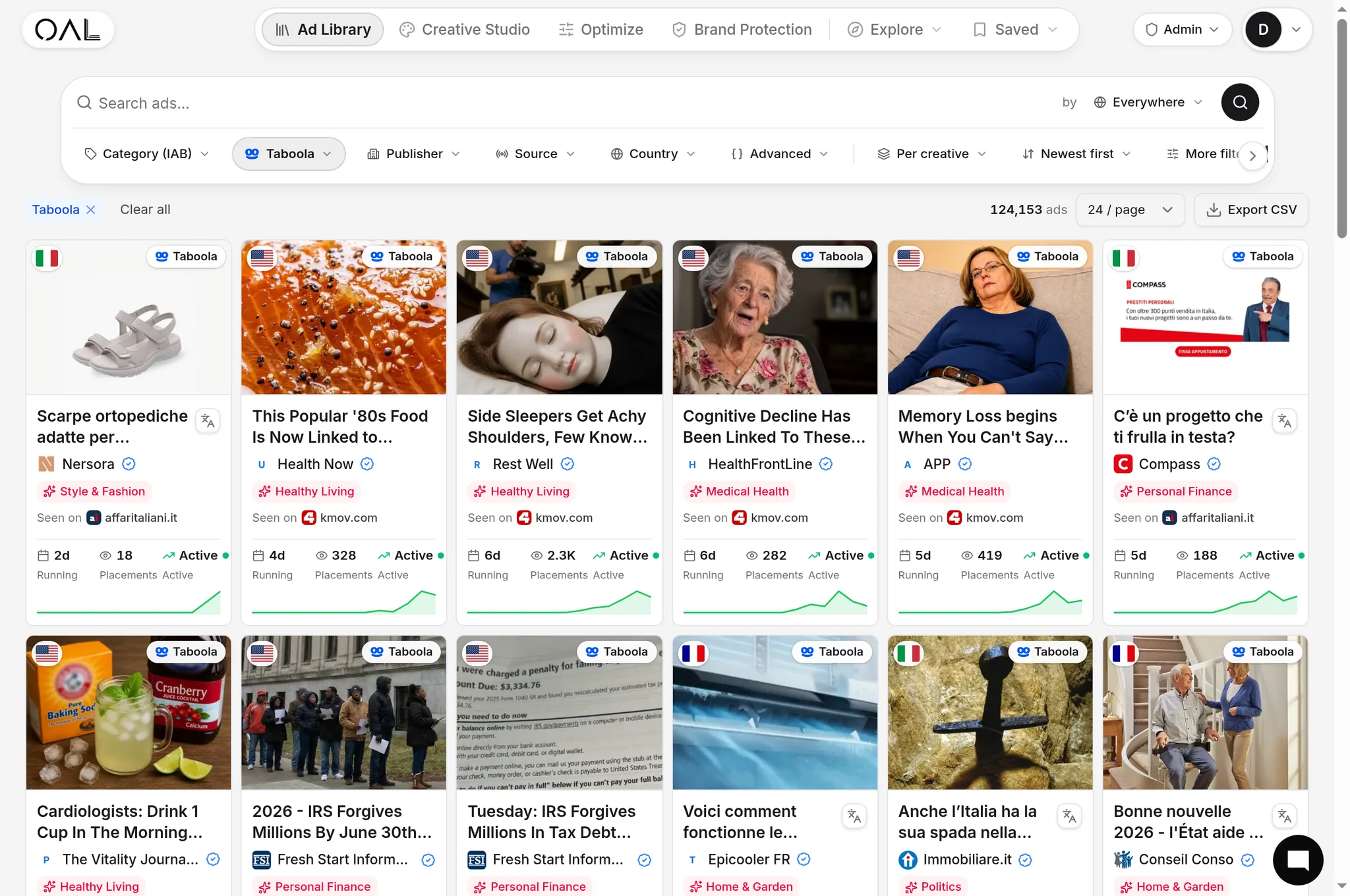
You cannot see a competitor's bids or results, and captured ads don't reveal them either. How long an ad stays in a feed is not a profitability signal: a creative can run for weeks on a brand budget, in a slow test or because nobody paused it, and an archive can miss when it stopped. What an archive can show is which advertisers, angles, landing pages, geos and devices appear in your vertical. Earlier captures included a hearing-care creative and a home-and-garden creative each observed over 37 days; that shows they were running, not what they paid or earned. A creative captured only on US desktop shows where we saw it, not where its economics work. On OpenAdLibrary, searching and filtering Taboola ads by vertical, geo and days running requires the Founders plan ($29.99/month); the free plan shows the 20 newest ads. Use what you find as hypotheses for your own test.
Price the click last. Understand the auction, fix your funnel math, study what competitors are running in your niche, then test: the CPC you pay becomes a variable you manage, not a mystery you absorb.