Español
 Português (Brasil)
 Français
 Deutsch
 Italiano
 Nederlands
 Polski
 Svenska
 Türkçe
 Русский
 日本語
日本語 한국어
한국어 简体中文
简体中文 Tiếng Việt
 Bahasa Indonesia
 繁體中文
繁體中文 Čeština
 Dansk
Dansk Norsk (bokmål)
 Suomi
Suomi Ελληνικά
 Română
 Magyar
 Українська
 ไทย
ไทย हिन्दी
 العربية
 עברית
עבריתHorizontal vs Vertical Scaling in Native Media Buying
Vertical scaling pushes more budget into a proven ad set while horizontal scaling clones the winner across new geos, networks, and angles, and reading competitor expansion patterns tells you the exact order to do it in.


Most native campaigns die one of two ways. The buyer finds a winner, jams the budget upward, and watches CPA balloon until the math breaks. Or they find a winner and never touch it again, leaving most of the available volume sitting on the table because they were scared to poke a profitable ad set. Both deaths come from the same misunderstanding: treating "scaling" as one thing when it is actually two. Vertical scaling pulls more out of the same conditions. Horizontal scaling rebuilds those winning conditions somewhere new. Mix them up and you torch budget. Getting the order right is the whole game in media buying.
This guide separates the two axes, shows you the exact moment each one stops working, and then does the part most articles skip: it uses real competitor expansion patterns from native advertising to give you a tested order for the horizontal move. If you are still assembling your first campaigns, start with the native advertising playbook for affiliates. This is the chapter you read after you have a winner and need to make it bigger without breaking it.
Horizontal vs vertical scaling, defined#
Vertical scaling means raising budget or bid on a campaign that already converts, squeezing more volume from the same offer, geo, network, and audience. Horizontal scaling means cloning that proven winner into new conditions: more geos, more networks, more devices, more placements, more angles. One saturated ad set becomes many parallel earners. Vertical deepens. Horizontal widens.
The two have completely different risk profiles, ceilings, and failure modes. Pushing the wrong one at the wrong time is exactly how ROI collapses.
| Vertical scaling | Horizontal scaling | |
|---|---|---|
| What changes | Budget / bid on the existing ad set | New geo, network, device, placement, or angle |
| What stays fixed | Offer, creative, targeting | The winning offer and creative (duplicated) |
| Speed | Fast, same day | Slower, needs new accounts and approvals |
| Main risk | CPA inflation as good inventory runs out | Each clone re-enters the learning phase |
| Ceiling | Hard, set by available high-intent traffic | Soft, multiplied by number of new conditions |
| When it shines | Early, on a fresh stable winner | After vertical hits its ceiling |
A vertically scaled campaign has one ceiling. A horizontally scaled offer has as many ceilings as it has conditions. That is why the biggest native spenders look wide and shallow, not tall and narrow.
Vertical scaling: extract before you replicate#
When an ad set has run profitably long enough to clear the learning phase and the data is stable, vertical scaling is the cheapest growth you will ever buy. No new creative to make. No new account to warm. No fresh approval queue. You are just asking the auction for more of what already works.
The discipline is all in the increments. Native algorithms re-optimize the second you change budgets, whether you are running on Taboola, where setup follows a specific campaign structure, or anywhere else. Move too hard and you reset delivery. Move too softly and you leave money idle. A rhythm that works:
- Confirm stability. The ad set should be net-positive over a window you can actually trust: several hundred conversions or several days of steady CPA, not one good Tuesday afternoon.
- Raise budget 20 to 50% at a time. Wait a full optimization cycle, often 24 to 48 hours on native, before the next bump. Small frequent increases beat one big jump every time.
- Track marginal CPA, not blended. Blended CPA hides the problem. The real question is whether the extra spend converted at an acceptable rate, not whether the campaign overall is still green.
- Find the ceiling and respect it. When each increase buys worse conversions than the last, and dialing the budget back down restores efficiency, you have drained the high-intent inventory for that offer in that geo on that network.
That ceiling is physical, not psychological. There are only so many people in one country, on one native ad network, seeing one native ad widget, who are in-market for your offer this week. Once you have them, more budget just bids you against yourself in the native ad auction. This is the exact wall covered in how to scale affiliate campaigns without killing ROI, and it is your cue to switch axes.
Finance is where you will hit this wall first, because it is the most crowded room in native. Finance is the single largest vertical in our index at 17,232 captured creatives, ahead of insurance (15,629) and health (14,895) (OpenAdLibrary index, June 2026). On Taboola alone we have logged 5,558 finance creatives and 4,303 insurance creatives. When that many advertisers are buying the same intent, the high-value inventory in any one geo saturates fast, and you feel the vertical ceiling sooner than you would in a thinner vertical.

Horizontal scaling: replicate the winner into new conditions#
Once vertical is tapped out, your winner has exactly one place left to grow: outward. Horizontal scaling takes the precise offer-and-creative combo the market already rewarded and re-runs it where that combo has never appeared. Four practical directions, roughly cheapest to test first:
- New networks. The offer that prints on one supply source has untouched inventory on the next. We track 42 networks in total, and the big three native sources alone hold huge separate pools: Taboola (157,727 creatives), Outbrain (84,252), and MGID (49,689) (OpenAdLibrary index, June 2026). A creative validated on one widget often transfers to a sibling network with minor tweaks, because the audiences overlap less than buyers assume.
- New geos. A winner in one Tier-1 country frequently works in adjacent Tier-1 markets, then in Tier-2 and Tier-3 markets where CPMs cost a fraction. This is the highest-leverage horizontal move for most affiliates and earns its own playbook: see scaling to new geos.
- New devices and placements. Splitting a unified winner into device-specific clones, and pulling top publisher widgets into their own ad sets, lets each one optimize on its own merits instead of being dragged by an average.
- New angles. The same offer reframed for a different motivation (fear vs aspiration, problem vs outcome) opens a fresh slice of the same audience with no new product.
The cost of horizontal scaling is real: every clone re-enters the learning phase and burns test budget before it stabilizes. So you do not clone blindly. You clone in the order with the highest prior probability of working, and that order is exactly what competitor data hands you.
Read competitor expansion patterns as a roadmap#
This is where intelligence beats intuition. When a serious advertiser scales horizontally, they leave a trail: the same creative surfacing in a new country a month later, the same pre-lander appearing behind a different native ad network, the same offer migrating from desktop-heavy widgets to mobile inventory. Read enough of those trails and you stop guessing which direction to expand. You are following a route someone else already paid to validate.
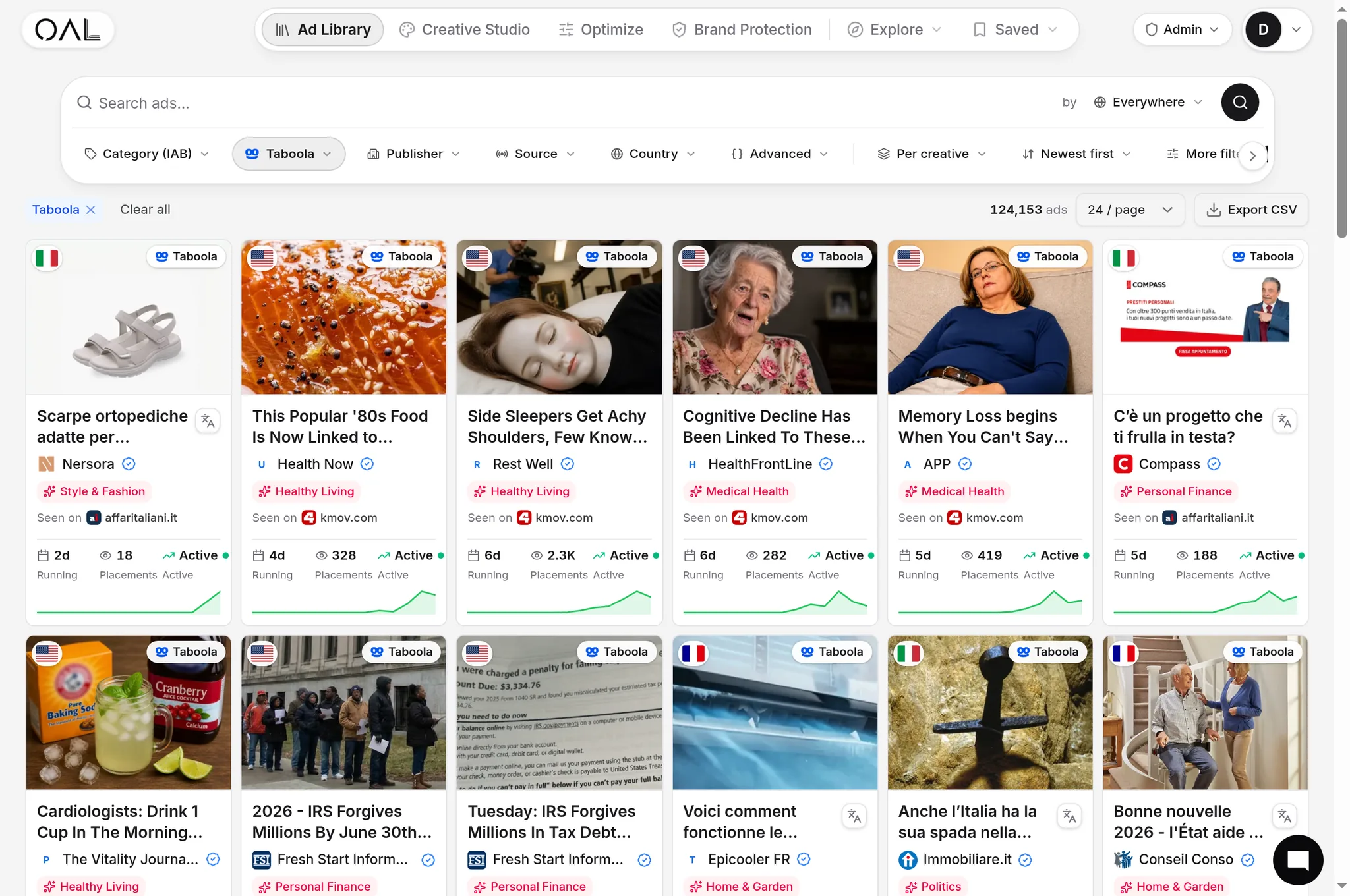
OpenAdLibrary exists to make that trail legible. We capture live public native ads across Taboola, Outbrain, MGID, Revcontent, Teads, MediaGo, Yahoo, and MSN, and we follow each click through to the advertiser's landing page (without clicking live ads). That lets you fingerprint a single offer and watch it move. Across the 589,036 creatives and 5.4 million ad observations we have captured, the patterns are loud:
- Spread tells you the proven order. When one creative shows up across six networks, the sequence it spread in (which network first, which next) is a tested expansion path. Run your own offer through the same lattice instead of inventing one.
- Geo footprint tells you which markets transfer. Seeing the same ad localized into three new countries is direct evidence those geos accept that angle. That shortlist saves weeks of cold testing.
- Longevity tells you what to trust. Our index currently spans up to about 28 days of continuous observation per creative, and the ads pinned to that ceiling are revealing. Hidden Hearing's "Try next-gen hearing aids," SmartAsset's "How Can I Avoid Paying Taxes on IRA Withdrawals?", and a cluster of "My IQ" quiz ads have all held continuously for the full 28 days we have watched them. (Separately, industry lore about 90-day winners is just that, lore. Our hard observed numbers cap at 28 days.) Either way, duration is the cheapest quality filter you have: an offer that survives weeks across multiple placements is worth modeling; one that flared for three days and vanished is noise.
- The real advertiser behind the ad lets you study one competitor's entire scaling behavior, every geo and network and angle they expanded into, instead of reacting to a single isolated creative.

That is reconnaissance, not plagiarism. You copy the structure of the expansion (the geos, the networks, the order, the cadence) and run your own offer and your own original creatives through it. To find these patterns fast, a native ad spy tool that captures full-quality creatives and traces clicks to the destination turns scattered observations into a ranked clone list. From there, Copy DNA surfaces the recurring hooks behind the long-runners, and Creative Studio helps you build your own originals before you push them live.
A worked example of the roadmap in practice#
Say your weight-management offer is maxed out vertically in the US on one network. Instead of guessing your next move, pull the spread of comparable long-running offers in the same vertical, the kind of analysis covered in the best affiliate verticals for native ads. Health is fertile ground for this: 14,895 health creatives sit in our index, and the longest-running ones we track are dominated by hearing-aid and supplement offers that have clearly been validated across multiple placements before expanding.

The data shows a dominant pattern: US desktop, then US mobile, then Canada and the UK, then a second network, then Tier-2 markets. That sequence becomes your clone queue. You replicate your winner in that order, give each clone its own budget and a clean learning phase, and apply the same vertical-scaling discipline to each one as it stabilizes. The two axes compound: every horizontal clone becomes a new vertical ceiling to push toward.
Putting both axes on one timeline#
Scaling is not a fork in the road between the two operations. It is a loop. The mature pattern looks like this:
- Validate a winner and let it clear the learning phase.
- Scale vertically in 20 to 50% steps until marginal CPA degrades.
- Clone horizontally into the highest-probability next condition, using competitor spread as your priority order.
- Scale each clone vertically to its own ceiling.
- Repeat, widening the footprint while deepening each placement.
Done well, a single proven offer becomes a grid of dozens of independently optimized ad sets, each near its own ceiling, with new conditions added faster than old ones saturate. That grid is what durable native profit actually looks like, not one heroic high-budget campaign. If you want the foundational mechanics of running the placements underneath all this, the beginner's guide to media buying for native ads covers the day-to-day operation.
The buyers who win the scaling game are not the ones who bid hardest. They are the ones who know which axis to push, exactly when to push it, and who use real market evidence to decide where to widen next.
Start free: browse 200 live native ads with no card, then track a single offer across every geo and network it runs in to build your own scaling roadmap.