Español
 Português (Brasil)
 Français
 Deutsch
 Italiano
 Nederlands
 Polski
 Svenska
 Türkçe
 Русский
 日本語
日本語 한국어
한국어 简体中文
简体中文 Tiếng Việt
 Bahasa Indonesia
 繁體中文
繁體中文 Čeština
 Dansk
Dansk Suomi
Suomi Ελληνικά
 Română
 Magyar
 Українська
 ไทย
ไทย हिन्दी
 العربية
 עברית
עבריתAffiliate Ad Compliance Monitoring: How Brands Police Their Affiliates
Regulators hold brands responsible for what their affiliates run. Here is the monitoring program that catches non-compliant affiliate ads before customers, networks, or the FTC do.


Affiliate ad compliance monitoring is the systematic auditing of the ads, pre-landers, and claims your affiliates run in your brand's name — across every traffic source they actually use, not just the ones they disclosed on their application. Brands police affiliates because regulators hold the advertiser responsible for what is said on its behalf: under the FTC's endorsement rules, "we didn't know what our affiliates were running" is not a defense. A working program needs three capabilities: visibility into where affiliate ads really run (increasingly native networks like Taboola, Outbrain, and MGID), captured evidence of each creative and landing page, and an enforcement ladder written into the affiliate agreement before the first violation happens.
Why affiliate compliance is the brand's problem#
The FTC's endorsement guides are blunt about responsibility: an advertiser is accountable for deceptive claims made by its marketing partners, including affiliates it has never spoken to directly. Enforcement actions routinely name the brand alongside whoever published the offending ad, and the required disclosures — material connection, paid placement, honest typical-results framing — apply to an affiliate's advertorial exactly as they apply to the brand's own campaigns.
The commercial damage usually lands before any regulator does. A fake endorsement or an invented health claim runs for weeks, buyers arrive with expectations the product cannot meet, refund and chargeback rates climb, and the brand starts appearing in screenshot threads about scam ads. Ad networks respond too: a pattern of deceptive affiliate creatives can get an offer — or an entire brand — banned from a network's marketplace. All of that can trace back to a single affiliate worth a few hundred dollars a month in commissions.
The asymmetry is the point. The affiliate risks an account; the brand risks the brand. That is why compliance monitoring is a brand-side function, not something to delegate to an affiliate network's own review queue.
The violations that actually show up in native feeds#
Native advertising is where affiliate compliance problems concentrate. Creative review is lighter than on Meta or Google, the advertorial format invites aggressive storytelling, and campaigns are easy to spin up under generic advertiser names. Across OpenAdLibrary's index of 725,000+ native ad creatives on 49 networks (June 2026), the recurring violation patterns look like this:
- Unauthorized claims. The affiliate invents efficacy, earnings, or savings figures the brand never approved — miracle-cure health promises, guaranteed-income framing, fabricated discounts. The brand's legal exposure is essentially the same as if it had made the claim itself.
- Fake endorsements. Celebrity photos, doctored TV-segment screenshots, invented expert quotes. These are the fastest route to both an FTC problem and a viral embarrassment.
- Undisclosed advertorials. Affiliate pre-landers styled as independent editorial or a news review, with no sponsored-content label anywhere. The FTC's disclosure rules for advertorials apply to affiliate funnels in full.
- Trademark misuse. Affiliates using the brand name in headlines, posing as the official store, or outranking the brand on its own terms. Our guide to trademark infringement in ads covers the detection side in depth.
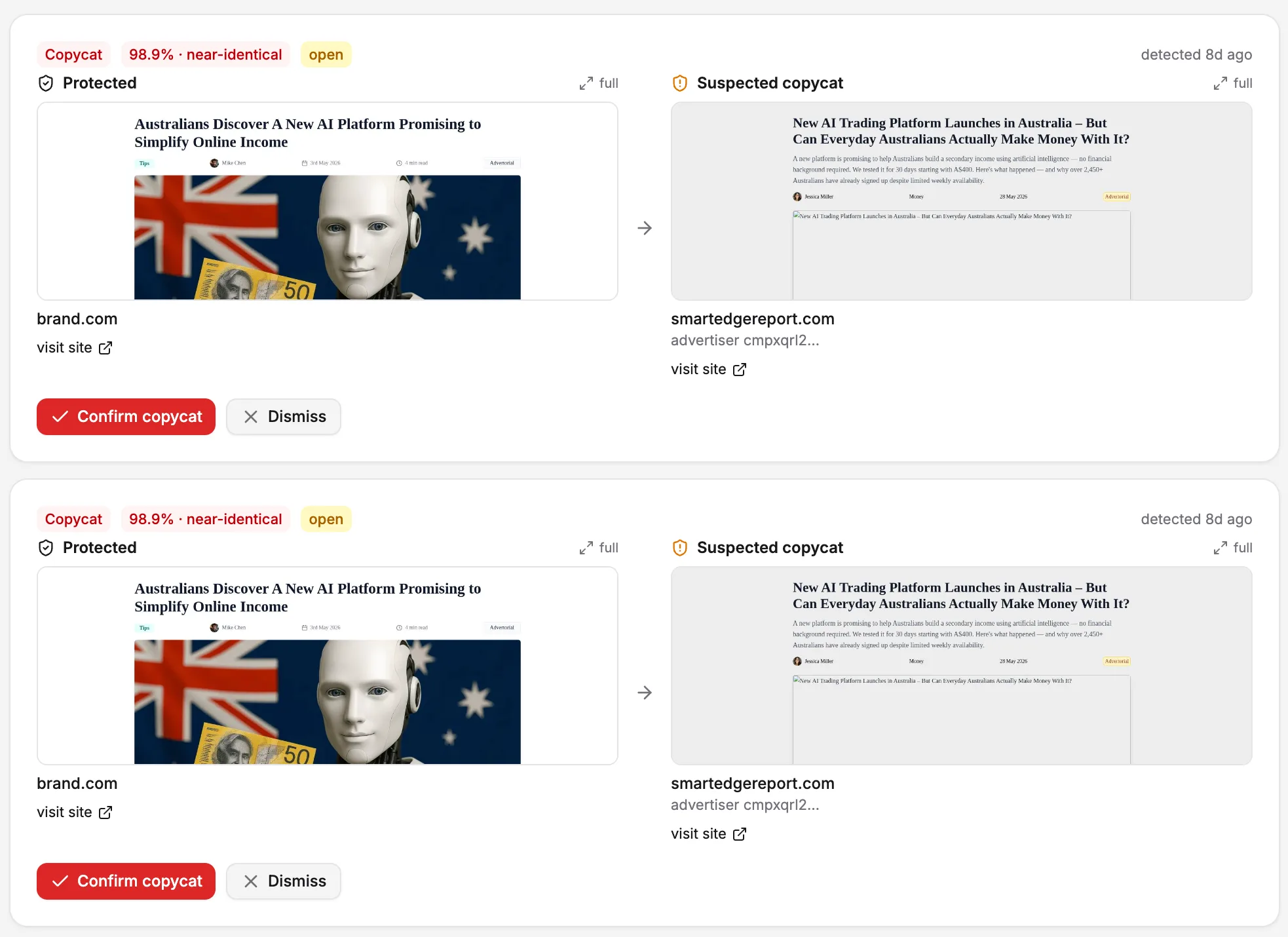
- Copycat landing pages. The harshest version: a cloned checkout or lookalike offer page harvesting your demand. Copycat landing pages deserve their own monitoring workflow because the operator often is not your affiliate at all — it is a fraudster wearing your brand.
- Cloaking. The affiliate shows network reviewers a compliant page and real users something else entirely. Our piece on how ad cloaking works and how evidence exposes it explains why this is grounds for immediate termination everywhere.
Why rogue affiliates are hard to catch by hand#
Brands that rely on spot-checking search results and their own social feeds miss most of this, for four structural reasons:
- Geo-targeting away from the brand. An affiliate running non-compliant angles will exclude the brand's home country, or target only the geos where the offer pays out. Your team never sees the ad from an office IP.
- Publisher scatter. Native campaigns spread across thousands of publisher sites through each native ad network's widget placements. There is no single feed to scroll the way there is on a social platform.
- Redirect chains. The click URL on a native ad is usually a tracker domain, not the destination. Without following the full redirect chain, you cannot prove which affiliate ran the ad or where it actually sent users.
- Short flights. Aggressive creatives are run hard for days, then rotated out before anyone at the brand can document them. If nothing captured the ad while it was live, the evidence is gone.
Building the monitoring program#
A workable affiliate compliance program has four parts, and none of them require a large team.
1. Put the rules in writing first. The affiliate agreement should enumerate approved claims, required disclosures, and prohibited tactics — brand bidding, cloaking, celebrity imagery, fabricated reviews — plus the evidence standard you will use. Enforcement without a written standard turns every violation into a negotiation.
2. Monitor where affiliates actually buy. That means the native networks, not just search and social. Searching an ad library by brand name, product name, and offer terms surfaces ads you were never meant to see — including geo-targeted ones, because an independent index captures ads across many countries. OpenAdLibrary's index spans 49 networks with 1.3 million+ captured landing pages (June 2026), so a brand search returns not just the creative but the pre-lander and final destination behind it — which is where most violations live. A native ad spy tool built for competitive research doubles as a compliance scanner: the workflow is identical, only the search terms change.
3. Capture evidence, not recollections. For each suspect ad, record the creative, headline, publisher context, full click path, landing page, and first/last-seen dates. Ad-library captures are timestamped and archived, which matters when an affiliate claims the ad "only ran for a day" or belonged to someone else.
4. Define the enforcement ladder. A typical ladder: documented warning with a takedown deadline, then commission hold pending correction, then termination with forfeiture for cloaking, fake endorsements, or clone pages. Publishing the ladder to your affiliates in advance is itself a deterrent.
A weekly routine that takes under an hour#
- Search your brand terms — brand name, flagship products, common misspellings — filtered to ads first seen in the last 7 days. Unfamiliar advertiser names running your terms are the first flag.
- Review new creatives promoting your offers. Anything carrying a claim you don't recognize gets its landing chain opened and read.
- Check the landers. Is the disclosure present? Are the claims inside your approved list? Does checkout resolve to your domain or a clone?
- Maintain a watchlist. The same competitor watchlist workflow works for your own brand terms and your known affiliate accounts — alerts on new creatives beat manual re-searching every week.
- Log everything: ad, evidence link, affiliate if identifiable, action taken, deadline, resolution.
Brands already running brand protection in native advertising can fold affiliate compliance into the same routine — the searches overlap almost completely, and the same captured evidence serves both.
When you find a violation#
Move in this order. First, capture evidence immediately — live ads disappear; archives do not. Second, identify the affiliate: tracking parameters and affiliate IDs in the click path frequently identify the account even when the advertiser name is generic. Third, contact the affiliate with the evidence and a deadline; most violations are sloppiness rather than malice and end with a takedown inside a day. Fourth, escalate in parallel when the ad is fraudulent rather than sloppy — fake endorsements and clone checkouts should also go to the ad network, and our guide on how to report a scam ad covers each network's reporting channel and the evidence it expects. Finally, enforce the ladder you published. A compliance program that never holds a commission teaches affiliates exactly how much the rules weigh.
The uncomfortable truth: most brands discover their worst affiliate ad from a customer complaint or a journalist, months into its run. An hour a week with the right search surface makes you the first to know instead of the last.