

Affiliate & Media Buying
Bid Adjustments by Device & Geo: Modifiers That Move ROAS
A flat bid across every device and geo is subsidizing your worst segments with your best. Here's how to build device and geo modifiers that actually move ROAS.
A flat bid across every device and geo is subsidizing your worst segments with your best. Here's how to build device and geo modifiers that actually move ROAS.

There's no single native ad CPM. Here's the rough ordering across major networks, the four factors that actually move your rate, and how to sanity-check it against live data.

Performance across publishers in the same native campaign can vary 5x or more. Publisher-level bidding is the underused lever that turns that variance into profit instead of waste.

News sites sell ad inventory through at least two channels with completely different price floors: negotiated direct or programmatic display, and self-serve native feed placements.

Automated CPA bidding can work on native networks, but native auctions are thinner than search or social, so the volume threshold for it to work is higher than most media buyers expect.
PAS and AIDA still work on native, but only once you compress them into a headline and hand the rest to the landing page. Here's how, with real headline patterns.

There's no magic number, but live captures show winning native headlines cluster in a fairly tight band. Here's the data and the rules worth following.

Both styles show up among the longest-running native ads in the index. The split that matters isn't curiosity versus clarity, it's which one fits the vertical and the reader's intent.

Whitelisting locks your native campaign to publisher placements you've already proven convert, instead of letting the algorithm spread budget across untested inventory. Here's when that trade-off pays off.

Nobody publishes real competitor ad spend, on any channel. Here's what Google Ads, Meta's Ads Library, and native networks actually show you instead, and how to build a defensible estimate from the proxies that remain.

Teads and Taboola both get called native advertising, but they sell very different products to very different buyers. Here's how they actually compare.
MediaGo and Taboola draw from very different supply. Here's how their inventory, cost and targeting compare, and which advertisers fit each one.

Scale a winning Taboola campaign the wrong way and CPC climbs fast. Here's the staged budget-increase method, horizontal vs vertical scaling, and the signs you're pushing too hard.

Taboola's dynamic keyword insertion can lift relevance on location-sensitive offers, or produce broken, low-trust headlines if the fallback text and character limits aren't handled carefully.

Taboola retargeting works through a site-wide pixel and audience segments, best used to warm up cart abandoners rather than as a cold prospecting substitute. Here's the setup and the tradeoffs.

Taboola has no platform minimum, which makes it look cheap. The real cost for a small business is the testing budget needed before creative and targeting find a profitable combination.

Taboola offers two ways in: self-serve Backstage with no fixed minimum, or a managed account with a dedicated strategist and a higher budget commitment. Here's how to pick based on your spend and goals.

The most common reasons a Taboola account gets suspended, how to write an appeal that actually gets reviewed, and the prevention checklist for your next campaign.

Pixel versus server-to-server tracking on Taboola, how click IDs connect a click to a downstream conversion, and the silent failures that make working funnels look dead.

Whether Taboola fits a lead-gen model, how to set up a campaign for it, realistic cost expectations, and what to do about lead quality being colder than search traffic.

Character limits, five headline formulas pulled from real long-running Taboola creative, and how to test angles without writing clickbait that bounces on the landing page.

The recommended dimensions, format and text rules for Taboola images, plus how the same creative crops differently on mobile vs desktop and what actually gets flagged in review.

Taboola ads look spammy for structural reasons: the auction rewards clicks over polish, and the marketplace mixes premium brands with thin-margin resellers in the same feed.
Taboola Smart Bid predicts conversion likelihood per impression and bids accordingly, but it needs real conversion volume to work. Here's when to trust it and when to stay manual.

Merger headlines and a shuttered Yahoo brand read like decline, but the live advertiser and creative data across 49 native networks tells a very different, and much healthier, story.
The ad you see in a "you may also like" widget wasn't chosen by the highest bidder alone. It won a real-time auction that weighs bid against how likely you specifically are to click it.

Native CPCs run lower than Facebook or Google because you're bidding on attention instead of intent, across far more inventory. That's also exactly why a cheap click can still be a wasted one.

Neither Taboola nor Outbrain publishes a hard pageview minimum, but real-world approval patterns cluster around a rough threshold, and content quality matters as much as volume.

The position of a native ad widget moves RPM more than the network behind it. Here's the placement hierarchy, sizing guidance and how to test changes properly.

Content recommendation RPM swings from under a dollar to well over $15 per thousand pageviews, and the network you pick matters far less than your geo, vertical and device mix.
Taboola sells native recommendation widget space; AdSense sells programmatic display. Which earns more depends on your content vertical and traffic, not on which network is better.

Ten standout native ads from this month's live index — picked by longevity, not taste — with the headline patterns behind each one and how to run the same analysis yourself.
Taboola pays publishers a negotiated share of widget click revenue — there is no flat rate. Here is the RPM math, the levers that actually move it, and how to inspect the demand that will fill your slots before you sign.

Taboola and Microsoft gate what MGID and Revcontent tolerate. A practitioner's comparison of eight native networks' content policies across nutra, crypto, dating, CBD and gambling — with the captured-ad evidence.
Native networks reject landers off a short, stable list of triggers: claims language, missing trust pages, disruptive behavior, ad mismatch. The full checklist, the fix for each, and why month-old live landers are your best compliance spec.

A stage-gate framework for scaling native campaigns: what each budget level must prove before the next, which levers to pull vertically and horizontally, and the spend signals that say a winner can absorb more.

The click-ID round trip that makes native conversion data trustworthy: setting up S2S postbacks on Taboola, Outbrain, MGID, and Revcontent, testing the loop before you spend, and the failure modes that silently eat conversions.

Taboola offers Smart Bid Max Conversions, Smart Bid Target CPA, and Fixed CPC. An independent guide to how each behaves, the data each one needs, and the campaign types where automation fights you instead of helping.

Revenue-share percentages are the headline; demand depth is the paycheck. A sell-side ranking of native ad networks built from the live advertiser activity we observe on each one.
The join key between your ad spend and your conversions is a macro. Here is the full Taboola set, the Outbrain, MGID and Revcontent equivalents, and the template mistakes that quietly break tracking.

Taboola's Backstage API automates everything in your own account — campaigns, creatives, reports. Here is the auth flow, the endpoints that matter, what buyers actually automate, and where to get the competitive data Backstage will never show you.

Most native ad rejections happen at the landing page, not the creative. Here is what reviewers on Taboola, Outbrain, MGID and Revcontent actually check, and the checklist that gets funnels approved the first time.
The image sizes, aspect ratios and headline limits for eight native ad networks in one table — plus the crop, thumbnail and composition realities the official spec pages leave out.

No vendor PR, no unverifiable ROAS: 12 live native campaigns — Domain.com.au, Flight Centre, Fisher Investments, search-arbitrage farms and more — decoded from observable capture data: longevity, creative sets, networks and funnels.

Two of the longest-running creatives in the entire index are hearing aid ads. Why the niche fits native feeds so well — demographics, economics, stigma — and what its five recurring angles teach any media buyer.

The DTC ads that survive native feeds cluster into four patterns — plain-benefit sentences, discovery stories, retail urgency, and identity offers. Live examples of each, with run times and the funnel each one needs.

Home & garden holds 11,032 live creatives in the index, and three of its ads have run 37+ days. The three angles that dominate the vertical, with live examples and what each teaches.

Realize is Taboola's 2025 rebrand of its advertiser platform — a strategic repositioning from 'content discovery' to performance advertising. Here is what genuinely changed, what didn't, and how to evaluate it.

Taboola ads live in sponsored feeds on publisher sites — below articles, mid-article, on homepages — and extend into Yahoo and Apple supply. Here is the placement map, and how to see exactly where any advertiser runs.

No native network publishes CTR benchmarks. Here are the bands practitioners actually report by placement, vertical and network — and the observable signal that predicts profit better than CTR does.

Taboola holds 206,145 live creatives in OpenAdLibrary's independent index — more than Outbrain, MGID and Revcontent combined. Thirty statistics on scale, verticals, and creative longevity, all from observed live captures.

Taboola sells performance clicks from content feeds; Teads — the merged Outbrain-Teads company — sells premium in-article attention. How the two differ on formats, cost, advertiser mix, and when each is the right buy.

Meta finds your buyer fast and burns creative in days; Taboola's cheaper clicks feed advertorial funnels that run for weeks. How the two channels differ on cost, intent, creative, and risk — and the playbook for running both.

Same-looking native ad unit, completely different machinery: Taboola's open-web publisher network versus Microsoft's own surfaces powered by Bing intent and LinkedIn profile targeting. Live index data on both feeds.

Taboola is the scale play; MediaGo is Baidu's algorithm-first native platform riding premium Microsoft-weighted supply. Live index data on both networks, and a sequencing playbook for using each where it wins.

Insurance is the third-largest vertical in our live native index. Where its 22,000+ creatives concentrate is a working map of which networks insurance advertisers should buy first.

Native feeds don't sell job-title targeting — the B2B advertisers who win make the headline and the funnel do the qualifying. Live examples from the index, the three plays that keep working, and how to pick a network.

Finance is the second-largest native ad vertical, with 24,068 live creatives in the index. Where the money runs, the five angles that dominate, and how to build a funnel that survives compliance.
Taboola, Outbrain (Teads), Revcontent, MediaGo, Microsoft Audience Network, Yahoo, Dianomi and TripleLift — eight MGID alternatives compared with live ad counts, entry bars and honest fit guidance.

Ads that keep serving keep paying. We pulled the longest-running creatives from an index of 206,145 live Taboola ads and dissected the five patterns the 30-day survivors share.

We ranked Taboola's niches using 206,145 live creatives: health, finance and insurance dominate. Here is the full data — and why the biggest niche is only 'best' if you can out-angle it.

Taboola reviews every ad and landing page as a pair. Here are the policies that matter in practice, the eight rejection reasons behind most failures, and the checklist that passes review the first time.

What it really takes to run Taboola as a publisher: the acceptance bar, the RPM drivers nobody quotes, the exclusivity trade-offs, and how to inspect the actual ads before you sign.

Taboola targeting is a different animal from social: geo, device, audiences, publisher controls and SmartBid. Here is what each lever does and the campaign structure practitioners actually run.

The sticker minimum and the real minimum are different numbers. Here is what each major native network commonly requires to open an account — and what you actually need to run a test that produces a decision.

Your first native bid should buy data, not margin. Commonly reported starting ranges for Taboola, Outbrain, MGID and Revcontent by geo and device — and the adjustment playbook that follows.

A native ad networks list with receipts: the seven major networks of 2026 — Taboola, Outbrain (Teads), MGID, RevContent, the Microsoft Audience Network, MediaGo and Yahoo — each with live creative counts from OpenAdLibrary's million-creative capture corpus, who each network suits, and the churn data that governs them all.

Health, finance and insurance carry Taboola's demand — the live creative counts prove it. The full ranking, what actually runs in each vertical, and how to pick your lane.

Placement waste is the quiet killer of Taboola accounts. Here's the block-list workflow practitioners actually use: spend-based thresholds, block vs bid-down, and graduating winners to whitelists.

Taboola doesn't publish its publisher list — but the network is mappable. The site tiers, the page placements, and three ways to check any website in under a minute.
Ecommerce is the fourth-largest vertical on Taboola. The live data shows exactly which product archetypes sustain spend on native feeds — and the advertorial funnel they all share.

Cutting your Taboola bid starves delivery. The levers that actually lower CPC: creative CTR, surgical site-level cuts, honest campaign splits, and Smart Bid fed with real conversion data.

There is no official Taboola CTR benchmark — but there are working bands buyers rely on, auction math that makes CTR your main cost lever, and a way to benchmark against live ads instead of hearsay.
Taboola the company is real, public and embedded in major news sites. The ads are a mixed marketplace. Here is how to judge the platform, the ads, and whether your money is safe there.
Google Ads captures demand; Taboola creates it. Here is how the two platforms differ on cost, creative and funnel fit — and a sequencing playbook for running both without wasting budget.
The affiliate model is welcome on Taboola; the raw affiliate link mostly is not. What review actually checks, what earns permanent bans, and the owned-lander setup that clears it.

Taboola offers affiliates premium-publisher scale in exchange for media-buyer discipline: owned advertorials, compliant claims, server-side tracking and real budgets. Here is the full operating manual.

Taboola sends real human clicks from mainstream publisher sites — cold ones, with huge variance between placements. What quality actually means on the network, and how the buyers who stay profitable handle it.

The platform's enforced minimum and the budget you actually need are two very different numbers. Here is the arithmetic that sets the real one, and how to stretch a small budget without starving the test.

Taboola has no rate card — every click clears in an auction. Here is what buyers commonly report by geo, device and vertical, and the math that decides what a click is worth to you.

Taboola has no official ad library, but any brand's Taboola ads are still findable. The exact lookup workflow, the five signals in a brand's footprint, and what to do when a search comes up empty.

SOFTWARE is a top-six vertical on almost every major native network we track. Who actually runs B2B native, which networks fit, and the playbook that makes the lead economics work.

Network share of 725,882 live native creatives across 49 networks: Microsoft, Taboola and Outbrain hold roughly 82% of observed volume. Full table, methodology and caveats inside.

What it really costs to start on each native ad network — entry models, commonly reported deposits and daily floors, and the test-budget math that actually matters.
The policy triggers behind most Taboola rejections, the fix for each, and how to tell a routine creative rejection from the account review that precedes suspension.

How to go from broad Taboola buys to a proven-site whitelist in three phases — and how to shortcut the expensive discovery phase with observation data.
The five levers that actually move Taboola performance — structure, creative rotation, site pruning, bidding and conversion feedback — benchmarked against what 30-day advertisers visibly do.
The same skincare advertiser is running 'Koreans Do This Instead' on two networks at once — because the formula works. A breakdown of that headline family and four other live skincare creatives, with run times.

Health is native advertising's biggest vertical: 24,472 live creatives in the index. These 12 captured ads show the authority, contrarian, curiosity and avoid-list hooks that keep winning.

An evidence-backed verdict on where Taboola genuinely delivers, where it will frustrate you, and which advertisers should skip it entirely.

Taboola runs a cost-per-click auction with no rate card. Here are the CPC ranges media buyers actually report, what a decision-grade test really costs, and the five variables that move your price most.
One master image, four crops, every major native network covered. The working image-size defaults for Taboola, Outbrain, MGID, Revcontent, MediaGo, MSN and Yahoo — plus the crop-survival rules that matter more than pixels.
50 real headlines from live native ads — 16 of them ran 30+ days — grouped into ten swipeable patterns, with the longevity data that separates proven angles from noise.

GDN is the broadest cheap-reach machine in advertising; Taboola is a native feed that supports advertorial funnels banners cannot. A practitioner framework — backed by live ad data — for deciding which job to give each channel.

One is an open-web recommendation network spanning thousands of publisher sites; the other is a single US local-news app. That structural difference decides which channel performs for you.

Insurance is the #3 native advertising vertical, with 22,427 live creatives in our index. This playbook maps where the volume runs, the funnel that converts, the angles that survive, and the compliance lines that end accounts.

Taboola, MGID, Revcontent, MediaGo, Microsoft, Yahoo, Google Demand Gen, Nativo, TripleLift: nine real Outbrain alternatives sized with live index data instead of vendor marketing.

Outbrain, MGID, Revcontent, MediaGo, the Microsoft Audience Network and five more Taboola alternatives, compared by what advertisers actually run on each network — not by sales-page claims.

Ten real Taboola creatives pulled live from a 171,050-ad index — with the advertiser behind each, how long it's been running, and the headline mechanism doing the work: eligibility hooks, casting-call angles, editorial blends, geo-personalization and offer-led cards.

No official Taboola ad library exists anywhere. Here is the independent one: 171,050 live Taboola creatives with advertisers, longevity, geo and landing pages, and how to use it for real competitive research.

Spend charts only update after the race is over, so to see what advertisers are scaling right now you read live native ad capture for longevity, spread, and variant signals. Here is the method, with real numbers from 589,000+ captured creatives.

DTC brands quietly buy native ads next to the arbitrage and nutra crowd, and here is a repeatable, data-backed method for surfacing which ones are live on Taboola, Outbrain, MGID and Revcontent this week, by category.

An ad that keeps spending week after week is telling you something a one-off scrape never can: here is how to rank native ads by lifespan, why longevity is the cleanest profitability signal on the open web, and how to run the analysis yourself.

Folklore says nutra and crypto own native, but across 589,000+ live-captured creatives finance, insurance and health actually lead; here's the method to measure native ads by vertical and network yourself.
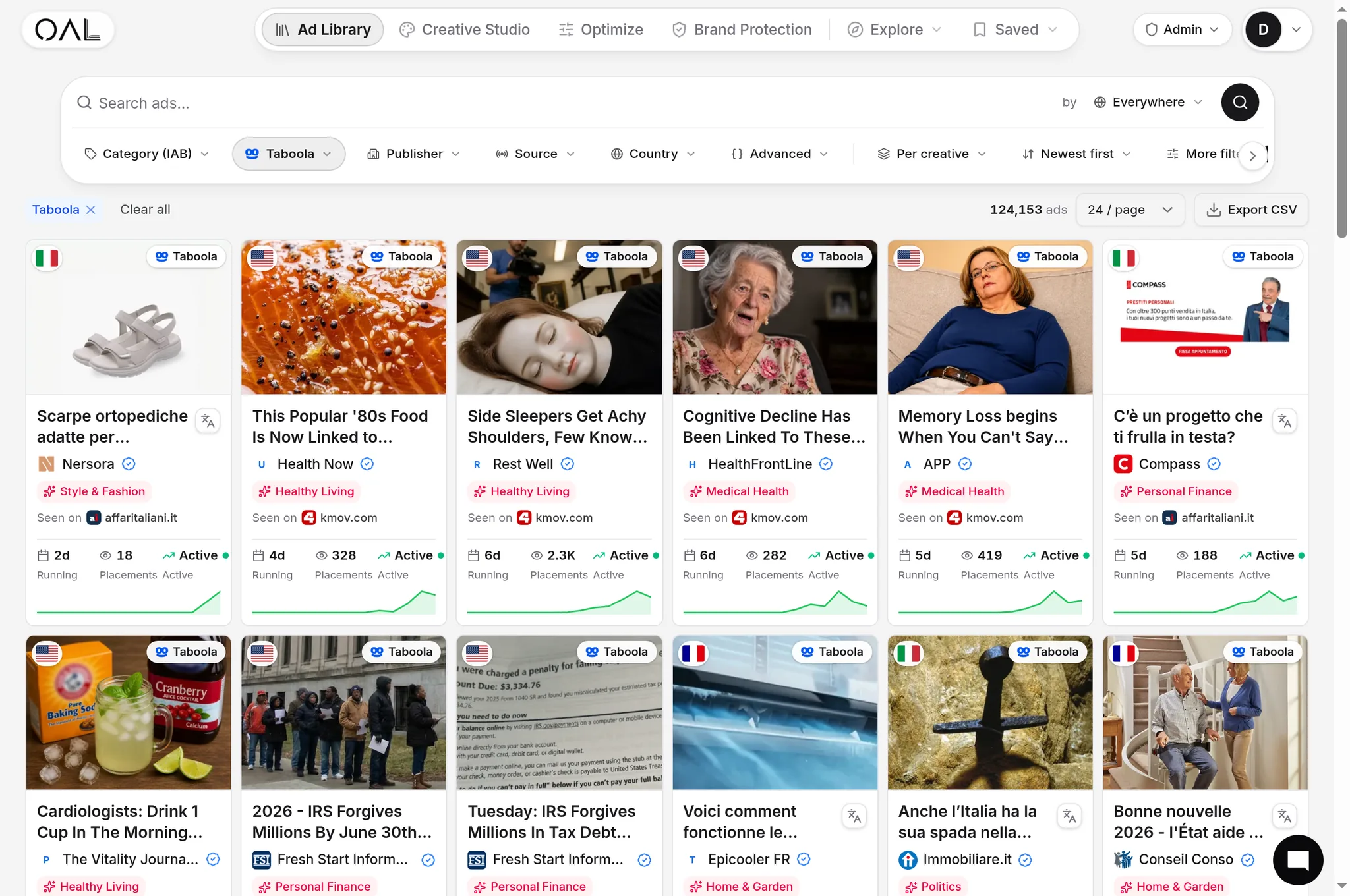
Most "top advertiser" lists are guesses; this one is rebuilt from 589,000 live native creatives, classified by real advertiser, network and vertical, then ranked by spread and longevity.
There's no public list of Taboola advertisers, so here's the exact method we use to reconstruct one from 157,000+ captured Taboola creatives, click-trace landing pages, and supply-chain classification.

Meta and Google run public ad libraries; Taboola, Outbrain and MGID never did, so here is what an open native ad library has to capture, and why that gap sat empty for a decade.
If Meta is 90% of your spend, you don't have a marketing channel, you have a single point of failure; here's how to add native as a second engine and use competitive recon to de-risk every step.

Native advertising wins for a narrow slice of dropshipping products, and here's the data-backed case for when it beats social, drawn from live native ad captures.
Most Taboola guides stop at "write a curiosity headline." This one walks the full Realize setup, budget math, Maximize Conversions, targeting, tracking, then shows what winning native creatives actually look like using live captured ads.
Native media buying is a four-part loop (offer, creative, bid, scale), and this 2026 playbook walks each step with concrete settings, live cross-network examples, and the metrics that actually move money.
Taboola has no public ad library, so here's how to reconstruct one: filter live captures by network, vertical and geo, rank advertisers by volume and days live, then pull the full creative and the click-to-landing trace.

Taboola, Teads (Outbrain), MGID, and Revcontent each reward different ecommerce categories and margins, and our June 2026 capture data shows exactly where your product type actually has demand before you spend a dollar.
Published CPC ranges for Taboola, Teads, MGID, and Revcontent only tell half the story; here is how to read live advertiser density and longevity to know what a click is really worth before you fund a test.
A practitioner's breakdown of what native advertising really costs in 2026: minimum deposits, CPC ranges and the test budgets that actually decide whether you win, grounded in live ad data from Taboola, Teads, MGID and Revcontent.
MGID lets you test from $100; Taboola realistically needs ~$300/day to clear its learning phase, and our capture index shows Taboola running three times the creatives MGID does.
Taboola is the scale incumbent and Revcontent the lower-floor challenger; we compare reach, entry cost, and the real advertiser mix on each using ads captured live (157,727 Taboola creatives vs 11,478 on Revcontent in our June 2026 index).

Outbrain bought Teads and the parent now trades as Teads, so here is how to compare the two networks using live ad data instead of vendor claims.
A media buyer's honest comparison of native ads and Facebook ads for DTC in 2026, covering CPC, iOS signal loss, creative, and intent, backed by the live native volume OpenAdLibrary tracks across Taboola, Outbrain, MGID, and Revcontent.
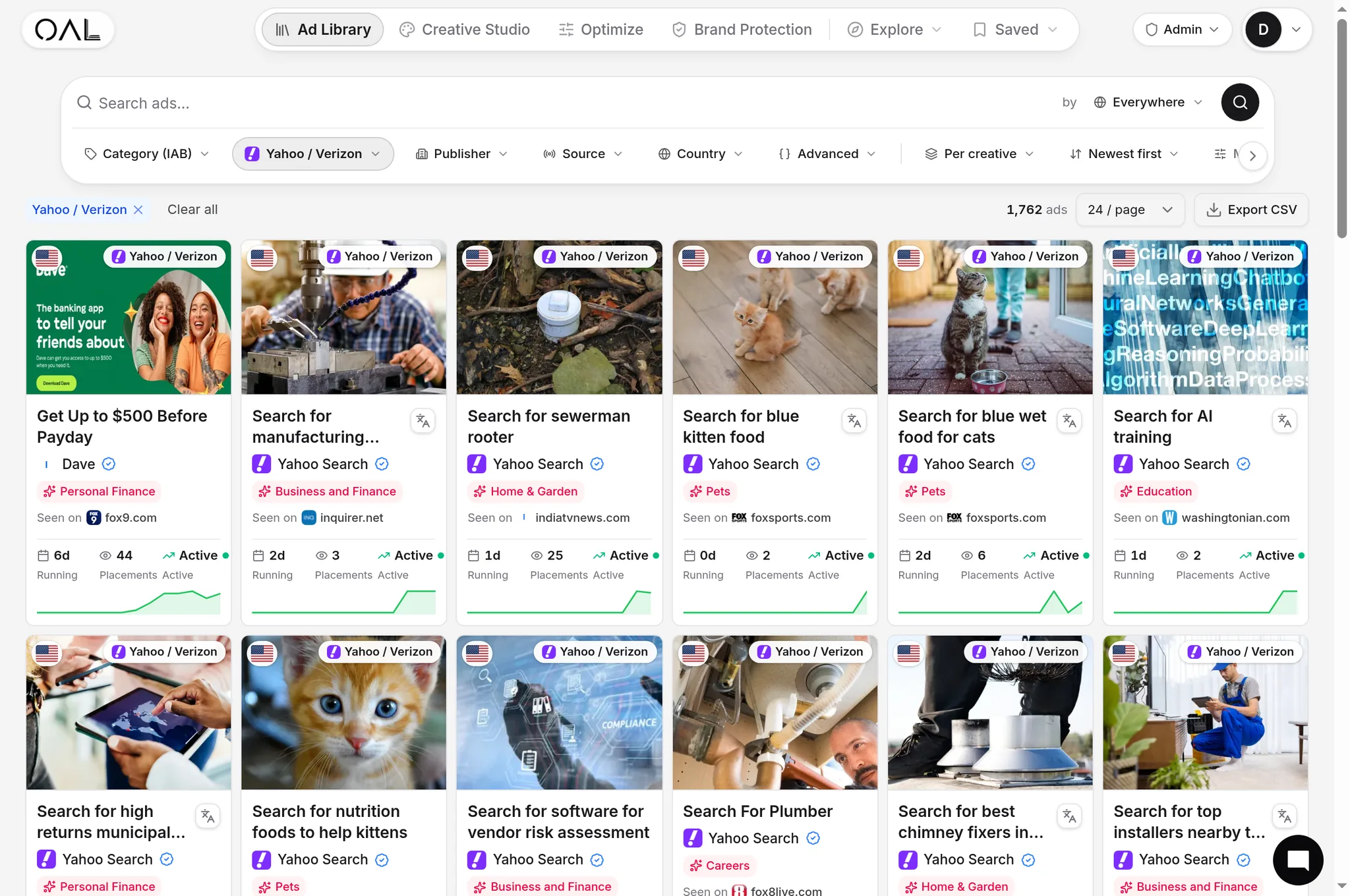
Yahoo Gemini was retired in 2023, and Yahoo native didn't die with it: demand moved to the Yahoo DSP and the supply is now run exclusively by Taboola, so here's the timeline and how to spy on live Yahoo creatives today.
Thirty real native ads captured live off Taboola, Outbrain and MGID in June 2026, each labeled with the actual advertiser, the network, and how long it has been running.
Yahoo Gemini is gone, but "Yahoo native" still trips up buyers: here is who really serves the ads in 2026, how to buy them, where MSN fits, and how to study live creatives.
A working media buyer's breakdown of how Taboola native ads actually run in 2026: the auction, the widget, CPC pricing, and the tracker chain behind every click, shown with live creatives we captured instead of vendor mockups.
Native ads hide in plain sight at the bottom of every article, and here is how to find who is really buying them, read the creative and supply chain behind each placement, and trace the click to the landing page without ever firing a live ad.

Adbeat and Anstrex both get called "ad spy tools," but one maps enterprise display spend and the other rips native landers for affiliates; here's the honest head-to-head, plus where an open native-first index changes the math.

A practitioner's head-to-head on AdPlexity, Anstrex, SpyOver and OpenAdLibrary, judged on price, network coverage, geos, landing-page capture, history and the supply-chain data each one actually exposes.

"Free native ad spy tool" gets searched far more than it gets answered honestly, so here is what is genuinely free for researching Taboola, Outbrain, MGID and Revcontent ads, and exactly where the limits bite.

A native ad spy tool turns the scattered, public-but-invisible world of Taboola and Outbrain into a searchable record: the real creative, the advertiser behind it, and the landing page the click actually leads to.

A practitioner's read on native advertising in 2026, built from 589,000+ live-captured creatives: who is advertising, which verticals dominate, and what ad longevity really tells you about the winners.
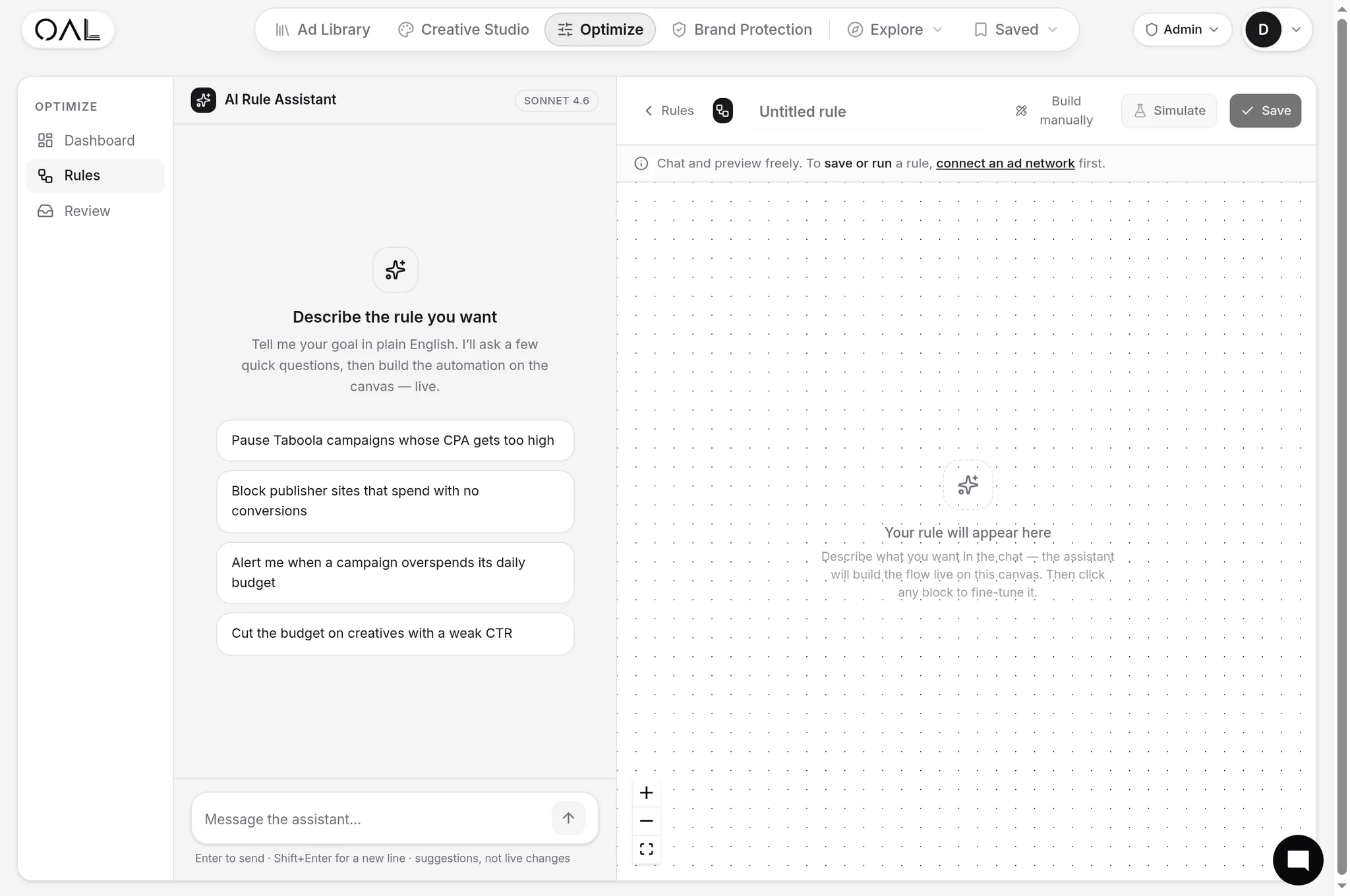
A practitioner's playbook for running native profitably as an affiliate in 2026: offer selection, creative angles, pre-landers, the test loop, and using live competitor ads to find proven winners and new geos.

We ranked the major native ad networks by the only metric that predicts where your money goes: how many live ads each one is actually running right now, pulled straight from OpenAdLibrary's index of 589,000+ captured creatives.

Taboola is a leading native advertising network that serves content-recommendation widgets across thousands of publisher sites worldwide.