Español
 Português (Brasil)
 Français
 Deutsch
 Italiano
 Nederlands
 Polski
 Svenska
 Türkçe
 Русский
 日本語
日本語 한국어
한국어 简体中文
简体中文 Tiếng Việt
 Bahasa Indonesia
 繁體中文
繁體中文 Čeština
 Dansk
Dansk Norsk (bokmål)
 Suomi
Suomi Ελληνικά
 Română
 Magyar
 Українська
 ไทย
ไทย हिन्दी
 العربية
 עברית
עבריתNegotiating Taboola & Outbrain Deals: Guarantees & Rev Share
Rev share, CPM guarantees and account support are all negotiable with Taboola and Outbrain, but only if you have real volume. Here's how the leverage works.


Publishers with meaningful traffic volume can negotiate better terms with Taboola and Outbrain, including higher revenue share, CPM or RPM guarantees, and dedicated account support, but the leverage exists almost entirely at the mid-to-large end of the traffic spectrum. A site doing a few thousand daily pageviews has essentially none; a site doing millions has real room to push.
What's actually negotiable#
The self-serve terms most small publishers see are a starting point, not a fixed price. What experienced publisher-development teams at both networks will discuss with larger partners:
- Revenue share percentage: the default split skews toward the network; larger volume commitments can move this
- CPM or RPM floors/guarantees: a minimum payout regardless of fill, in exchange for exclusivity or a volume commitment
- Payment terms: net-30 is standard, but faster payment cycles are sometimes available for established partners
- Dedicated account management: a named contact instead of a support ticket queue, which matters enormously when something breaks
- Early access to new formats and placements: testing new ad units before general rollout, which can be worth real money if the format performs
- Category and demand-quality commitments: informal agreements around avoiding certain low-tier demand tiers on your specific inventory
None of this is published or standardized. It is a direct negotiation, and the network's default posture is to hold the line unless you demonstrate leverage.
Where your leverage actually comes from#
Three things move a negotiation, and none of them is "asking nicely":
- Traffic volume: this is the primary lever. Networks compete hardest for publishers who move the needle on their own supply-side numbers.
- Traffic quality: US and UK desktop traffic in high-value verticals (finance, health, home improvement) is worth defending more aggressively than international mobile traffic in lower-value categories.
- Credible alternative demand: if you can genuinely run Outbrain or Taboola as a real alternative, and the network knows it, that changes the conversation. A publisher who's clearly locked in with no real switching cost has no negotiating position at all.
If you don't have real volume yet, the honest move is to grow it first and revisit terms at a scale threshold, rather than spending time negotiating from a position with no leverage.
How to actually run the conversation#
Before you contact your account manager (or request one, if you don't have a named contact yet):
- Pull your own numbers first: sessions, RPM trend over the last 6 to 12 months, and how your traffic mix breaks down by geo and device. Networks respond to specifics, not "I think we deserve more."
- Benchmark against comparable publishers if you can: exact numbers rarely get shared publicly, but directional context (whether your RPM trend looks healthy or is lagging) strengthens your position.
- Ask for a specific ask, not an open-ended one: "we'd like to discuss a revenue share increase given our volume growth" gets further than "can we get a better deal."
- Time it around a real event: a traffic milestone, a competing network approaching you with better terms, or a contract renewal date all create natural negotiation windows.
- Get the terms in writing: verbal commitments from an account manager who later leaves the company are worth nothing without documentation.
The Outbrain-Teads factor#
Outbrain merged with Teads in 2026, folding native placements into a combined Outbrain-Teads platform. If you're a publisher already running Outbrain inventory, this merger is itself a natural point to revisit terms: organizational changes like this often mean account teams are being reshuffled, which is exactly the kind of moment where a proactive conversation about your terms can land well, before you get automatically reassigned to a generic support queue. See our full breakdown of what changed after Outbrain became part of Teads.
What to watch for in guarantee structures#
If a network offers you a CPM or RPM floor in exchange for exclusivity, read the actual mechanics carefully:
- Is the guarantee per-session or an aggregate monthly minimum? These behave very differently if your traffic is seasonal.
- What triggers a rate review or termination of the guarantee? Some agreements let the network exit the guarantee if performance underdelivers, without a symmetrical clause protecting you.
- Does exclusivity apply to your whole site, or a specific section? A blanket exclusivity clause can lock you out of testing alternatives even in placements the guarantee doesn't actually cover.
A guarantee that reads generously in a sales conversation can turn out to be narrower once you read the contract clause by clause. Have anything non-standard reviewed before signing.
How OpenAdLibrary helps you walk in informed#
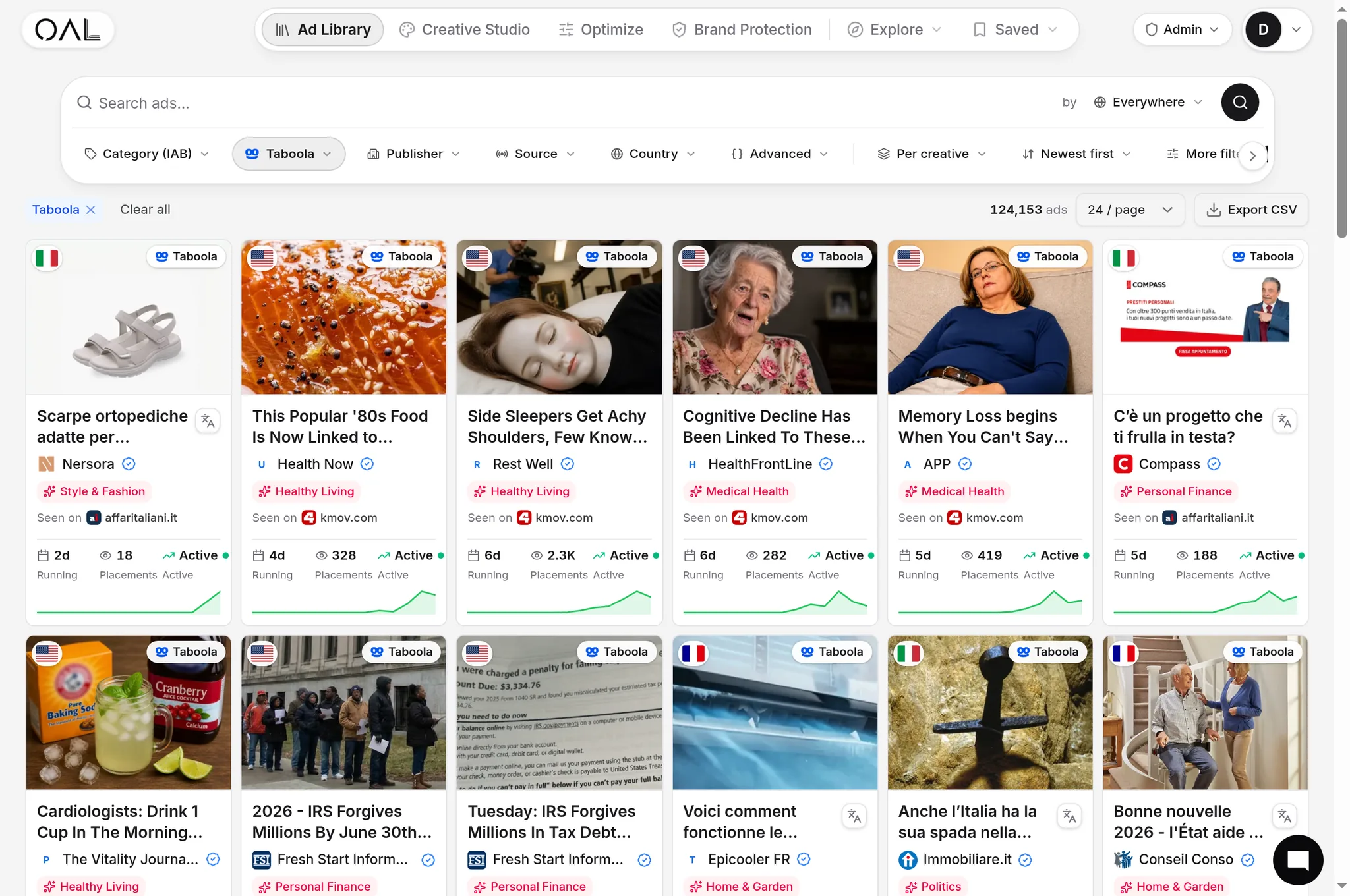
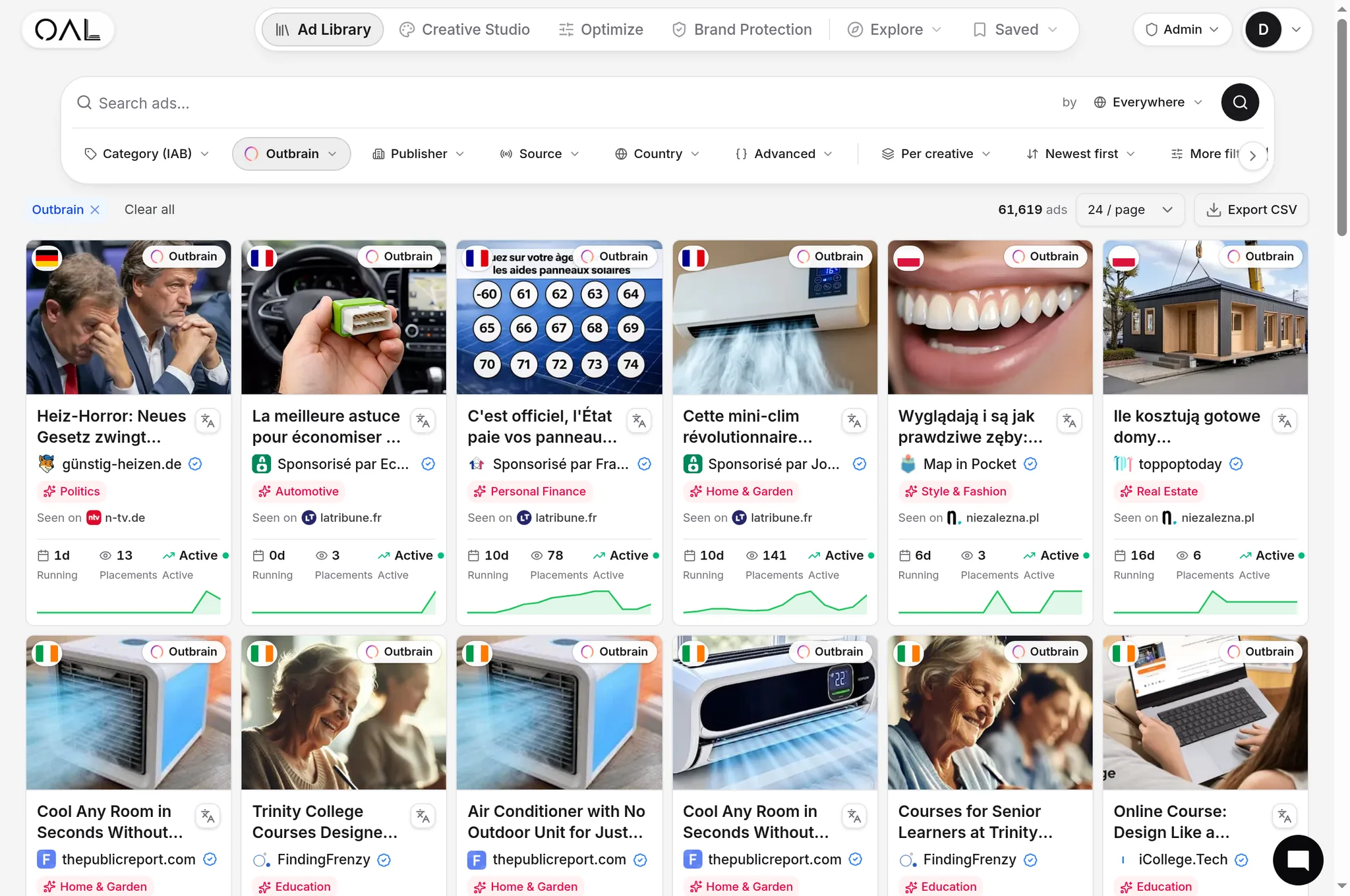
Part of negotiating well is knowing what demand actually looks like on a network before you commit to exclusivity or a volume-based term. OpenAdLibrary's Taboola and Outbrain tools let you see live advertiser activity, creative volume and vertical mix on each network, so you're not negotiating blind based only on what your account manager tells you. If your traffic sits heavily in finance or health, for instance, you can check how much active demand each network is actually running in those verticals right now, which is a more useful data point than a generic RPM promise.
What large publishers get that small ones don't#
There's a meaningful gap between what a mid-size publisher can access and what the largest partners on either network get, and understanding the difference helps calibrate expectations. Large publishers, typically those contributing significant volume relative to a network's total supply, tend to get a genuinely named account team rather than a rotating support contact, input into upcoming ad format testing, and enough weight in the relationship that a rate conversation gets a serious hearing rather than a form response.
Mid-size publishers usually get a responsive but less senior account contact, access to standard (not bespoke) guarantee programs if they qualify by volume, and negotiating room on rev share that's real but bounded. Smaller publishers are mostly on self-serve terms with limited room to negotiate anything beyond basic support responsiveness. None of these tiers are officially published; they're inferred from how account teams are typically staffed and how negotiating conversations tend to unfold at each level, and your specific experience can vary.
Common negotiation mistakes#
A few patterns tend to weaken a publisher's position before the conversation even starts:
- Leading with dissatisfaction instead of data. "Your RPM has been disappointing lately" is a weaker opener than a specific trend chart showing your traffic growth outpacing your revenue growth over a defined period.
- Not knowing your own traffic quality story. If your geo or device mix shifted (more US desktop, say), that's a concrete reason rates should improve; failing to surface it means the network has no reason to move.
- Threatening to leave without a credible alternative in place. Account teams can usually tell the difference between a publisher who has genuinely tested Outbrain as a real option and one who's bluffing.
- Accepting a verbal promise without a documented follow-up. Account managers change roles or leave; anything agreed needs to survive that turnover in writing, ideally in an actual contract amendment or email confirmation you can point back to.
- Negotiating too early. Approaching a network for better terms before you have a meaningful volume or growth story to point to usually just burns the relationship's goodwill for a future conversation that would have landed better with real leverage behind it.
How often should you revisit terms#
There's no fixed cadence, but sensible trigger points include: a sustained period of meaningful traffic growth (not a single good month), a major shift in your traffic quality (new geo expansion, a successful push into a higher-value vertical), a structural change at the network itself (like the Outbrain-Teads merger), or an approaching contract renewal date if you have one. Revisiting terms too frequently without a real change in your leverage tends to just signal impatience rather than strengthen your position.
The bottom line#
Rev-share negotiation is real but scale-gated. Below a meaningful traffic threshold, spend your energy growing volume and traffic quality instead. Above it, come prepared with your own numbers, a specific ask, and a credible sense of your alternatives, and treat any guarantee structure as a contract to read carefully, not a headline number to take at face value.