Español
 Português (Brasil)
 Français
 Deutsch
 Italiano
 Nederlands
 Polski
 Svenska
 Türkçe
 Русский
 日本語
日本語 한국어
한국어 简体中文
简体中文 Tiếng Việt
 Bahasa Indonesia
 繁體中文
繁體中文 Čeština
 Dansk
Dansk Norsk (bokmål)
 Suomi
Suomi Ελληνικά
 Română
 Magyar
 Українська
 ไทย
ไทย हिन्दी
 العربية
 עברית
עבריתWhy Taboola Ads Look So Spammy (An Inside Look at the Auction)
Taboola ads look spammy for structural reasons: the auction rewards clicks over polish, and the marketplace mixes premium brands with thin-margin resellers in the same feed.


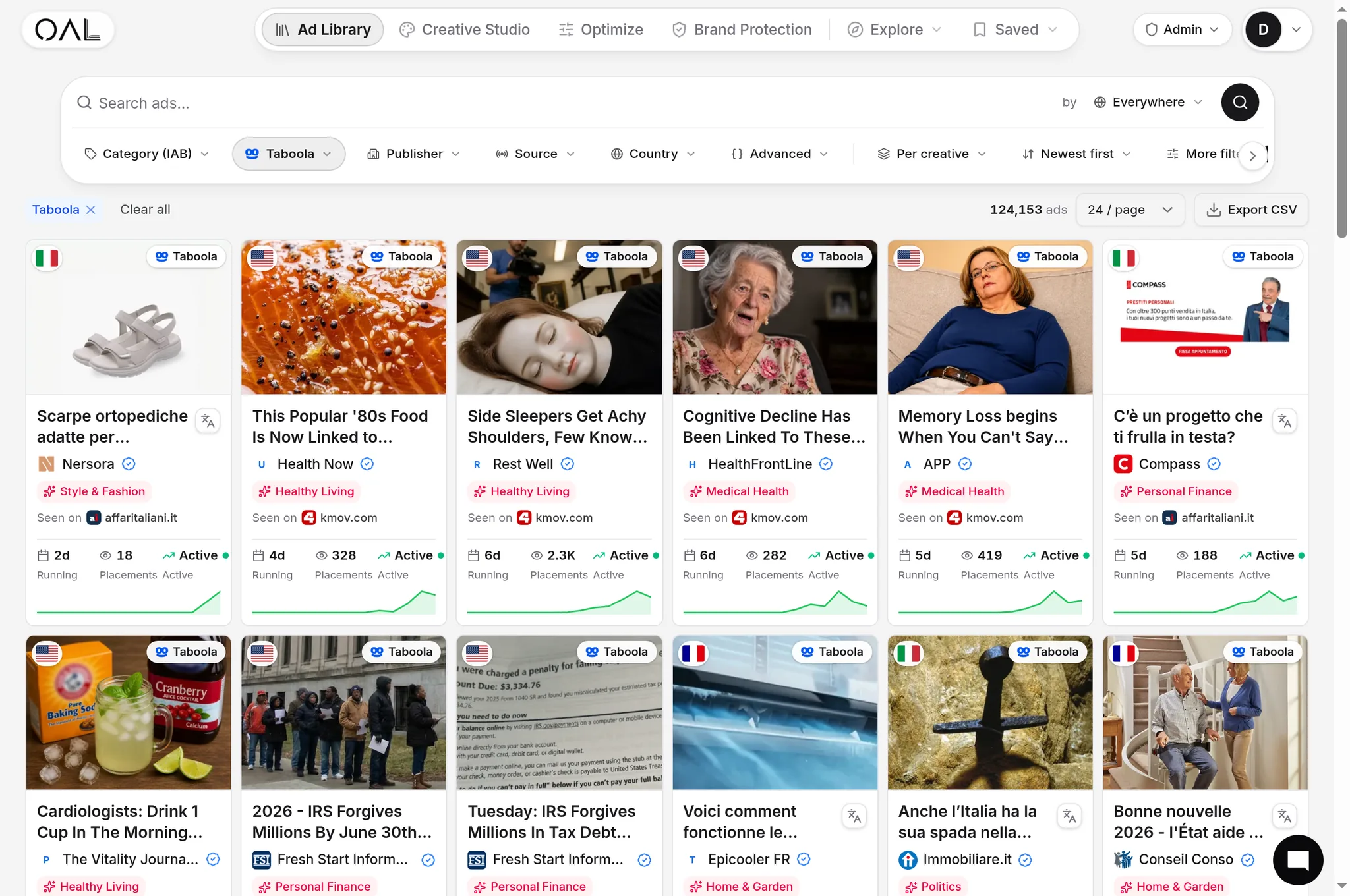
Taboola ads look spammy because the auction rewards predicted click-through rate times bid, not editorial quality, and clickbait headlines reliably win more clicks per impression than measured ones. Add a marketplace with tens of thousands of advertisers of wildly different quality, resold inventory that passes through several layers before it reaches a publisher, and content policy enforcement that's largely automated and uneven across geos, and you get a feed where a Georgetown University ad can sit right next to "Doctors Are Stunned by This One Household Item."
The auction doesn't care what the ad looks like, only what it earns#
Taboola runs a real-time auction across a widget's available slots, and the winning bid is effectively a function of your CPC bid multiplied by the platform's prediction of how likely that specific creative is to get clicked in that specific placement. A tame, honest headline about a legitimate product often has a lower predicted CTR than an exaggerated, curiosity-driven one, because curiosity gap headlines are, mechanically, better at generating clicks. That means a genuinely lower-quality or more sensational ad can out-earn a higher-quality one in the same auction, purely because it wins more clicks per impression, which is exactly what the publisher is being paid for. The publisher's revenue per mille goes up regardless of whether the ad looks tasteful, and the algorithm is optimizing for publisher revenue and advertiser results, not brand perception.
The marketplace is genuinely mixed quality by design#
Taboola's advertiser base spans everything from Fortune 500 brands running direct-buy premium campaigns to small performance advertisers and resellers running thin-margin arbitrage offers. That's not an accident or a failure of the platform; it's the underlying business model of an open marketplace that needs enough advertiser demand and enough bid density to fill a huge volume of publisher inventory. The native ad supply chain often includes resold inventory passed through demand partners rather than sold direct, which adds layers between the original advertiser and the final placement, and makes consistent quality control across every single ad harder to enforce at scale.
Policy enforcement is mostly automated, and automation misses things#
With millions of creatives cycling through the system, human review of every single ad isn't practical, so a large share of policy enforcement runs on automated classifiers looking for known patterns: banned claim language, prohibited imagery, disallowed categories. Automated systems catch the obvious cases well and miss subtler ones, particularly headlines that are technically true but framed misleadingly, or images that are suggestive without crossing an explicit line. Enforcement also isn't perfectly consistent across every geo and publisher tier, since lower-tier, made-for-advertising sites often have thinner review relationships and more incentive to accept whatever fills the slot, compared with premium publishers who negotiate stricter content standards directly.
Why the same widget can show both extremes#
It's genuinely normal to see a Flight Centre travel deal, a Georgetown University program ad, and a "This Household Item Ends Knee Pain" creative in the same content-recommendation feed, because they're often served through the same underlying auction infrastructure even though they represent completely different advertiser tiers and campaign types. Premium brand advertisers frequently buy through more curated placement options (particular publisher tiers, specific verticals, brand-safety categories) while performance and arbitrage advertisers tend to run broader, cheaper reach that touches more of the lower-tier inventory. From a single reader's perspective scrolling one page, all of it just looks like "Taboola," even though the buying strategies and quality bars behind each ad are quite different.
| Perception | What's actually driving it |
|---|---|
| "The headlines are all clickbait" | Curiosity-gap headlines mechanically win more clicks, so the auction favors them |
| "Every ad looks like a scam" | Marketplace spans premium direct-buys to thin-margin resellers, both visible in the same feed |
| "Nothing gets moderated" | Automated review catches obvious violations, misses subtler misleading framing |
| "The same ad follows me everywhere" | Retargeting and broad-reach performance campaigns concentrate impressions on active users |
| "Quality varies wildly by site" | Publisher tiers negotiate different content standards; lower tiers accept broader inventory |
What advertisers can actually control#
Advertisers who want to avoid ending up next to the worst of the marketplace do have real levers: publisher whitelist/blacklist targeting to exclude lower-tier or made-for-advertising sites, section- and category-level targeting to stay within specific editorial contexts, and working directly with account teams on brand-safety category exclusions. None of this changes the auction's underlying incentive structure, but it does let an advertiser opt out of the widest, cheapest reach in favor of a curated slice of the same network. Our guide on how Taboola ads work covers the placement and targeting controls in more depth, and who advertises on Taboola breaks down the actual advertiser mix by vertical, which is a useful reality check against the "it's all junk" impression a quick scroll can leave.
Is it actually a fraud problem, or a taste problem?#
It's worth separating two different complaints that both get labeled "spammy." One is aesthetic: exaggerated, curiosity-driven headlines that are technically accurate but framed for maximum clicks. The other is a real compliance problem: outright false claims, ad cloaking, or ad fraud dressed up in native format. The first is a byproduct of the auction's incentives and isn't going away as long as clicks are the currency. The second is genuinely against every major network's policy and is worth documenting and reporting when you see it, both for your own brand-safety research and because repeated reports are part of how networks tighten enforcement over time.
How to see the actual mix instead of guessing from a scroll#
Casually scrolling a feed gives you a skewed sample, since you're seeing whatever the algorithm decided to serve you specifically, at that moment, based on your own browsing profile. Looking at the actual advertiser and vertical distribution across a large captured sample tells a different, more balanced story than "every Taboola ad is spam." Across the OpenAdLibrary index, health, finance, and insurance verticals carry the largest volume of Taboola creatives, but ecommerce, software, and home and garden are close behind, and plenty of that volume is unremarkable, straightforwardly branded advertising that just doesn't stand out the way a sensational headline does.
If you want to check what's actually running before assuming a category is dominated by junk, OpenAdLibrary's Taboola ad spy tool lets you search by advertiser, vertical, and geo directly, rather than relying on whatever your own feed happens to surface.
The vertical concentration makes the pattern worse, not better#
Health, finance, and insurance dominate native ad volume across every major network, and those are exactly the categories where the gap between a legitimate offer and an exaggerated one is hardest for a casual reader to judge. A supplement claim, a "hidden government benefit," or a device that "doctors don't want you to know about" all use the same narrative structure whether the underlying offer is a real, compliant product or something considerably shadier. Because these verticals also happen to be the ones with the strongest performance-marketing economics (high margins, straightforward affiliate payouts, broad appeal to older demographics with disposable income), they naturally attract the largest volume of both legitimate advertisers and the most aggressive performance marketers, concentrated in the same content categories. That concentration is a big part of why the "spammy" impression feels strongest specifically in those verticals rather than being spread evenly across everything Taboola serves.
The bottom line#
Taboola ads look spammy because the auction is built to reward click-worthiness and advertiser bid, not brand polish, and because the marketplace genuinely contains everything from premium direct-buys to thin arbitrage plays running side by side. That's a structural feature of an open, high-volume ad marketplace, not evidence that the whole network is a scam. The advertisers who care about company they keep have real targeting tools to opt out of the roughest inventory; most just haven't bothered, because it converts fine either way.