 Español
 Português (Brasil)
 Français
 Deutsch
 Italiano
 Nederlands
 Polski
 Svenska
 Türkçe
 Русский
 日本語
日本語 한국어
한국어 简体中文
简体中文 Tiếng Việt
 Bahasa Indonesia
 繁體中文
繁體中文 Čeština
 Dansk
Dansk Suomi
Suomi Ελληνικά
 Română
 Magyar
 Українська
 ไทย
ไทย हिन्दी
 العربية
 עברית
עבריתTaboola Account Suspended: Causes, Appeals, Prevention
The most common reasons a Taboola account gets suspended, how to write an appeal that actually gets reviewed, and the prevention checklist for your next campaign.


Taboola accounts typically get suspended for one of a handful of reasons: policy violations in the creative or landing page (misleading claims, prohibited categories), a landing page that doesn't match what the ad promised, payment or billing problems, or account-level trust signals like using multiple accounts to evade a previous suspension. Most suspensions come with a stated reason inside the account or by email, so start there before assuming the worst.
This covers the common causes in more detail, what an appeal actually involves, and how to structure a new campaign so it doesn't happen again.
The most common causes#
Landing page mismatch. The single most common trigger is a gap between what the headline and image promise and what the landing page actually delivers. If your ad implies a free offer and the landing page immediately asks for a credit card, or the ad shows one product and the page sells something else, that's a policy violation regardless of how you intended it.
Prohibited or restricted categories. Certain verticals (some financial products, weight-loss claims, cryptocurrency in some geos, adult-adjacent content) carry tighter restrictions or outright bans depending on region. Running in a restricted category without the required disclosures or without qualifying for that category at all is a fast route to suspension.
Misleading or unsubstantiated claims. Health and finance ads carry the highest scrutiny because they carry the highest consumer-harm risk. A claim like "cures" or a guaranteed financial return without the appropriate disclaimers routinely gets flagged. Our FTC disclosure rules for advertorials and native ads covers where the legal line sits, separate from Taboola's own policy line, which is often stricter.
Cloaking or showing reviewers a different page than real users see. Serving a compliant-looking landing page to Taboola's review systems while real traffic lands somewhere else is one of the more serious violations, since it's treated as deliberate evasion rather than a mistake. See our explainer on ad cloaking for how this gets detected from the outside.
Payment issues. A declined card, an expired payment method, or a chargeback dispute can trigger an account hold or suspension separate from any content issue. This is usually the easiest to resolve, since it's an account-admin fix rather than a policy dispute.
Multiple accounts or account-sharing. Running several accounts to spread risk, or operating an account under someone else's name after a prior suspension, is treated as a trust violation on its own, independent of what the ads themselves say.
What to do when it happens#
- Read the suspension notice carefully. The stated reason, even if brief, tells you which of the above categories you're dealing with, which determines whether this is a fast fix (payment) or requires a real appeal (policy).
- Audit your landing page against your ad, not just against your own opinion of it. Look at the exact headline, image and any implied claim, then check whether the landing page delivers that specific thing within the first screen a reader sees.
- Don't immediately spin up a new account. Opening a second account to route around a suspension is itself a policy violation and tends to get both accounts permanently banned once detected, rather than solving the original problem.
- Submit an appeal with specifics, not a general objection. An appeal that says "I disagree" gets nowhere. An appeal that says "here is the specific claim you flagged, here is the disclosure language we've added, here is the updated landing page" gives a reviewer something concrete to reconsider.
- Fix the root cause before requesting reinstatement, not after. Reviewers can generally see whether the flagged issue has actually been addressed versus whether you're just asking for the suspension to be lifted with nothing changed.
How to prevent it happening again#
- Match ad and landing page intent exactly, every time, not just for your first few campaigns. This is the single highest-frequency cause, and it's entirely within your control.
- Keep disclosure language current for regulated verticals. Requirements shift, and what passed review six months ago in health or finance creative might not clear today.
- Don't run identical creative across multiple accounts or reuse a landing page domain that was previously flagged, even for a different, compliant campaign.
- Keep payment methods current and respond to any billing notice immediately rather than letting an account drift into a payment hold.
- Review your own funnel periodically the way a compliance reviewer would, not just the way a media buyer optimizing CTR would. The two perspectives catch different problems.
Suspension severity isn't all the same#
Not every suspension is equal, and treating them all the same wastes time. A payment hold is typically the fastest to resolve, often just a matter of updating a card and the account resumes serving on its own. A single flagged creative or landing page issue on an otherwise clean account usually results in that specific campaign being paused rather than the whole account going dark, and often just requires a fix and resubmission. A full account suspension for a pattern of violations, or for something serious like cloaking, is the hardest to reverse and the one where a vague appeal is least likely to work.
Knowing which category you're in changes your response. Don't write a lengthy policy appeal for what's actually a billing issue, and don't expect a quick reinstatement for something that reads, from the reviewer's side, as a deliberate pattern rather than a one-off mistake.
Working with an account manager if you have one#
If your spend level qualifies you for a dedicated Taboola account manager, loop them in as soon as a suspension happens rather than only after a self-service appeal has already failed. An account manager often has visibility into the specific internal flag that triggered the review and can tell you faster than a generic support queue whether this is a fixable content issue or something more serious. This channel isn't available to every advertiser, so if you're spending at a level where it should be, make sure you actually have a named contact rather than assuming you do.
Documenting compliance before you need it#
The advertisers who recover fastest from a suspension are usually the ones who already had documentation ready: the specific disclosure language used, screenshots of the landing page at the time the ad was live, and a record of what claims the creative actually made. Assembling this after the fact, once a page may have already changed or a campaign has been paused for a while, is much harder than having it on hand from the start.
A simple habit that pays off here: whenever you launch a new campaign in a regulated vertical, save a dated screenshot of both the ad creative and the landing page together. If a suspension happens weeks later, you have an immediate, verifiable record of exactly what was live at the time, rather than relying on memory or a possibly-changed live page.
When it's time to move on#
Occasionally the right response to a suspension isn't an appeal at all, it's recognizing that the specific angle or vertical you were running genuinely doesn't fit the network's policies, no matter how you adjust the copy. Pushing the same borderline claim through repeated appeals, each time with slightly softened language, tends to escalate scrutiny on the account rather than resolve it. If a category is consistently flagged across multiple attempts, that's a signal to either restructure the offer more substantially or consider whether a different channel entirely is a better fit for that specific product. Our comparison of native ads vs Facebook ads for DTC is a useful starting point if you're weighing whether to shift a flagged vertical to a different channel.
How OpenAdLibrary helps#
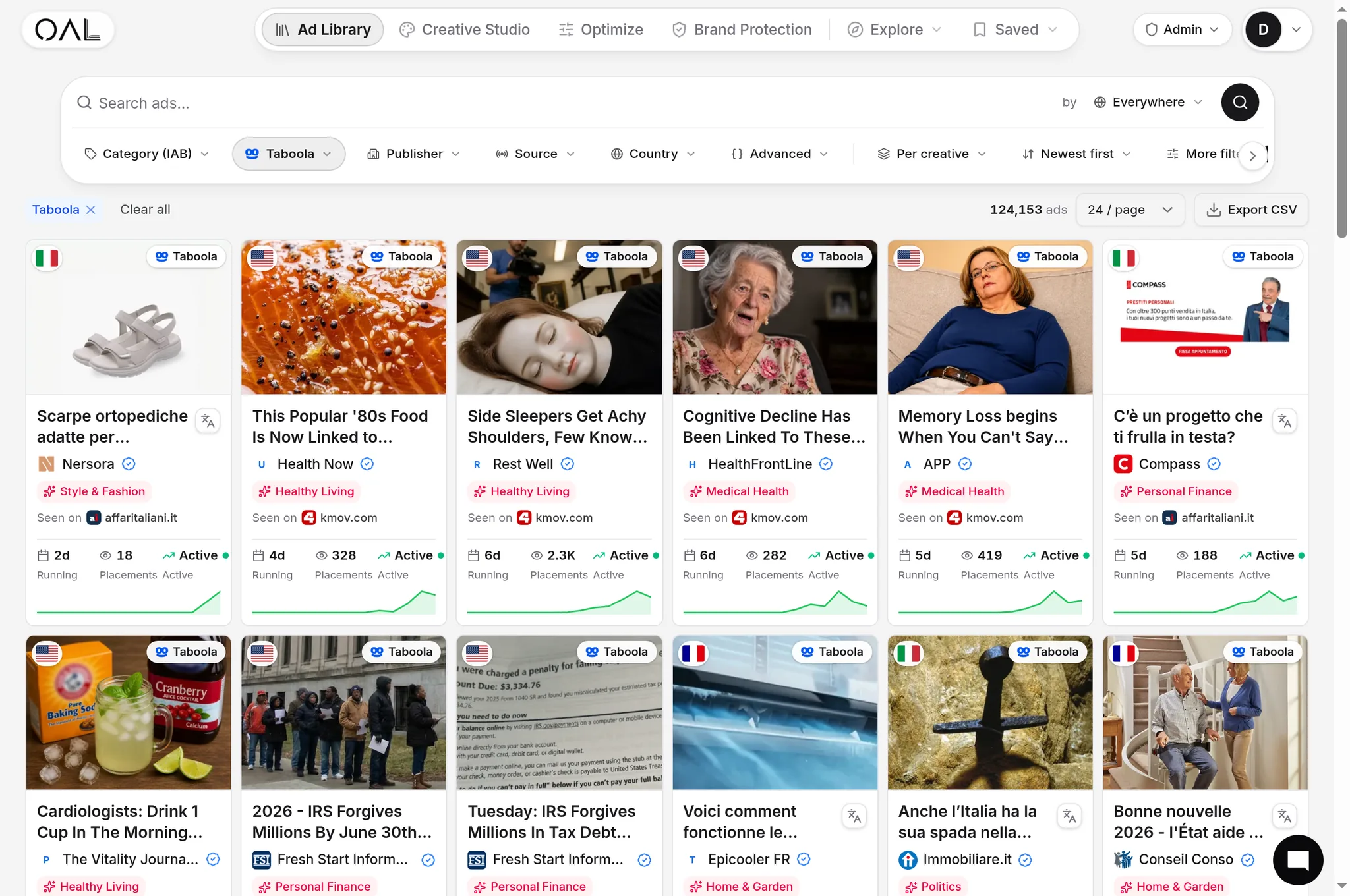
If you're rebuilding a campaign after a suspension, it helps to see what's currently running and staying live in your vertical, since a creative and landing page combination that's survived weeks of continuous observation has, by definition, cleared ongoing scrutiny. The Taboola ad spy tool shows live creative with observed run length by vertical and geo, which is a useful sanity check against your own new campaign before you relaunch. For the platform setup basics, see How to Advertise on Taboola.
FAQ#
Frequently asked questions about a suspended Taboola account.