Español
 Português (Brasil)
 Français
 Deutsch
 Italiano
 Nederlands
 Polski
 Svenska
 Türkçe
 Русский
 日本語
日本語 한국어
한국어 简体中文
简体中文 Tiếng Việt
 Bahasa Indonesia
 繁體中文
繁體中文 Čeština
 Dansk
Dansk Norsk (bokmål)
 Suomi
Suomi Ελληνικά
 Română
 Magyar
 Українська
 ไทย
ไทย हिन्दी
 العربية
 עברית
עבריתTaboola Headline Best Practices: Limits, Formulas, Examples
Character limits, five headline formulas pulled from real long-running Taboola creative, and how to test angles without writing clickbait that bounces on the landing page.


A Taboola headline that works does one job: it makes a reader curious enough to interrupt scrolling, without over-promising so badly that the click bounces off the landing page. Keep headlines under roughly 60-70 characters so they don't truncate in the widget, lead with a concrete detail rather than a vague claim, and test at least three angles per image rather than one headline you're sure about.
That's the short version. The rest of this covers the actual character limits, the formulas that keep showing up in high-longevity ads across our index, and real examples pulled from live Taboola creative.
Character limits and truncation#
Taboola headlines get cut off past a certain length depending on the placement, and a headline that gets truncated mid-word looks sloppy and can change the meaning entirely. As a working rule, write for 70 characters or fewer and read the truncated version back to yourself, since some placements will cut earlier than others. If the first 50 characters alone don't make sense or don't carry the hook, the headline is too dependent on its back half.
Front-load the interesting part. "Discover a Device Transforming Lives for People Who Struggle to Hear Clearly" buries the hook; "Struggling to Hear Clearly? Discover a Device Transforming Lives" leads with the problem, which is closer to how this actually ran and survived 37 days in our index. The lesson isn't the specific wording, it's the ordering: problem or curiosity first, resolution second.
Formulas that keep showing up in surviving ads#
Across the health, finance and insurance verticals that dominate Taboola volume in our index (11,982, 8,200 and 7,422 live creatives respectively), a handful of headline structures recur far more often than random chance would explain:
- The specific-number claim. "Inside television star's $9.1 million payday" works because the number is oddly specific rather than round, which reads as reported fact rather than marketing copy.
- The direct question. "Struggling to Hear Clearly? Discover a Device Transforming Lives" opens with a question the reader can answer yes or no to internally before they've even clicked.
- The listicle framing. "Top 5 Shampoos To Avoid" borrows the structure readers already trust from editorial content, which is exactly why native widgets sit next to real articles in the first place.
- The unexpected-timeframe hook. "Granny Pods in 2026: Options That May Surprise You" pairs a mildly unusual topic with a forward-looking year to signal freshness rather than a stale, recycled ad.
- The understated observation. "A bra that not only lifts but also improves your posture." reads almost like a product review sentence rather than sales copy, which is part of why it doesn't trigger the reader's ad-blindness reflex.
None of these are tricks unique to one advertiser; they're patterns that recur because native feeds sit inside editorial content, and headlines that read like editorial content get more clicks than headlines that read like ads. Our native ad headlines piece goes deeper on the formula side if you want more variations to test.
Curiosity without the compliance problem#
There's a line between curiosity and misleading, and it matters both for approval and for downstream conversion. A headline that promises something the landing page doesn't deliver gets you a high click-through rate and a terrible conversion rate, plus review flags. The difference between "Discover a Device Transforming Lives" (curiosity, vague enough to be true for many products) and a headline claiming a specific unverified cure is the difference between a normal ad and one that gets pulled. If you're writing in a regulated vertical like health, insurance or finance, read our FTC disclosure rules for advertorials and native ads before you finalize copy, not after.
How many headlines to test per image#
One image, three to five headline variants, is a reasonable starting split for a new campaign, since headline changes are cheap to test compared to new creative. Vary the angle, not just the wording, meaning don't test five ways of saying the same thing; test a question angle against a number angle against a listicle angle, and let the data tell you which structural approach your audience responds to before you optimize word choice within the winner.
Watch longevity, not just early click-through rate. A headline that spikes CTR in the first day and then dies fast is often clickbait that doesn't convert; a headline still running weeks later is one where the whole funnel, headline through landing page, actually works together. Our piece on ad longevity as a winning signal explains why this matters more than day-one metrics.
Common headline mistakes#
- Burying the hook past character 50. If the truncated version doesn't make sense on its own, rewrite it.
- Generic superlatives. "Amazing," "incredible," and "best ever" get filtered out by readers as ad language; specific, slightly odd details read as more credible.
- One headline per image forever. Native creative fatigues. A headline that worked for two weeks straight will eventually decay even with the same image; refreshing the headline is often cheaper than reshooting the creative.
- Ignoring the vertical's norms. A finance headline that reads like a health headline (or vice versa) often underperforms because readers pattern-match the feed's content mix before they even register the specific claim.
Matching tone to vertical#
The emotional register a headline should carry differs sharply by category, and using the wrong one is a subtle way to underperform without any obvious mistake. Health and beauty headlines in our index skew toward personal, slightly conspiratorial framing ("doctors won't tell you," "the trick nobody talks about"), which works because readers in that context expect a personal-discovery angle. Finance and insurance headlines skew more toward practical urgency (rate changes, eligibility windows, specific dollar amounts) rather than mystery, because readers evaluating a financial decision respond better to concrete stakes than to curiosity alone.
Copying a health-style curiosity hook into a finance headline, or vice versa, tends to underperform even when the individual words are fine, because the tone doesn't match what the reader unconsciously expects from that category of native placement. Skim a handful of live headlines in your exact vertical before writing your own; the pattern becomes obvious quickly once you've read twenty or thirty real examples back to back.
Localizing headlines across geos#
A headline formula that works in one English-speaking market doesn't always translate cleanly, and a literal translation into another language often loses the exact thing that made it work. Idioms, cultural reference points (a specific celebrity, a specific tax rule, a region-specific concern) rarely survive translation intact. If you're scaling a winning headline into a new geo, treat it as a rewrite guided by the same underlying angle rather than a direct translation job, and check that any specific claim (a dollar figure, an age bracket, a regulatory reference) is actually accurate and relevant in the new market. Our guide on scaling to new geos covers this in more depth if you're expanding a proven Tier-1 campaign into Tier-2 or Tier-3 markets.
Measuring headline performance beyond click-through rate#
Click-through rate tells you whether a headline stops the scroll, but it doesn't tell you whether the reader it attracted was the right reader. A headline can post a strong CTR by attracting curious clicks that have no real interest in the underlying offer, which shows up downstream as poor conversion rate and, on lead-gen funnels, low-quality leads. The more useful metric is longevity combined with conversion data together: a headline that's both still running weeks later and converting at an acceptable rate has passed a much higher bar than one that simply gets clicked a lot on day one.
If you're running the same image with multiple headline variants, compare not just which headline wins on CTR but which one, paired with your landing page, actually produces the outcome you're paying for. A headline that scores lower on CTR but higher on conversion rate is often the better long-term choice, even though it looks worse on the surface-level dashboard metric most reporting tools surface first.
How OpenAdLibrary helps#
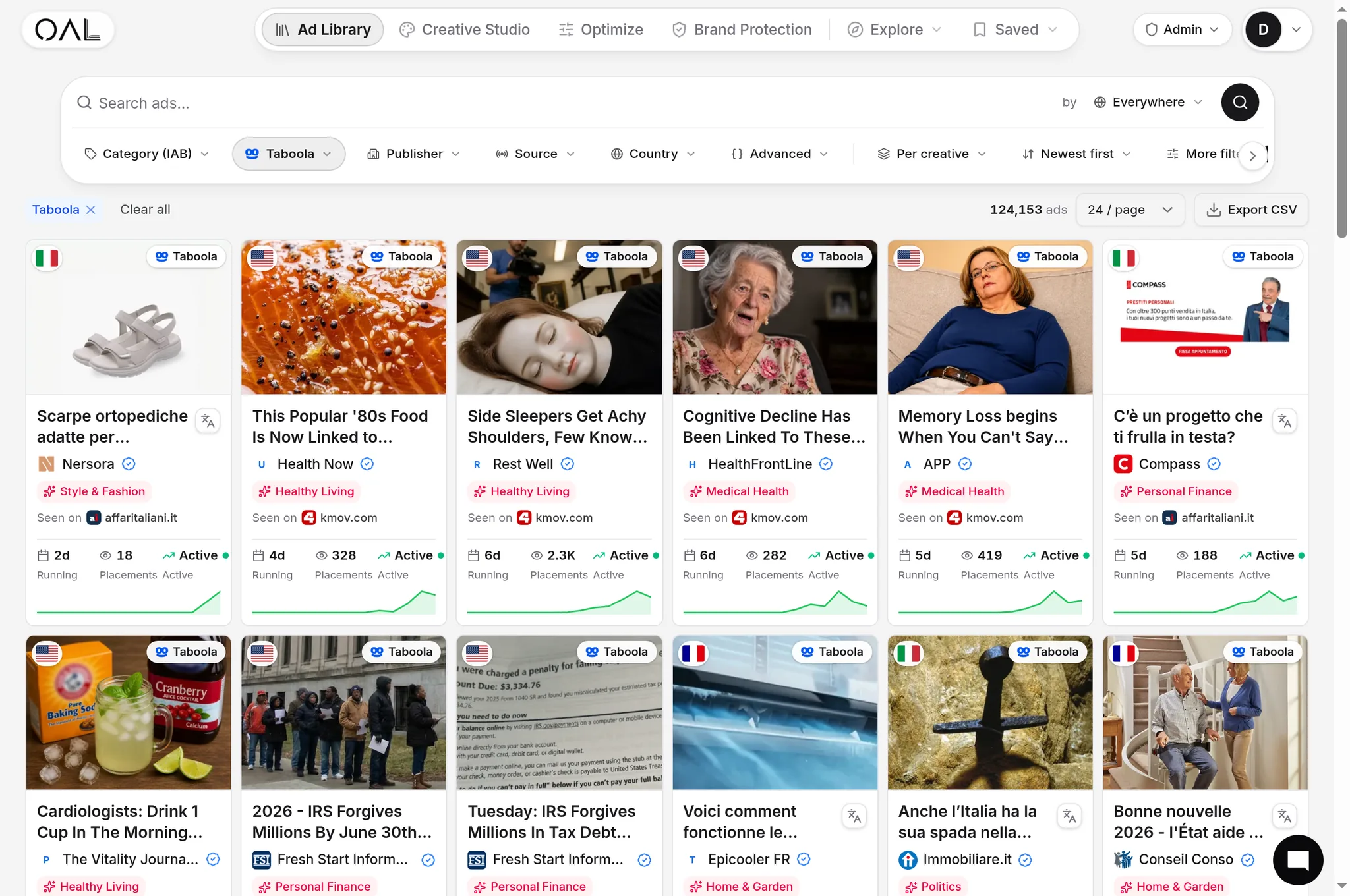
Reading headline advice in the abstract only gets you so far; seeing what's actually surviving in your vertical right now is more useful. The Taboola ad spy tool lets you filter live creative by vertical and geo, sorted by how long each one has been running, so you can build your own shortlist of proven headline structures instead of guessing from a formula list. Our broader guide on how to spy on competitor native ads covers the full research workflow if headlines are just one part of what you're studying.
FAQ#
Frequently asked questions about Taboola headline best practices.