 Español
 Português (Brasil)
 Français
 Deutsch
 Italiano
 Nederlands
 Polski
 Svenska
 Türkçe
 Русский
 日本語
日本語 한국어
한국어 简体中文
简体中文 Tiếng Việt
 Bahasa Indonesia
 繁體中文
繁體中文 Čeština
 Dansk
Dansk Norsk (bokmål)
 Suomi
Suomi Ελληνικά
 Română
 Magyar
 Українська
 ไทย
ไทย हिन्दी
 العربية
 עברית
עבריתThe Longest-Running Native Ads (And What Makes Them Evergreen)
An ad that keeps spending week after week is telling you something a one-off scrape never can: here is how to rank native ads by lifespan, why longevity is the cleanest profitability signal on the open web, and how to run the analysis yourself.


Most native ads are dead inside two weeks. A buyer ships fifteen creatives, the algorithm crowns a winner in 72 hours, the losers get paused, and even the winner usually fatigues out of rotation before the month is out. That churn is the default rhythm of the open web. So when you find one creative that has been live and spending for months, it is not noise. It is the cleanest profitability signal you can get without logging into the advertiser's account.
This study is about those outliers: how to find the longest-running native ads, how to rank them, and what their survival teaches you about building creative that lasts. We are not going to hand you a made-up leaderboard with invented run-times. Lifespan numbers only mean something when they come from continuous, dated observation. So instead you get the method, what the signals actually mean, and a workflow you can run yourself against live data.
One thing up front, because it matters for how you read everything below. Our index currently spans up to about 28 days of continuous observation per creative (OpenAdLibrary index, June 2026). That is the real observed ceiling in our data today, and it grows every day the crawler runs. When you see people quote "90-day" or "180-day" winners, that is general industry lore about what evergreen looks like, not a number we have personally clocked. We will keep the two clearly separate.
Why ad lifespan is the most honest metric in competitive research#
Lifespan is the number of days between the first time a creative was seen running and the last time it was seen live. An ad that survives is one a rational advertiser keeps choosing not to turn off. On performance networks, advertisers turn off anything that loses money, fast. That makes longevity a strong public proxy for profitability, far more reliable than impression estimates or modeled spend, which are guesses dressed up as data.
The logic is hard to argue with. Native traffic on Taboola, Outbrain, and MGID is bought on performance through a native ad auction: the advertiser pays per click and chases a cost-per-acquisition target. If a creative stops converting profitably, it gets paused within days, because every extra day costs real money. Persistence is revealed preference. The advertiser is voting with their budget, every single day the ad stays up.
A creative that has been live for three weeks has survived roughly three weeks of daily chances to be killed. Nobody keeps paying for an ad that loses money. Longevity is the market grading the creative for you.
This is why lifespan beats the metrics most spy tools lead with. Estimated spend and impression counts are modeled, extrapolated from thin sampling and presented with confidence they have not earned. First-seen and last-seen dates are observed facts: a tool either saw the ad on a given day or it did not. The honesty of the metric comes entirely from how often, and for how long, the underlying platform actually looks. We cover the broader measurement picture in The State of Native Advertising 2026, but lifespan is the single signal we trust most.
To put scale behind that: the longevity field sits on top of 5.4 million ad observations across 589,000+ captured creatives and 42 networks (OpenAdLibrary index, June 2026). Every one of those observations is a dated look at a real placement, which is exactly the raw material lifespan is built from.
How to measure native ad lifespan (the data you actually need)#
No ad network publishes competitor lifespan data. Meta's public ad library shows start dates for social ads, but the open native ecosystem, the native ad widgets at the bottom of news articles, has no equivalent built-in transparency. The EU's Digital Services Act now forces the largest platforms to keep public ad repositories with the dates an ad ran plus at least a year after, which is a real step. It also covers a narrow slice of platforms and skips the long tail of native networks where most performance buying happens.
To measure lifespan across the actual native ecosystem, you need a platform that does three things, continuously:
- Captures live native ads repeatedly over time. A one-off scrape gives you a snapshot, not a lifespan. You need a system that re-observes the same placements day after day, so a creative's presence (or absence) becomes a time series.
- Records a stable first-seen date and updates a last-seen date. The first sighting stamps first-seen. Every later capture refreshes last-seen. Lifespan is the gap. This needs reliable creative fingerprinting, so the same ad is recognized across captures instead of logged as brand new each time.
- Ties the creative to the real advertiser and landing page. Lifespan without context is trivia. The interesting question is who is running the survivor and what offer it points to, which means following the click to the landing page, not just storing a thumbnail.
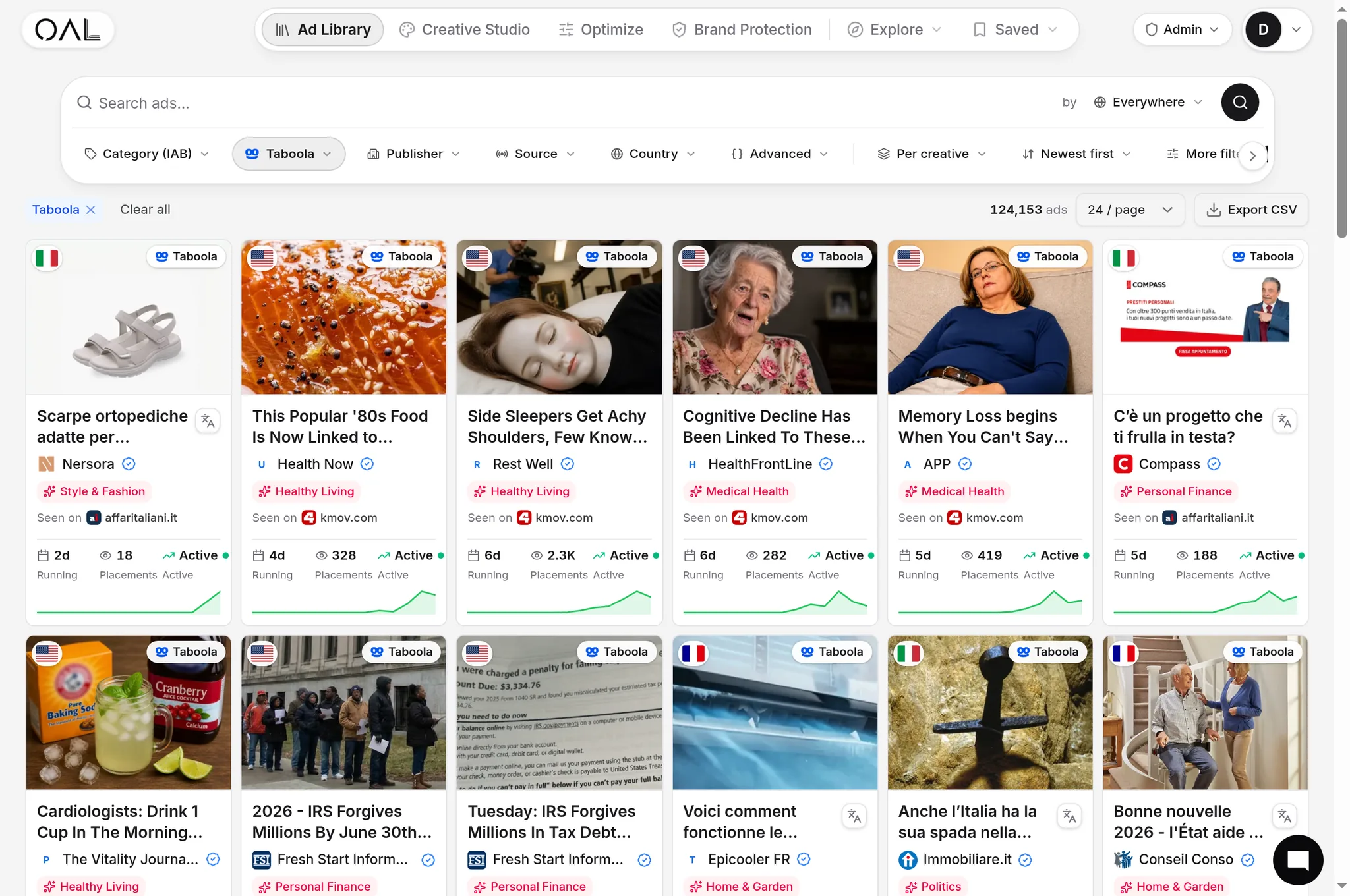
This is the gap OpenAdLibrary was built to fill. It captures live public native ads across Taboola, Outbrain, MGID, Revcontent, Teads, Yahoo, MSN and more, fingerprints each creative, and maintains first-seen/last-seen timestamps as it re-observes placements. Lifespan becomes a queryable, sortable field instead of something you reconstruct by hand. Because it also follows each ad's click through to the advertiser's landing page (without ever clicking the live ad), every long-running creative arrives attached to the offer and pre-lander that kept it alive.
Here is one near the top of our current run-time list. SmartAsset has held this finance creative live for 28 days straight on Outbrain, the longest end of our observed window:

A note on measurement caveats#
Be honest about the limits of any lifespan figure, ours included. A few things distort the number:
- Sampling gaps. If a platform misses a placement for a stretch, an ad can look like it "paused" and "restarted" when it never stopped. Denser capture narrows this error; sparse capture widens it. Treat lifespan as a high-quality estimate, not a stopwatch reading.
- Creative re-uploads. Advertisers sometimes refresh an ad ID while keeping the same image and headline. Good fingerprinting collapses those into one logical creative; weak matching inflates the count of "short" ads and hides true longevity.
- Geo and device scope. An ad running only in one country or on one device type looks shorter-lived to a crawler that does not capture from that geo or device. Lifespan is always lifespan-as-observed.
State these caveats and your analysis stays credible. Hide them and you are just modeling spend by another name.
What the longest-running native ads have in common#
Once you can sort a vertical by lifespan, the patterns show up fast. The survivors are rarely the flashiest creatives. They are the most structurally durable. Across the verticals we monitor, the long-runners share a recognizable set of traits.
| Trait | Why it extends lifespan | What fatigues quickly instead |
|---|---|---|
| Curiosity-gap headline, no hard claim | Avoids a specific promise that gets stale or trips compliance | Dated price points ("$1.99 today") and time-bound claims |
| Evergreen offer (insurance, supplements, finance education) | Demand exists every month of the year | Seasonal or event-tied offers (tax season, holiday sales) |
| Native-feeling editorial image | Reads as content, resists banner blindness longer | Polished "ad" creative audiences pattern-match and skip |
| Strong pre-lander / advertorial funnel | Does the selling, so the ad only needs the click | Ad that carries the whole pitch and burns out faster |
| Broad, replenishing audience | New users enter the funnel constantly | Narrow audiences that saturate in days |
Look at the actual top of our run-time list and the curiosity-gap pattern is everywhere. My IQ has multiple "what's your IQ" quiz creatives sitting at 28 days on the Microsoft Audience Network. Hidden Hearing runs the same understated "next-gen hearing aids" line. Cleverst keeps a "dog licks aren't kisses" pet hook alive on Outbrain. None of these make a hard, dated claim, and that is exactly why they keep running.

The throughline: long-running native ads are built on a durable offer and funnel, not a clever one-off image. The creative is the doorway; the advertorial pre-lander is the room where the money gets made. That is why the angle and the landing page matter as much as the headline. A deeper breakdown of which angles persist lives in our analysis of the most common native ad angles.
Vertical mix matters too, and our index makes the skew obvious. Finance leads the whole platform with 17,232 creatives, followed by insurance (15,629) and health (14,895), with ecommerce close behind at 13,872 (OpenAdLibrary index, June 2026). On Taboola specifically, health (6,048 creatives) and finance (5,558) sit at the top of the pile. These are the year-round, recurring-demand categories where evergreen survivors cluster. Sweepstakes and seasonal ecommerce churn through creatives far faster. We quantify the split in Top Native Ad Verticals in 2026, and you feel it the moment you sort any vertical by lifespan.
Plenty of these finance and health hooks are short-run today but built on the same evergreen scaffolding. Here is a live Taboola tax-debt ad that leans on a hard deadline, the kind of time-bound claim that tends to cap a creative's shelf life:

How to run this analysis yourself#
Here is the practical workflow for building your own longest-running list in a vertical you care about. The whole point is that you do not take anyone's leaderboard on faith. You generate, sort, and inspect the data directly.
- Filter to a vertical or advertiser. Start broad with a category like "skincare supplements" or narrow to a single competitor. A focused set makes lifespan comparisons meaningful. Comparing an insurance ad's run to a flash-sale ad's run tells you nothing.
- Sort by lifespan (first-seen ascending). The oldest first-seen dates that are still updating their last-seen are your evergreen candidates. An old first-seen with a recent last-seen is the signature of a true survivor.
- Separate live from retired. A creative whose last-seen is days ago is still spending. One whose last-seen is months old had a long run but is now retired, still instructive, but a different lesson: what worked, versus what is working now.
- Check the advertiser type. Confirm the long-runner belongs to a performance advertiser, not a brand running awareness on a fixed budget. For direct-response advertisers, longevity reliably implies profitability; for brand budgets, it may not. Cross-referencing who is actually advertising on Taboola helps you make that call fast.
- Follow the click to the landing page. Open the captured landing page and pre-lander. The longevity lives in the funnel as much as the creative: the offer, the proof elements, the pacing of the advertorial. This is the part competitors cannot copy from a screenshot.
- Cross-check against share of voice. A single long-running ad is interesting. A long-running ad from a dominant advertiser is a blueprint. Layering lifespan over native ad share of voice shows you which survivors come from players who own a vertical versus a lucky one-off.
If your tooling supports it, this is where alerting earns its keep. Flag any creative crossing a longevity threshold in your vertical and you build a continuously refreshed shortlist of proven winners instead of re-running the query by hand. With 25,933 advertisers and 926,000+ landing-page captures already in the index (OpenAdLibrary, June 2026), there is plenty to filter down from.
Reading lifespan without fooling yourself#
A few interpretation rules keep this rigorous instead of wishful.
- Longevity is a proxy, not proof. It strongly implies breakeven-or-better economics for direct-response advertisers, but it is inference, not a P&L. Hold it as a confident hypothesis, then validate with the funnel.
- Survivorship works in your favor here, so use it on purpose. You want to study survivors, because they passed the market's test. Just do not mistake "this is what survives" for "this is what most advertisers run." Most creatives are short-lived. That is the baseline, and the overall lifecycle picture shows how skewed the distribution really is.
- Match the comparison set. Lifespan benchmarks are vertical-specific. A 20-day run might be top-decile in fast-churning sweepstakes and unremarkable in insurance. Always rank within a category.
- Watch for programmatic re-serving. In programmatic native, the same creative can flow through multiple supply paths and audience segments built from a data management platform, which stretches effective lifespan by constantly finding fresh eyeballs. That is a feature to learn from, not a measurement error, but know it is happening.
Treat lifespan as the opening move, not the conclusion. It tells you where to look. The funnel tells you why it works. Here is a health hook that has been running on Taboola for 26 days, the kind of "Americans are ditching X for Y" angle that tends to age well precisely because it makes no dated promise:

Turn longevity signals into your own evergreen creative#
The reason to hunt for long-running ads is not to copy them. It is to reverse-engineer the durable structure underneath and apply it to your own offers. When you can see which headline patterns, image styles, and pre-lander structures keep surviving in your vertical, you stop guessing at what evergreen looks like. You work from the market's own answer.
This is where lifespan analysis connects to building. Once you have isolated the survivors, OpenAdLibrary's Creative Studio and Copy DNA tools let you study the recurring creative DNA across a set of long-runners and use it as a brief, learning the structure, not cloning the asset. And because every long-running ad in the index ties back to its real advertiser and landing page, you are reverse-engineering complete funnels, not orphaned thumbnails.
That openness is the practical edge. Established native ad networks and legacy spy tools wall lifespan data behind $250 to $400/month subscriptions, if they expose first-seen/last-seen at all. OpenAdLibrary makes native advertising lifespan data sortable and queryable on a free tier (browse 200 ads, no card) and a $29.99/month full plan, with an API and MCP endpoint if you want to pull lifespan straight into your own models. Start free and sort your first vertical by lifespan. The ads at the top are a list of proven winners the rest of the market is still paying to validate.