Español
 Português (Brasil)
 Français
 Deutsch
 Italiano
 Nederlands
 Polski
 Svenska
 Türkçe
 Русский
 日本語
日本語 한국어
한국어 简体中文
简体中文 Tiếng Việt
 Bahasa Indonesia
 繁體中文
繁體中文 Čeština
 Dansk
Dansk Norsk (bokmål)
 Suomi
Suomi Ελληνικά
 Română
 Magyar
 Українська
 ไทย
ไทย हिन्दी
 العربية
 עברית
עבריתWhich DTC Brands Are Running Native Ads Right Now
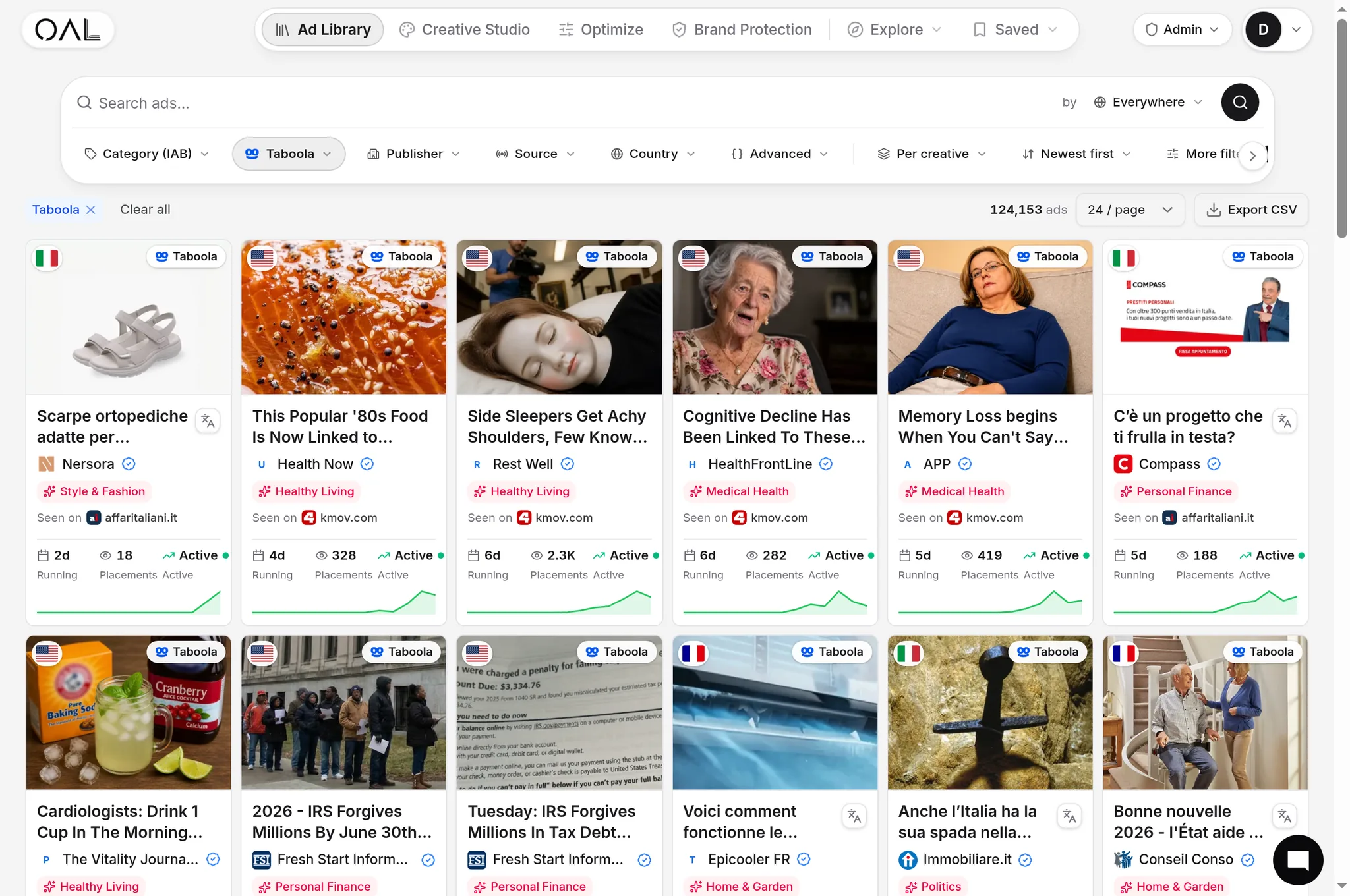
DTC brands quietly buy native ads next to the arbitrage and nutra crowd, and here is a repeatable, data-backed method for surfacing which ones are live on Taboola, Outbrain, MGID and Revcontent this week, by category.


If you sell direct-to-consumer, the received wisdom is that native belongs to someone else: the arbitrage publishers, the "one weird trick" advertorials, the supplement funnels. Half true, half a missed opportunity. A real layer of DTC brands buys native every single day, treating it as a prospecting channel that reaches the audiences Meta and Google have already squeezed dry. The catch is visibility. A native ad vanishes from the page seconds after it renders, and the advertiser usually hides behind a tracking redirect. You can't study what you can't see.
So this isn't a "top 50 brands" list that goes stale the day it ships. It's a repeatable method for surfacing which DTC advertisers are live on native right now, organized by category, plus how to read the signals that separate a genuine scaled spender from a one-day test. Run it yourself and you get a roster current to this week, not last quarter.
For scale, the dataset behind every number here is OpenAdLibrary's live index: 589,036 captured creatives from 25,933 distinct advertisers across 42 networks, backed by 926,259 landing-page captures and more than 5.4 million individual ad observations (OpenAdLibrary index, June 2026). That is the haystack. The method is how you pull DTC needles out of it.
What "DTC on native" actually means#
A DTC brand running native is any direct-to-consumer company buying native advertising placements (the in-feed, "recommended for you" units below articles) to drive first-touch prospecting to its own branded landing page. You identify them by capturing the live creative, resolving the real advertiser behind the click, and confirming the destination is a branded product or quiz page with a checkout, not an advertorial chain.
That last clause does most of the work. Native is full of creatives that look like DTC (clean product shot, lifestyle imagery, a confident tagline) where the click actually lands on a 2,000-word advertorial that funnels to a generic offer page. A true DTC advertiser sends you to its own domain, with its own brand, its own pricing, and a cart. Following the click is the single most reliable way to tell the two apart, and it's the step most "spy" workflows skip.
Here's the kind of creative that trips people up. It reads like a tech product, it photographs like one, but the headline is doing classic native curiosity work:

The creative tells you what the brand wants you to feel. The landing page tells you who is actually paying. Collect only creatives and you are studying half the funnel.
Why DTC brands choose native at all#
Three structural reasons keep DTC money flowing into native, and each one tells you which categories to expect.
Audience fatigue on social is the first. When CACs on Meta and TikTok climb, native opens a different door: an often older, higher-intent audience reading premium publisher content. The pillar overview of native advertising in 2026 tracks that shift across the broader market.
Editorial context is the second. A mattress, a cookware set, or a supplement reads more credibly next to a health or lifestyle article than mid-scroll between a friend's holiday photos. The native ad widget format borrows the publisher's trust, and that trust is most of the value.
Scale at the long tail is the third. Taboola and Outbrain place ads across tens of thousands of publisher sites, and since 2024 Taboola also powers Yahoo's native inventory, so one campaign reaches volume that's hard to replicate elsewhere (Taboola, Yahoo announcement). Those two networks alone account for 157,727 and 84,252 creatives respectively in our index (OpenAdLibrary, June 2026), which is why a DTC media plan that ignores them is leaving reach on the table.
The categories that follow from those reasons are predictable: anything with a health, longevity, beauty, home-comfort, or financial-confidence story. That is where the DTC presence is densest.
The categories where DTC shows up on native#
The vertical mix in our index lines up with the theory. Across all 42 networks, Finance leads with 17,232 creatives, followed by Insurance (15,629), Health (14,895), Ecommerce (13,872), Home & Garden (7,707), and Fashion (6,277) (OpenAdLibrary, June 2026). Inside Taboola specifically, Health (6,048), Finance (5,558), and Insurance (4,303) sit at the top, with Ecommerce and Home & Garden close behind. Read that as a map: Health, Ecommerce, Home & Garden, and Fashion are where branded DTC hides among the performance offers.
Here are the DTC categories you should expect to find live, and what their funnels typically look like. Treat the funnel shapes as illustrative of the category, not a claim about any one advertiser's current spend. Verify each one live before you cite it.
| Category | Typical funnel shape | What to verify in the data |
|---|---|---|
| Supplements & wellness (branded) | Quiz or product page on own domain | Real label, named brand, checkout, not an advertorial chain |
| Mattresses & sleep | Comparison or product page | Branded domain, consistent advertiser across creatives |
| Cookware & home | Product or bundle page | Discount framing, seasonal cadence |
| Apparel & accessories | Collection or PDP | Creative refresh rate, retargeting-style copy |
| Pet food & care | Subscription quiz | Recurring-revenue language, vet/ingredient angle |
| Oral care & personal care | Subscription or starter-kit page | "First box" pricing, before/after restraint |
| Fintech & money apps | App download or signup | "Confidence" angle, regulated-claim caution |
The home-comfort category is a good example of how mixed the supply is. This solar-battery ad sits in Home & Garden, has been observed running for 27 days, and uses the same "experts agree about one thing" hook you see across the vertical:

Now the honest caveat any real data study owes you: by raw volume, branded DTC is not the majority of native inventory. Arbitrage and performance offers dominate the count, a reality quantified in the vertical breakdown of nutra, finance, crypto and sweeps. DTC is the higher-quality minority you have to filter for. The method below is how you isolate it.
The method: build a live DTC roster yourself#
This is the core of the study. Five steps, repeatable weekly, each one producing a column in your roster.
- Start from category, not brand. You don't know who's advertising yet. That's the point. Filter the live capture set by a DTC-leaning vertical (supplements, home, sleep, pet) instead of searching a brand name. This surfaces advertisers you would never have thought to check.
- Resolve the real advertiser. For each creative, identify who is actually behind it. Native's defining problem is that the visible "by Brand X" label is often a publisher or an arbitrage intermediary, not the spender. Resolving the true advertiser is what turns a pile of images into a roster of companies.
- Follow the click to the landing page. This is the DTC filter. A captured click-path that terminates on a branded domain with a cart is DTC. One that terminates on an advertorial or a generic offer page is arbitrage. Doing this without clicking live ads (by tracing the recorded click path) keeps the analysis clean and avoids polluting the advertiser's own data.
- Confirm spend with longevity and spread. A single capture proves a test, not a budget. Check how long the creative has been live and across how many publishers and geos it appears. The longest-running native ads study goes deep on why duration is the most honest performance signal in a channel with no public spend numbers.
- Profile the network mix. Note which networks each advertiser runs. Most scaled DTC brands appear on more than one. The network share breakdown across Taboola, Outbrain and MGID explains how to read a brand's network distribution.
Each pass adds rows. Re-run it weekly and you have a living roster that captures new entrants, paused campaigns, and creative refreshes, the things a static list can never show.
Reading the signals: test vs scaled winner#
Once you have a roster, the analytical work is separating noise from signal. Native gives you no impressions, no spend, no CTR. Those are private. What live capture does give you are proxies:
- Longevity. Weeks live beats days live. Advertisers kill losers fast, so anything that survives is earning its slot in the native ad auction. Be precise about the unit, though: our index measures continuous observed run length, and the current ceiling is about 28 days of unbroken capture per creative (OpenAdLibrary, June 2026). The pets ad below sits right at that 28-day mark. Industry lore about "90-day winners" is a different thing, an inference about renewals, not something we have directly observed, so keep the two separate when you write up a row.
- Spread. The same creative across many publishers and multiple geos signals a budget broad enough to matter, often bought through programmatic native rather than hand-placed deals.
- Creative depth. A brand running ten variations of one angle is iterating on a winner. A brand with one creative is testing.
- Angle consistency. Recurring hooks across a brand's set reveal its core message. The analysis of the most common native ad angles is a useful reference for classifying what you find.

Put those together and a roster row stops being "Brand X runs native" and becomes "Brand X has run a curiosity-angle quiz funnel for nearly four weeks across 40+ publishers in 3 geos, refreshed twice." That is an actual competitive insight you can act on.
A worked example (illustrative)#
Say you filter Health and surface a creative with a clean product shot and the headline "Americans Are Ditching Hearing Aids for This New Device." Here is the method applied:
- Advertiser resolution shows the click routing to a single consistent domain across several creatives, a real brand rather than a rotating arbitrage redirect.
- Click-path terminates on a branded product page with a cart. DTC confirmed.
- Longevity shows the lead creative observed running for 26 straight days, close to the 28-day ceiling our index currently spans. Not a test.
- Spread shows it across multiple publishers in the US. Real budget.
- Network mix shows it concentrated on Taboola, the largest premium-publisher network in our data at 157,727 creatives.
That is a complete, defensible roster row. The numbers above are real captures from our index, but the "brand resolution" and "cart" conclusions are the kind of judgment you must verify live yourself before publishing. The discipline of a real data study is that every cell is reproducible.
One more reason to follow the click rather than trust the creative: headlines in this channel are engineered to provoke a click, not to describe a product. A finance ad like this one lives or dies on the destination, not the promise on the tile.

Where to run this#
You can run the method on any native ad intelligence dataset that captures live public ads, resolves the true advertiser, and records the click path. OpenAdLibrary was built for exactly this workflow. It captures live native ads across Taboola, Outbrain, MGID, Revcontent, Teads, MediaGo, Yahoo and MSN at full creative quality, classifies the supply chain to reveal the real advertiser, and traces each click to the landing page without clicking live ads. The category filters, the longevity and spread signals, and the per-advertiser drill-downs map directly onto the five steps above. It is also open and affordable at $29.99/month against legacy tools that run $80 to $400. If you want to go straight to the live data, the native ad spy tool is the entry point. For sustained work, start free and browse around 200 captured ads with no card before you commit.
The takeaway#
DTC brands do run native, just not as loudly or as densely as the arbitrage crowd, which is precisely why a method beats a list. Filter by category, resolve the real advertiser, follow the click to confirm DTC, then let longevity and spread tell you who's spending versus who's testing. Do that on a live, refreshable dataset of 589,036 creatives and counting, and you stop guessing whether native is "for DTC" and start naming, this week, the specific direct-to-consumer brands betting that it is.
Sources: Taboola, Yahoo 30-year native partnership announcement. All ad counts and run-length figures are from OpenAdLibrary's live index, June 2026.