
 Español
 Português (Brasil)
 Français
 Deutsch
 Italiano
 Nederlands
 Polski
 Svenska
 Türkçe
 Русский
 日本語
日本語 한국어
한국어 简体中文
简体中文 Tiếng Việt
 Bahasa Indonesia
 繁體中文
繁體中文 Čeština
 Dansk
Dansk Norsk (bokmål)
 Suomi
Suomi Ελληνικά
 Română
 Magyar
 Українська
 ไทย
ไทย हिन्दी
 العربية
 עברית
עבריתHow to Scale Taboola Campaigns Without CPC Blowout
Scale a winning Taboola campaign the wrong way and CPC climbs fast. Here's the staged budget-increase method, horizontal vs vertical scaling, and the signs you're pushing too hard.


Scaling a winning Taboola campaign without blowing up your CPC means increasing spend in small, staged increments, expanding into new placements and geos before making large vertical budget jumps, giving the algorithm's learning phase time to re-stabilize after each change, and refreshing creative before fatigue sets in rather than after CTR has already dropped. Jump a budget three times overnight and CPCs usually climb as Taboola's algorithm chases volume through progressively more expensive placements. Raise it in twenty to fifty percent steps every few days and it usually holds.
Why CPCs spike when you scale carelessly#
A Taboola campaign that's performing well has usually settled into a stable pattern of placements and audiences that the auction has learned convert efficiently for your creative. A sudden, large budget increase forces the algorithm to find more volume fast, and the cheapest available inventory is already being used; the new volume comes from placements the system was previously passing on, which are typically less efficient. This is the same dynamic that resets a campaign's learning phase: a big change signals the system to re-explore rather than exploit what it already learned, which shows up as a short-term CPC spike and CTR dip before things settle again, if they settle at all. Our native ad CPC benchmarks piece is useful context for what a normal range looks like across networks before you start comparing your own numbers.
Horizontal vs vertical scaling#
Vertical scaling means raising the budget on the same campaign and letting it find more volume within its existing structure. Horizontal scaling means duplicating a proven campaign into new geos, placements, or audience segments while leaving the original alone. Our full breakdown in horizontal vs vertical scaling covers this in more depth, but the short version for Taboola specifically:
| Vertical scaling | Horizontal scaling | |
|---|---|---|
| What changes | Budget on the existing campaign | New campaigns in new geos or placements |
| Risk to CPC | Higher, especially in large jumps | Lower, isolates risk to the new segment |
| Speed | Faster to execute | Slower, more setup per expansion |
| Best used | Small, staged increases only | Once you've proven a core geo or audience |
Most durable scaling combines both: modest vertical increases on a proven core campaign, paired with horizontal expansion into adjacent geos or placements that haven't been tested yet.
A worked example: scaling a proven insurance campaign#
Say a campaign has run steadily at a fixed daily budget for two weeks with a stable CPA in a single Tier-1 geo. The tempting move is doubling the budget overnight to capture more of what's clearly working. A steadier path looks different: raise the budget thirty percent, hold for two to three days watching CPA rather than CPC alone, raise again if it held, and in parallel duplicate the same creative and targeting into a second, similar geo at the original budget level rather than folding it into the existing campaign. Within a couple of weeks you've likely doubled total spend across the two campaigns with far less CPC disruption than a single overnight jump would have caused, because the vertical increases were small enough to avoid a learning-phase reset and the horizontal expansion drew from a fresh pool of inventory rather than competing with your own existing campaign for the same placements.
The staged budget-increase method#
- Raise budget in increments of twenty to fifty percent, not multiples.
- Wait two to three days between increases before raising again, long enough for the algorithm to stabilize against the new budget level.
- Watch cost per acquisition, not just CPC, since CPC can rise slightly while CPA holds steady if conversion rate improves alongside volume.
- Pull back to the previous budget level if CPA drifts meaningfully worse for more than a day or two, rather than assuming it will self-correct.
Creative refresh cadence#
Every native creative eventually fatigues: the same audience sees it enough times that response drops, a pattern covered in our note on creative fatigue. Scaling accelerates this because a bigger budget shows the same creative to more of your target audience faster, compressing the fatigue timeline. The fix is refreshing headlines and images on a schedule tied to your scaling pace, not waiting until CTR has already visibly dropped. Longevity is a useful signal here too: our ad longevity guide explains why a creative that's still running strong after weeks is a good candidate to keep, and one that's decaying fast is a signal to have a refresh ready before you push more budget behind it.
Signs you're scaling too fast#
- CPC climbing while CTR stays flat or drops, a sign the extra spend is buying weaker placements rather than more of the same efficient inventory.
- CPA drifting upward over several consecutive days rather than a single noisy day.
- A sudden drop in delivered impressions right after a budget increase, often a sign the learning phase reset and the algorithm is re-exploring rather than serving efficiently.
Signs you have room to keep scaling#
- CPA holding steady or improving as spend rises, meaning the extra volume is genuinely incremental rather than cannibalizing efficiency.
- The core creative is still running strong with no fatigue signals after a meaningful stretch of time.
- You've only tapped a handful of geos or placements so far, meaning there's real untapped inventory to expand into horizontally rather than forcing more volume through an already-saturated campaign.
Pacing across the week, not just the day#
Native performance often varies by day of week, and a budget increase that lands on an unusually strong or weak day can look like a signal when it's actually noise. Judge a budget change against at least a full week of data before deciding it worked or didn't, and avoid making a second increase on top of one you haven't fully evaluated yet. This is the same discipline that applies to changing one variable at a time: if you raised budget and swapped creative in the same week, you won't be able to tell which change moved the numbers when you review the results afterward.
Common mistakes that undo good scaling discipline#
- Scaling a campaign that's already showing early fatigue signs. More budget on a creative that's about to decay just gets you to the decay point faster; refresh first, then scale.
- Reacting to a single bad day. One noisy day of CPA drift isn't a trend. Pulling back after one rough day as often as after a genuine multi-day decline means you never actually learn your campaign's real ceiling.
- Scaling every winning campaign at the same pace. A campaign in a thin, low-competition geo often has more room to scale gently than one already competing hard in a saturated Tier-1 market; treat them differently rather than applying one universal percentage across your whole account.
How OpenAdLibrary helps you scale with better inputs#
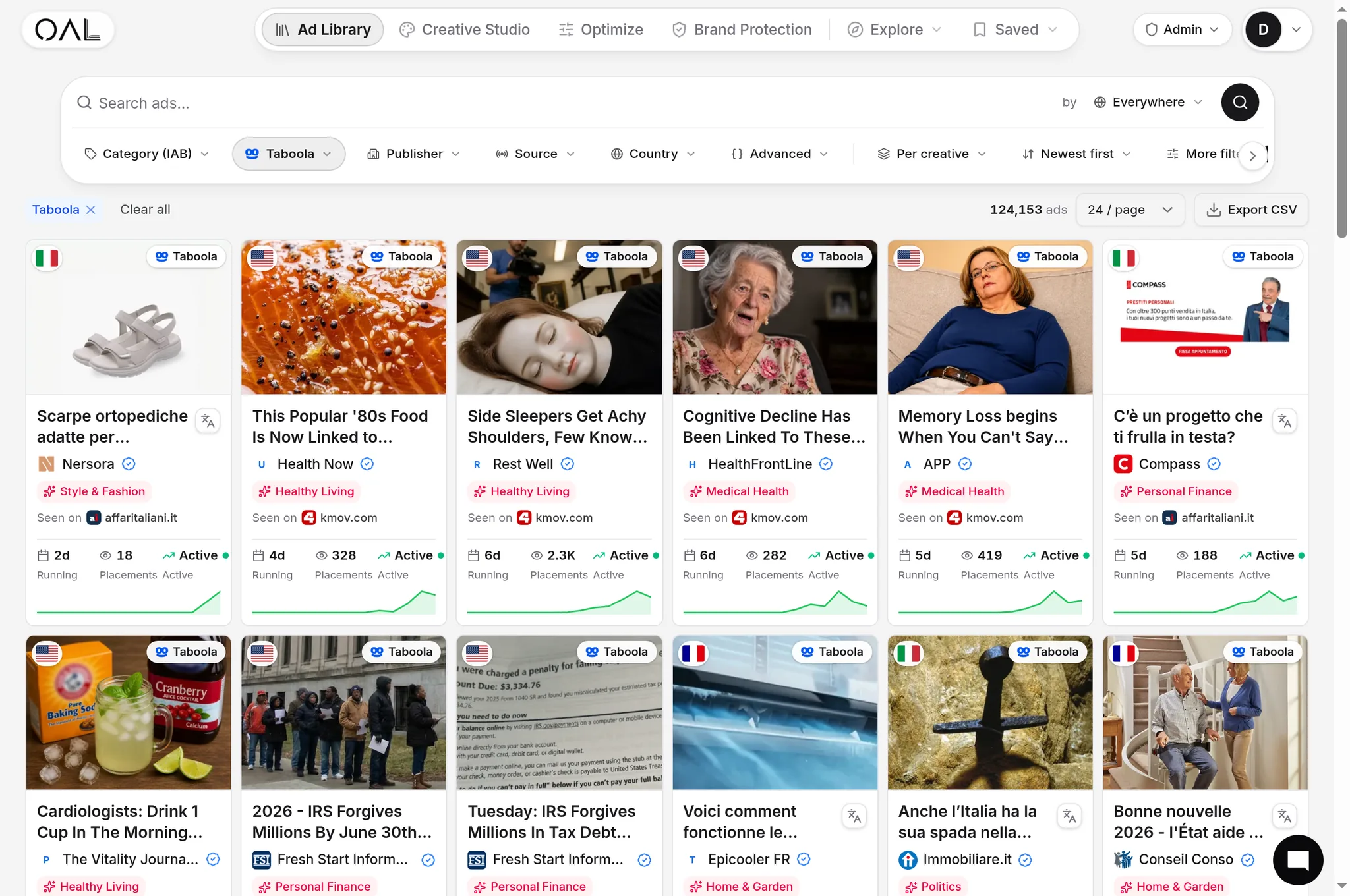
Before you commit a bigger budget to scaling, it helps to know what advertisers running at real volume in your vertical actually look like. Advertiser-level creative counts in the OpenAdLibrary index, drawn from 206,145 live Taboola creatives as of June 2026, are a useful proxy for who's actually scaled successfully versus who's still testing: an advertiser running thousands of creative variants has found something that works and is iterating on it, not experimenting from zero. Who advertises on Taboola and top native advertisers by network break this down by vertical, and /spy/taboola lets you search any specific competitor's creative volume and longevity directly before you decide how aggressively to push your own budget.
That same data is useful for setting expectations before you scale, not just for benchmarking after. If the largest advertisers in your vertical are running a handful of creative variants at a time, that's a sign the category rewards a narrower, more targeted approach; if they're running hundreds or thousands, it's a sign the category rewards exactly the kind of staged, patient scaling described above, sustained over months rather than achieved in a single aggressive push.