Español
 Português (Brasil)
 Français
 Deutsch
 Italiano
 Nederlands
 Polski
 Svenska
 Türkçe
 Русский
 日本語
日本語 한국어
한국어 简体中文
简体中文 Tiếng Việt
 Bahasa Indonesia
 繁體中文
繁體中文 Čeština
 Dansk
Dansk Norsk (bokmål)
 Suomi
Suomi Ελληνικά
 Română
 Magyar
 Українська
 ไทย
ไทย हिन्दी
 العربية
 עברית
עבריתWhat 30-Day Taboola Winners Have in Common: A 206,000-Ad Study
Ads that keep serving keep paying. We pulled the longest-running creatives from an index of 206,145 live Taboola ads and dissected the five patterns the 30-day survivors share.


Taboola ads that survive 30 or more days share a recognizable anatomy: a story-shaped headline in plain, first-person or observational language; a curiosity gap anchored to a concrete object; a self-qualifying hook that filters out the wrong clickers; an image that reads as editorial photography rather than advertising; and, behind the click, an advertorial funnel instead of a bare product page. Those five patterns come from OpenAdLibrary's index of 206,145 live Taboola creatives (June 2026), using observed run time as the success signal — because no advertiser keeps paying Taboola CPCs for a month on an ad that loses money.
Methodology: why longevity is the winner signal#
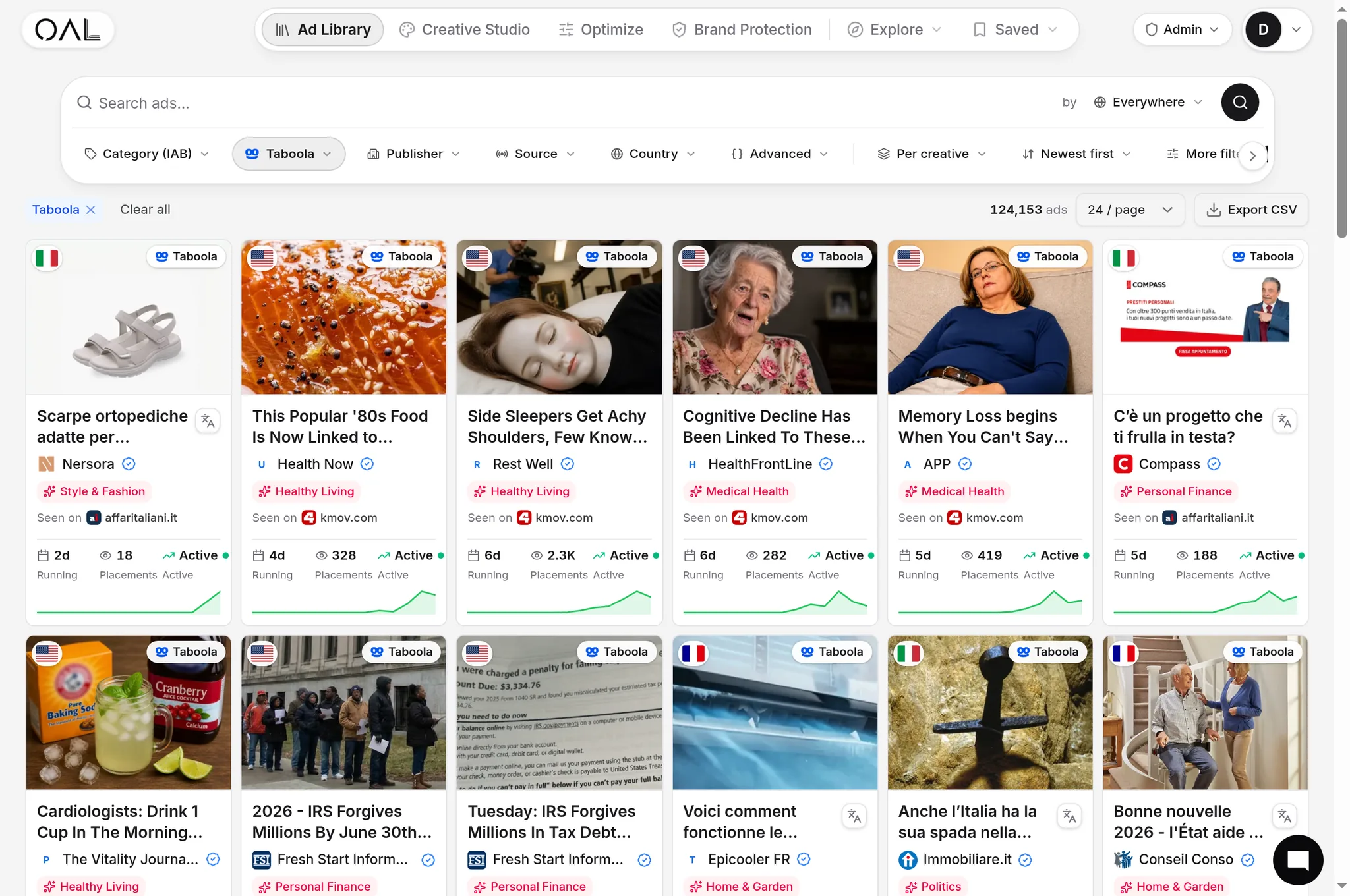
Nobody outside an advertiser's account sees its CTR, spend, or ROAS. What an outside observer can see — continuously, at scale — is whether an ad keeps running. OpenAdLibrary captures live Taboola placements daily and records, for each creative, the first-seen and last-seen dates, the resolved advertiser, a vertical classification, geo and device observations, and the traced landing page. The Taboola corpus in this study is 206,145 live creatives, part of a wider index of 725,000+ creatives across 49 networks with 1.3 million landing captures (June 2026).
The logic of longevity is simple economics. Native CPC traffic is paid for click by click. An ad still serving on day 30 has had thirty days of invoices behind it, and direct-response advertisers — who dominate Taboola's feeds — cut losers within days. Sustained delivery is therefore the strongest public proxy for profitability we have; we make the full argument in Why a Native Ad Running 30+ Days Is Probably Profitable, and it anchors our broader signals framework for finding winning ads.
Three honest limits before the findings:
- We observe delivery, not economics. A long-running ad from a brand advertiser may be sustained by budget, not performance. We weight the analysis toward direct-response advertisers, where the pay-per-click discipline holds.
- Observation windows truncate. A creative first captured three weeks ago shows 21 days even if it ran earlier elsewhere. Run times in this study are minimums, not totals.
- The patterns are qualitative. We are describing what recurs across the long-running set, not publishing invented percentages. Where we give a number, it comes from the index.
The survivors: real 30-day Taboola winners#
Here are captured creatives from the index with the longest observed runs — the specimens this study dissects:
| Headline | Advertiser | Vertical | Days observed |
|---|---|---|---|
| "My garden had no butterflies for years — then I hung one of these up" | Butterfly Lovers | Home & garden | 37 |
| "Struggling to Hear Clearly? Discover a Device Transforming Lives" | Audika | Health | 37 |
| "The Surprising Household Item People Are Using for Hair Regrowth" | Halogrow | Beauty | 31 |
| "A Window Cleaner Explained Why Sprays Make Your Glass Worse" | Aussie Clean Living | — | 23 |
| "Top 5 Shampoos To Avoid" | Shampoos | Beauty | 21 |

Every one of these has paid for weeks of clicks. Now the anatomy.
Pattern 1: story-shaped headlines beat claims#
The 37-day butterfly ad is a complete two-act story in fourteen words: a relatable problem held over time ("My garden had no butterflies for years") and a turn hinging on an unnamed object ("then I hung one of these up"). No product name, no benefit list, no exclamation mark. It reads like a comment a neighbor would make — which is exactly the register of the content feed it sits in.
Across the long-running set, this recurs constantly: winners are narratives or discoveries, not claims. "A Window Cleaner Explained Why Sprays Make Your Glass Worse" (23 days) is testimony from a tradesperson; a claim version of the same idea — "The #1 Spray-Free Glass Cleaner" — is an ad, and feeds punish ads. The distinction between the hook doing the clicking and the claim doing the converting is one we map fully in Hook vs Angle vs Claim, and the recurring formulas behind these headlines are cataloged in Native Ad Headlines That Get Clicks.
Pattern 2: the curiosity gap is anchored to a concrete object#
Notice what the winners withhold — and what they don't. "One of these." "A device." "The surprising household item." Each headline names that a specific thing exists and withholds only its identity. That is a very different mechanism from pure mystery bait ("You won't believe what happened next"), which network review teams increasingly reject and readers increasingly skip.

The 31-day Halogrow ad is the cleanest example: "The Surprising Household Item People Are Using for Hair Regrowth" promises a concrete, checkable reveal. The word "household" does double duty — it lowers the perceived commitment (no exotic product, nothing to buy yet) while sharpening the itch to know. The reader's click is a small, specific transaction — tell me the item — and the advertorial behind it can pay that off in the first paragraph and spend the rest of the page selling. A well-built curiosity gap survives for weeks; unanchored clickbait fatigues in days and invites policy trouble besides.
Pattern 3: the audience qualifies itself before the click#
CPC economics make junk clicks the enemy: you pay for every reader who taps, including the ones who can never buy. The longest-running ads build the filter into the headline.
Audika's 37-day hearing-aid creative opens with the qualifier as a question: "Struggling to Hear Clearly?" Readers without hearing difficulty scroll past — and that non-click is a gift, not a loss. The ad spends its budget almost exclusively on people in-market for exactly what the landing page sells. You will see the same self-selection move in demographic call-outs ("Seniors...", "Homeowners...", geo-inserted lines) all over the long-running set.
The negative frame is the same pattern inverted: "Top 5 Shampoos To Avoid" (21 days) qualifies by anxiety — it selects readers who buy shampoo and worry about choosing badly, then sells the alternative inside a listicle advertorial. Avoidance listicles are one of the most durable formats in the entire index; we cataloged the recurring frames in The Most Common Native Ad Angles.

Pattern 4: images that belong in the feed, not in an ad#
Put the long-runners side by side and the visual pattern is unmistakable: they look like photos from an article, not assets from a brand shoot. A garden. A person's ear and hand. A bathroom counter. Ambient light, believable framing, no logo lockups, no overlay text, no studio white.
This is the visual half of the same native logic: Taboola placements sit inside editorial content, and creative that matches the reader's visual expectation of content earns the read that the headline then converts into a click. Polished display-ad imagery signals "advertisement" one scroll-glance sooner and dies faster. The craft details — framing, faces, objects, what to test first — are in our native creative best-practices guide.
Pattern 5: an advertorial funnel is waiting behind the click#
Longevity is never just the ad — it is the whole funnel refusing to lose money. Because the index traces each creative's click through to its destination, we can see where the survivors send traffic, and the recurring answer is: not to a product page. Story headlines resolve into advertorials that pay off the curiosity gap and then sell; question hooks resolve into quiz flows or listicle pages that carry the reader from problem to recommendation.
The pattern makes sense of the economics: cold feed traffic clicked a story, and a pre-lander finishes telling it before asking for money. When you research a long-running competitor, always capture the funnel, not just the creative — the landing page is usually where the actual persuasion lives.
The contrast set: what short-lived ads do differently#
The index also captures the ads that vanish, and the failure modes are as consistent as the success patterns. Reading a sample of creatives that disappear within days, four anti-patterns recur:
- Claim-first copy. Headlines that lead with the product and its superlative — the classic display-ad register — get scrolled past in a content feed. The reader came for stories; an ad-shaped ad forfeits the click before the auction is even relevant.
- Unanchored shock bait. Pure "you won't believe" mystery with no concrete object to reveal earns a burst of low-intent clicks, converts none of them, and dies on CPC economics — when it isn't rejected by review first.
- Studio-polished imagery. White-background product shots and text-overlay graphics mark the placement as an advertisement instantly. In a feed, looking professional is a handicap; looking like content is the job.
- Direct-to-cart destinations. Story-shaped hooks that dump the reader onto a bare product page break the narrative contract. The click was a request to finish the story; a price tag is not an ending.
None of this means those ads never worked anywhere — it means that on a CPC feed, each mismatch between the ad and the feed's reading context taxes the economics until the advertiser pulls the budget.
Winners are portfolios, not lone ads#
One more pattern sits above the creative level: long-running ads rarely travel alone. The advertisers behind them run families of variants on the same angle, and the survivors are the selected few from a much larger tested set.
The index shows this directly. Tri-Lift, a skincare advertiser, runs its Korean-skincare-secret angle as "Wrinkles: Most People Use Lotions. Koreans Do This Instead (It's Genius)" on Taboola — and a sibling creative, "Everyone Lotions Crepe Skin. Koreans Do This Instead (It's Genius!)", on MGID. Same angle, re-cut per network. Health Weekly, a health advertorial publisher, runs parallel doctor-authority hooks across Outbrain and Revcontent simultaneously. Cross-network replication of a proven angle is one of the most reliable tells in the entire index: when an advertiser pays to run the same angle in two auctions at once, that angle is funding its own expansion.
For a researcher, this changes what you look for. A single long-running ad is a data point; an advertiser running six variants of one angle across two networks is a validated angle with the testing bill already paid. Pull an advertiser's full creative set before copying conclusions from one ad — the variant spread tells you which elements they tested and which survived.
Where the winners cluster: Taboola's vertical mix#
Long-running creatives concentrate in the same verticals that dominate the network overall. The Taboola index breaks down like this (classified live creatives, June 2026):
| Vertical | Live Taboola creatives |
|---|---|
| Health | 11,982 |
| Finance | 8,200 |
| Insurance | 7,422 |
| Ecommerce | 5,185 |
| Home & garden | 4,414 |
| Software | 3,665 |
Health, finance, and insurance together out-volume the next several verticals combined — they are where native's advertorial mechanics pay best, and consequently where the deepest bench of 30-day survivors sits. If you buy in these verticals, the good news is an enormous library of proven patterns to study; the bad news is that every one of those advertisers is your auction competition. The advertiser-level view is in Who Advertises on Taboola?.
How to apply the five patterns to your next campaign#
A practical checklist, in build order:
- Write five story-shaped headline variants — first-person discovery, tradesperson testimony, or avoidance listicle. No claims, no superlatives.
- Anchor every curiosity gap to a concrete object or number the landing page can reveal in its first paragraph.
- Put the qualifier in the headline — a question, a demographic, or a situation that makes the wrong reader scroll past.
- Shoot or select editorial-grade images: ambient light, real settings, no text overlays, no logos.
- Build the advertorial before you launch, and make its first paragraph pay off the headline's promise.
- Judge yourself against the incumbents. Before spending, pull the 30-day survivors in your vertical and ask honestly whether your creative would survive next to them.
Step 6 is the one most buyers skip, and it is the cheapest. You can run this study's method yourself — filter live Taboola creatives by advertiser, vertical, and observed run time in the Taboola spy tool; browsing is free, and the premium tier unlocks the full index depth for funnel tracing at scale.
What this study can't tell you#
Delivery data cannot separate a brilliantly profitable ad from a merely break-even one, and it cannot see budget caps, dayparting, or the advertiser's margin. Treat the five patterns as a strong prior for what to build and test — not as a guarantee, and never as a license to copy a specific ad outright. Cloned creatives inherit none of the originating funnel's economics and all of its legal exposure. Learn the pattern; write your own.