
 Español
 Português (Brasil)
 Français
 Deutsch
 Italiano
 Nederlands
 Polski
 Svenska
 Türkçe
 Русский
 日本語
日本語 한국어
한국어 简体中文
简体中文 Tiếng Việt
 Bahasa Indonesia
 繁體中文
繁體中文 Čeština
 Dansk
Dansk Norsk (bokmål)
 Suomi
Suomi Ελληνικά
 Română
 Magyar
 Українська
 ไทย
ไทย हिन्दी
 العربية
 עברית
עבריתTaboola Bidding Strategy: Smart Bid, Target CPA or Fixed CPC?
Taboola offers Smart Bid Max Conversions, Smart Bid Target CPA, and Fixed CPC. An independent guide to how each behaves, the data each one needs, and the campaign types where automation fights you instead of helping.


Taboola gives advertisers three ways to bid: Smart Bid in Max Conversions mode (the default), Smart Bid with a Target CPA goal, and Fixed CPC. The practical rule: run Smart Bid when the campaign feeds Taboola a steady, honest conversion signal through a pixel or server-to-server postback; run Fixed CPC when conversions are thin or delayed, or when you're buying clicks of known value — arbitrage, whitelist campaigns, and early creative tests. More native budget is wasted by running the wrong strategy for the campaign's data reality than by bidding a few cents too high.
How Taboola's three bid strategies behave#
| Strategy | How it bids | What it needs | Best for |
|---|---|---|---|
| Smart Bid — Max Conversions | Adjusts the bid impression by impression to win the clicks most likely to convert, spending the full budget | A reliable conversion event arriving at steady volume | Scaling campaigns with working conversion tracking |
| Smart Bid — Target CPA | Same engine, but steers average cost per conversion toward your stated goal | Conversion history on the campaign plus a realistic target | Mature campaigns with hard unit economics |
| Fixed CPC | You set the cost per click; the algorithm doesn't move it, though you can adjust bids per publisher | Your own judgment and active publisher management | Whitelists, arbitrage, thin-conversion offers, clean tests |
Labels and mode availability shift as Taboola iterates on the Ads Console, so treat exact UI wording as a moving target and check Taboola's help center for the current version — the mechanics above have been stable for years. For the wider platform context (placements, targeting, how the auction prices clicks), see how Taboola ads work.
What Smart Bid needs before you can trust it#
Smart bidding is a prediction machine, and it predicts from the conversions you send it. Four preconditions decide whether it helps or hurts:
- An honest event. Optimize to the event that makes you money. Feed it lander arrivals or soft micro-conversions and it will cheerfully buy curiosity instead of buyers — the numbers improve while revenue dies.
- Volume. Media buyers commonly report that a campaign needs conversions arriving steadily — as a rough rule, dozens per month per campaign rather than a handful — before Smart Bid's decisions beat a static bid. Below that, it's guessing with your money.
- Low latency. If your conversion fires days after the click (CRM-qualified leads, cash-on-delivery confirmation), the model is permanently learning from stale data and chasing last week's traffic.
- A clean container. One geo and one device class per campaign. A mixed campaign forces the model to average across auctions that have nothing in common — the structural discipline covered in the native media buying guide.
Getting the signal wired correctly — pixel or postback, deduplicated, carrying the real event — is its own project, and it's worth doing before the first Smart Bid dollar is spent, not after.
When smart bidding fights you#
Symptoms first: CPCs drifting upward while volume stays flat; spend concentrating on a handful of publishers; reported CPA holding steady while lead quality collapses; conversions "disappearing" because they complete outside the attribution window.
The usual causes:
- Thin or delayed conversions. Lead gen with downstream approval, capped affiliate offers, or any funnel where the network sees only a fraction of true conversions, late.
- Value variance the model can't see. Smart Bid optimizes conversion count. If one conversion is worth ten times another — arbitrage RPMs, mixed payout offers — count optimization actively misallocates your spend toward the cheap ones.
- Learning-phase spend on short-lived campaigns. The exploratory spend Smart Bid needs makes it a poor fit for creative tests you intend to kill within days.
- Wrong event choice. The classic failure: switching optimization to pre-lander arrivals because the real event was too sparse. Every dashboard metric improves; the P&L quietly doesn't.
None of this makes Smart Bid bad — it makes it data-hungry. When you can't feed it, stop asking it to think for you and take the bid back.
If you want to stay on automation despite a thin signal, there are honest remedies before surrender: consolidate near-identical campaigns so their conversions pool into one learning container; pass real revenue values through your postback so the model optimizes value instead of count; or move the optimization event one step up-funnel only if you also monitor the back-end rate so the shortcut can't drift into fiction. If none of those apply, Fixed CPC isn't a downgrade — it's the correct tool for the data you actually have.
Running Fixed CPC properly#
Fixed CPC on Taboola is a manual game with a simple loop:
- Start mid-range. Media buyers commonly report Tier-1 desktop CPCs from roughly $0.20 to $0.90 on Taboola, with mobile typically cheaper — treat that as unofficial folklore rather than a rate card, because vertical, geo, and season move it a lot. The native ads CPC benchmarks piece and how much native ads cost give fuller budgeting context.
- Buy delivery, then trim. If impressions won't flow, raise the bid in small steps until they do. On native, volume problems are usually bid problems, not targeting problems.
- Manage per publisher. This is the real work: raise bids on sites that convert, and cut or block sites that spend past your threshold without converting. Publisher-level bid control is Fixed CPC's structural advantage over automation — if you're not using it, you're paying for the strategy without collecting its benefit.
- Graduate winners. Move consistently converting publishers into a separate whitelist campaign with higher bids, and keep the discovery campaign broad and cheap.
Choosing between Max Conversions and Target CPA#
Start with Max Conversions. It spends the budget, generates volume, and builds the conversion history that Target CPA needs to function. Switch to Target CPA when two things are true: the campaign has weeks of steady conversions behind it, and you have a hard CPA ceiling that matters more to you than volume. Set the target near your recently observed cost per acquisition, not your aspiration — an aggressive target doesn't negotiate better prices, it just strangles delivery. If volume dries up after the switch, the target is telling you it's fiction: loosen it, or go back to Max Conversions and fix the funnel instead. And revisit the target seasonally — a number set during a cheap-traffic month will choke the campaign when auction pressure rises in Q4.
The same decision on Outbrain, MGID, and Revcontent#
The Taboola logic ports almost directly. Outbrain's conversion-bid strategies similarly run from fully automatic through semi-automatic to manual CPC with per-section adjustments — context in how Outbrain works. MGID is manual-CPC-first with optional automated price-adjustment features layered on top (how MGID works), and Revcontent remains substantially a manual, widget-level bidding platform (how Revcontent works). On the smaller networks the "does my conversion volume justify automation?" question usually answers itself: it doesn't, so manual discipline wins by default. Check each network's current documentation before assuming a specific mode exists on your account.
Set bids with market context, not in a vacuum#
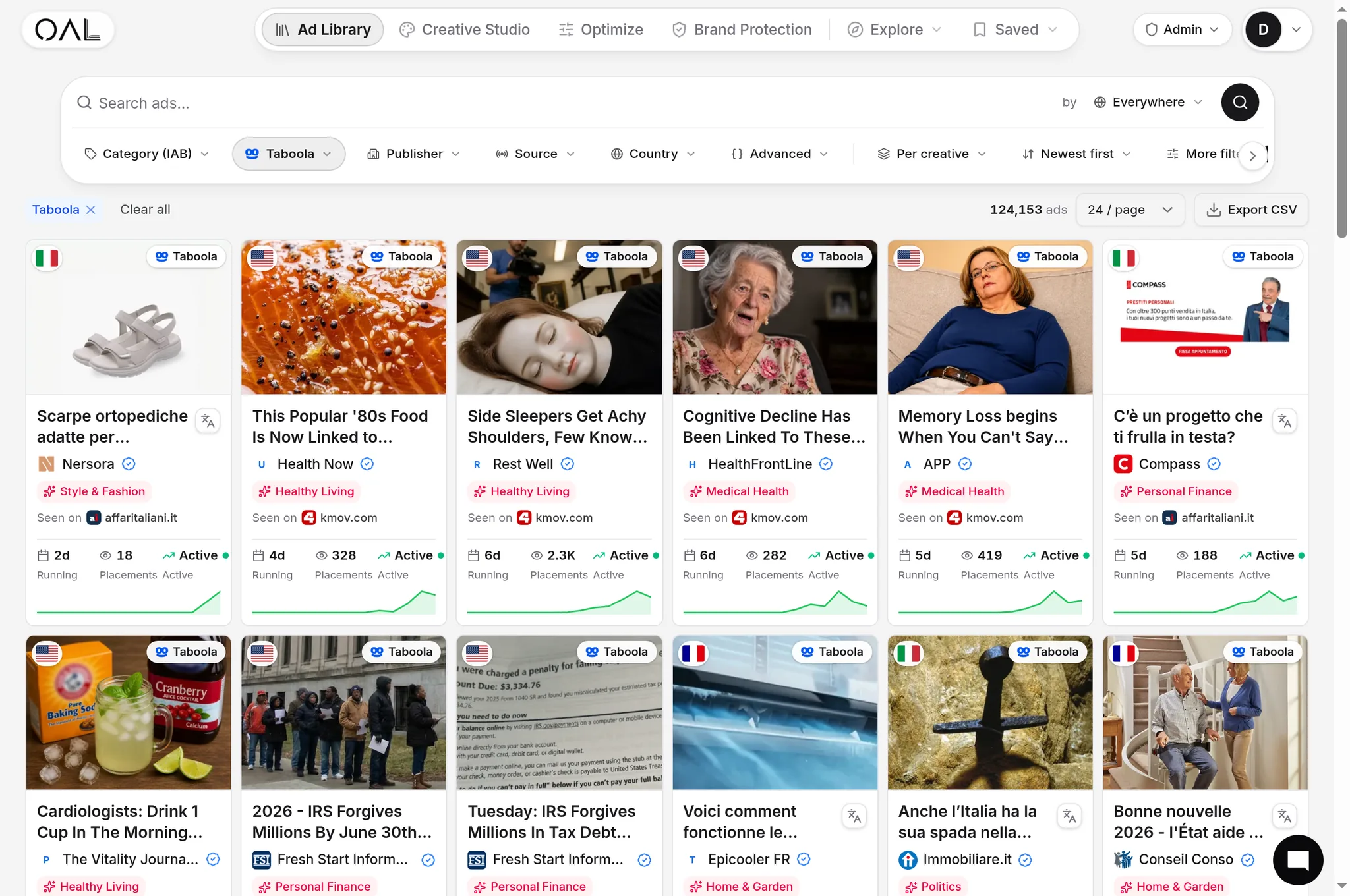
You can't see competitors' bids, but you can see what their spending behavior implies. Taboola alone accounts for 206,000+ live creatives in OpenAdLibrary's index (June 2026), and creative longevity is the closest public proxy for "the economics work": an advertiser whose ads run for weeks is winning auctions at prices they can sustain. Before entering a vertical, browse its live Taboola ad set. If incumbent ads churn within days, you're looking at a brutal auction where Smart Bid's learning spend gets expensive; if the same creatives sit for a month, there's stable margin worth competing for. Is Taboola worth it digs into what those longevity patterns say about the platform overall — and they're the sanity check your bid, whatever strategy sets it, should never contradict.