Español
 Português (Brasil)
 Français
 Deutsch
 Italiano
 Nederlands
 Polski
 Svenska
 Türkçe
 Русский
 日本語
日本語 한국어
한국어 简体中文
简体中文 Tiếng Việt
 Bahasa Indonesia
 繁體中文
繁體中文 Čeština
 Dansk
Dansk Suomi
Suomi Ελληνικά
 Română
 Magyar
 Українська
 ไทย
ไทย हिन्दी
 العربية
 עברית
עבריתThe Best Niches for Taboola Ads, Ranked by Live Ad Volume (2026)
We ranked Taboola's niches using 206,145 live creatives: health, finance and insurance dominate. Here is the full data — and why the biggest niche is only 'best' if you can out-angle it.


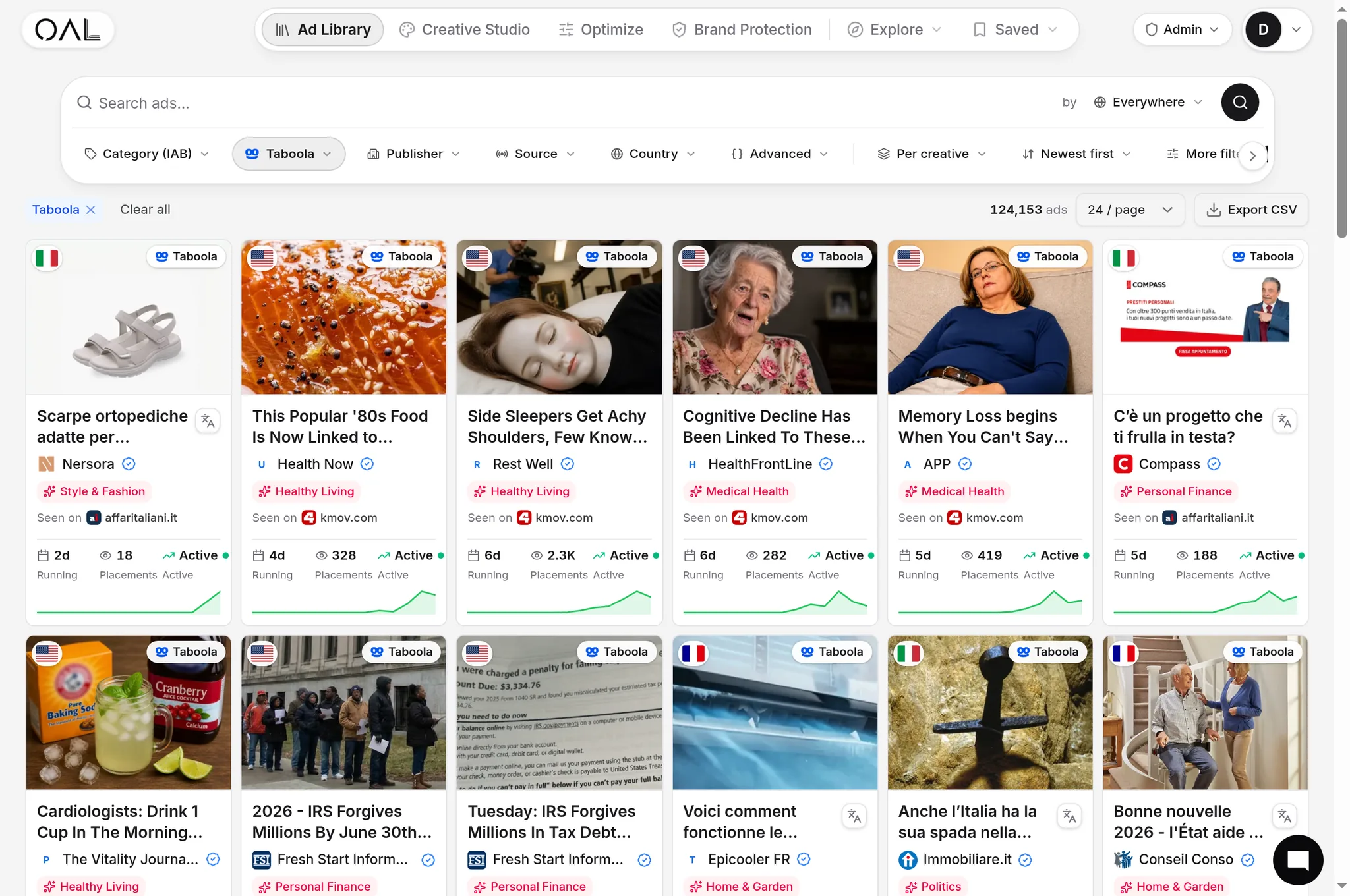
Ranked by live ad volume, the best niches for Taboola ads are health (11,982 classified live creatives in the OpenAdLibrary index, June 2026), finance (8,200), insurance (7,422), ecommerce (5,185), home & garden (4,414) and software (3,665). Ad volume is the most honest public signal of where money is being made: nobody keeps thousands of creatives live on a CPC network unless enough of them are paying for themselves. This study ranks Taboola's niches from the 206,145 live Taboola creatives in our index, shows what actually runs inside each one, and covers the part most "best niches" lists skip — that the biggest niche is also the most contested, and where that leaves a buyer choosing an entry point.
Methodology#
OpenAdLibrary continuously captures live native ad placements from the networks' own delivery systems — 725,000+ creatives from 29,000+ advertisers across 49 networks as of June 2026, of which 206,145 are Taboola. Behind those creatives sit 6.8 million individual ad observations and 1.3 million traced landing pages, which is what makes longevity and funnel data usable at niche level rather than anecdote level. Each creative carries the advertiser behind it, the geo and device it was captured on, first-seen/last-seen dates, and a traced landing page; a classifier assigns an industry vertical where it can do so with confidence. Three honesty notes before the ranking:
- Counts below are classified creatives. Not every captured creative gets a confident vertical label, so the per-niche numbers are a large classified subset of the full Taboola corpus — right for comparing niches against each other, understated as absolute market sizes.
- Volume measures presence, not profit. A creative being live means someone is paying to run it; a niche having thousands of live creatives means many advertisers sustain spend there. It does not tell you margins — we treat sustained volume plus ad longevity as the best available public proxy.
- The index skews to the geos we capture most, which are Tier-1 heavy. A niche that lives mostly in Tier-3 geos will be underrepresented here even if it sustains real spend — treat the ranking as a Tier-1-weighted view of the network, because that is what the capture footprint reflects.
The ranking: Taboola niches by live ad volume#
| Rank | Niche | Live classified creatives (June 2026) | Character of the demand |
|---|---|---|---|
| 1 | Health | 11,982 | Hearing, joint pain, supplements, devices — advertorial-heavy |
| 2 | Finance | 8,200 | Retirement, banking, investing education, comparison offers |
| 3 | Insurance | 7,422 | Quote funnels: auto, life, health, home |
| 4 | Ecommerce | 5,185 | Problem-solving gadgets and DTC products |
| 5 | Home & garden | 4,414 | Home improvement leads, garden products, cleaning |
| 6 | Software | 3,665 | Consumer utilities, VPNs, apps, B2B tools |
Health and finance together account for roughly half of the top-six classified volume. That concentration is the single most important fact about Taboola's demand side: the feed is, to a first approximation, a health-finance-insurance machine with everything else attached.
Why volume is the right ranking signal (and its one catch)#
On a self-serve CPC network, every live ad is a running bet with real money behind it. Creatives that don't perform get paused by their buyers within days — so a standing population of thousands of creatives in one vertical means the niche continuously clears the bar of profitability for many independent advertisers. It's the same logic that makes longevity the single best signal at the individual-ad level, aggregated up to niche level.
The catch: volume measures opportunity and competition simultaneously. Health's 11,982 creatives mean the demand is proven — and that your creative will compete against the most tested hooks in native advertising, written by teams that have iterated for years. The right read is not "pick #1" but "match the niche's competitive intensity to your ability to differentiate." More on that in the decision section at the end.
Inside the top niches#
Health: the deepest, hardest pool#
Nearly 12,000 classified live creatives make health Taboola's flagship niche — and our cross-network data shows Taboola carries roughly half of all classified health creatives in the entire 49-network index (11,982 of 24,472). Hearing care, joint pain, sleep, supplements and personal devices dominate. The creative pattern that survives is benefit-adjacent rather than claim-heavy: a hearing-care ad in our index had been running 37 days with "Struggling to Hear Clearly? Discover a Device Transforming Lives" — a question and an invitation, nothing a regulator or reviewer can falsify.

Health is also the most compliance-sensitive niche on the network — the offers that last are the ones that stay on the right side of review, and the nutra compliance realities apply here in full. For a buyer weighing entry: the upside is the deepest library of proven hooks in native advertising sitting in plain sight; the downside is that every obvious angle has been run to exhaustion, so the winners differentiate on offer and funnel, not on rediscovering the question-hook format.
Finance: the highest-value clicks#
Finance's 8,200 live creatives cluster around retirement planning, savings products, investing education and comparison offers — an audience match made in demographics, since native feeds over-index on older, desktop-heavy news readers with money decisions in front of them. The vertical's live examples range from "Granny Pods in 2026: Options That May Surprise You" (a finance-classified housing-cost angle captured at 5 days) to established brand campaigns. Finance clicks are among the most expensive on the network because the lifetime value behind a funded account or an insurance-adjacent lead supports deep bids — see the live finance examples breakdown for how these funnels are built. Two structural notes for anyone eyeing entry: regulation is a moat here (financial-promotion rules and geo licensing filter out casual competition, which is partly why margins persist), and the comparison-mediator model — ranking or comparing providers rather than selling one — is the dominant funnel shape because it monetizes the whole consideration set instead of a single conversion.
Insurance: the quote-funnel machine#
Insurance is arguably the purest native vertical: 7,422 live creatives, almost all feeding quote-comparison funnels for auto, life, health and home. The model is mechanical — headline localizes the problem ("drivers in your state"), pre-lander qualifies, form monetizes — and it sustains enormous continuous spend. For a buyer, insurance is less about creative invention than about traffic quality and funnel math; the incumbents have optimized both for a decade. It's also rhythmically seasonal: enrollment windows and renewal cycles move demand in waves, and the lead buyers on the back end reprice accordingly — a niche where knowing the calendar is part of the edge.
Ecommerce: the product-discovery lane#
5,185 live creatives of problem-solving products: home gadgets, comfort wear, cleaning tools, seasonal items. A live example from the index: a posture-bra creative ("A bra that not only lifts but also improves your posture") captured within its first week — classic problem-agitation-product structure. Ecommerce on Taboola behaves differently from social: discovery-driven, older-skewing, desktop-meaningful. The math is unforgiving in a specific way — CPC traffic against a physical-product margin means average order value has to carry the funnel, which is why the products that survive here skew toward higher price points, bundles, or subscription attachment rather than one-off trinkets. The full playbook is in our native ads for ecommerce guide, and product research from live ads shows how to mine this niche for product ideas before saturation.
Home & garden: quiet volume, long runners#
4,414 live creatives spanning home-improvement lead-gen and physical products. This niche produces a disproportionate share of very long-running ads — a butterfly-feeder product ad in our index had been running 37 days with a first-person story hook ("My garden had no butterflies for years — then I hung one of these up"). Lower glamour, less competition from elite buyer teams, steady seasonal demand. The niche splits into two distinct businesses: lead-gen for contractors and installers (closer to insurance mechanics, geo-sensitive) and physical products (closer to ecommerce mechanics, story-hook-driven) — pick one deliberately rather than drifting between them.

Software: the sleeper B2C/B2B mix#
3,665 live creatives — consumer utilities, security products, mobile apps, and an increasing share of B2B tools discovering that native reaches decision-makers reading the news. Less saturated per advertiser than health or finance, and creative standards are lower, which cuts both ways: easier to stand out, weaker proven-hook library to learn from. B2B software buyers here live on desktop placements during working hours, which makes this one of the few niches where device and schedule targeting matter from day one rather than as late refinements.
What the long-runner cohort shows#
Volume is one lens; durability is the other. Among the long-running Taboola creatives sampled for this study, the 30-plus-day cohort clusters around evergreen problems — a hearing-device ad at 37 days, the butterfly-feeder ad at 37, a hair-regrowth ad at 31 — rather than newsy or trend-driven angles, which cycle in and out of the index in days. Read together, the two lenses give you a niche's texture: high volume with many long-runners (health, home & garden) signals durable economics where a proven creative can pay for months; high volume with fast churn signals trend-chasing, where the work is continuous creative replacement. When you evaluate a niche, don't stop at the creative count — sort it by longevity and look at what the survivors have in common. In every niche we examined, the survivors look calmer than the median ad: fewer exclamation points, softer claims, more story.
Niches punching above their weight#
The classified top six aren't the whole story. Two patterns from the capture data worth flagging:
- Beauty behaves like a top niche even though it doesn't rank like one. Among long-running Taboola captures, beauty creatives keep appearing: a Korean-skincare-angle ad at 12 days, a hair-regrowth ad at 31 days, the "Top 5 Shampoos To Avoid" negative-angle listicle at 21 days. Sustained runners at that density suggest healthy economics for buyers with strong angles — the anatomy of these hooks is broken down in the most common native ad angles.
- Brand and portal demand is real. Real-estate portal Domain.com.au appears repeatedly in fresh Taboola captures with editorial-style celebrity-property headlines. Brand money using native for reach changes the auction: it pays for awareness, not conversions, and it raises the floor in the geos where it concentrates. For performance buyers this cuts both ways — brand bids make clicks more expensive, but brand creative is also easier to out-perform on CTR, which the auction rewards.
How Taboola's mix compares to native overall#
Same index, all 49 networks, classified creatives (June 2026): health leads overall (24,472), finance is a near-tie (24,068), then insurance (22,427), ecommerce (19,368) — and entertainment (18,179), which barely registers in Taboola's top six. That gap is the interesting part: entertainment/celebrity-content demand concentrates on MGID and similar mid-tier networks, not Taboola. Meanwhile Taboola over-indexes hard on health — again, roughly half of all classified health creatives across the entire index run on Taboola. If your offer is a health, finance or insurance play, Taboola is the deepest pool in native; if it's entertainment-adjacent arbitrage, other networks fit better. The full cross-network picture is in top native ad verticals and the affiliate-vertical rankings.
Choosing your niche: match intensity to your edge#
A decision frame that has held up across the buyers we talk to:
- Enter health/finance/insurance if you have an edge — a differentiated offer, compliance experience, or funnel economics that tolerate expensive learning. The proof density is unmatched; so is the competition. Study the incumbents first: who advertises on Taboola maps the biggest spenders by vertical.
- Enter ecommerce/home & garden/software to learn the network. Real volume, softer competition, and mistakes cost less. Long-running ads in these niches are easier to out-angle.
- Whatever you pick, read the niche before you spend. Every claim in this study is reproducible in the library: filter /spy/taboola to your vertical and geo, sort by longevity, and you're looking at the niche's proven playbook — hooks, landing pages, advertiser mix. The free tier covers exploratory research; paid plans unlock the full index depth when you're committing budget.
One final budgeting note: niche choice sets your learning cost, not just your ceiling. An expensive-click niche means every publisher test, every creative iteration and every geo probe costs multiples of what the same lesson costs in a softer niche — which is an argument for learning the network's mechanics somewhere forgiving before spending health-vertical CPCs on beginner mistakes.
The meta-lesson of the data: "best niche" is a function of the buyer, not just the market. Health is the best niche on Taboola and the worst place to be mediocre.