Español
 Português (Brasil)
 Français
 Deutsch
 Italiano
 Nederlands
 Polski
 Svenska
 Türkçe
 Русский
 日本語
日本語 한국어
한국어 简体中文
简体中文 Tiếng Việt
 Bahasa Indonesia
 繁體中文
繁體中文 Čeština
 Dansk
Dansk Norsk (bokmål)
 Suomi
Suomi Ελληνικά
 Română
 Magyar
 Українська
 ไทย
ไทย हिन्दी
 العربية
 עברית
עבריתTaboola Self-Serve vs Managed Accounts: Which Should You Pick?
Taboola offers two ways in: self-serve Backstage with no fixed minimum, or a managed account with a dedicated strategist and a higher budget commitment. Here's how to pick based on your spend and goals.


Taboola splits advertiser onboarding into two tracks: self-serve through the Backstage platform, where you build and manage every campaign yourself with no fixed minimum beyond your own daily budget, and managed accounts, where a Taboola strategist sets up targeting and handles ongoing optimization on your behalf, usually gated behind a larger monthly commitment and a sales conversation. If you're testing a new offer, vertical, or geo, self-serve is the only realistic entry point. If you're already spending heavily and want a dedicated team tuning bids and placements, a managed account is worth pursuing. Everything else comes down to how much control you want to keep versus how much budget you're willing to commit before anyone helps you.
How self-serve (Backstage) actually works#
Self-serve means you sign up directly through Taboola's Backstage platform, fund the account with a card or invoice, and build every campaign yourself: creative upload, targeting, bidding, budget pacing, all of it. There's no account minimum beyond whatever daily budget you set, which is why it's the default path for anyone testing a new offer or geo before committing real money. You get a real-time dashboard, the standard campaign objectives (traffic, conversions, app installs), and the full targeting stack Taboola offers self-serve advertisers: platform, geo, device, and audience segments, plus dynamic keyword insertion in the ad builder itself. Support is ticket-based rather than a dedicated rep, so answers to policy or delivery questions take longer to land than a phone call would. If you want the full mechanics of how the auction and placements work before you touch Backstage, How Taboola Ads Work and How to Advertise on Taboola cover the setup end to end.
What changes with a managed account#
A managed account puts a Taboola account strategist between you and the platform. They help structure campaigns, recommend targeting and bid changes based on what they see across their book of advertisers, and in some cases get you into beta placements or custom deal terms before those roll out broadly to self-serve. The tradeoff is a real budget commitment: Taboola's sales team qualifies managed accounts around a monthly spend threshold that shifts over time, so confirm the current figure directly with Taboola rather than trusting a number you saw somewhere online. You also give up some day-to-day control. Changes typically route through your rep instead of a self-serve toggle, which is fine when changes are infrequent and genuinely slower when you need to react same-day to a bid spike or a policy flag on a live campaign.
Budget and control: the real dividing line#
| Self-serve (Backstage) | Managed account | |
|---|---|---|
| Minimum commitment | Your own daily budget, no network minimum | A qualifying monthly spend level (confirm the current threshold with Taboola) |
| Setup time | Same day | Sales conversation plus onboarding |
| Day-to-day control | Full, real-time | Routed through your account strategist |
| Support | Ticket-based | Dedicated rep |
| Best fit | Testing, tight budgets, fast iteration | Established spend, hands-off optimization |
Most advertisers we see in the index start self-serve and only move to managed once a vertical gets competitive enough that a dedicated strategist's placement and bid recommendations are worth the loss of control. Nothing forces the switch, and plenty of experienced media buyers stay self-serve permanently because they'd rather make their own bid decisions off their own data than route requests through a rep. Understanding the cost baseline first helps here too; our guide to how much native ads cost breaks down the budgeting math either path assumes.
Common mistakes when choosing a track#
The most frequent mistake is requesting a managed account before spend justifies it. Sales teams generally decline or waitlist these requests, and the advertiser is left waiting on a conversation instead of just building in Backstage where they could have started immediately. The opposite mistake is treating self-serve as a beginner's tool you graduate out of the moment you can afford otherwise. Plenty of advertisers running serious volume stay self-serve because the platform gives them real-time control a managed relationship can't match, and they've built enough internal expertise that a strategist's guidance wouldn't add much. The right question isn't "which one looks more advanced," it's whether a rep's involvement would change your actual outcomes given your spend, your vertical's complexity, and how much time you have to manage campaigns yourself.
Vertical matters here too. Advertisers in policy-sensitive categories like nutra or finance sometimes find a managed relationship worth pursuing earlier than pure budget math would suggest, simply because having someone inside Taboola who can flag a compliance issue before it becomes a disapproval saves real time and creative-production cost. A straightforward ecommerce offer with no unusual claims rarely needs that safety net as urgently.
When self-serve is the better call#
- You're testing a new offer, vertical, or geo and don't yet know if the unit economics work.
- Your budget is modest and every dollar needs to go toward media, not toward a spend level you're not ready for.
- You want to react to performance the same day, not wait on a rep to make a change.
- You're comfortable reading your own campaign data and adjusting bids and creative without guidance.
- You want to build your own creative pipeline from what's already proven elsewhere on the network. Studying Taboola ad examples or running an advertiser search on /spy/taboola tells you what's working before you spend anything testing blind.
When a managed account earns its keep#
- You're already spending at a level where a strategist's placement recommendations move real revenue, not just theoretical efficiency.
- Your vertical carries real policy risk, health and finance claims especially, and having an advocate inside Taboola who can flag issues before they turn into disapprovals is worth the overhead.
- You want earlier access to new ad formats or placements before they reach self-serve.
- You'd rather hand day-to-day bid management to someone else and spend your own time on offers and creative instead.
A hybrid path is normal#
None of this is permanent or exclusive. It's common to launch self-serve, prove an offer works, and then have the sales conversation once volume justifies it. Some advertisers run a managed account for their core, proven campaigns while keeping a self-serve account open for testing new angles that haven't earned a strategist's attention yet. If you're unsure which side of the line you're on, look at your last thirty days of spend and ask honestly whether a rep's involvement would have changed the outcome. If the answer is no, stay self-serve until it is.
A quick decision checklist#
If most of the following describe your situation, stay or start self-serve: you're still validating whether the offer works on Taboola at all, your monthly budget is well under whatever qualifying level Taboola's sales team currently sets for managed accounts, you want same-day control over bids and targeting, and you have the time and comfort level to read your own performance data without a coach.
If most of the following describe you instead, it's worth having the sales conversation: you're consistently spending at a level where a strategist's placement recommendations would move meaningful revenue, your vertical carries policy risk where an internal advocate saves real time, you've hit a ceiling scaling further on your own and suspect access to different inventory would help, or you simply don't have the bandwidth to manage campaigns day to day and would rather pay for that time back in the form of guidance. Neither list is permanent. Revisit the question every quarter as your spend and your comfort with the platform change, and don't let account type become a status symbol rather than an operational decision.
How OpenAdLibrary fits either path#
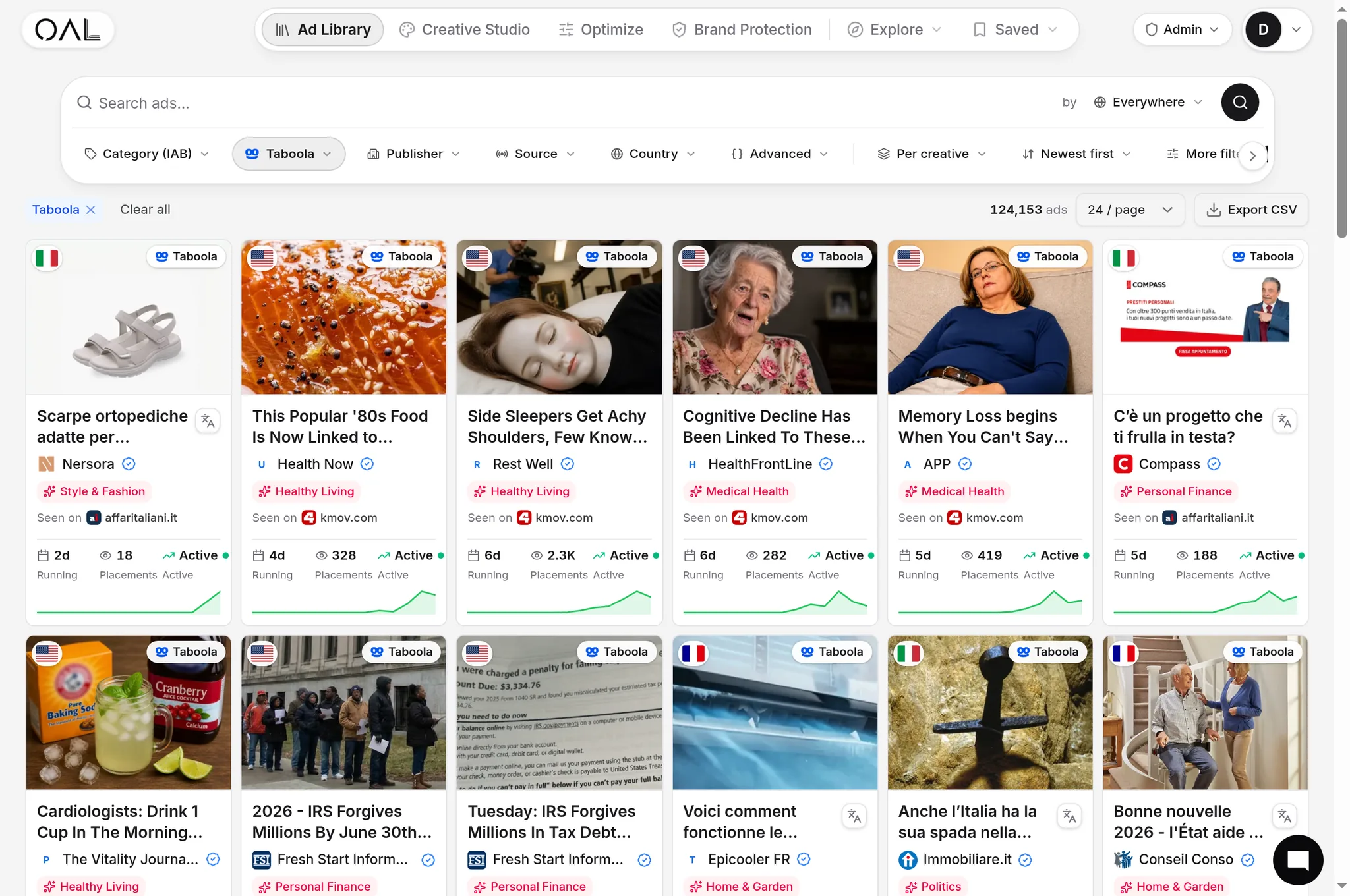
Whichever account type you run, the research question underneath it is identical: what's actually working on Taboola right now, for advertisers like you. OpenAdLibrary's index holds 206,145 live Taboola creatives as of June 2026, each with the resolved advertiser, observed run length, and the traced landing page attached. That's useful before you ever open Backstage, because it shows which angles have survived long enough to be worth testing rather than guessing cold. It stays just as useful once you're managed, because a strategist's recommendations are only as good as the market context you bring into that relationship. The Taboola ad spy guide walks through the research workflow in more depth, and media buying for native ads is a solid primer if Backstage is your first native platform.