Español
 Português (Brasil)
 Français
 Deutsch
 Italiano
 Nederlands
 Polski
 Svenska
 Türkçe
 Русский
 日本語
日本語 한국어
한국어 简体中文
简体中文 Tiếng Việt
 Bahasa Indonesia
 繁體中文
繁體中文 Čeština
 Dansk
Dansk Norsk (bokmål)
 Suomi
Suomi Ελληνικά
 Română
 Magyar
 Українська
 ไทย
ไทย हिन्दी
 العربية
 עברית
עבריתLanding Page Rejected? Why Taboola and Other Networks Say No
Native networks reject landers off a short, stable list of triggers: claims language, missing trust pages, disruptive behavior, ad mismatch. The full checklist, the fix for each, and why month-old live landers are your best compliance spec.


When Taboola rejects your landing page, the cause is almost always on a short list: unsubstantiated claims, missing trust elements (privacy policy, contact details, disclosures), disruptive page behavior like pop-ups or forced redirects, a mismatch between what the ad promises and what the page delivers, a restricted category, or a page that simply fails to load for the reviewer. The same checklist applies at Outbrain, MGID, and Revcontent — the networks differ mainly in how strictly they enforce it. Below is the trigger-by-trigger breakdown, the fix for each, and how to resubmit without burning account trust.
How native networks review your landing page#
Review covers the full click path, not just the URL you submitted. Reviewers — a mix of automated checks and human policy teams — follow the creative through any pre-lander to the final offer page, so a compliant advertorial in front of a non-compliant checkout still gets the whole campaign rejected. Account history matters: new accounts get slower, stricter review, and a record of violations tightens it further. Approval is also not permanent — pages get re-checked after they go live, which is why swapping content post-approval is treated as evasion rather than iteration.
Policies move, and each network publishes its own; check current specifics in the Taboola Help Center rather than relying on year-old forum threads. The campaign-side mechanics are covered in our guides to how Taboola ads work and advertising on Taboola step by step.
The rejection-trigger checklist#
| Trigger | What the reviewer sees | The fix |
|---|---|---|
| Unsubstantiated claims | Cure, guarantee, or overnight-results language; miracle superlatives | Soften to supportable claims; qualify; cite sources |
| Before/after imagery | Transformation photos in health, beauty, weight loss | Replace with product or lifestyle imagery |
| Missing required pages | No privacy policy, contact info, terms, or ad disclosure | Add real, linked, working versions of all four |
| Disruptive behavior | Pop-ups on load, exit traps, autoplay audio, forced downloads, redirect on load | Remove all of it — one interaction, one page |
| Ad-lander mismatch | Headline promise absent from the page; different product; count mismatch on a listicle | Make the lander pay off the ad's exact promise |
| Fake authority | Imitation news layouts, government-program framing, unearned "as seen on" logos | Remove or substantiate; use your own branding |
| Restricted category | Supplements, financial products, crypto, gambling without pre-approval | Read the category policy first; get written approval |
| Technical failure | Slow loads, broken mobile rendering, SSL errors, geo-blocking the reviewer | Test from multiple geos and devices before submitting |
| Cloaking | Reviewer sees a different page than users | Never — this is a ban, not a rejection |
Two of these deserve expansion.
Claims language is the most common rejection and the most fixable. The index shows the spectrum clearly: aggressive headlines in the style of "2 Veggies Will Kill Your Belly Fat Overnight!" circulate on native, but they live short, risky lives on strict networks — while an advertiser like Audika ran "Struggling to Hear Clearly? Discover a Device Transforming Lives" for 37 straight observed days on Taboola (June 2026 index data). Notice the construction: a question, then "discover," with no promised outcome. Softening a claim rarely costs as much CTR as buyers fear, and it is the difference between a lander that survives review and one that bounces twice.
Cloaking — serving the reviewer a clean page while users see something else — is in a different category from everything above it. Networks actively fingerprint for it, and detection means account termination, not a resubmission loop. We wrote up the detection mechanics in how ad cloaking gets exposed; the practice itself is defined in the glossary. If a "compliance consultant" proposes it, walk away.
Fixing and resubmitting#
- Read the stated rejection reason literally, then audit beyond it. Reviewers cite one violation; they rarely enumerate all of them. Resubmitting with only the named issue fixed — while a second sits unfixed — earns a second rejection and starts a pattern.
- Fix every instance across the full path. The pre-lander, the offer page, and any interstitial all count. So does the mobile rendering, which is what most native traffic — and often the reviewer — actually sees.
- Test the funnel exactly as it will be served. Click your own ad path with tracking parameters live, from the geo you are targeting. A broken redirect chain or a tracker error page mid-path reads as suspicious, not merely broken.
- Resubmit, and use your rep when you believe review erred. Resubmission review usually takes about as long as initial review. If you have an account manager, a specific, polite "here is what changed" note gets rereviews unstuck faster than silent resubmission.
- Log what triggered the rejection. A running compliance checklist, applied before each launch, is cheaper than the day of paused spend a rejection costs.
The pre-submission pass that prevents most of this#
Every trigger in the table is checkable before you submit, and the pass takes fifteen minutes:
- Load the full path on a phone, over cellular, from the target geo. Reviewers increasingly check mobile first because that is where the traffic is. A page that renders broken on a mid-range Android is a rejection regardless of how clean the desktop version is.
- Click every link in the footer. Privacy policy, terms, contact — they must resolve, not 404. Placeholder pages copied from a template with another brand's name still inside them are an instant credibility kill for a human reviewer.
- Read the lander aloud next to the ad. Anywhere the page makes a promise the ad didn't, or the ad made a promise the page doesn't keep, is mismatch surface. This catch is nearly free and buyers skip it constantly.
- Search your own copy for the red-flag words. "Cure," "guaranteed," "overnight," "banned," "doctors hate" — each one is either fixable in a minute now or a rejection in a day.
- Check the language matches the targeted geo. An English lander behind a campaign targeting a non-English geo reads as either a mistake or arbitrage, and both get flagged.
Rejection versus account risk#
A one-off content rejection is routine — every buyer running pre-landers at volume collects them. What escalates into account-level trouble is pattern behavior: repeating the identical violation across resubmissions, cycling fresh domains to dodge review (an evasion signal networks specifically watch for), and anything in cloaking territory. Networks price account trust into review speed and strictness, so protecting it compounds: clean accounts get faster approvals, which means faster testing cycles.
The verticals with the toughest claims scrutiny — supplements above all — have their own playbook of compliant angle construction; the nutra on native ads guide covers what survives review in the hardest category. Disclosure requirements, which trip up advertorial-style landers constantly, are laid out in the FTC advertorial disclosure rules.
Model landers that stay approved#
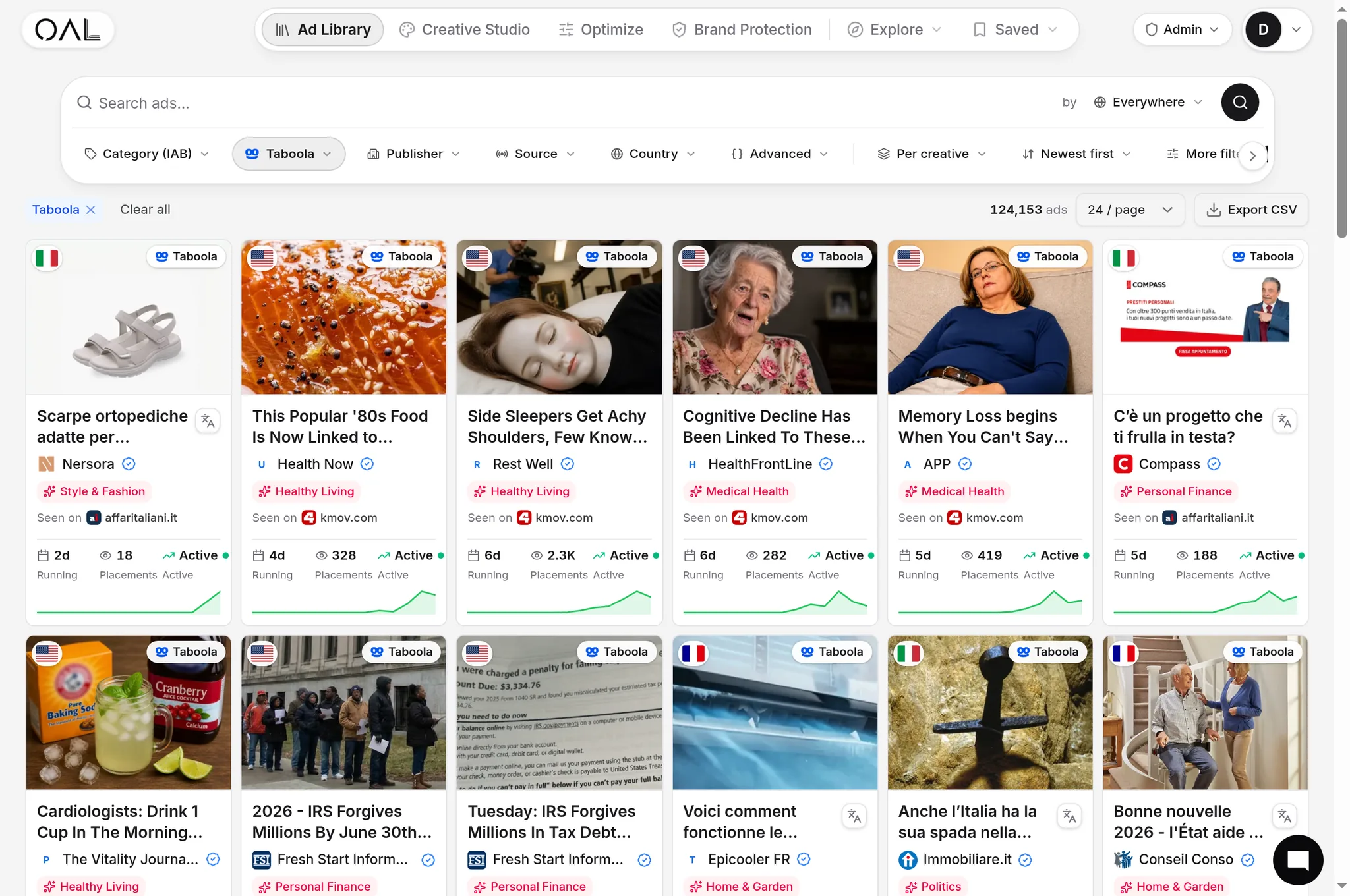
The most underused study set for approval problems: landing pages behind ads that keep running. A lander live and funded for 30+ days has, by definition, passed review and survived re-checks — and OpenAdLibrary's index holds 206,000+ live Taboola creatives (June 2026) with their captured landing pages. Filter Taboola's live ads in your vertical, sort toward the longest-running creatives, and read five of the landers behind them. The shared pattern is unmistakable: question-form or softened claims, visible disclosures, working footer pages, no interruption mechanics. That is the compliance spec, demonstrated by pages that are paying rent under it right now.
Rejections are feedback with unusually low ambiguity — the list of things networks check is short, stable, and mostly public. Fix the trigger, audit the rest of the path while you are in there, and build the checklist into your launch routine so review becomes a formality instead of a gate.