 Español
 Português (Brasil)
 Français
 Deutsch
 Italiano
 Nederlands
 Polski
 Svenska
 Türkçe
 Русский
 日本語
日本語 한국어
한국어 简体中文
简体中文 Tiếng Việt
 Bahasa Indonesia
 繁體中文
繁體中文 Čeština
 Dansk
Dansk Norsk (bokmål)
 Suomi
Suomi Ελληνικά
 Română
 Magyar
 Українська
 ไทย
ไทย हिन्दी
 العربية
 עברית
עבריתTraffic Needed for Taboola & Outbrain: Thresholds by Network
Neither Taboola nor Outbrain publishes a hard pageview minimum, but real-world approval patterns cluster around a rough threshold, and content quality matters as much as volume.


Neither Taboola nor Outbrain publishes a hard minimum traffic threshold for publishers, but in practice both networks approve accounts far more readily above roughly 50,000 monthly pageviews, and sites well below that (a few thousand pageviews a month) frequently get rejected or approved with widgets that barely fill, because there simply isn't enough volume to make the integration worth the network's review overhead or an advertiser's auction interest.
Why there's no official number#
Taboola and Outbrain both review publisher applications case by case, weighing traffic volume alongside content quality, niche, geo mix and site legitimacy (real editorial content, clear ownership, no policy violations like cloaked redirects or prohibited categories). A smaller site in a high-value vertical like personal finance can get approved faster than a much larger site with low-quality, ad-farm-style content, because the review isn't purely a volume gate. That said, volume is still the single biggest practical factor, since a widget on a site with negligible traffic generates negligible revenue for either the publisher or the network, making the review cost not worth it on tiny sites.
Rough thresholds publishers report#
These are patterns publishers and forum communities describe from their own application experiences, not official published minimums, and network policy changes over time, so check each network's current publisher application requirements directly before assuming these hold.
| Network | Traffic pattern commonly associated with easier approval |
|---|---|
| Taboola | Roughly 50,000+ monthly pageviews, established site history |
| Outbrain | Similar range to Taboola, slightly more flexible for niche/quality sites |
| MGID | Known for a lower bar, approves smaller and newer sites more readily |
| Revcontent | Mid-range, often approves sites Taboola/Outbrain reject |
| MediaGo | Newer, smaller network; generally more open to smaller publishers |
What actually gets reviewed beyond raw pageviews#
- Content legitimacy. Real, original editorial content, not scraped or auto-generated pages, and a site that reads like it exists for readers, not purely to host ad widgets.
- Traffic source quality. Organic and direct traffic weighs more favorably than traffic acquired through paid arbitrage or low-quality push notification campaigns, which some networks flag or reject outright.
- Geo mix. A site with meaningful Tier-1 traffic (US, UK, Canada, Australia, Western Europe) tends to clear review faster, since that's where advertiser demand concentrates; a site with traffic concentrated in lower Tier-2/Tier-3 geos may face more scrutiny or lower initial fill even if approved.
- Site health basics. Working privacy policy, clear contact or about information, functioning navigation, no obvious malware or cloaking, HTTPS. These are baseline trust signals reviewers check regardless of traffic size.
- Existing ad load. A site already saturated with aggressive display ads, pop-unders or redirect ads may get flagged for policy concerns rather than approved outright, since native networks want their widget to look like a legitimate content recommendation, not one more piece of ad clutter.
What to do below the threshold#
If your site sits under the rough volume where Taboola or Outbrain approve readily, a few paths exist rather than simply waiting to grow:
- Apply to MGID, Revcontent or MediaGo first. These networks are commonly reported as more open to smaller and newer publishers, and you can build revenue and traffic history while growing toward Taboola/Outbrain-level scale.
- Consolidate traffic under fewer, larger properties if you run multiple small sites, since a single site with combined traffic clears review more easily than several sites each below threshold individually.
- Focus growth on a high-value vertical rather than general content, since a smaller but genuinely engaged finance, health or insurance audience can be more attractive to a reviewer (and to the auction afterward) than a much larger but low-value entertainment audience.
- Reapply after a meaningful traffic milestone, rather than repeatedly reapplying on marginal month-to-month changes; most networks note repeated near-identical applications and it rarely speeds up approval.
How geo mix shifts the effective threshold#
The rough pageview numbers above assume a reasonably Tier-1-weighted audience. A site with the same total pageviews but concentrated in Tier-2 or Tier-3 geos often needs meaningfully more volume to hit the same approval bar, since reviewers (and the auction afterward) weigh the advertiser value of the traffic, not just its size. A site with 80,000 monthly pageviews split across a dozen lower-value geos can be a tougher approval than a site with 40,000 pageviews concentrated in the US and UK. If most of your audience sits outside Tier-1 markets, it's worth checking our geo tiers glossary entry to understand how networks typically bucket geo value, and applying to MGID or Revcontent first, since both are commonly reported as more willing to work with non-Tier-1-heavy traffic.
Multi-site and network publishers#
Sites or networks of sites that operate under one publisher account (a media group with several verticals, for instance) often clear thresholds more easily by applying at the account level rather than per domain, since the combined traffic and combined content history reads as more established to a reviewer. If you operate several smaller sites individually, check whether the network supports a multi-domain publisher account before applying separately for each one; getting rejected on a standalone small site and then reapplying under a combined account is a common and often successful path.
Why volume matters even after approval#
Getting approved is only the first gate. Below a certain volume, the widget's own auction dynamics work against you: too few impressions per day means the network's optimization has too little data to learn which advertisers perform on your specific traffic, so early fill and CPC often underperform what a higher-volume site with faster learning would see. This is a separate effect from the approval threshold itself, and it's why some newly-approved small publishers see disappointing early numbers even after clearing review, and see them improve gradually as volume accumulates and the algorithm has more signal to work with.
The application process itself#
Both networks typically ask for your site URL, traffic estimates (often self-reported, sometimes cross-checked against analytics tools the network trusts), content category, and monetization goals during signup, a lighter version of what an advertiser goes through in our step-by-step Taboola setup guide. Expect a review period ranging from a couple of days to a couple of weeks depending on the network and current application volume; Taboola and Outbrain, being larger organizations with more applications to process, sometimes take longer than smaller networks like MediaGo. Some publishers report faster review when applying through an account manager or partner referral rather than the self-serve signup form, though this isn't guaranteed and depends on the network's current sales capacity.
If rejected, most networks allow reapplication after addressing the stated reason (adding a privacy policy, improving content originality, growing traffic) rather than a permanent ban, so treat an initial rejection as a checklist rather than a dead end. Reading the specific rejection reason carefully matters more than reapplying quickly; a rejection for "insufficient traffic" and a rejection for "content policy concern" call for completely different fixes.
Weighing starting small against waiting to grow#
There's a real tradeoff between applying now to a more permissive network like MGID or Revcontent versus waiting until your traffic clears the range comparable to Taboola vs Outbrain approval, and whether that wait is even worth it depends on whether Taboola is worth it for your specific niche in the first place. Starting small has two advantages: you begin earning and learning the optimization mechanics (widget placement, tile testing, understanding your own RPM patterns) sooner, and you build a track record that can make future applications to bigger networks smoother. The downside is that running a smaller network's widget doesn't preclude switching later, since most publishers aren't locked into exclusivity, so there's limited real cost to starting now rather than waiting.
Checking what's actually running before you commit#
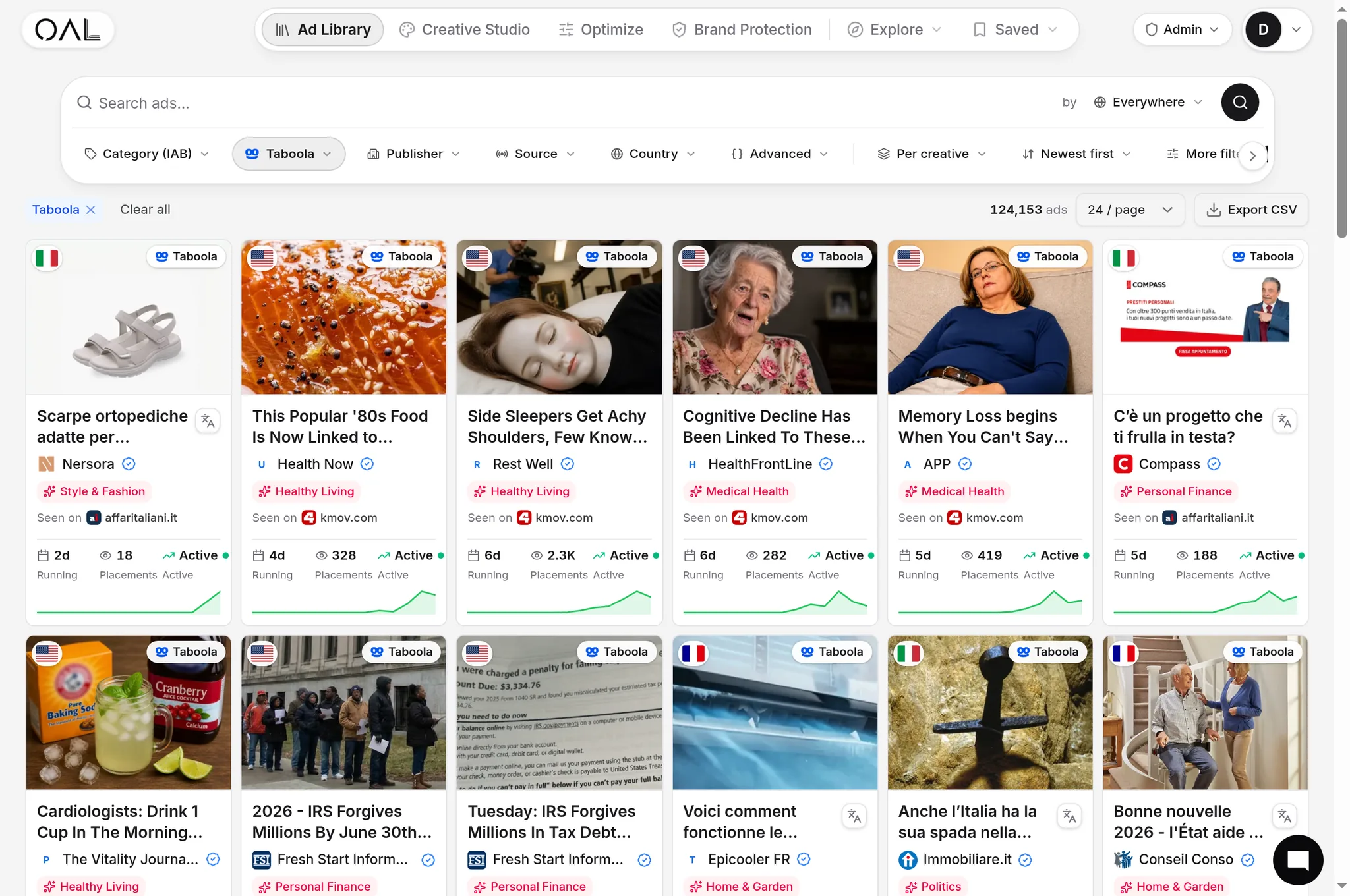
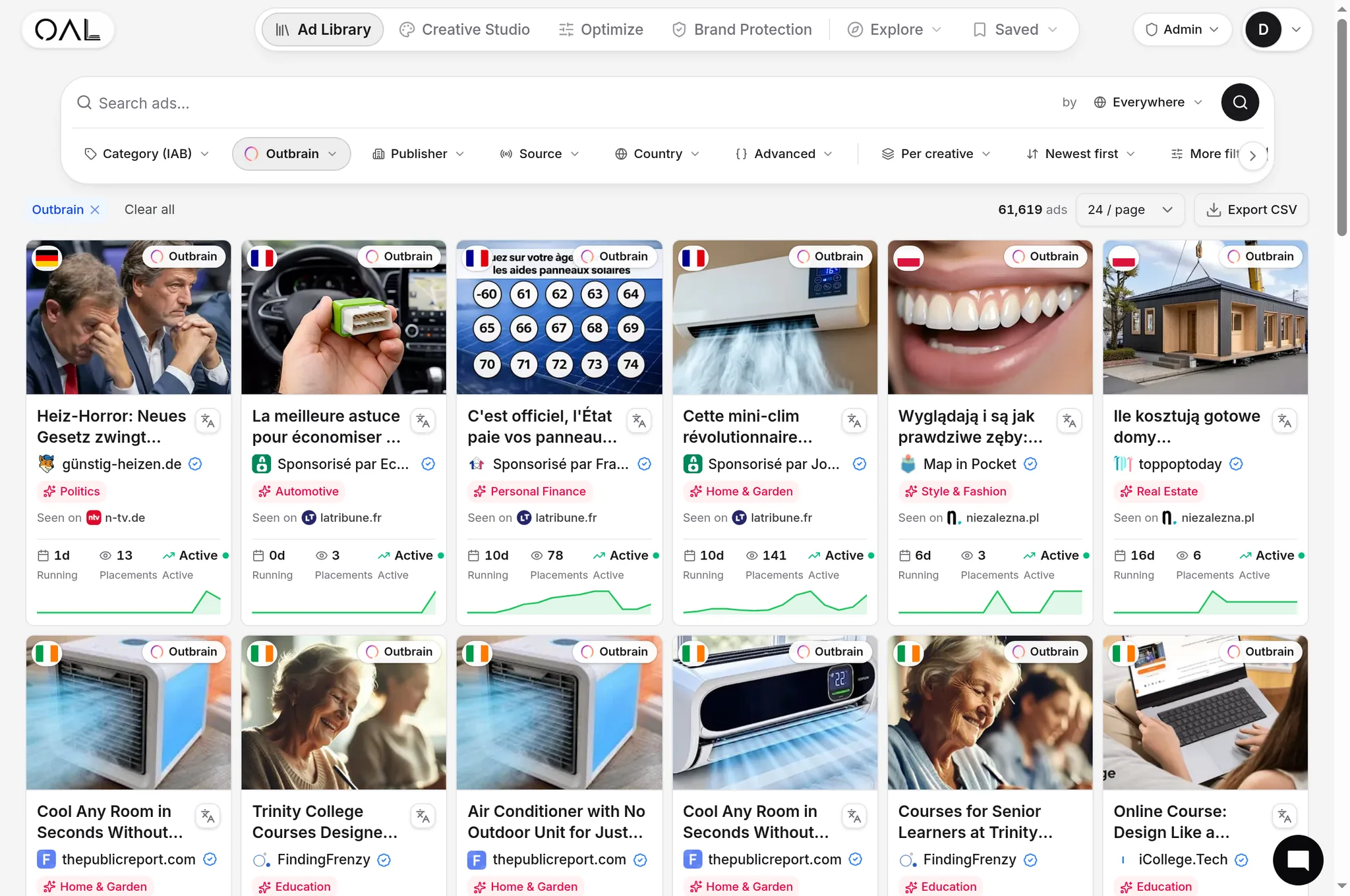
Rather than guessing which network fits your traffic profile from marketing pages alone, it helps to look at what's actually live on each network in your content vertical and comparable geos. OpenAdLibrary's index tracks over 725,000 native ad creatives across 49 networks as of June 2026, including a Taboola corpus over 206,000 creatives deep and an Outbrain corpus over 108,000, which gives you a sense of how much active advertiser competition (and therefore likely auction depth) exists on each network before you go through an application process. You can browse this by network on the Taboola and Outbrain tool pages.