Español
 Português (Brasil)
 Français
 Deutsch
 Italiano
 Nederlands
 Polski
 Svenska
 Türkçe
 Русский
 日本語
日本語 한국어
한국어 简体中文
简体中文 Tiếng Việt
 Bahasa Indonesia
 繁體中文
繁體中文 Čeština
 Dansk
Dansk Norsk (bokmål)
 Suomi
Suomi Ελληνικά
 Română
 Magyar
 Українська
 ไทย
ไทย हिन्दी
 العربية
 עברית
עבריתHow Much Does Taboola Pay Publishers? RPM Economics Explained
Taboola pays publishers a negotiated share of widget click revenue — there is no flat rate. Here is the RPM math, the levers that actually move it, and how to inspect the demand that will fill your slots before you sign.


Taboola does not pay publishers a flat rate. Like Outbrain, it pays a negotiated share of the advertiser revenue its widget generates on your pages — so your income depends on how many widget clicks your audience produces, the CPCs advertisers pay for those clicks, and your revenue-share percentage. There is no official public rate card. Publishers commonly report effective RPMs anywhere from well under $1 to the low double digits per thousand pageviews depending on geo, audience, and placement — a huge range, which is exactly why understanding the mechanics matters more than chasing a single number. Here is the model, the math, the levers, and what live capture data reveals about the demand that actually fills those widgets.
How the payment model works#
Taboola places a content recommendation widget — the "Sponsored" or "You May Like" grid — on your article pages. Advertisers pay Taboola per click on those items; Taboola passes a contracted percentage of that revenue to you. Three contract shapes are common:
- Revenue share. You get a percentage of what advertisers paid for clicks on your pages. This is the default for most publishers.
- Guaranteed rate. Large publishers sometimes negotiate a guaranteed RPM or a guaranteed minimum, shifting yield risk onto the network. Guarantees are a function of leverage — meaningful, loyal traffic in geos advertisers want.
- Hybrid. A floor plus upside share.
Both major networks also gate entry on traffic volume, and thresholds change over time — check Taboola's current publisher documentation rather than trusting any number in a blog post, including this one. Smaller sites that don't clear the bar usually start on mid-tier networks instead.
The RPM math#
Your effective widget RPM — revenue per 1,000 pageviews — decomposes into three numbers:
Widget RPM = (widget clicks per 1,000 pageviews) × (average advertiser CPC) × (your revenue share) — where clicks per 1,000 pageviews is itself widget viewability × click-through rate.
A purely illustrative example (these are round numbers for arithmetic, not benchmarks): if 1,000 article pageviews produce 8 sponsored clicks, advertisers paid an average of $0.25 per click, and your share is 50%, your widget RPM is 8 × $0.25 × 0.5 = $1.00. Double the CPC — because your audience is US desktop finance readers instead of tier-3 mobile entertainment traffic — and the same click behavior pays $2.00. The formula explains why two publishers with identical traffic volume can earn wildly different amounts from the same widget.
What actually moves your number#
- Geography. Advertiser bids concentrate on tier-1 geos — US, UK, Canada, Australia, Western Europe. The same widget on the same content earns a fraction as much from tier-2/3 traffic because the click market clears at lower CPCs.
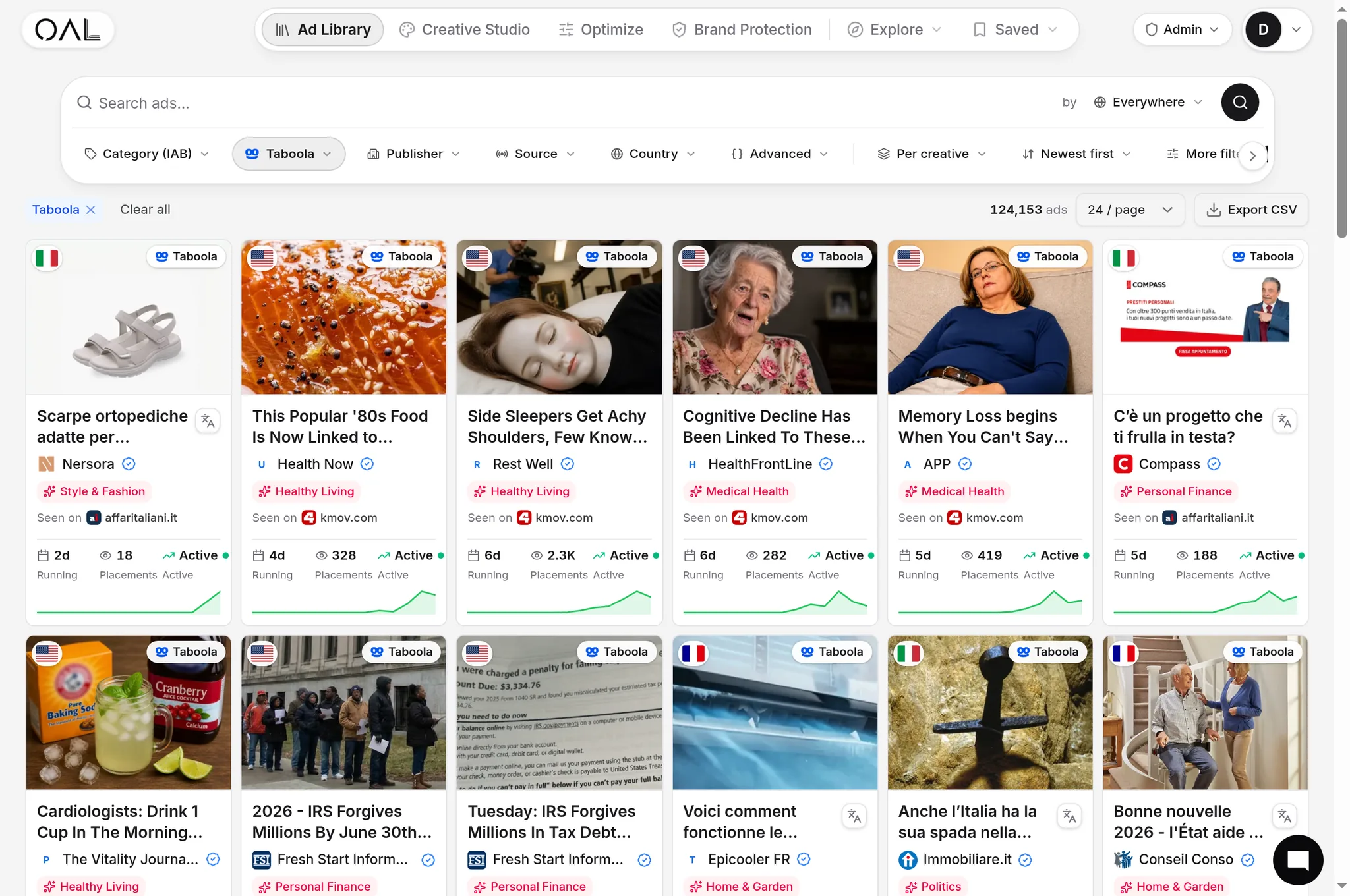
- The advertiser mix bidding on your audience. Demand depth is not evenly distributed. In OpenAdLibrary's live index (July 2026), the biggest Taboola verticals by live creatives are health (11,982), finance (8,200), and insurance (7,422) — categories that historically sustain stronger CPCs than entertainment arbitrage demand. If your audience matches what those advertisers want, your clicks are worth more. See who advertises on Taboola for the full demand picture.
- Placement and integration. The standard below-article widget is the baseline. Mid-article units and feed-style integrations typically lift CTR, at a real cost in user experience — a trade every publisher has to price for themselves.
- Device and audience intent. Long-session desktop readers who finish articles reach the widget; bounce-heavy social mobile traffic often never scrolls to it.
- Seasonality. Q4 demand pushes auctions up; the January reset pulls them down. The pattern is directionally reliable even though magnitudes vary.
Taboola vs Outbrain vs the mid-tier networks#
From the publisher's chair, the choice looks like this:
| Network | Entry bar | Demand depth (live creatives in our index, July 2026) | Typical fit |
|---|---|---|---|
| Taboola | High — volume-gated | 206,000+ | Large general-interest and news publishers |
| Outbrain | High — volume-gated, quality-positioned | 108,000+ | Premium editorial brands |
| MGID | Accessible to smaller sites | 62,000+ | Mid-size and international publishers |
| Revcontent | Accessible | 15,000+ | Niche and mid-size sites |
Index counts measure observed live creative supply, not revenue — but they are a usable proxy for how deep the advertiser pool bidding for your slots is. The head-to-head differences are covered in Taboola vs Outbrain and MGID vs Revcontent. One structural note: since the Outbrain–Teads merger, Outbrain's publisher offering sits inside a larger omnichannel company, which has changed little about the widget economics themselves.
A related reality check: a meaningful slice of widget demand is traffic arbitrage — advertisers buying your clicks to monetize them on their own ad-stacked pages. That demand is real revenue, but it caps CPCs (arbitrageurs need margin) and shapes the ad quality your readers see.
See what actually fills the widgets#
Before and after signing, you can inspect the demand side directly. OpenAdLibrary captures live native placements — 725,000+ creatives across 49 networks, with per-network advertiser and vertical breakdowns — so you can see exactly what kind of ads run on publishers like yours, which brands are behind them, and how long campaigns persist. Browse live Taboola demand in the Taboola spy tool, or look up a specific publisher to see which networks serve it and whose ads fill the slots. For a publisher weighing an offer, checking what the widget will actually show next to your journalism is due diligence, not curiosity — how Taboola ads work explains the advertiser side of the same market.
Practical levers to raise your widget RPM#
Once live, most publishers treat the widget as fixed furniture and leave money on the table. The controllable levers:
- Fix viewability before anything else. A widget that loads below content nobody finishes earns nothing regardless of CPCs. Improving article completion — tighter intros, fewer interstitials above the widget — lifts widget RPM as a side effect of lifting engagement.
- Test placement variants deliberately. Run the network's alternative units (mid-article, feed-style) on a subset of templates and compare page RPM and session metrics. Some publishers find the extra revenue isn't worth the recirculation and retention cost; others find the opposite. Measure it rather than guessing.
- Shape content toward demand, within reason. You should never chase widget revenue with editorial strategy, but at the margin it helps to know that health, finance, and insurance advertisers make up the deepest bid pool. A personal-finance explainer will usually monetize its widget better than a celebrity gallery with identical traffic.
- Prune what the block lists let you prune. Cutting the lowest-quality ad categories can raise long-run revenue by keeping readers on the site — the CPC you lose on one click is often smaller than the sessions you keep.
- Renegotiate on evidence. After six months you have real RPM data. If your traffic has grown or your geo mix has improved, that is leverage; networks revisit terms for publishers they don't want to lose.
Questions to ask before you sign#
- Revenue share or guarantee — and what exactly triggers the guarantee? Guarantees often carry placement, exclusivity, or traffic conditions; know what voids them.
- Is the contract exclusive? Widget deals commonly lock the below-article slot for the term. Model what you give up if a competitor offers better terms in month six.
- What ad-quality controls do I get? Category blocks and advertiser blocklists exist on every major network; ask how granular they are and who enforces them.
- What are the payment terms? Net terms and minimum payout thresholds affect cash flow for smaller publishers.
- What does reporting expose? You want click-level geo and page-level RPM visibility, not just a monthly total — you can't optimize what you can't see.
The honest summary: "how much does Taboola pay?" has no single answer because you are selling clicks into a live auction and keeping a negotiated cut. Publishers with tier-1 audiences, engaged readers, and demand-heavy verticals do well; publishers hoping a widget will rescue thin, low-intent traffic are usually disappointed. Run the RPM math with your own numbers, inspect the live demand before you commit, and negotiate the contract terms — not just the headline percentage.