Español
 Português (Brasil)
 Français
 Deutsch
 Italiano
 Nederlands
 Polski
 Svenska
 Türkçe
 Русский
 日本語
 한국어
 简体中文
 Tiếng Việt
 Bahasa Indonesia
 繁體中文
 Čeština
 Dansk
 Norsk (bokmål)
 Suomi
 Ελληνικά
 Română
 Magyar
 Українська
 ไทย
 हिन्दी
 العربية
 עברית
10 Taboola Ad Examples Captured in July 2026, and What Each Headline Does
Ten Taboola creatives captured in July 2026, each with its recorded advertiser label, observed span and headline technique: eligibility hooks, casting-call angles, editorial blends, geo-personalization and offer-led cards.


This gallery shows ten Taboola creatives that OpenAdLibrary captured in July 2026. Each entry gives the headline, the image, the advertiser label recorded at capture and the observed span: the number of days between the first and last time the creative appeared in our captures. An observed span is not continuous delivery, and it does not show spend, clicks, conversions, profit or policy approval. The ten were selected to show a range of advertiser types and headline techniques; they are not a representative sample of Taboola's feed.
We have grouped the examples by the headline technique each one uses, because the technique is the transferable part. Copy a headline and you get one ad; understand the technique and you can write your own variants to test. If you want the theory first, read hook vs. angle vs. claim; this page is the applied version.
A note on selection: we picked these to show a range of advertiser types, including lead-generation offers (hearing aids, senior rebates), a healthcare provider, an airline, a bank, an investment firm and a publisher buying traffic to its own articles. The set is illustrative. It does not measure the feed's composition or show which advertiser types or techniques perform best. Observed spans describe the July 2026 captures only.
1. The eligibility hook: "Government Rebates for Over 60s [Check Eligibility]"#

Advertiser label: Senior Savings · Observed span: 13 days (July 2026 captures)
This headline offers a benefit the reader might already be entitled to and adds a qualification step. Three techniques are combined. The demographic callout ("Over 60s") addresses a specific reader. "Government" borrows institutional authority, which is also why the claim needs care: the rebate must exist, be described accurately and not suggest that the advertiser is a government body. Realize's policies tell advertisers to avoid government symbols on landing pages and, for mortgage ads, bar any suggestion of official government affiliation. The bracketed "[Check Eligibility]" frames the click as a verification step. The capture does not verify the rebate, and a 13-day observed span does not show that the campaign was profitable or that the ad met any policy.
2. The casting-call angle: "Wanted: Australians who want to try High-Tech Hearing Aids"#

Advertiser label: auditorey.com · Category label at capture: Health · Observed span: 4 days (July 2026 captures)
"Wanted:" reframes a product pitch as a recruitment notice, so the reader appears to be selected rather than sold to. The geo callout ("Australians") and the novelty qualifier ("High-Tech") make it read like a limited opportunity, so the landing page has to match that impression: if there is no real trial or selection, the framing can mislead. The 4-day observed span could reflect a new variant, a short test, a paused ad or a gap in our captures; the capture does not tell us which.
3. The benefit-shift variant: "Gov't Now Pays For Your Hearing Aids (See If You Qualify)"#

Advertiser label: auditorey.com · Category label at capture: Health · Observed span: 19 days (July 2026 captures)
This is the same advertiser label as #2 with a different angle. In the July 2026 captures the casting-call variant had a 4-day observed span and this eligibility variant 19 days. That difference does not show which variant performed better: the two may have started on different dates, run on different placements or been captured unevenly. "Now" implies a recent policy change, so it is only acceptable if such a change actually happened and readers can qualify on the terms the landing page sets out. A government-funding claim for a health product needs substantiation and qualified review. The parenthetical qualifier plays the same role as example #1's brackets. Comparing a competitor's variants is covered in how to analyze winning native ad creatives.
4. The editorial blend: "Lung Cancer Screening: What Australians Ask Most"#

Advertiser label: I-MED Radiology Network · Category label at capture: Health · Observed span: 19 days (July 2026 captures)
This healthcare provider's headline is structured like a health-desk FAQ article: no urgency, just a question readers may already have. Editorial styling has a limit. The FTC's native advertising guidance says advertisers are responsible for making native ads identifiable as advertising, and Taboola requires sponsored content to carry the sponsoring company's name, so matching the editorial tone works only while the sponsor label stays clear. The 19-day observed span does not show that the campaign worked or that it was reviewed as compliant, and health-screening content needs qualified review for the target market. For how sponsored cards are presented, see how Taboola's feed actually works.
5. The explainer variant: "Australia's Lung Cancer Screening Program Explained"#

Advertiser label: I-MED Radiology Network · Observed span: 11 days (July 2026 captures)
I-MED again, with "Explained" alongside "What Australians Ask Most." The two variants had observed spans of 11 and 19 days. Running parallel variants is a common way to test messages, but these captures do not show whether I-MED was testing, how budget was split or which variant performed better. To compare a competitor's variants yourself, map a competitor's full creative set and record the date of each sighting.
6. The seasonal-local hook: "Escape to cooler New South Wales"#

Advertiser label: Singapore Airlines · Observed span: 10 days (July 2026 captures)
Five words. The technique is context: for readers in a hot climate such as Singapore's, where we captured it, "cooler" carries the pitch and "Escape" supplies the action. Our captures show where we saw the ad, not the airline's targeting settings. It reads like a feed headline (a promise and a place, with no slogan), but the capture does not show how it performed against the brand's other creatives.
7. The sensory listicle: "Snow, sea and springtime blooms in Sydney and New South Wales"#

Advertiser label: Singapore Airlines · Observed span: 15 days (July 2026 captures)
The sibling creative to #6, with a longer observed span (15 vs. 10 days), which does not by itself show that it performed better. Instead of one benefit it stacks three concrete images (snow, sea, blooms), a rhythm borrowed from travel features. Two variants from one brand appear in the July 2026 captures; that is one example, not evidence of how airlines generally run native campaigns.
8. The offer-led card: "Up to S$22 off with minimum spend every weekend"#

Advertiser label: HSBC Credit Cards · Category label at capture: Ecommerce (the offer is a credit-card promotion) · Observed span: 21 days (July 2026 captures)
This had the longest observed span in the gallery (21 days) and is the least "native" headline of the ten: a straight promotion with an exact amount (S$22), a condition (minimum spend) and a repeating window ("every weekend"). Those details make the offer concrete, but the observed span does not show that the funnel converted (see what ad longevity can and cannot show); a bank may keep an always-on card promotion running for brand or partnership reasons. Check current policy before copying the format: Realize's help article on exaggerated title claims (June 2025) says promotions must not contain exact dollar amounts that users can save or earn, so this capture is not evidence that the same headline would be approved today.
9. The geo-personalized finance angle: "Retirement Income: Exclusive Tips for Singaporeans"#

Advertiser label: Fisher Investments Singapore · Category label at capture: Finance · Observed span: 2 days (July 2026 captures)
The structure combines a category keyword ("Retirement Income"), an exclusivity cue ("Exclusive Tips") and a nationality ("for Singaporeans"). This creative had a 2-day observed span in July 2026, so it shows only that the format was in use. Retirement and investment promotions are regulated in many markets, and Taboola's finance rules require compliance with applicable local law, so "Exclusive" must be accurate and the claims need qualified review for the target market. Our finance native ads breakdown has more finance examples; neither page measures how common this template is.
10. The content-arbitrage card: "All the biggest trends in luxury hospitality in Asia this 2026"#

Advertiser label: Prestigeonline.com · Observed span: 3 days (July 2026 captures)
A publisher buying feed traffic to its own articles. Depending on how the publisher earns from that traffic, this is called audience development or arbitrage; the capture does not show which applies here. The headline uses editorial packaging ("All the biggest trends… this 2026"): superlative, niche and recency. Taboola publishes separate policy guidance for stories and slideshow arbitrage. This gallery does not measure how much of the feed such buyers account for; who advertises on Taboola discusses the advertiser mix, subject to the same capture limits.
The headline formulas behind these ten ads#
The ten headlines above reduce to five patterns. Each needs an accurate claim and a current policy check before you reuse it:
| Pattern | Captured example (July 2026) | What it does | Check before using |
|---|---|---|---|
| Benefit + audience + [qualifier] | "Government Rebates for Over 60s [Check Eligibility]" | Frames the click as an eligibility check | The benefit must exist and be described accurately; do not imply government affiliation |
| "Wanted:" / recruitment framing | "Wanted: Australians who want to try High-Tech Hearing Aids" | Presents the offer as a selection | Use only if there is a real trial or selection |
| Authority + "Now" + parenthetical | "Gov't Now Pays For Your Hearing Aids (See If You Qualify)" | Implies a recent change | Use only if the change is real; health and government-funding claims need substantiation |
| Question/FAQ editorial structure | "Lung Cancer Screening: What Australians Ask Most" | Matches the tone of nearby articles | Keep the sponsor label clear; the ad must be identifiable as advertising |
| Specific offer + recurring window | "Up to S$22 off with minimum spend every weekend" | Makes the offer concrete | Check current rules on exact amounts users can save, and state the conditions |
Two observations from these ten, which describe this small selection only. First, seven of the ten headlines name a nationality or place ("Australians," "Singaporeans," "New South Wales," "Asia"); whether location callouts raise response would need a controlled test, and Taboola's title guidance flags geographic statements that are inaccurate for the users targeted. Second, the longest observed spans do not share one style: the 19- and 21-day creatives include two with qualifying conditions ("See If You Qualify," "minimum spend") and one plain editorial question (I-MED's "What Australians Ask Most"). Observed spans are not a performance ranking. Our native ad headlines guide covers headline patterns more broadly.
The images show patterns too, though ten examples cannot rank them. Several use people in everyday settings (the hearing-aid and screening creatives), and several show the product or destination in context (HSBC's card, the airline's destination photography) rather than a studio shot. None uses heavy text overlays. These are observations about this selection, not evidence that one image style outperforms another. Keep images accurate to the offer: Realize's thumbnail policy prohibits misleading thumbnails and before-and-after photos.
A note on geography: these ten were captured through our Australia and Singapore feed monitoring. The techniques may not transfer to other markets, and advertisers, rules and audiences can differ by country, so validate any angle in your target geo; the Taboola ad spy guide covers country-level research.
What these ten cannot tell you about the Taboola feed#
A ten-ad gallery cannot describe the whole feed. Health, finance and travel offers appear in this selection, but our category counts describe the creatives we captured and how our classifier labelled them, not Taboola's market share, spend or audience. Taboola says its ads appear on publisher sites including Yahoo, NBC News, MSN, The Independent and The Weather Channel; check the audience and placements available to your own campaign rather than inferring them from a sample.
The advertiser labels in the July 2026 captures were also more varied than this gallery suggests. Besides brands (Singapore Airlines, HSBC, I-MED) and lead-generation offers (auditorey, Senior Savings), they included creatives labelled Yahoo Search and publishers buying traffic to their own pages. A creative count per label measures how many distinct creatives we captured, not spend or reach, and a label is not always the company that sells the final offer. Who advertises on Taboola and our top advertisers by network ranking discuss the mix, subject to the same limits.
Turnover is hard to measure from captures. The share of creatives first seen in a recent window depends on when our capture started and how consistently it ran, so it is not a measure of how quickly advertisers replace creatives. A creative that stays visible for weeks has not necessarily been re-bought by an advertiser watching profits: it may belong to an always-on brand budget, a slow test or an automated rotation, and our captures can miss days.
How to build your own Taboola example library#
Static galleries, including this one, age. The creatives above were captured in July 2026, and some will no longer be running when you read this. Newer captures show what advertisers are running now, not what is working. To repeat this analysis yourself:
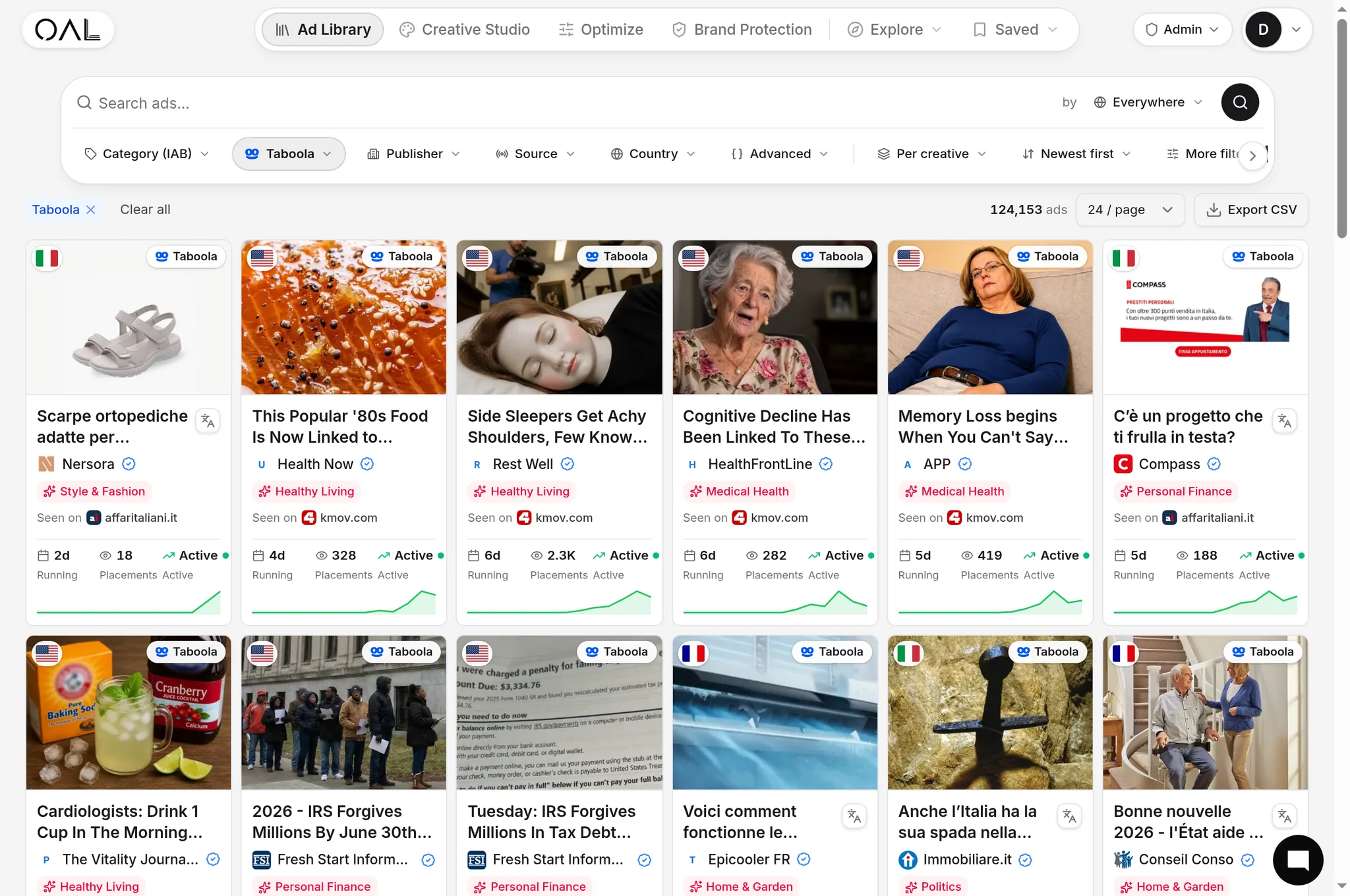
Open the Taboola ad library view and filter by your vertical and geo (search and filters require the Founders plan). Use the days-running filter to find creatives with long observed spans, and treat them as candidates for inspection, not proven winners. Open each advertiser to see their variant set (like auditorey's two angles above) and follow the traced landing page to the funnel. Save the patterns, not the pixels: remix the mechanism, never copy the creative, and check each claim against current policy. Repeat the review on a schedule that suits your market and date every capture you save; a gallery built in July is a historical record within weeks.
The free plan, with no card, shows the 20 newest Meta, TikTok and native ads, including ad detail, the supply chain behind native ads, and redirect trails and captured landing pages for native ads. To search and filter Taboola creatives, including by days running, start a full account on the Founders plan ($29.99 a month).