Español
 Português (Brasil)
 Français
 Deutsch
 Italiano
 Nederlands
 Polski
 Svenska
 Türkçe
 Русский
 日本語
日本語 한국어
한국어 简体中文
简体中文 Tiếng Việt
 Bahasa Indonesia
 繁體中文
繁體中文 Čeština
 Dansk
Dansk Suomi
Suomi Ελληνικά
 Română
 Magyar
 Українська
 ไทย
ไทย हिन्दी
 العربية
 עברית
עבריתTaboola for Lead Generation: Setup, Costs and Quality
Whether Taboola fits a lead-gen model, how to set up a campaign for it, realistic cost expectations, and what to do about lead quality being colder than search traffic.


Taboola works for lead generation, but the economics depend heavily on vertical. Insurance and finance, two of the largest categories on the network, are built around exactly this model (a click that turns into a form fill), while low-consideration ecommerce products tend to fit a direct-sale model better. If your offer already converts on a quote form or a short application, Taboola's feed placements are a reasonable channel to test; if your funnel requires a long, trust-heavy sales process, expect a rougher fit.
This covers how a lead-gen setup on Taboola actually works, what quality to expect, and the costs media buyers commonly report.
Why lead gen fits Taboola's feed format#
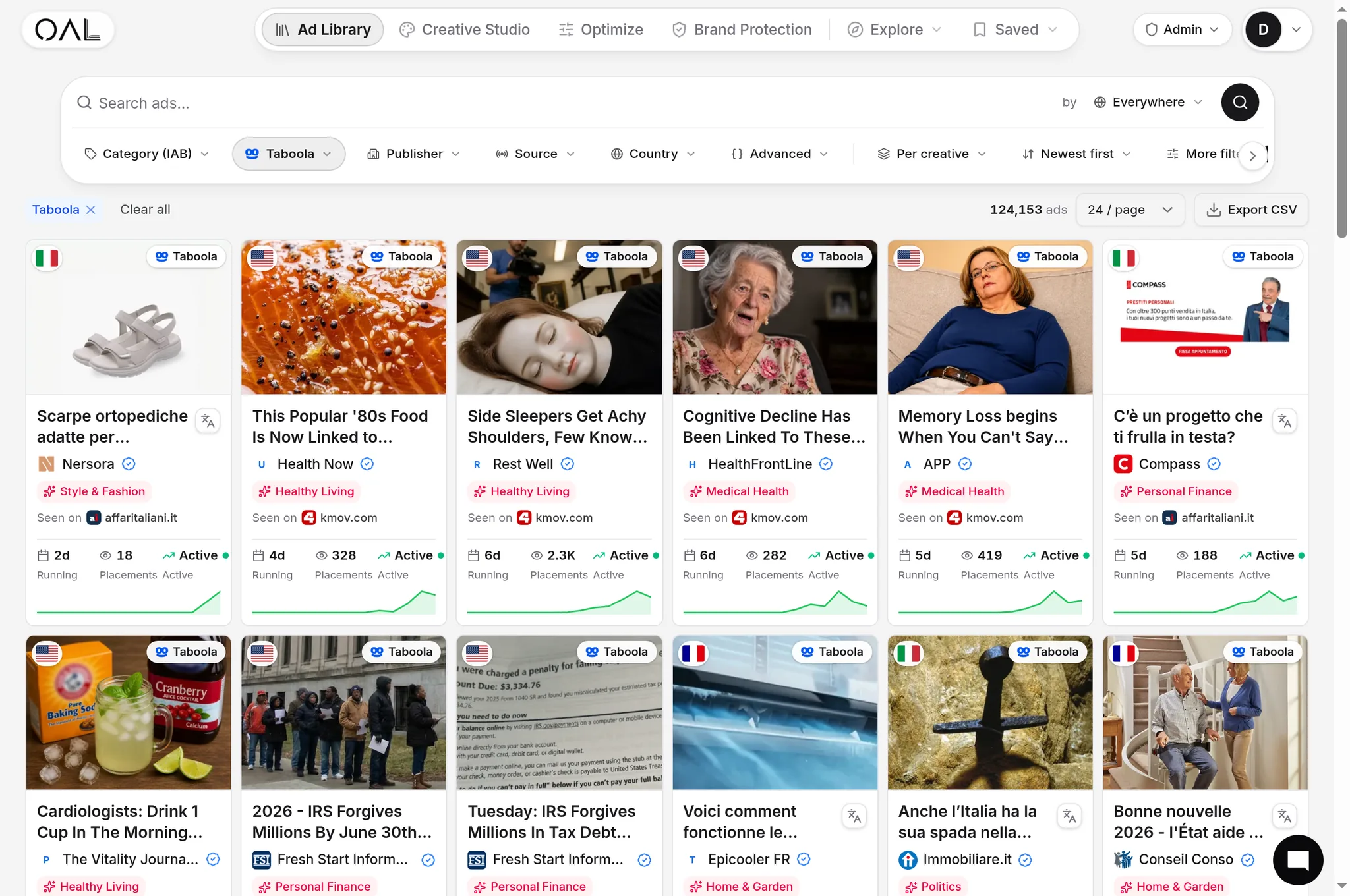
Taboola placements sit inside publisher content, often financial news, health articles, or lifestyle pieces, which puts the reader in an information-seeking mindset rather than a buying mindset. That context favors offers phrased as "check your eligibility" or "see your rate" over offers phrased as "buy now." Insurance carries 7,422 live creatives and finance 8,200 in our index of Taboola captures, and both verticals lean almost entirely on quote-comparison and eligibility-check angles rather than hard-sell copy, which tells you the format the network rewards.
The reader has to travel further to become a lead than to become a sale, since a lead usually means filling out a multi-field form. That's a real cost. It's offset by the fact that native CPCs are typically a fraction of search CPCs, so you can afford a lower conversion rate on the click and still make the math work, provided your CPL target has room for it.
Setting up a lead-gen campaign#
A few things matter more for lead gen than for a straightforward ecommerce campaign:
- Pre-lander before the form, in most cases. Sending cold native traffic straight to a bare form usually converts worse than warming the reader through a short pre-lander that restates the value and sets expectations for what the form will ask. See what is a pre-lander for the format breakdown.
- Match the headline promise to the form's actual ask. If the headline implies a two-second eligibility check and the form has twelve fields, expect a high abandon rate mid-form. Keep the promise and the form length aligned.
- Geo and device targeting matter more here than in most verticals, since eligibility rules (age brackets, state-specific insurance products, income thresholds) often only apply to a subset of your traffic. Wasted clicks to ineligible readers are pure loss in a lead-gen funnel.
- Set conversion tracking up before you spend meaningfully. A lead-gen campaign without a working pixel or postback is optimizing blind, since click-through rate alone won't tell you which creative is actually producing qualified leads. See our conversion tracking glossary entry for the baseline mechanics.
For the platform basics, How to Advertise on Taboola covers account setup and campaign structure if you're starting from zero.
Cost expectations#
Media buyers commonly report Tier-1 desktop CPCs on Taboola running from roughly $0.20 to $0.90, though your niche, geo and creative will move that a lot; treat any number you read, including this one, as a rough starting point rather than a guarantee. Cost per lead on top of that depends entirely on your form's conversion rate: a short, low-friction form in a well-matched vertical (insurance quote comparison, for instance) tends to convert clicks into leads at a meaningfully higher rate than a long application form for a complex financial product.
The practical way to budget is to work backward from what a lead is worth to you, set a target CPL with margin built in, and test with a small enough daily spend that you can kill underperforming creative before it burns real budget. Native traffic quality varies a lot by publisher and placement, which is part of why a single week of test data at low spend tells you more than a single day at high spend.
Lead quality: what to actually expect#
Lead quality from native traffic skews toward lower intent than search traffic, because the reader wasn't actively looking for your offer, they were reading an article and got interrupted by curiosity. That's not automatically bad; it just means your downstream process (call center speed-to-lead, follow-up cadence, form-field validation) needs to account for a colder starting point than a Google Ads lead.
Two things that materially improve lead quality on Taboola:
- A pre-lander that pre-qualifies. Asking one or two soft-qualifying questions before the reader reaches the full form filters out the least-motivated clicks before they cost you a full form submission.
- Real-time form validation. Catching invalid phone numbers, disposable emails, and obvious bot patterns at the form level, rather than discovering them after you've already paid a vendor for the lead, protects your actual CPL.
If you're testing whether an offer is worth scaling, our guide on validating affiliate offers applies directly to lead-gen products, not just affiliate sales.
Which lead-gen verticals actually work here#
Based on the vertical distribution across our Taboola index, insurance, finance and to a lesser extent home services and legal are where the network's traffic mix naturally fits a lead-gen model. That's not a coincidence: these are categories where "check your rate" or "see if you qualify" is a completely normal, expected offer, so it doesn't fight the reader's expectations the way a hard lead-gen pitch would in, say, an entertainment-adjacent placement.
If you're deciding whether to run lead gen on Taboola versus a competing native network, our MGID vs Taboola and Revcontent vs Taboola comparisons cover reach and cost differences that matter for budget planning.
Structuring the offer itself#
Beyond the ad and the form, the offer structure matters more in lead gen than in a straightforward product sale. A single, narrow offer ("compare auto insurance rates in your state") tends to outperform a broad one ("compare all your insurance needs") because the reader can immediately picture what filling out the form gets them. Multi-step forms that ask one or two easy questions first (zip code, age range) before asking for contact details also tend to hold more readers through to completion than a single long form presented all at once, since the reader has already invested a small amount of effort before the harder questions arrive.
Where possible, show the reader something before asking for anything, an estimated range, a sample result, a partial answer, since that reciprocity nudges completion rates up without changing the underlying offer at all. This is the same mechanic that makes a pre-lander outperform a bare form: readers commit further once they've already taken a small step.
Scaling a lead-gen campaign that's working#
Once a combination of creative, pre-lander and form is producing leads at an acceptable cost, resist the urge to change several things at once when scaling budget. Increase spend gradually and watch cost per lead and lead quality together, since native delivery systems often widen the audience as budget increases, which can pull in a less-qualified segment of readers than your initial, narrower test audience.
Horizontal scaling, adding new geos, new publisher placements, or new device targets, tends to be safer for maintaining lead quality than simply increasing spend within the same narrow targeting, since it spreads volume rather than forcing the existing targeting to stretch further than it naturally would. Our guide on horizontal vs vertical scaling in native media buying covers this trade-off in more depth.
How lead gen on Taboola compares to other channels#
Compared to running the same lead-gen offer on Meta or Google, Taboola's feed context generally produces a colder click but at a meaningfully lower cost per click, which is the trade every native lead-gen campaign is making implicitly. Whether that trade works in your favor depends on how cheaply your funnel can convert a colder click into a qualified lead. If your form and pre-lander are strong enough to convert at a reasonable rate even on lower-intent traffic, the lower CPC usually wins on blended cost per lead; if your funnel needs a warmer, more intent-driven click to convert at all, a search or social channel may simply fit the offer better than native does. Our comparison of native ads vs Facebook ads for DTC covers a related version of this trade-off for product sales rather than leads.
How OpenAdLibrary helps#
Before committing budget, it helps to see what lead-gen advertisers in your exact vertical are actually running right now, not last year. The Taboola ad spy tool lets you filter by vertical and geo and see which creatives have survived weeks of continuous running, a strong signal that the funnel behind them, headline through form, is actually converting at a workable cost. Pricing for full access, including landing-page traces, starts on our pricing page.
FAQ#
Frequently asked questions about Taboola for lead generation.