Español
 Português (Brasil)
 Français
 Deutsch
 Italiano
 Nederlands
 Polski
 Svenska
 Türkçe
 Русский
 日本語
日本語 한국어
한국어 简体中文
简体中文 Tiếng Việt
 Bahasa Indonesia
 繁體中文
繁體中文 Čeština
 Dansk
Dansk Norsk (bokmål)
 Suomi
Suomi Ελληνικά
 Română
 Magyar
 Українська
 ไทย
ไทย हिन्दी
 العربية
 עברית
עבריתAre Content Recommendation Ads Worth It? Revenue vs Reputation
Content recommendation widgets pay real revenue, but the reputation cost lands on you, not the network. Here's how to weigh the trade-off and the controls that fix it.


Content recommendation ads, the "you may also like" widgets that Taboola, Outbrain, MGID and Revcontent drop below your articles, are worth running if you actively manage what shows up in them. Left on autopilot, the extra revenue comes with a real cost: a reader who sees a lurid weight-loss teaser under your byline blames your site, not the network that served it. The math works in your favor only when you treat the widget as inventory you curate, not a script tag you paste in once and forget.
What these widgets actually pay#
Payouts vary enormously by traffic geo, vertical and device mix, so treat any number you read (including this one) as a starting point, not a promise. Publishers running US or UK desktop traffic through Taboola or Outbrain in verticals like finance, health or home improvement tend to see meaningfully higher RPMs than publishers running tier-2 mobile traffic in entertainment or general news. MGID and Revcontent generally sit below Taboola and Outbrain on average payout per session but often have lower minimum traffic requirements to get approved, which matters if you are a smaller site.
The advertiser side of the ledger tells you where that money originates. Across OpenAdLibrary's index of 725,882 native creatives spanning 49 networks, health (24,472 creatives), finance (24,068) and insurance (22,427) are the three largest verticals by volume. Those are also the categories most associated with aggressive, curiosity-driven creative: "doctors hate this," before/after transformations, and vague government-benefit claims. High-paying inventory and reputation risk are correlated for a structural reason, not a coincidence: the advertisers willing to bid the most per click in a content-recommendation auction are often direct-response performance marketers running a curiosity gap hook, because that format converts well on cold, low-intent traffic.
The reputation problem is real, and readers blame you for it#
Your widget sits inside your own page template, using your fonts and your column width, directly under content you wrote and vouched for. Most readers do not parse the visual and legal distinction between "sponsored content served by a third-party ad network" and "content the publisher chose to feature." A sponsored content label in 11px gray type does not fix that perception gap on its own.
This is not a hypothetical. Complaints about "chumbox" ads, screenshots of the ugliest creative a site served that day, circulate regularly on social media and get attached to the publisher's name, not the network's. If your brand depends on trust (a health publisher, a personal-finance site, anything aimed at an older or less ad-literate audience) the reputational cost of an unmoderated widget can outweigh the RPM lift, especially once you account for returning-visitor decay. A reader who has one bad experience with your recommendation widget is less likely to come back directly next time, which shows up nowhere in your ad network dashboard.
Where the actual risk concentrates#
Not all inventory in a content-recommendation widget carries equal risk. The patterns worth watching for:
- Health and supplement claims with no substantiation, often using stock "doctor" imagery
- Government benefit and "you may be owed" offers that lean on vague, geo-targeted claims about entitlements
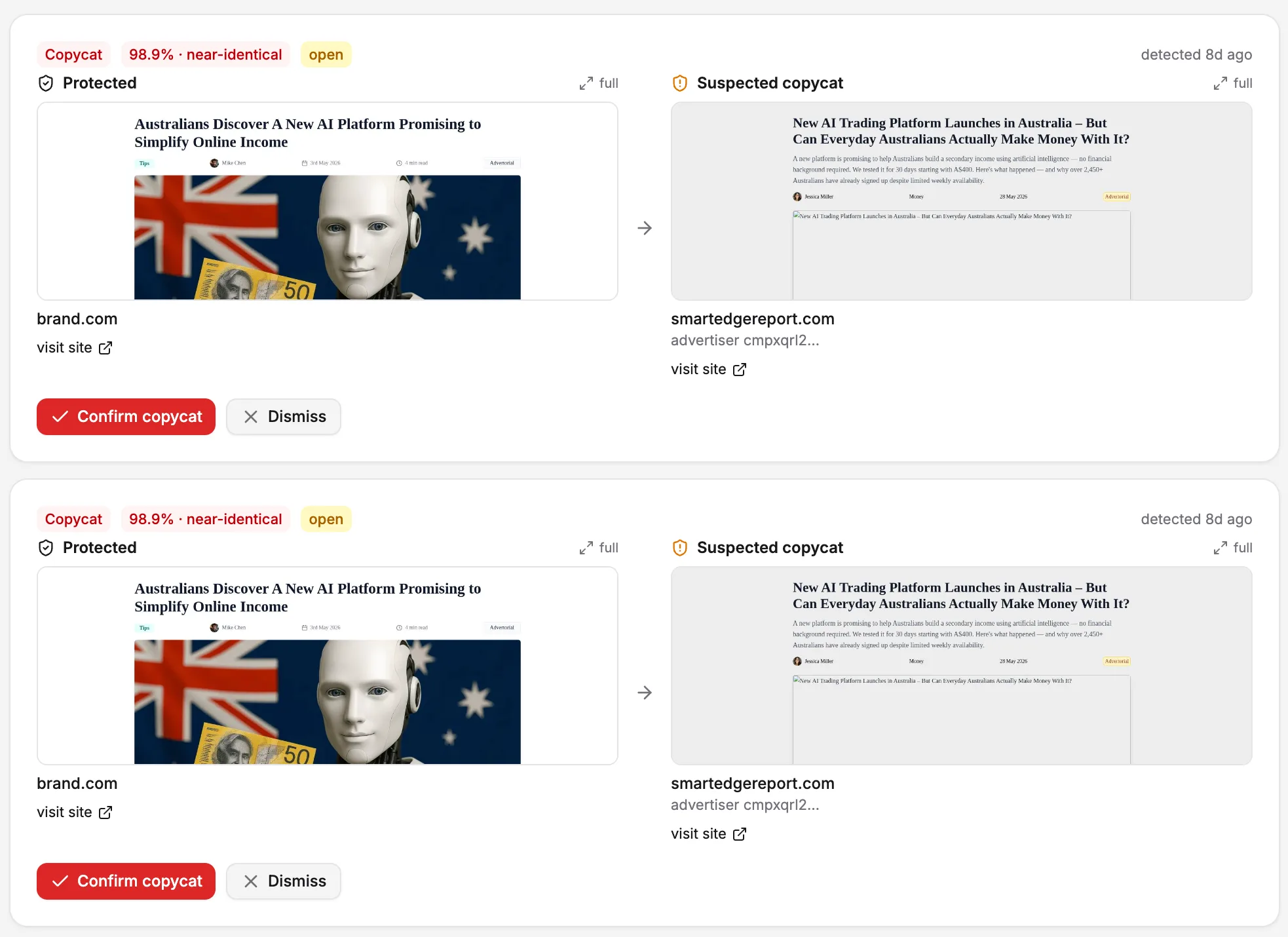
- Copycat landing pages that impersonate a known brand or news outlet to borrow its credibility; see our breakdown of how scammers clone brands in native ads
- Undisclosed advertorial formatting that reads as editorial content rather than an ad, which runs into FTC disclosure requirements
- Outright ad fraud, including cloaked landing pages that show reviewers a clean page and everyone else something different; see ad fraud in native advertising
None of these are edge cases. They are the recurring reasons publishers end up fielding reader complaints about a widget they did not personally review.
The controls that actually change the outcome#
Every major network gives publishers levers to narrow what serves, even if the defaults favor the network's fill rate over your brand safety:
| Control | What it does | Where it helps most |
|---|---|---|
| Category/vertical blocking | Excludes verticals like weight loss, dating, or "shocking" entertainment | Health, finance, family-facing sites |
| Advertiser blocklist | Blocks specific brands or domains you've flagged | Ongoing, after you spot a bad actor |
| CPC/CPM floor | Sets a minimum bid, which filters out the lowest-tier bulk demand | Sites with strong direct traffic |
| Widget placement and count | Fewer units, placed further from the byline | Sites prioritizing trust over yield |
| Manual creative review | Periodic spot-checks of what's actually live on your pages | All publishers, especially post-launch |
The uncomfortable trade-off is real: tightening every lever reduces fill rate and RPM, sometimes by a lot. The publishers who get the best of both worlds usually start loose to see the ceiling, then tighten specifically against the categories and advertisers that generated complaints, rather than guessing in advance which controls to apply.
A simple decision framework#
Before you install or keep a content-recommendation widget, weigh four questions honestly:
- Does my audience skew toward high-trust content (health, finance, parenting, local news)? If yes, the reputational downside is larger than average.
- What's my realistic RPM ceiling for my traffic mix? Ask the network for geo- and vertical-specific benchmarks rather than the blended average they lead with.
- Do I have the bandwidth to actually moderate it, checking blocklists and reviewing live creative periodically, or will it run unmanaged?
- What's my direct-traffic and return-visitor rate, and how much would a bad-widget experience realistically cost me there?
A high-authority niche site with strong direct traffic often finds the reputational math doesn't favor an unmanaged widget. A high-volume, low-loyalty content site monetizing pageviews from search and social has much less to lose per session and can run it more aggressively.
How OpenAdLibrary fits into this#
Before you sign up with a network, or after you notice a bad ad on your own pages, it helps to see what's actually running on that network right now rather than relying on the sales deck. OpenAdLibrary's ad intelligence platform indexes hundreds of thousands of live creatives across Taboola, Outbrain, MGID, Revcontent and other networks, so you can look up the advertiser behind a specific ad, check how long it's been running (a longer-running ad has usually cleared more compliance review than a brand-new one), and get a realistic read on the mix of creative quality a network is actually serving before you decide how tightly to lock down your own widget. Pricing starts with a free tier if you just want to spot-check a few advertisers.
A worked comparison: two publisher profiles#
Picture two sites running the same content-recommendation widget with identical default settings. Site A is a niche personal-finance blog with strong direct and email traffic, an engaged returning audience, and a brand built on being trustworthy with money advice. Site B is a general-interest news aggregator pulling most of its traffic from search and social, with low return-visitor rates and readers who rarely associate the site's name with any single piece of content.
For Site A, an unmanaged widget serving aggressive "you may be owed" finance offers directly beneath careful, well-sourced financial advice creates a jarring credibility gap. The RPM lift is real, but the risk to the thing the site is actually built on (trust) is disproportionate. Site A should run a tighter setup: category blocking on the most aggressive offer types, a CPC floor to filter bulk demand, and a placement further from the byline.
For Site B, the same widget carries much less brand risk, since readers aren't forming a lasting relationship with the publisher's name regardless of what serves. Site B can reasonably run a looser configuration and capture more of the available RPM, because the reputational cost per bad impression is genuinely lower.
Neither approach is universally correct. The point is that the right setting depends on what your site is actually worth to you beyond the widget's own line item.
Signs your widget has drifted toward bulk demand#
Even publishers who set up blocklists carefully at launch often stop checking, and content-recommendation inventory tends to drift toward lower-tier bulk demand over time as networks fill remaining impressions. Watch for:
- A rising share of "shocking," "doctors hate this" or vague-benefit headline styles compared to when you first launched the widget
- Reader complaints clustering around specific offer types, which usually means a category filter has lapsed or was never set
- Falling RPM alongside falling perceived creative quality, which often signals the network is filling your inventory with cheaper, high-volume demand rather than the premium tier it sold you on initially
- Increasing frequency of the same handful of advertisers, which can indicate a single aggressive buyer dominating your available inventory
None of these show up automatically in your network dashboard. They require you to actually look at what's rendering periodically, which is the single most underused habit among publishers running these widgets.
The bottom line#
Content recommendation ads are worth running for most content sites, but "worth it" assumes active management, not a set-and-forget integration. Set category and advertiser blocklists on day one, review what's actually live monthly, and weigh the RPM against your audience's trust sensitivity rather than against the network's blended benchmark number. The publishers who complain that these widgets "wrecked" their site are almost always the ones who never touched the controls after initial setup.