Español
 Português (Brasil)
 Français
 Deutsch
 Italiano
 Nederlands
 Polski
 Svenska
 Türkçe
 Русский
 日本語
日本語 한국어
한국어 简体中文
简体中文 Tiếng Việt
 Bahasa Indonesia
 繁體中文
繁體中文 Čeština
 Dansk
Dansk Norsk (bokmål)
 Suomi
Suomi Ελληνικά
 Română
 Magyar
 Українська
 ไทย
ไทย हिन्दी
 العربية
 עברית
עבריתBest Native Ad Networks for Publishers: The Sell-Side Ranking
Revenue-share percentages are the headline; demand depth is the paycheck. A sell-side ranking of native ad networks built from the live advertiser activity we observe on each one.


For most publishers, Taboola and Outbrain are still the strongest native ad networks on the factors that decide revenue — advertiser demand depth, auction pressure and fill — but both gate entry behind traffic minimums that rule out smaller sites. MGID accepts much smaller publishers at the cost of a lower-quality demand mix, Revcontent sits between, and the Microsoft and Yahoo native ecosystems are largely closed to independent publishers entirely. This ranking is built from the sell-side questions that matter — who actually competes for your inventory, what their ads will do to your pages, and what it takes to get in — using live demand evidence from OpenAdLibrary's index of 725,000+ native creatives across 49 networks (July 2026).
What actually drives your native RPM#
Your RPM from a content recommendation widget is a product of four factors: how many advertisers compete for your audience and geos (auction density), what they bid, how well the placement earns clicks, and your revenue share. Network sales decks emphasize the revenue share. The factor that actually varies most between networks is auction density — a widget with thin demand behind it fills with low-bid remnant and cross-promos that no revenue-share percentage can fix.
Auction density is also the one factor you can verify before signing anything, because it is public behavior: the ads a network serves are visible on its publishers' pages, which means an outside observer can count them.
Demand depth by network, measured#
OpenAdLibrary continuously captures live native placements across publishers, geos and devices — 725,882 live creatives from 29,257 advertisers as of July 2026. The number of distinct live creatives we observe per network is a reasonable proxy for how much advertiser demand competes for that network's publisher inventory:
| Network | Live creatives in index (July 2026) | Top observed verticals |
|---|---|---|
| Taboola | 206,145 | Health, finance, insurance |
| Outbrain (Teads) | 108,573 | Insurance, finance, health |
| MGID | 62,765 | Entertainment, health |
| Revcontent | 15,789 | Health, finance, home & garden |
| MediaGo | 6,571 | Insurance, home & garden, ecommerce |
| Yahoo (native) | 5,926 | Software, finance |
(The single largest corpus in our index is the Microsoft Audience Network at 281,839 live creatives — more below on why that mostly does not help independent publishers.)
Read the table as auction pressure. Taboola's live advertiser pool is roughly three times MGID's and thirteen times Revcontent's. More live advertisers means more bids per impression, better fill in secondary geos, and faster backfill when a big spender churns.
The rankings for publishers#
1. Taboola — deepest open demand, highest entry bar#
Taboola's 206,145 live creatives make it the deepest open-web native demand pool we observe outside Microsoft's closed ecosystem. Its advertiser mix skews toward verticals with sustained budgets — health, finance and insurance lead its classified creatives — which matters on the sell side because these advertisers renew continuously and keep fill stable. The entry bar is real: commonly cited traffic minimums sit around the half-million monthly pageview mark, terms run on negotiated contracts, and smaller sites get routed to resellers. If you qualify, it is worth understanding how Taboola works from the buy side too — it shows you what advertisers see when they bid on your inventory.
2. Outbrain (now Teads) — comparable depth, more brand demand#
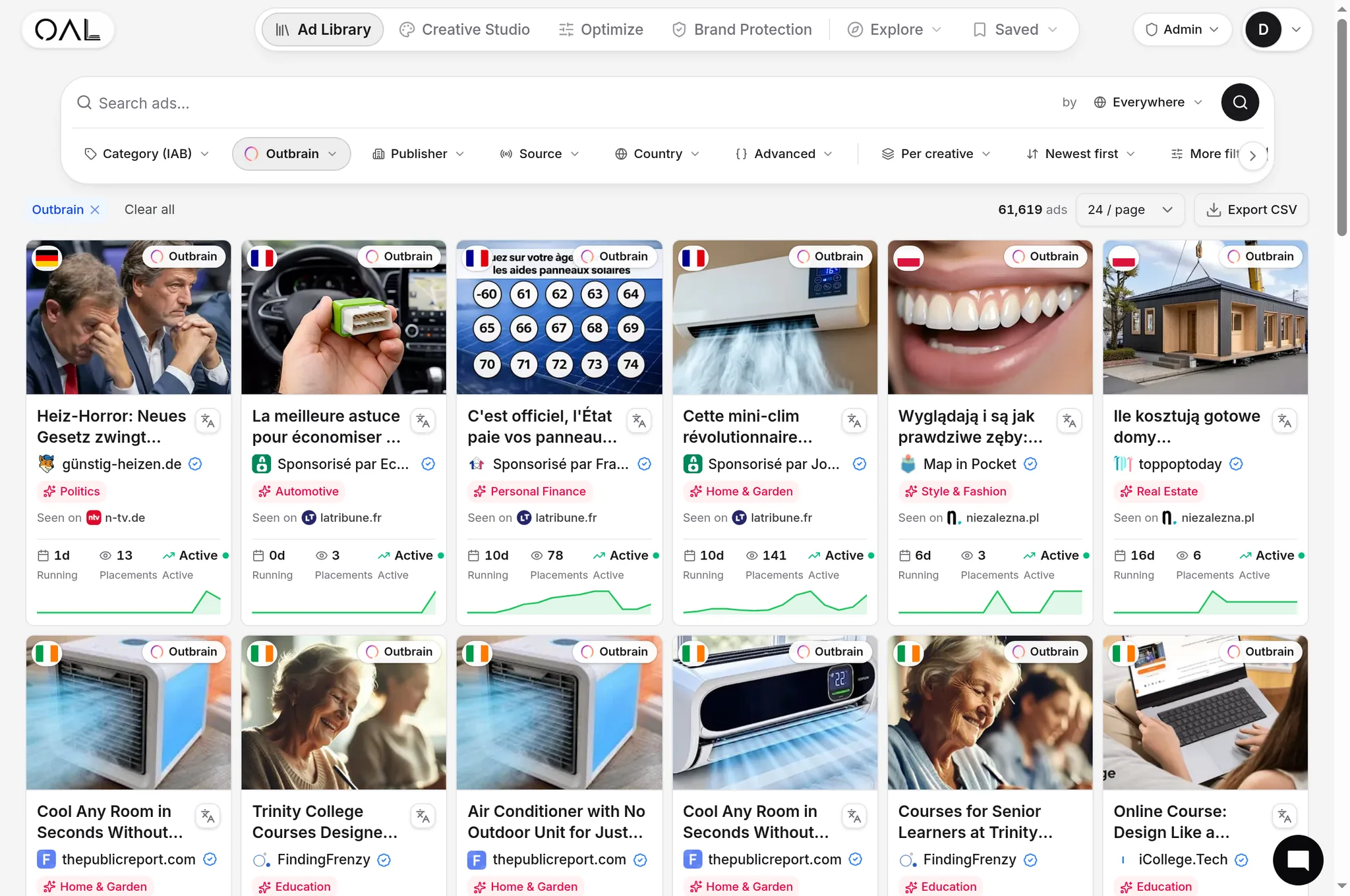
Outbrain's 108,573 live creatives include noticeably more corporate and brand content campaigns than any other feed network we index, running alongside the usual performance demand. Since the Outbrain–Teads merger, the combined company also brings video and display demand into the same publisher relationship, which can lift total page yield beyond the feed widget itself. Entry expectations are broadly similar to Taboola's; how Outbrain works covers the platform mechanics.
3. MGID — the accessible one#
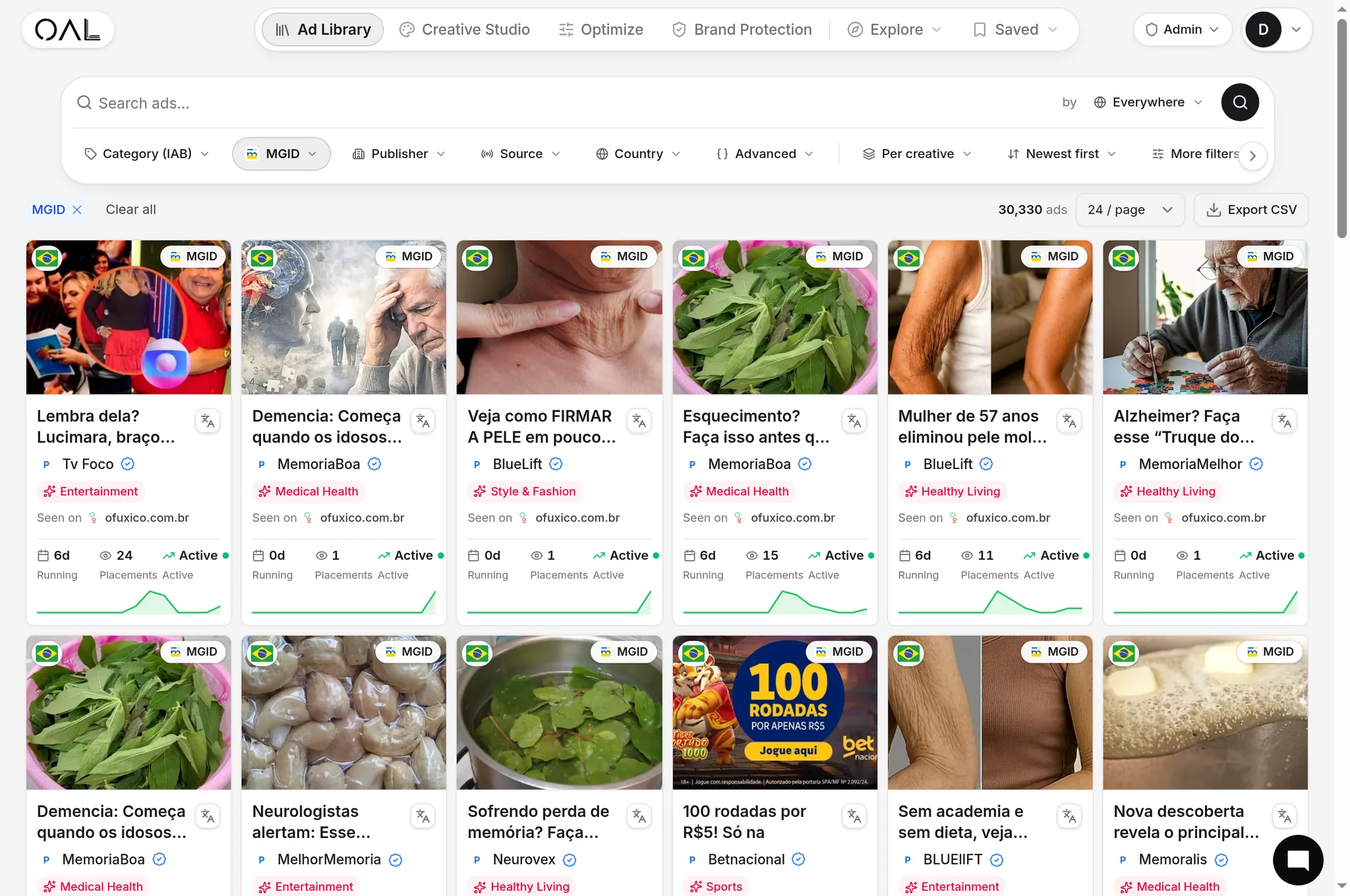
MGID takes far smaller publishers than the top two, often with no meaningful traffic minimum — hence its popularity with niche sites and emerging-market publishers. The demand is real (62,765 live creatives), but the mix is different: entertainment dominates with 13,987 classified creatives, an order of magnitude ahead of its next vertical. In practice that means more celebrity and curiosity chum in your widgets and lower average bids, partially offset by MGID's strength in geos the majors serve thinly. How MGID works covers the details.
4. Revcontent — the middle path#
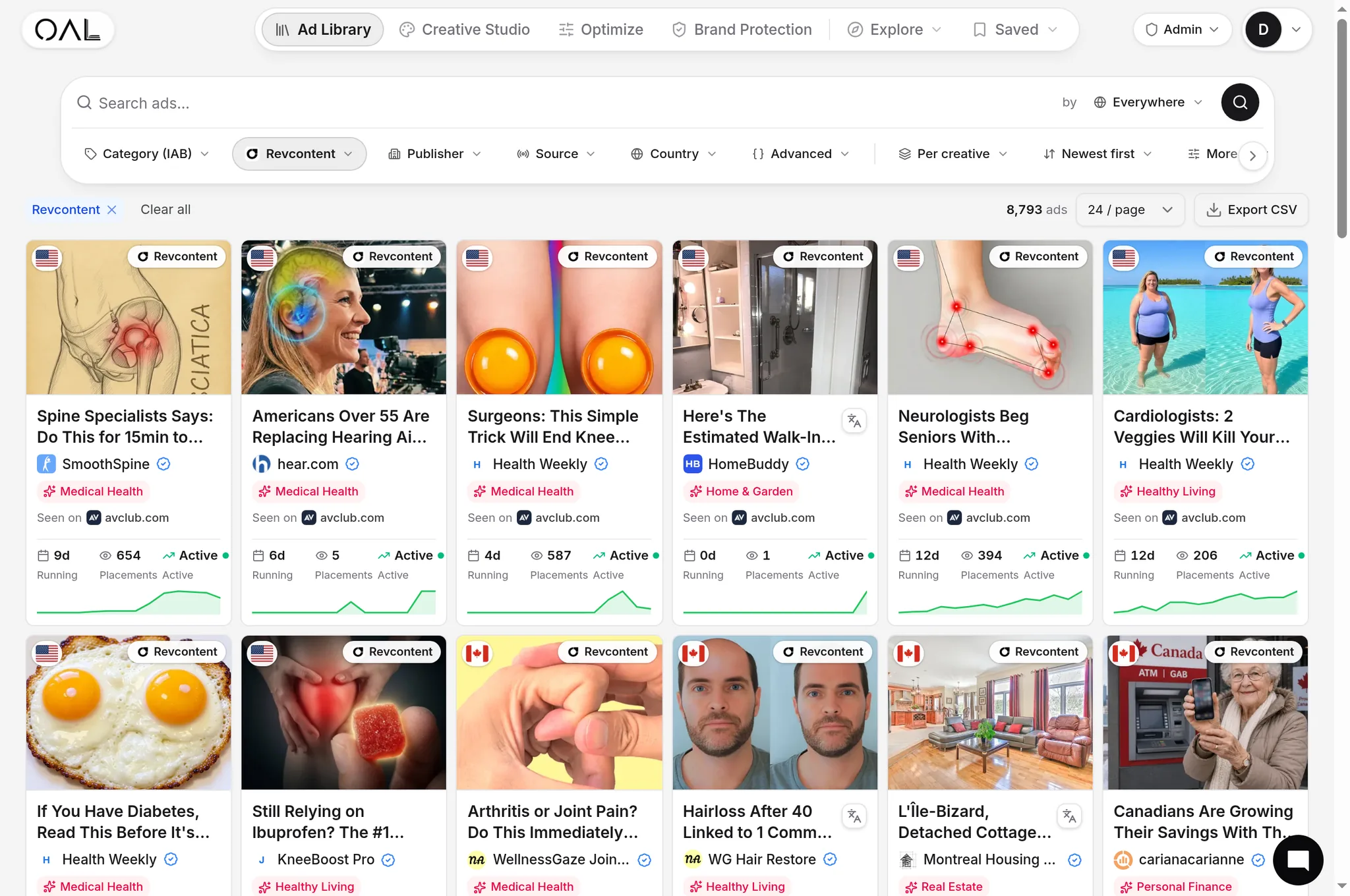
Revcontent (15,789 live creatives, health leading its mix) positions itself as more selective about publishers than the volume players — verify what that means for your site in the current review process rather than trusting the positioning. For mid-size sites with substantial US traffic that do not clear Taboola's bar, it is frequently the practical first step up in demand quality. See how Revcontent works.
5. Microsoft, Yahoo and MediaGo — the mostly closed demand#
The Microsoft Audience Network is the largest single corpus in our index, but that demand flows overwhelmingly to Microsoft's own surfaces — MSN, Outlook, Edge — and a curated partner set; it is not a self-serve network a small publisher signs up for. The same is broadly true of Yahoo's native demand (what remains of Yahoo Gemini) and of MediaGo, which is fundamentally a demand-side platform pushing into partner supply. For most independent publishers, these matter only as demand you might touch indirectly through resold-inventory relationships with your other partners.
What the widget will do to your brand#
The tradeoff no rate card prices: native widgets pay you in RPM and charge you in reader trust. The difference between networks is visible in their live creative mix, and you should look at it before you sign — not after the reader complaints arrive.
The practical check takes ten minutes. Pull each candidate network's live ads for your primary geo in OpenAdLibrary's ad intelligence and scan the bottom of the quality range, because that is what your widget looks like on a bad day. While you are at it, look up what actually runs on comparable sites in your niche — who is buying ads on a website walks through the method. If a network's feed for your geo is dominated by miracle-cure creatives you would not want next to your byline, no RPM floor makes that a good trade.
Two structural mitigations are worth negotiating up front. First, category and advertiser blocks: every serious network offers them, but the granularity and turnaround differ widely, and you want the mechanics demonstrated during the sales process, not promised in it. Second, placement position: the further the widget sits from your editorial voice — below the article rather than inline — the less its worst creative bleeds into your credibility. Publishers who treat the widget as a tenant rather than a co-author tend to keep both the RPM and the readers.
Due diligence before you sign#
- Audit the live demand for your geo and vertical using the check above — the network's live ads are its real sales deck.
- Get the revenue share and any RPM floor in writing. Floors are commonly time-limited introductory terms; ask what happens after the guarantee window.
- Confirm placement requirements. Below-article is standard; commitments to mid-article units or homepage placements change the reader-experience math considerably.
- Ask about blocking controls — category, advertiser and creative-level blocks, and how fast takedown requests are honored.
- Check the ads.txt entries required and make sure they do not conflict with existing demand partners.
- Verify payment terms. Net windows and minimum payout thresholds vary by network and contract; get specifics, not ranges.
- Avoid long exclusivity before RPM is proven. A trial period or short initial term is a reasonable ask, and reputable networks will discuss it.
The bottom line#
Match the network to your traffic reality. If you clear the entry bar for Taboola or Outbrain, their demand depth usually wins the RPM argument on its own. Below that bar, MGID and Revcontent are legitimate options — go in with placement rules and category blocks configured from day one, and audit your own widgets monthly the way a reader sees them. Whatever you choose, evaluate the network with the same evidence advertisers use: what is actually running on it right now.