Español
 Português (Brasil)
 Français
 Deutsch
 Italiano
 Nederlands
 Polski
 Svenska
 Türkçe
 Русский
 日本語
日本語 한국어
한국어 简体中文
简体中文 Tiếng Việt
 Bahasa Indonesia
 繁體中文
繁體中文 Čeština
 Dansk
Dansk Norsk (bokmål)
 Suomi
Suomi Ελληνικά
 Română
 Magyar
 Українська
 ไทย
ไทย हिन्दी
 العربية
 עברית
עבריתTaboola Ad Library: Search 171,000+ Live Taboola Ads (2026)
No official Taboola ad library exists anywhere. Here is the independent one: 171,050 live Taboola creatives with advertisers, longevity, geo and landing pages, and how to use it for real competitive research.


Search for "Taboola ad library" and you will find something strange: nothing. Meta has an official ad library. Google has a Transparency Center. TikTok has a Commercial Content Library. Taboola, one of the largest native advertising networks in the world, offers no public, searchable library of the ads running through it. The pages that rank for the phrase are Taboola's own product marketing and a few thin listicles pointing at tools that do not actually hold Taboola inventory.
We built the thing the query is asking for. As of July 2026, the OpenAdLibrary index holds 171,050 live Taboola creatives, and 167,524 of them — 98% — were first captured within the last 30 days. This guide covers why no official Taboola library exists, exactly what our Taboola index captures, how to use it for competitive research, and where its honest limits are. If you want the workflow-focused walkthrough of researching competitors on the network, that lives in our Taboola ad spy guide and the /spy/taboola tool page; this article is about the library itself: what is in it and how to read it.
Why Taboola has no official ad library#
The big transparency surfaces you already know exist because regulators forced them or because political-ads scrutiny made them unavoidable. Meta's library grew out of election-interference fallout. Google's Transparency Center and TikTok's Commercial Content Library expanded under the EU's Digital Services Act, which obliges very large online platforms to run public ad repositories.
Taboola sits below that regulatory line and outside the political-ads spotlight. Its feed placements — the sponsored-content widgets under articles on publisher sites — carry mostly performance and affiliate demand, not election ads. So there has been no forcing function, and no commercial incentive either: a searchable archive of every advertiser's creatives is exactly the competitive-intelligence surface most of Taboola's advertisers would rather not exist. The result is a genuine gap. You can look up any brand's Facebook ads in seconds, but the network serving ads across thousands of open-web publishers has no equivalent lookup at all. We wrote about this gap more broadly in What Is a Native Ad Library and Why One Didn't Exist Until Now.
That gap is what an independent library fills: instead of the network publishing its own ads, a third party observes the public placements and archives them. The ads are shown to the public, so collecting them is observation of public information — the same principle behind every clipping service that ever archived print ads.
What the OpenAdLibrary Taboola index captures#
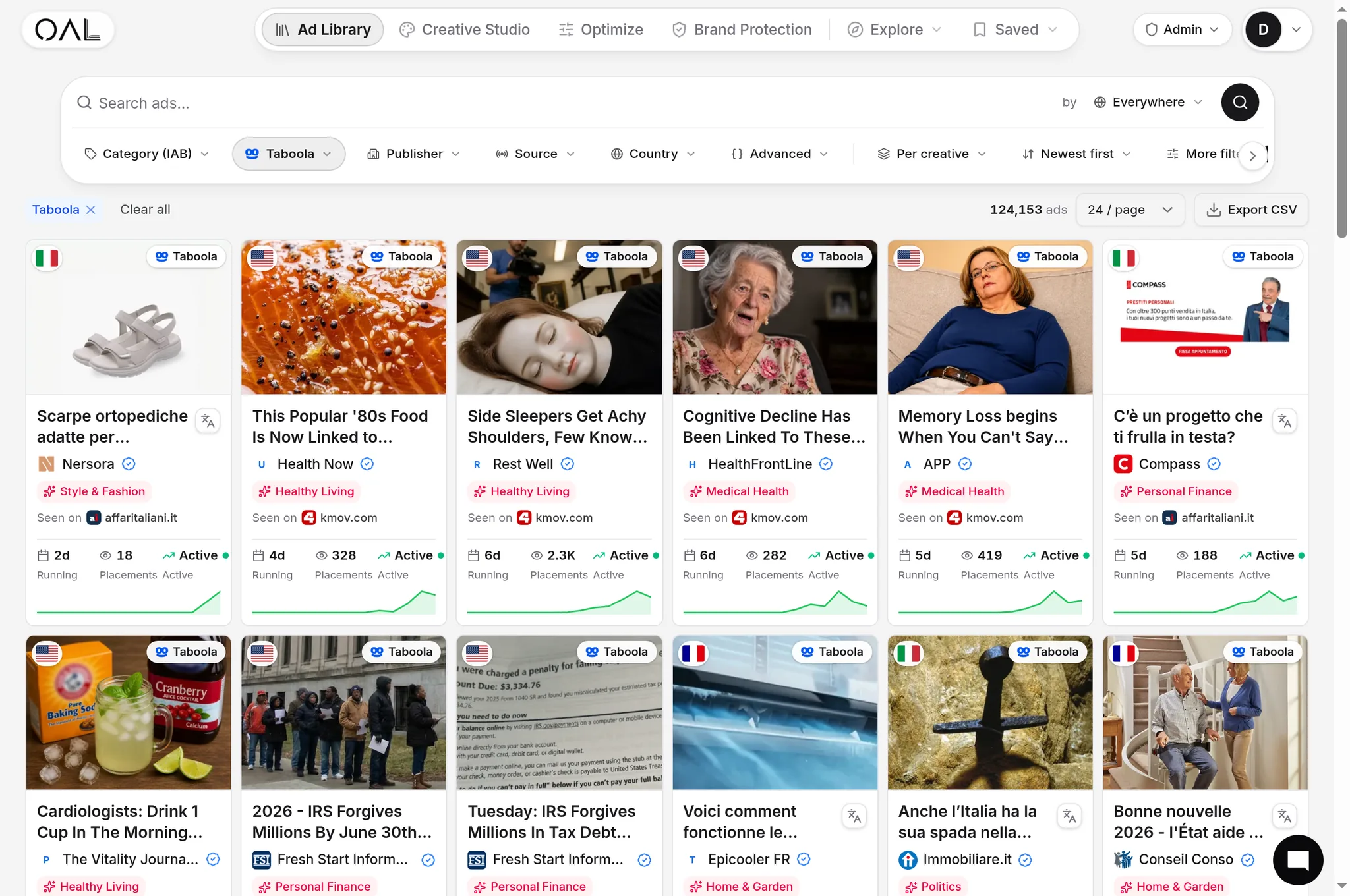
We capture live public Taboola placements continuously, store the real creative at full quality, and resolve what sits behind each ad. Concretely, for each of the 171,050 Taboola creatives in the index (July 2026) you get:
- The creative itself — full-quality image plus headline, not a degraded thumbnail.
- The advertiser — the brand label behind the ad, resolved from the tracking chain, not just the vague byline in the widget.
- Longevity — first-seen and last-seen dates from continuous observation, the closest public proxy for "this ad is paying." Our ad longevity guide explains why an ad that keeps running is almost certainly profitable.
- The landing page — we follow the click through the redirect chain (without ever generating a billable click) to the destination page or pre-lander. Across all networks the index has traced 1,081,997 landing pages as of July 2026.
- Geo and device — which countries and which device types (desktop, Android, iOS) each creative was captured on, because Taboola campaigns are heavily geo- and device-split.
- Vertical classification — every creative is classified into an industry category, so you can pull "insurance ads in Australia" rather than scrolling everything.
Here is what a real entry looks like — a health creative that has been running for 19 days, which on Taboola usually means the economics work:

And it is not all direct-response arbitrage. Major brands run the same feed — this HSBC credit-card creative had been live for 21 days when captured:

What's actually running on Taboola right now#
Because the library is queryable, we can summarize the whole network rather than cherry-pick. The vertical mix in the Taboola index as of July 2026:
| Vertical | Live Taboola creatives (July 2026) |
|---|---|
| Health | 6,857 |
| Finance | 5,936 |
| Insurance | 4,961 |
| Ecommerce | 3,688 |
| Home & garden | 2,961 |
| Software | 2,395 |
Health, finance and insurance dominate — together they account for more classified Taboola creatives than the next six verticals combined, which tells you where the money verticals and the toughest competition sit. If you want the advertiser-level view, Who Advertises on Taboola? breaks the network down by advertiser and vertical.
A few advertiser-scale numbers worth quoting. The single largest Taboola advertiser in our index is Yahoo Search with 4,184 distinct creatives — search-arbitrage demand at industrial scale. OTTO Insurance runs 2,337 distinct Taboola creatives, and comparison shops like Comparisons.org (1,095 creatives) show how hard the quote-comparison model leans on the network. When one advertiser ships thousands of creative variants, that is not experimentation; that is a machine that found something profitable and is feeding it.
Longevity data tells the other half of the story. Across the full index, 88.9% of the 637,514 creatives with longevity data sit in the shortest-lived tier of our distribution, and only about 2.3% survive into the two longest-running tiers. Most native ads die fast. The small minority that persist for weeks — like the hearing-aid ad above at 19 days — are the ones worth studying, and a library is the only practical way to find them.
How to use the Taboola ad library#
The library is a research surface, not a scrolling feed. The highest-leverage workflows:
- Search an advertiser. Type a competitor or any brand you have seen in a feed and get every creative we have captured from them on Taboola: headlines, images, first-seen dates, landing pages. This answers "what is their whole playbook" instead of "what did I happen to see."
- Filter a vertical and geo. Pull, say, insurance ads captured in Australia and sort by longevity. The top of that list is a ranked shortlist of proven angles in your exact market.
- Trace the funnel. Click through from creative to captured landing page. The ad is the hook; the pre-lander and offer page are where conversion actually happens. Our guide to reverse-engineering a competitor's native ad funnel walks the full method.
- Watch for movement. New creatives from a known advertiser signal a new test or a new offer. A creative that suddenly stops after weeks of persistence signals either fatigue or a compliance takedown — both useful.
- Pull it programmatically. Everything in the library is available through our native ad data API, so you can pipe Taboola creatives, advertisers and landing pages into your own tooling or AI agents rather than clicking around.
If you are new to how the network itself functions — bidding, placements, the publisher side — read How Taboola Ads Work first; the library makes a lot more sense once you know what a "placement" actually is. And if you are deciding between Taboola and its main rival, our Taboola vs Outbrain data comparison uses this same index to compare the two networks head to head.
A worked example: researching one advertiser end to end#
Abstract workflows are easy to nod along to, so here is what the library actually produces on a single query. Take OTTO Insurance, the auto-insurance comparison advertiser we mentioned above.
Search the name and the library returns 2,337 distinct Taboola creatives attributed to the brand, with the longest-observed ones running the full 30 days of our current observation window. Scanning the headlines, the angle taxonomy is immediately visible: mileage-based hooks ("drivers who drive less than X miles"), age-bracket hooks, state-specific urgency hooks, and seasonal rate-change hooks. The creative volume itself is the first insight — 2,337 variants is not a brand experimenting, it is a conversion machine iterating on a proven funnel.
Then the landing-page traces. Following the captured click paths shows which headlines route to which pre-landers, where the quote-form funnel begins, and how the compliance language shifts between geos. In fifteen minutes you have what used to take a media buyer weeks of screenshotting feeds on different devices and VPN exits: the advertiser's full observable playbook — angles, funnel structure, geo strategy, and which of it all has survived long enough to be called proven. Now repeat for the top five advertisers in your vertical, and you have a competitive map before you have spent anything.
The same query pattern works defensively. Brands search their own name to find affiliates running unauthorized angles, or copycats trading on their reputation — a use case that does not exist without an archive, because by the time legal sees a screenshot, the ad is usually gone.
What "98% fresh" actually means#
One number in this article deserves unpacking, because it is the one that separates a live library from a stale archive: 167,524 of our 171,050 Taboola creatives — 98% — were first seen within the last 30 days.
Native creative churns brutally fast. Advertisers kill losing variants within days, and even winning angles get refreshed with new images and headline tweaks weekly. An archive dominated by six-month-old creatives describes a Taboola that no longer exists; the angles have rotated, the advertisers have moved, and the offers behind the landing pages have changed terms. A library where 98% of the corpus entered within the past month is, functionally, a snapshot of the network as it runs right now — which is the only version of the network you can actually compete against.
The flip side is a trade-off we make openly: our strength is the live picture and recent history, not multi-year archaeology. If you want to know what ran on Taboola in 2023, no honest tool can fully show you. If you want to know what is winning this month — which is what decides campaigns — freshness beats archive depth every time.
Honest limitations#
An independent library observes the network from the outside, and you should know exactly what that means:
- It is a deep sample, not a census. We capture ads by continuously observing public placements across publishers, geos and devices. 171,050 live creatives is a very large window into Taboola, but no third party sees every impression on every publisher in every country. If an advertiser runs only on a handful of niche publishers in a geo we observe lightly, we may catch them late or not at all.
- Longevity is observed, not lifetime. "Running 21 days" means we have observed the creative for 21 days, with our continuous-observation window currently extending to roughly a month. An ad may have started before our first capture. Treat longevity as a floor, not an exact age.
- No spend or performance numbers. We show what is running, who is behind it, how long it has persisted and where the click goes. We do not show CTR, conversions or budgets, and we do not fabricate "estimated spend" figures — any tool showing you precise Taboola spend per advertiser is modeling, not measuring.
- Geo coverage is weighted. English-language markets are our deepest (251,633 English creatives across the index), with strong German, Spanish and French coverage. Thinner geos have thinner data.
We would rather you know these edges than discover them mid-research. The mechanics of how capture works — and why we never click live ads — are documented in How Ad Spy Tools Capture Native Ads.
Taboola ad library vs. a Taboola ad spy tool#
The two phrases overlap but the intent differs, and we maintain both surfaces. The library is the archive: search everything, cite the numbers, browse what exists. The Taboola ad spy tool is the workflow on top of it: watchlists, alerts on new competitor creatives, funnel tracing, and export into Creative Studio to adapt what you find. If your question is "what is running on Taboola," start with the library. If your question is "how do I beat this specific competitor on Taboola," start with the spy tool.
Either way, the free tier lets you browse live Taboola ads with no credit card — create a free account and search any advertiser today.
The bottom line#
There is no official Taboola ad library, and there is unlikely to be one soon: no regulation compels it and no advertiser wants it. The practical substitute is an independent index built from continuous observation of public placements. Ours holds 171,050 live Taboola creatives as of July 2026 — 98% first seen in the last 30 days — each with the advertiser, longevity, geo, device and traced landing page attached, inside a total index of 635,443 creatives from 27,256 advertisers across 46 networks. That is enough depth to answer the questions that matter on Taboola: who is really advertising, what is actually working, and where the click goes.