Español
 Português (Brasil)
 Français
 Deutsch
 Italiano
 Nederlands
 Polski
 Svenska
 Türkçe
 Русский
 日本語
日本語 한국어
한국어 简体中文
简体中文 Tiếng Việt
 Bahasa Indonesia
 繁體中文
繁體中文 Čeština
 Dansk
Dansk Norsk (bokmål)
 Suomi
Suomi Ελληνικά
 Română
 Magyar
 Українська
 ไทย
ไทย हिन्दी
 العربية
 עברית
עבריתHow to Get Approved on Native Ad Networks: A Compliance Checklist
Most native ad rejections happen at the landing page, not the creative. Here is what reviewers on Taboola, Outbrain, MGID and Revcontent actually check, and the checklist that gets funnels approved the first time.


Approval on a native ad network comes down to three things a reviewer can verify: a landing page that keeps every promise the ad makes, creative that avoids the network's prohibited claims, and an account that looks like a real, reachable business. Reviewers click through your funnel the way a user would, which is why most rejections happen at the landing page, not the creative. Prepare the entire chain — creative, pre-lander, offer page, checkout — before you submit, expect the first review to take anywhere from a few hours to several business days depending on the network, and never show reviewers a different page than users see: cloaking is the one offense that reliably turns a rejection into a permanent ban.
What native ad reviewers actually check#
Every major native network — Taboola, Outbrain, MGID, Revcontent — runs a mix of automated screening and human review on new accounts, new campaigns, and new creatives. The details differ, but reviewers consistently work through four layers:
- The account. Real company name, a working website on the domain you advertise, valid billing details. Accounts created with throwaway domains and mismatched payment information get flagged before a creative is ever read.
- The creative. Headline claims, image content, prohibited categories. Health imagery — before/after shots, body close-ups, shock imagery — is the most commonly disallowed creative element across all four networks, along with fake UI elements (play buttons on static images) and unearned urgency.
- The landing page. Reviewers click the ad. They check that the page matches the ad's promise, that legal pages exist and work (privacy policy, terms, contact), that claims are substantiated, and that editorial-style pages are labeled as advertising. If you run a pre-lander, it is reviewed as part of the funnel, not exempt from it.
- The offer. Trial terms, billing disclosures, and checkout transparency — scrutinized hardest for supplements, skincare, and anything sold on a negative-option trial.
The near-universal instant-ban offense is cloaking — serving reviewers a compliant page while sending real traffic somewhere else. Networks fingerprint review traffic, re-crawl funnels after approval, and independent ad libraries now make the gap between what was approved and what actually runs publicly auditable. Treat approval as a standard your funnel has to keep meeting, not a gate you pass once.
Taboola vs Outbrain vs MGID vs Revcontent: how review differs#
The four networks sit on a strictness spectrum shaped by their publisher base. Premium-publisher networks police harder because one bad advertorial can cost them a news-brand relationship. The comparison below reflects patterns media buyers commonly report; every network updates its policies regularly, so check the current policy documentation before submitting.
| Network | Review posture | What trips buyers up most |
|---|---|---|
| Taboola | Strict; premium publisher pressure; category-level restrictions enforced per geo | Health claims, before/after imagery, undisclosed advertorials |
| Outbrain | Strict; historically the most conservative on creative tone | Superlatives, sensational headlines, body imagery |
| MGID | Moderate; more tolerance for aggressive verticals in some geos, with a compliance team that reviews funnels | Landing-page disclosures, trial-offer terms |
| Revcontent | Moderate; smaller network with an active quality push | Misleading claims, funnel/creative mismatch |
Two practical implications. First, sequence your launches: a funnel that clears Taboola or Outbrain will almost always clear MGID and Revcontent, but not the reverse — so if you build to the strictest standard once, you unlock all four. Second, geo matters: the same nutra funnel that gets rejected for a Tier-1 English geo may be approvable in other markets under the same network's regional policies. Rejections are often geo-and-category decisions, not verdicts on you as an advertiser.
The pre-submission compliance checklist#
Run this before you hit submit. It covers the overwhelming majority of first-review rejections.
Landing page and funnel#
- Privacy policy, terms of service, and a contact page that all load and contain real information — including a reachable email or form.
- Clear advertising disclosure on any editorial-style page. If it reads like an article but sells a product, label it — the FTC's native advertising guidance is explicit, and networks enforce it because their liability is on the line too. Our guide to FTC disclosure rules for advertorials covers exact placement and wording.
- Every claim on the page is one you could substantiate: no fabricated testimonials, no fake expert endorsements, no celebrity images you don't have rights to.
- No fake scarcity: countdown timers that reset and "3 left in stock" counters that never change are explicit policy violations on the stricter networks.
- No back-button hijacking, no auto-downloads, no pop-ups that trap the visitor.
- HTTPS everywhere, fast load, and a page that actually renders on mobile — reviewers check on mobile because that's where most native traffic is.
- The page delivers what the ad promised. A headline about "this one kitchen trick" landing on a generic supplement checkout is a mismatch rejection.
- For trial or subscription offers: price, rebill terms, and cancellation method visible before the payment step.
Creative#
- No before/after imagery for health and beauty offers; no zoomed body parts; no gore or shock images.
- No unsubstantiated superlatives ("the best," "#1 doctor recommended") without a source.
- No trademarks or brand logos you don't own — see our guide to trademark infringement in ads for how quickly that surfaces.
- Clean spelling and grammar. Sloppy copy is a real, common soft-rejection trigger.
- Image and headline must relate to the landing page. Pure curiosity-bait with no connection to the offer fails review on the stricter networks.
Account#
- Register with real company details that match your billing method and your domain's WHOIS or legal pages.
- Warm up new accounts with your most compliant offer first; a clean history buys tolerance for edgier tests later.
- One account. Getting banned and re-registering is ban evasion, and networks are good at linking accounts.
Common rejection reasons and how to fix them#
| Rejection reason | What it usually means | Fix |
|---|---|---|
| "Landing page non-compliant" | Missing legal pages, disclosure, or claims problems | Add privacy/terms/contact, label advertorials, soften claims |
| "Misleading creative" | Headline over-promises relative to the page | Rewrite the headline to match what the page delivers |
| "Prohibited category" | Your vertical is restricted in that geo | Ask your rep which geos allow it, or pick another network |
| "Unacceptable imagery" | Before/after, body parts, shock images | Swap to lifestyle or product imagery |
| "Site quality" | Broken links, slow load, thin content | Fix the page before resubmitting — reviewers re-click everything |
| "Account verification" | Business details don't match billing | Align company name, domain, and payment method |
The pattern to notice: almost every fix is a funnel fix. Buyers burn days rewriting headlines when the reviewer's actual objection was a missing disclosure two clicks deep.
Restricted verticals: where approval gets harder#
Nutra, finance, crypto, sweepstakes, dating, and CBD all sit in restricted-category territory on most networks — allowed in some geos with conditions, banned in others, and frequently requiring manual pre-approval through an account rep. Sweepstakes offers and negative-option trials attract the most scrutiny because they generate the most complaints. If you run these verticals, the playbook is: talk to a rep before building, get the geo list in writing, and study our nutra compliance guide for how compliant funnels in the hardest vertical are actually structured.
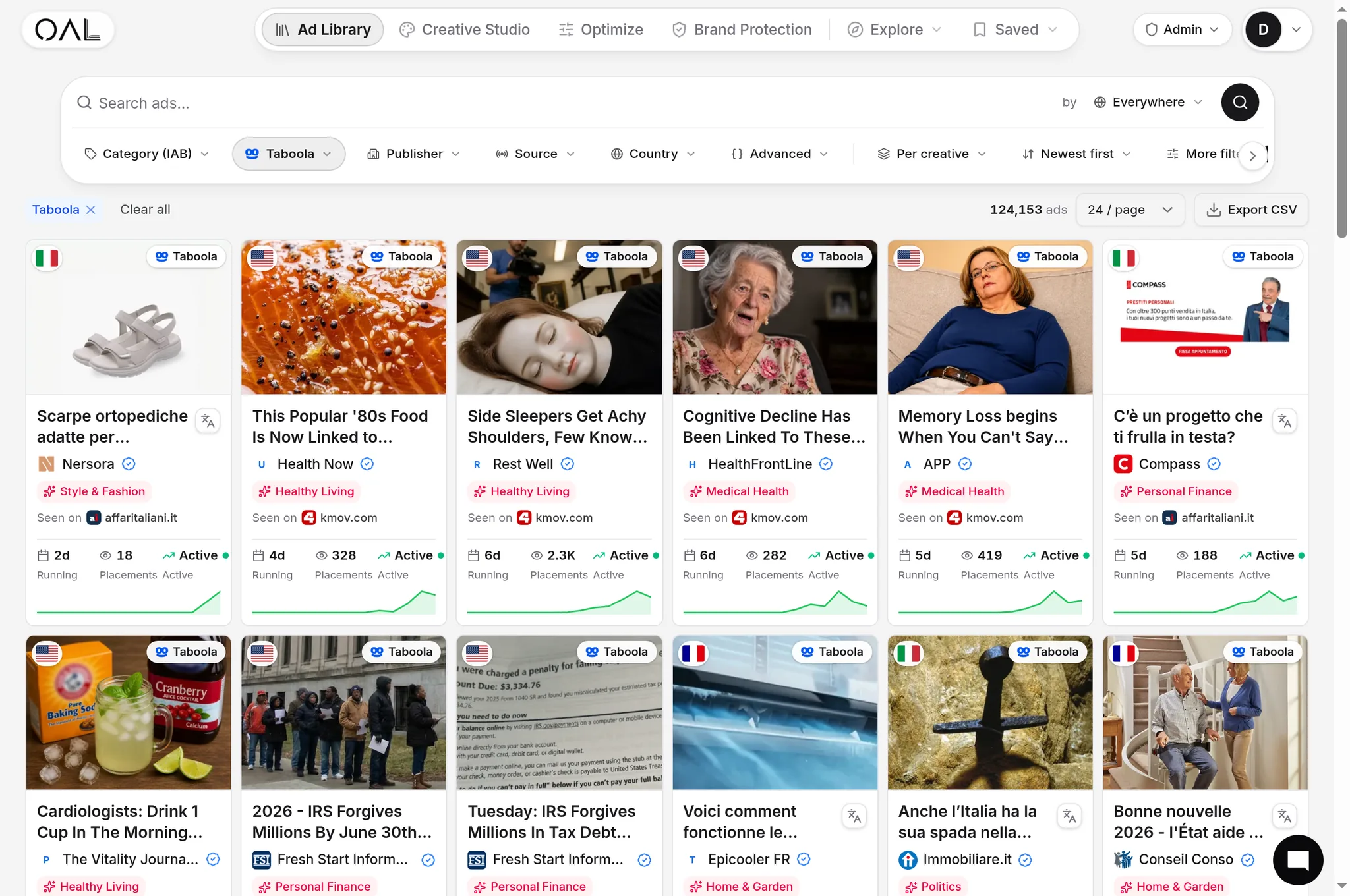
The fastest way to calibrate what a network's review actually tolerates is to look at what's live right now. OpenAdLibrary's index of 725,000+ native ad creatives across 49 networks (July 2026) shows you the claims, imagery, and funnel structures that passed review in your vertical and geo — and the ad-longevity data shows which of them keep passing ongoing re-review. Search your vertical in the native ad spy tool and pattern-match against ads that have survived for weeks, not against your own guesses about the policy line.
What to do when you get rejected#
First, read the rejection reason carefully — networks reject at the campaign, creative, or funnel level, and the fix differs for each. Second, fix the actual issue rather than lightly rewording; reviewers see resubmission histories, and repeated near-identical submissions erode goodwill. Third, use your rep if you have one: a one-line email asking "what specifically failed?" often gets you the real answer behind a generic reason code. Fourth, resubmit on the same account. And if a network's policy genuinely won't accommodate your offer, move networks rather than trying to sneak it through — the mid-tier networks exist for a reason, and a permanent ban on a major network is a real cost to your business.
Approval isn't a one-time hurdle. Networks re-review live campaigns, re-crawl landing pages, and respond to user complaints. The advertisers who never think about approval again are the ones who built the compliant funnel first and let the ad library evidence — not wishful thinking — define where the policy line sits.