Español
 Português (Brasil)
 Français
 Deutsch
 Italiano
 Nederlands
 Polski
 Svenska
 Türkçe
 Русский
 日本語
日本語 한국어
한국어 简体中文
简体中文 Tiếng Việt
 Bahasa Indonesia
 繁體中文
繁體中文 Čeština
 Dansk
Dansk Norsk (bokmål)
 Suomi
Suomi Ελληνικά
 Română
 Magyar
 Українська
 ไทย
ไทย हिन्दी
 العربية
 עברית
עבריתNative Ad Network Content Policies Compared: What 8 Networks Allow
Taboola and Microsoft gate what MGID and Revcontent tolerate. A practitioner's comparison of eight native networks' content policies across nutra, crypto, dating, CBD and gambling — with the captured-ad evidence.


Native ad networks differ sharply in what they let you run. The premium feeds — Taboola, Outbrain, Microsoft Audience Network, Yahoo, Teads — enforce strict content policies shaped by their brand-name publishers, while the mid-tier — MGID, Revcontent, MediaGo and the long tail — accepts categories and creative styles the majors reject or heavily gate. Below is a practitioner's comparison of how eight networks treat the five categories buyers ask about most — nutra, crypto, dating, CBD and gambling — plus what OpenAdLibrary's captured-ad index shows actually running on each. Policies change and vary by geo; treat this as the map, and each network's current documentation as the territory.
The comparison at a glance#
| Network | Nutra / supplements | Crypto | Dating | CBD | Gambling |
|---|---|---|---|---|---|
| Taboola | Restricted — allowed with claim limits and review | Restricted — licensed products, geo-gated | Mainstream only; no adult | Largely prohibited; narrow geo exceptions | Licensed operators in regulated geos, certification required |
| Outbrain | Restricted — stricter on health claims than most | Restricted — geo-gated, licensed only | Mainstream only | Largely prohibited | Licensed, geo-gated |
| MGID | Allowed — core category, moderated | Allowed with restrictions by geo | Allowed, broader tolerance | Case-by-case by geo | Allowed in licensed geos |
| Revcontent | Allowed — visibly a core category | Restricted | Allowed | Case-by-case | Restricted; sweeps-style offers more common |
| MediaGo | Restricted — premium-supply constraints | Restricted | Mainstream only | Prohibited on most supply | Licensed, geo-gated |
| Microsoft Audience Network | Restricted — supplements with strict claim rules | Largely prohibited; narrow licensed exceptions | Restricted; no adult | Prohibited | Per-market licensing plus certification |
| Yahoo | Restricted — premium standards | Restricted | Mainstream only | Prohibited | Licensed, geo-gated |
| Teads | Effectively closed to performance nutra; brand-led supply | Restricted | Mainstream brand campaigns only | Prohibited | Licensed brand campaigns only |
Three reading notes. First, "restricted" almost always means pre-approval, claim limits and geo gates rather than a clean yes. Second, Outbrain and Teads have been one company since the 2025 merger (background: how Outbrain works now that it is part of Teads), but the feed product and the brand-video product remain distinct supply surfaces with distinct tolerance levels. Third, every cell above moves — networks tighten after publisher complaints and loosen when revenue demands it, so verify against current policy pages before funding an account.
Why the premium feeds are strict#
Taboola and Outbrain sell their widgets to household-name publishers, and one screenshot of a lurid ad on a broadsheet homepage costs more than the advertiser paying for it brings in. That publisher pressure shows up as advertiser review at signup, creative-level rejection queues, sensitive-category certification and per-publisher blocklists. It also shows up in the data: in our index, Taboola's biggest classified verticals are health, finance and insurance — mainstream lead-gen, not gray-zone offers (see how Taboola ads work for the full mechanics). Microsoft Audience Network is the strictest of the set because it inherits Microsoft Advertising's policy framework wholesale — the practical consequences for buyers are covered in our MSN native ads guide.
Where the mid-tier is genuinely looser#
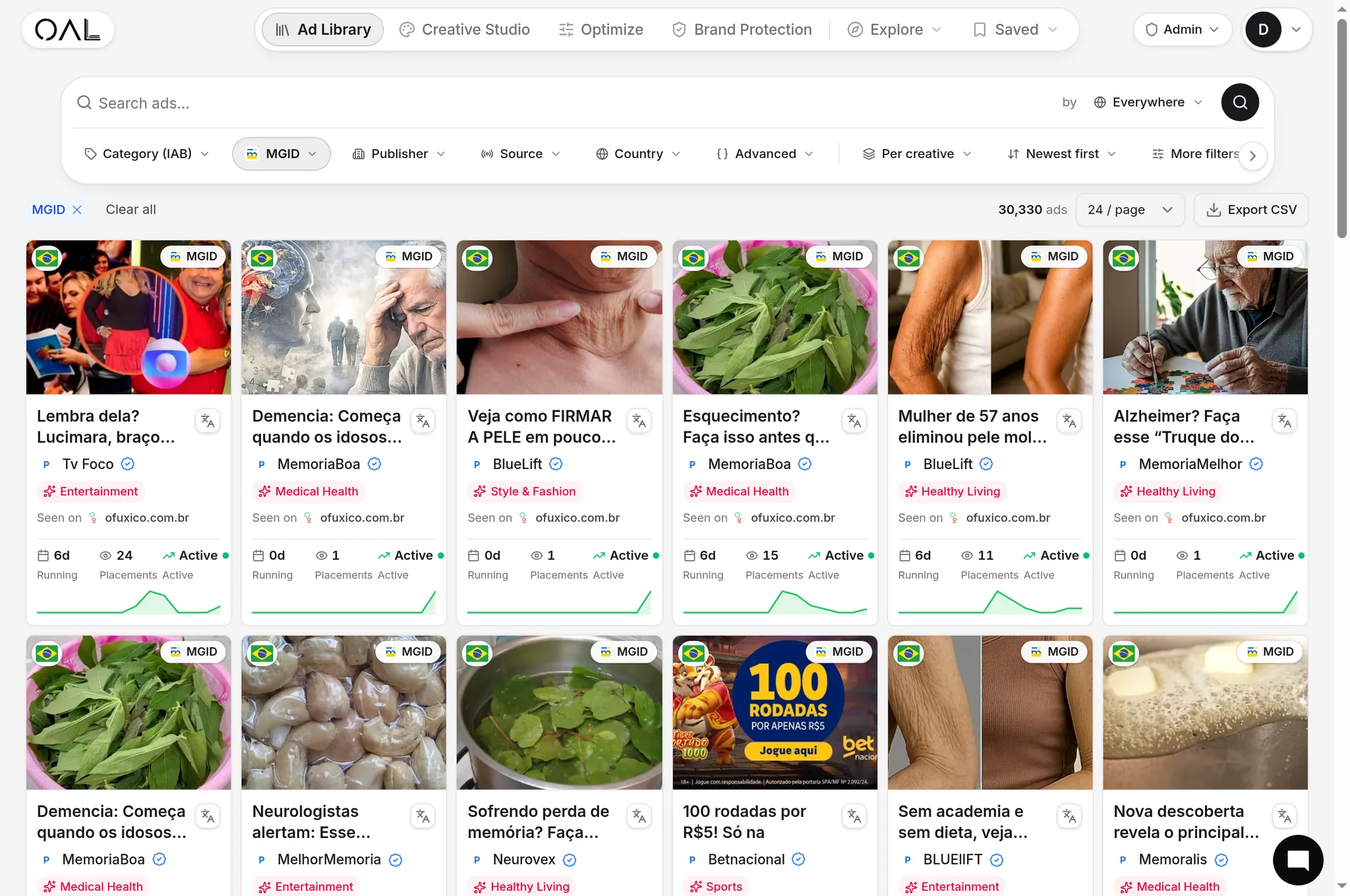
The looseness is visible in captured ads, not just policy text. Revcontent is the only network in our index where nutra appears among the top classified verticals outright (440 creatives, June 2026), and health is its single biggest classified category at roughly 16% of its indexed creatives — nearly three times health's share on Taboola. MGID's largest classified vertical is entertainment at roughly a fifth of its corpus, the classic celebrity-hook advertorial territory. The trade-offs between these two networks — and what "looser" costs you in traffic quality — are detailed in MGID vs Revcontent.
Looser does not mean lawless. Mid-tier networks still reject creatives, still ban accounts, and none of them shields you from regulators: FTC substantiation and disclosure rules apply identically on a strict network and a permissive one (see FTC disclosure rules for advertorials). The mid-tier tolerance is about network policy, not legal exposure — a distinction that matters most in nutra, where the aggressive claim styles the mid-tier tolerates are exactly what regulators pursue.
Beyond category bans: creative-style policies#
Category permission is only half the policy surface. Even for a fully allowed offer, networks regulate how the ad is constructed, and the premium/mid-tier split shows up here too:
- Before/after imagery — prohibited or heavily restricted on premium feeds for health and beauty; common in the mid-tier's live inventory.
- Personal-attribute callouts — headlines that assert something about the reader ("If you have diabetes…", geo-injected "Homeowners in {city}") are restricted on premium networks as sensitive targeting; the pattern remains a mid-tier staple.
- Clickbait constructions — fabricated urgency ("before it's removed"), fake-celebrity implications and misleading thumbnails are banned everywhere on paper; tolerance in practice varies exactly along the premium/mid-tier line.
- Claim superlatives — "cure", "guaranteed", "#1 doctor recommended" trigger rejection on premium review and, regardless of network, create regulatory exposure the network cannot absorb for you.
- Sponsored-label integrity — every network requires ads to render with the publisher's sponsored disclosure; attempting to blend past it violates both network policy and, in the US, FTC format rules.
A useful habit: when a creative style is central to your funnel economics — nutra advertorials live and die on before/after proof, for instance — check the target network's live inventory for that style specifically, not just the category.
Policy versus practice: what enforcement actually looks like#
Written policy tells you what a network says; enforcement tells you what it does. In practice enforcement operates at four levels:
- Account review — sensitive categories often require declared verticals, business verification, or a minimum spend commitment before approval.
- Creative review — the rejection queue. Premium networks reject on claim language, before/after imagery and clickbait constructions; mid-tier networks mostly reject on outright policy violations.
- Post-approval flags — an ad that passed review can be pulled weeks later after publisher or user complaints. Landing pages get re-crawled; a pre-lander swapped after approval is the fastest route to a ban, and cloaking attempts compound it (what detection looks like from the outside: ad cloaking).
- Category purges — networks periodically clear whole categories (crypto after a fraud wave, sweeps after publisher pushback: sweepstakes offers have cycled on and off several networks).
The most useful enforcement signal is observational: what is running right now, and for how long. An ad that has survived three weeks in your category on a given network is evidence of current, real-world tolerance in a way no policy PDF is.
How to verify before you fund an account#
- Read the current policy page for your exact category and geo — not a forum summary. For example, Microsoft publishes its full policy set at about.ads.microsoft.com/policies and Taboola's advertiser policies live in its help center at help.taboola.com.
- Ask your rep the specific question in writing — "can I run X offer with Y claim structure in Z geo" — and keep the answer.
- Check what is actually running. Search your category, network and geo in a native ad research tool and sort by longevity. Persistent ads define the practical ceiling; their absence in a category the policy nominally allows is a warning.
- Compare across networks before committing budget — the volume-based ranking in best native ad networks plus the vertical breakdown in top native ad verticals shows where your category actually lives.
- Budget for rejections. Even clean offers lose creative variants to review on premium networks; build resubmission time into launch plans.
The pattern worth internalizing: network policy is a moving, negotiated line, and the captured-ad record is the only public evidence of where the line sits today.