 Español
 Português (Brasil)
 Français
 Deutsch
 Italiano
 Nederlands
 Polski
 Svenska
 Türkçe
 Русский
 日本語
日本語 한국어
한국어 简体中文
简体中文 Tiếng Việt
 Bahasa Indonesia
 繁體中文
繁體中文 Čeština
 Dansk
Dansk Norsk (bokmål)
 Suomi
Suomi Ελληνικά
 Română
 Magyar
 Українська
 ไทย
ไทย हिन्दी
 العربية
 עברית
עבריתAre Native Ads Good for Beginners? A Realistic Starting Guide
Native ads are more forgiving to start with than Facebook or Google, but the format's simplicity hides real work in angle testing, compliance, and patience.


Native ads are one of the more approachable channels for someone starting out in paid media, mostly because entry budgets are lower and account reviews are less punishing than Facebook or Google Ads. That said, approachable is not the same as easy. You still need a landing page that matches what the ad claims, a handful of angles worth testing, and enough budget discipline to survive the week or two it takes to find a combination that works.
This isn't a knock on native as a starting channel. It's a realistic look at what "beginner-friendly" actually buys you, and what it doesn't.
What actually makes native advertising approachable#
A few things genuinely lower the barrier to entry compared to social or search:
- Smaller test budgets get usable signal. Most networks will let you run a real test on a modest daily budget, well below what you'd need to get a Meta or Google campaign out of the learning phase.
- Account approval is faster and less brittle. Native networks generally review creative and landing pages rather than scrutinizing your whole business model up front, so first-time advertisers in categories like nutra, personal finance, and home services get approved without the account-suspension roulette common on Meta.
- Production value matters less. Native units sit inside content feeds, in the "you may also like" widgets below articles, so a believable photo and a curiosity-driven headline routinely outperform a polished studio banner. You don't need a video team to start.
- Choice of network. Taboola, Outbrain (now folded into Teads), MGID, Revcontent, MediaGo, and Yahoo all sell native inventory with different minimums, review speeds, and vertical strengths, so a beginner has somewhere to start regardless of niche.
Where the beginner-friendly label breaks down#
The format looks simple. The strategy behind a working campaign is not.
First, native buys attention, not intent. Someone reading an article about retirement didn't search for "best hearing aids," so your ad has to manufacture curiosity or relevance the way a search ad never has to. That usually means writing several angles, not one, and testing them against each other before you know which resonates.
Second, most profitable native campaigns for regulated or claim-heavy verticals (health, nutra, finance, insurance) rely on a pre-lander, a page between the ad and the offer that builds context and, in strict verticals, keeps the ad copy itself compliant. Skipping this step is the single most common reason a beginner's first campaign gets disapproved or, worse, approved and then shut down mid-flight.
Third, native optimizes on a slower clock than search. Where a Google Ads account can show meaningful signal within hours, native campaigns often need several days of spend before the algorithm and your own read on the data are reliable. Beginners who kill a test after three hours of underwhelming clicks are usually killing tests too early.
Network entry difficulty, roughly#
None of these figures are official network pricing. They reflect what practitioners commonly report as the effort and spend needed to get a first read, and your vertical and geo will move things a lot.
| Network | Review friction | Best fit for a first campaign |
|---|---|---|
| Taboola | Moderate; larger advertiser base | Broad consumer verticals: health, finance, home & garden |
| MGID | Lower; faster onboarding for smaller advertisers | Entertainment, sweepstakes, lower-CPC testing |
| Revcontent | Moderate | Health, finance, home services |
| Outbrain / Teads | Moderate to higher on premium placements | Brand-safe consumer categories, ecommerce |
| MediaGo | Lower, newer advertiser base | Insurance, ecommerce, auto |
A realistic first 30 days#
- Research before you write a single ad. Look at what's already running and for how long in your vertical. An ad still live after a few weeks is a decent proxy that it's making money, since networks and advertisers don't keep paying for losers. Our guide on how to find winning ads walks through the signals worth trusting.
- Build 3 to 5 angle variations and one or two landing pages. Don't launch a single creative and hope. Angles fail for different reasons (weak hook, wrong audience, mismatched landing page), and you can't diagnose which without variation.
- Pick one network and a modest daily budget. Spreading a small test budget across four networks on day one just means four underpowered tests instead of one you can actually read.
- Let it run long enough to matter, then cut what's clearly underperforming and keep feeding budget to what's working.
- Scale gradually. Jumping a winning ad set's budget by 5x overnight tends to reset the algorithm's learning and tank performance, a pattern practitioners refer to as breaking the delivery.
Common mistakes beginners make#
- Judging an ad on CTR alone. A high-CTR, low-conversion ad is worse for your business than a modest-CTR ad that actually sells, because the network happily charges you for clicks that never turn into revenue.
- Not tracking all the way to the sale or lead. If you're only watching clicks and spend, you're optimizing a number that doesn't pay your bills. Set this up before launch, not after a disappointing first week.
- Copying a competitor's angle without building a compliant landing page for it. This is one of the fastest ways to get an account flagged in regulated verticals like health or finance, since the network holds you responsible for the full funnel, not just the ad text.
- Treating native like search. Expecting fast, obvious signal within hours instead of giving a campaign the several days it typically needs is the single most common reason beginners abandon tests that would have turned around.
- Ignoring longevity as a research signal. An ad still running after several weeks has usually survived real budget scrutiny from its advertiser. Skipping this kind of research and guessing at angles from scratch means repeating mistakes other advertisers already paid to discover.
- Spreading a small budget across too many networks at once. Four underpowered tests give you four sets of noisy, unreadable data instead of one test you can actually learn from.
Tracking and attribution before you launch#
A beginner mistake that costs more than any bad ad: launching without a tracker connected. You need to know, per ad and per landing page variant, how many clicks turned into a lead or sale, not just how many clicks you bought. Set up conversion tracking and a tracking pixel or postback URL before your first dollar spends, not after your first week of data is already unusable.
This matters more in native than in search because CTR on native ads tends to run lower relative to intent, and a good angle can post a mediocre click-through rate while still converting well downstream. Without conversion data, you'll optimize toward the wrong ads.
When native probably isn't your best first channel#
Native isn't the right starting point for every business. If your offer needs a highly qualified buyer right at the moment of intent (a specific software category someone is actively comparison-shopping, for instance), a search campaign captures that demand more directly than a native placement ever will. Native works best for demand you have to create: a curiosity hook, a problem the reader didn't know they had, or a story-driven angle that earns the click. If your product doesn't lend itself to that kind of narrative, or your margins can't absorb a testing phase measured in days rather than hours, it's worth weighing Facebook or Google as an alternative starting point before committing your first budget to native.
How OpenAdLibrary helps#
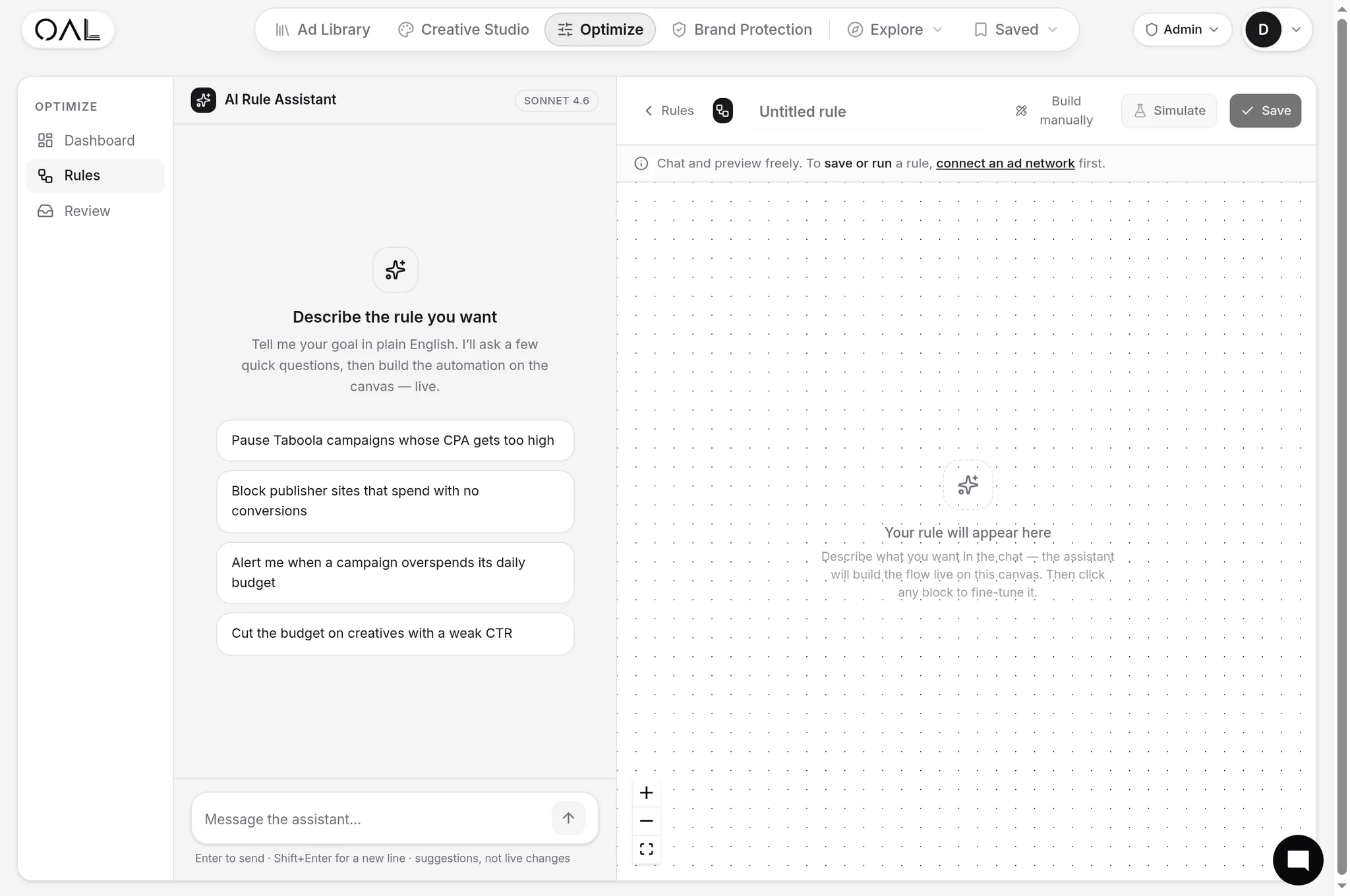
Before you spend a dollar, it's worth seeing what's actually running. OpenAdLibrary indexes native creatives across dozens of networks, including headline, image, advertiser, and how long each ad has been live, so you can shortlist angles that have already survived real budget instead of guessing blind. The native ad spy tool is built specifically for this kind of pre-launch research, and there's a free tier to start with before you commit to a paid plan.
Beginners who spend an afternoon studying what's working before writing their first ad tend to skip a lot of the expensive trial and error described above. It won't remove the learning curve entirely, but it shortens it considerably.