Español
 Português (Brasil)
 Français
 Deutsch
 Italiano
 Nederlands
 Polski
 Svenska
 Türkçe
 Русский
 日本語
日本語 한국어
한국어 简体中文
简体中文 Tiếng Việt
 Bahasa Indonesia
 繁體中文
繁體中文 Čeština
 Dansk
Dansk Norsk (bokmål)
 Suomi
Suomi Ελληνικά
 Română
 Magyar
 Українська
 ไทย
ไทย हिन्दी
 العربية
 עברית
עבריתIs Native Advertising Saturated? Where the Openings Still Are
The channel isn't saturated, but plenty of specific vertical-geo-angle combinations are. Here's how to tell which situation you're actually in before you spend a testing budget finding out.


Native advertising isn't saturated as a channel overall, but specific combinations of vertical, geo and angle absolutely get saturated, and that's the level at which the question actually matters. The mistake is treating "native advertising" as one market. It's really thousands of narrow micro-markets (one per vertical-geo-network combination), and saturation moves independently across all of them.
Why the channel-level question is the wrong one#
Total ad volume on the major native networks has grown steadily for years, more advertisers, more publishers, more spend. That growth is real, and it's also not the thing that determines whether you personally can profit in native right now. A crowded overall market with room in specific corners looks identical from the outside to a genuinely saturated one, until you look at the right level of detail.
The right question isn't "is native saturated," it's "is my specific angle, in my specific vertical and geo, saturated right now." Those two questions can have completely different answers.
What real saturation looks like at the micro level#
A vertical-geo-angle combination is genuinely saturated when:
- Many advertisers are running near-identical creative and offers, which pushes CPCs up as they compete for the same impressions and compresses everyone's margin.
- CTR and CVR are declining across the board on that angle, not just for your account, because audiences have seen the same hook too many times (creative fatigue at a market level, not just an ad level).
- The angle has been running unchanged for a long time with no new variations appearing, suggesting the pool of advertisers testing it has stopped innovating and is just running the same thing until it stops working.
That's a real signal to move on or differentiate hard. But it describes a specific pocket, not the entire channel.
It's also worth distinguishing saturation from maturity. A mature angle that's been running for a long time with a stable, moderate number of advertisers isn't automatically saturated, it might simply be a durable evergreen offer that continues to convert because the underlying need it addresses doesn't go away. See the longest-running native ads for examples of angles that have stayed live for extended periods without collapsing under competition, which is a different situation from a crowded, fast-churning angle with dozens of near-identical advertisers.
Where the openings still are#
Three places saturation is reliably lower, even in crowded overall verticals:
Tier-2 and tier-3 geos. The heaviest competition concentrates in top-tier English-speaking geos because that's where the biggest advertiser budgets go first. Smaller geos often have real audience volume with far fewer advertisers competing for it. See scaling to new geos for how to evaluate whether a geo has enough native ad volume to be worth testing before you commit budget.
Newer or smaller networks relative to the big two. Taboola and Outbrain carry the most volume and the most competition. MGID, Revcontent and MediaGo often have thinner competition on the same offer types, at the cost of somewhat lower total reach.
Angle variation within a proven vertical. A vertical being competitive doesn't mean every possible angle within it is saturated. Health as a category is intensely competitive across the top vertical data, but a specific angle that hasn't been tried yet inside that broad category can still have real room, especially paired with a fresh creative treatment.
How to actually check saturation before you commit budget#
Guessing at saturation from gut feel is how people either avoid genuinely good opportunities out of excess caution, or walk into genuinely crowded ones without realizing it. A more reliable check looks at what's actually running:
- Count how many distinct advertisers are running a similar angle in your target vertical and geo. A handful of advertisers testing an angle is very different from dozens running near-identical creative.
- Check how long those ads have been running. Long-running ads mean the angle still converts despite the competition, which is a different situation than lots of short-lived ads churning through fast, which suggests the angle is dying, not thriving.
- Look at how much creative variation exists. If every ad in the space uses the same headline formula and image style, that's a saturated, tapped-out angle. If you're seeing new variations appear regularly, advertisers are still finding room to differentiate, which usually means the market underneath still has room too.
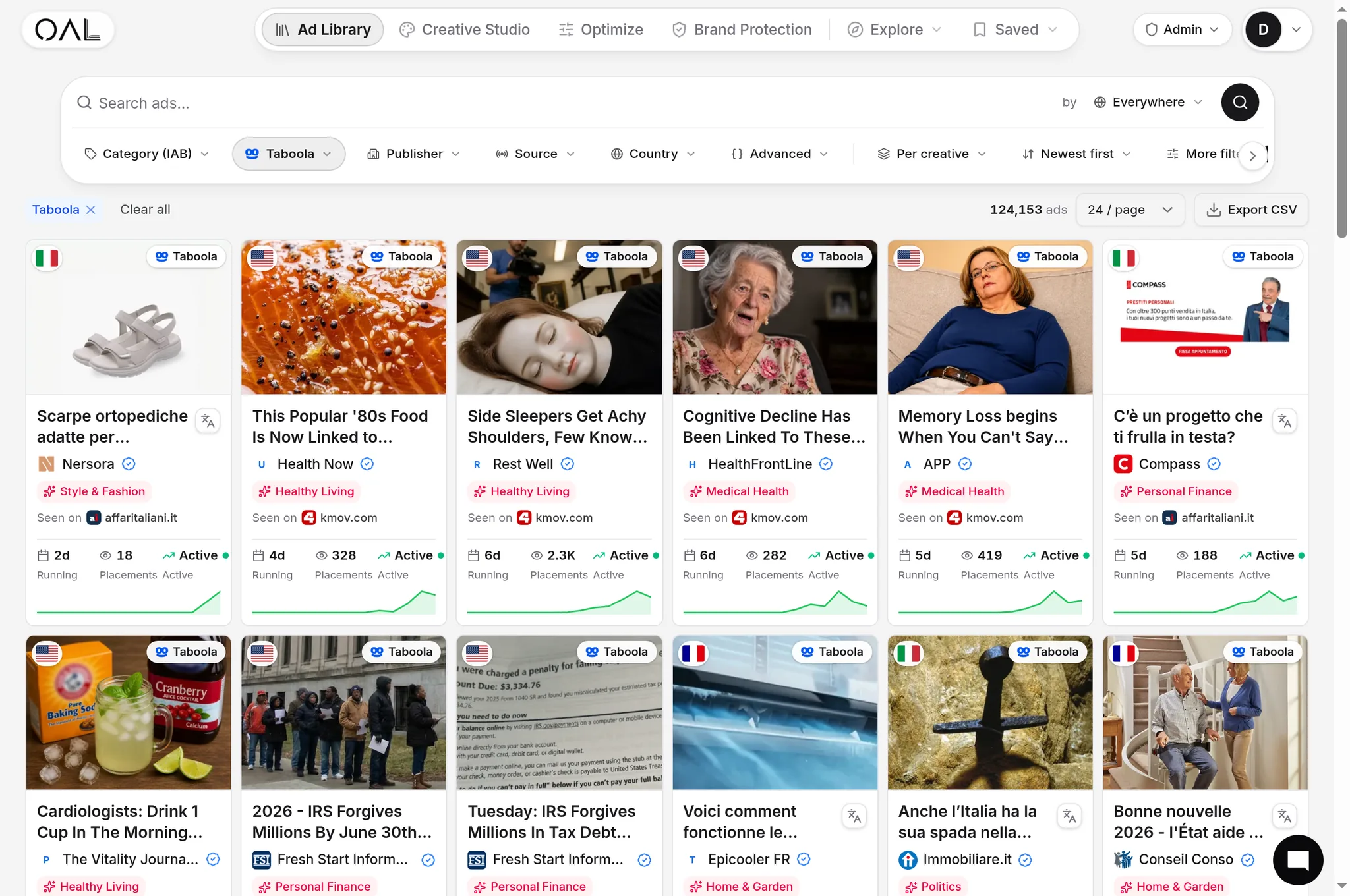
This is exactly the kind of check that's hard to do from memory or gut feel and much easier with actual data. OpenAdLibrary's index lets you filter live native creatives by vertical, network and geo, see how many distinct advertisers are active, and check run length and creative variation directly, rather than guessing at saturation from anecdotes. See how to do competitor ad analysis for a fuller framework, and share of voice for measuring how concentrated a vertical actually is among a small number of advertisers versus spread across many.
How network choice changes the saturation math#
Saturation isn't evenly distributed across networks either, and this is often the fastest lever to pull when a specific angle feels tapped out on your primary network.
Taboola and Outbrain carry the largest volumes and, correspondingly, the deepest competition on proven angles in the biggest verticals. An angle that's genuinely saturated on Taboola specifically can still have real room on a network with thinner competition for the same offer type, simply because fewer advertisers have gotten around to testing it there yet. This isn't a permanent gap, competitive angles do eventually spread across networks as advertisers diversify their own spend, but the lag between "saturated on network A" and "saturated everywhere" is often long enough to be worth exploiting.
MSN's native feed and Yahoo's native inventory both carry meaningfully different audience compositions than the pure-play native networks, which sometimes means an angle that's exhausted its audience on Taboola still has fresh reach available through a different feed entirely, even at similar or lower competition levels.
Saturation signals that are easy to misread#
Two patterns commonly get misread as saturation when they're actually something else:
- A short-term CPC spike isn't the same as saturation. Auction dynamics can push CPCs up temporarily for reasons unrelated to long-term competition, seasonal demand, a large advertiser temporarily entering the auction, or a publisher-side inventory change. Check whether the CPC increase persists over multiple weeks before concluding the angle itself is saturated.
- Your own declining performance isn't proof the whole market is saturated. Sometimes it's creative fatigue specific to your audience exposure, not a market-wide effect. Refreshing your own creative on an otherwise-healthy angle sometimes resolves what looks like saturation but is actually just your specific ad wearing out.
The practical takeaway#
Don't ask whether native advertising as a whole is saturated. Ask whether the specific angle, vertical and geo combination you're about to spend budget on is saturated right now, using actual evidence rather than assumption. Channel-level growth and micro-market saturation coexist constantly in native, and conflating the two is what leads either to giving up on a channel that still has real openings, or wasting budget testing into a corner that's already tapped out.
Building a habit out of this, not a one-time check#
Saturation isn't a fixed answer you look up once. Vertical-geo-angle combinations move in and out of saturation continuously as advertisers enter, test, scale, and eventually exhaust an angle, then move on. Treat competitive research as an ongoing part of your process rather than a one-off check before your first campaign. Buyers who build a recurring habit around it, a weekly or biweekly look at what's newly appearing, what's still running strong, and what's thinning out in their vertical, catch both emerging openings and fading angles earlier than buyers who only check when a campaign is already struggling. See building a competitive ad intelligence workflow for how to turn this into a repeatable routine rather than an occasional gut-check.