Español
 Português (Brasil)
 Français
 Deutsch
 Italiano
 Nederlands
 Polski
 Svenska
 Türkçe
 Русский
 日本語
日本語 한국어
한국어 简体中文
简体中文 Tiếng Việt
 Bahasa Indonesia
 繁體中文
繁體中文 Čeština
 Dansk
Dansk Norsk (bokmål)
 Suomi
Suomi Ελληνικά
 Română
 Magyar
 Українська
 ไทย
ไทย हिन्दी
 العربية
 עברית
עבריתSmall Business Native Ads Budget: Monthly Numbers That Make Sense
There's no universal monthly number for a small business native ads budget. Here's a framework to set one from your own margin, split it across testing phases, and know when a creative has earned scaling spend.


A small business testing native ads for the first time should plan around two separate numbers: a testing budget to find a working angle and audience, and a scaling budget to spend once one is found. Media buyers commonly frame the testing phase at roughly a few hundred to a couple thousand dollars a month per vertical, non-official and highly dependent on your niche, geo and margin, with scaling budget only added after a creative proves itself over real time, not a single good day.
Why native ads suit a small, careful budget#
Native ad units sit inside a publisher's content feed and read as recommended stories rather than banner ads, which is why click-through tends to be more forgiving of small budgets than open display: you are not fighting banner blindness on a channel where users already expect to click through to an article. Media buyers commonly report native CPCs run a fraction of typical search CPCs, though this varies hugely by vertical, geo and network, and should be verified against your own account rather than assumed. That lower floor is exactly why native suits a small business testing budget: you can run enough impressions to get a real read without needing an enterprise media budget.
The tradeoff is that native requires more creative iteration than search. A single high-intent keyword can carry a search campaign for months; a native creative fatigues as the same audience sees it repeatedly on the same publisher network. Budget for creative refresh, not just clicks, or a small testing budget gets eaten by a stale hook long before you learn whether the offer itself works.
A simple framework for setting your first monthly number#
Work backward from what a single conversion is worth to your business, then decide how many conversions you need to call a test conclusive, rather than picking a round number because it sounds reasonable.
- Set your maximum acceptable cost per conversion, based on your margin and lifetime value, not on what a network sales rep suggests.
- Decide how many conversions constitute a real signal. A handful of conversions tells you almost nothing about whether an angle works; you need enough volume to separate a real pattern from noise.
- Multiply that conversion count by your acceptable cost ceiling, then add a buffer, typically 30 to 50%, because your first creative rarely performs at your target cost on day one.
- Split that number across 2 to 3 distinct creative angles, not one, since a single angle failing tells you nothing about whether native as a channel works for your offer.
This produces a monthly figure specific to your offer and margin, which is more useful than any generic "spend $X a month" rule, because a $40 supplement offer and a $2,000 B2B service have nothing in common on the cost side.
How to split the budget across phases#
| Phase | Rough share of budget | Purpose |
|---|---|---|
| Angle testing | 60-70% | Find which hook, headline and image combination gets a response at all |
| Audience and geo testing | 15-20% | Narrow down which geo tiers and devices convert once an angle works |
| Scaling the winner | remaining, added later | Only funded once a creative shows durable performance, not a single strong day |
Resist the urge to fund the scaling column before you have a proven winner. The most common way small budgets get wasted is treating every new creative as if it has already earned scaling spend.
One network or several?#
With a limited monthly budget, running on one network well beats spreading thin across four. Each native network (Taboola, Outbrain/Teads, MGID, Revcontent, MediaGo, Yahoo, Teads) has its own minimum viable daily spend to get a fair read from its algorithm, and splitting a small budget across all of them means none of them gets enough signal to optimize properly. Pick the network whose audience and format best match your offer, run there until you have a repeatable playbook, then expand. How to advertise on Taboola and how MGID native ads work are good starting points for understanding format and setup differences before you commit a first budget to either.
Signals that justify increasing the budget#
Do not scale on gut feel. Look for:
- A creative that keeps converting at or under your cost ceiling across more than one day of the week, not just a single strong session.
- A creative still running without a refresh needed, since early creative fatigue is a sign the audience is smaller than it looks.
- Consistent performance across more than one geo tier, which suggests the angle, not a lucky audience pocket, is doing the work.
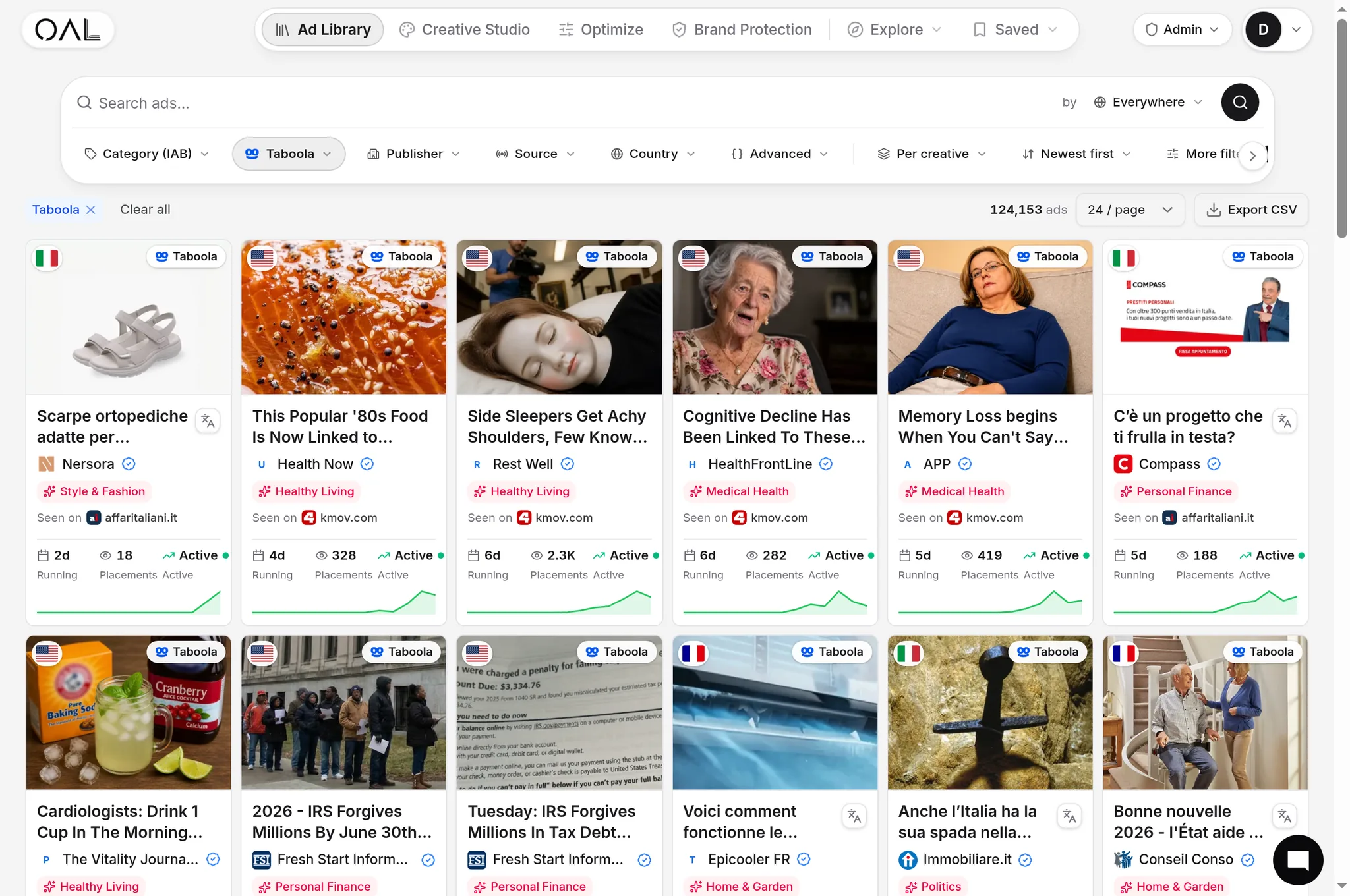
It is also worth checking whether the angle you found is one that has already proven durable elsewhere. OpenAdLibrary's index tracks how long native creatives stay live across networks (a rough proxy for profitability, since networks and advertisers don't keep paying for underperforming creative), covering best native ad networks for ecommerce and dozens of other verticals; if a similar hook to yours has been running for weeks elsewhere, that's independent confirmation the pattern works before you commit more of a small budget to it.
Don't forget the costs that aren't media spend#
The number you set aside for clicks is not the whole budget. Two line items get skipped constantly by small businesses moving from search or social into native, and both cause the "budget" to fail even when the media spend line looks fine:
- Tracking infrastructure. A postback-capable tracker or a network's native pixel needs to be set up correctly before you spend a dollar, or you will not be able to tell a winning creative from a losing one. This is not optional overhead; it's the only way the budget framework above produces a real answer instead of a guess.
- Creative production. Native ads fatigue faster than a single evergreen search ad, so budget for a rotating set of images and headlines, not one static creative you hope lasts the whole test. Even a modest ongoing creative refresh line item, planned in advance, prevents the common failure of a good angle dying of fatigue before you noticed it was working.
Both of these are small relative to media spend, but skipping them is the difference between a test that produces a decision and one that produces an ambiguous shrug.
Common budgeting mistakes small businesses make#
- Funding one creative instead of a set. A single ad failing proves nothing about the channel.
- Skipping a tracking budget. A cheap or missing conversion tracker means you cannot tell a winning creative from a losing one, no matter how the platform dashboard reads.
- Spreading across every network at once. Thin spend on five networks produces five weak signals instead of one clear one.
- Scaling on a single good day. Native performance swings by day of week and by publisher mix; one strong day is not durability.
- Ignoring minimum daily spend requirements. Check each network's current documentation before committing, since these change and vary by account type.
Where OpenAdLibrary helps a small budget go further#
Testing native on a limited budget is largely a research problem before it is a spend problem: the businesses that get a good first read are usually the ones that picked an angle already proven to hold up, rather than guessing cold. OpenAdLibrary's ad intelligence index lets you check what is currently running and for how long across your vertical before you spend a dollar of your own testing budget, which turns blind creative testing into an informed shortlist.
A small, disciplined native budget beats a large, scattered one every time. Set your ceiling from your own margin math, split it across a few angles instead of one, hold the scaling spend back until a creative earns it over more than a single good day, and treat research as part of the budget, not an afterthought.