Español
 Português (Brasil)
 Français
 Deutsch
 Italiano
 Nederlands
 Polski
 Svenska
 Türkçe
 Русский
 日本語
日本語 한국어
한국어 简体中文
简体中文 Tiếng Việt
 Bahasa Indonesia
 繁體中文
繁體中文 Čeština
 Dansk
Dansk Norsk (bokmål)
 Suomi
Suomi Ελληνικά
 Română
 Magyar
 Українська
 ไทย
ไทย हिन्दी
 العربية
 עברית
עבריתNative Ads on a Small Budget: A $500 Test Plan That Works
Yes, $500 buys a real native ads test — on the right network, in one geo, on one device, measured as data rather than profit. Here is the network-by-network viability call and the phase-by-phase plan.


You can test native ads on a $500 budget, but only if you pick a network with low minimums, restrict the campaign to one geo and one device, and treat the $500 as the price of data rather than a profit attempt. On self-serve mid-tier networks like MGID and Revcontent, $500 buys enough clicks — especially outside Tier-1 geos — to tell you whether a funnel deserves real budget. On premium networks like Taboola and Outbrain, $500 is workable for one narrow test and gone in days at broad settings.
What $500 actually buys: the click math#
Everything follows from CPC. Media buyers commonly report Tier-1 desktop CPCs from roughly $0.20 to $0.90 on the premium native networks, with mid-tier networks, mobile inventory and Tier-2/3 geos often running at a fraction of that — these are practitioner-reported ranges, not official rates, and your vertical will move them a lot. The current landscape is mapped in our native ads CPC benchmarks.
Run the arithmetic before you spend: at $0.50 CPC, $500 is about 1,000 clicks; at $0.10, it is 5,000. That difference decides what you can legitimately measure:
- 1,000–5,000 clicks can measure: creative CTR differences, landing-page click-through, cost per lead on low-friction offers, and obvious placement burners.
- It cannot measure: reliable CPA on a high-ticket or low-conversion-rate funnel. If your offer converts at 0.5%, a $500 Tier-1 test might see two conversions — noise, not signal.
Match the test to the budget: small budgets test upper-funnel mechanics (angles, creatives, landers) and cheap conversion events, not full unit economics. For the broader pricing picture, see how much native ads cost.
Network-by-network: where $500 is viable#
| Network | Self-serve | $500 viability | Why |
|---|---|---|---|
| MGID | Yes | Strong | Low entry requirements, cheap Tier-2/3 supply |
| Revcontent | Yes | Strong | Self-serve, mid-tier CPCs, health-heavy demand |
| Taboola | Yes | Tight | Deepest premium supply; Tier-1 CPCs eat $500 fast |
| Outbrain | Yes | Tight | Premium supply; same math as Taboola |
| MediaGo / Yahoo / Microsoft | Varies | After validation | Higher setup friction; better once a funnel is proven |
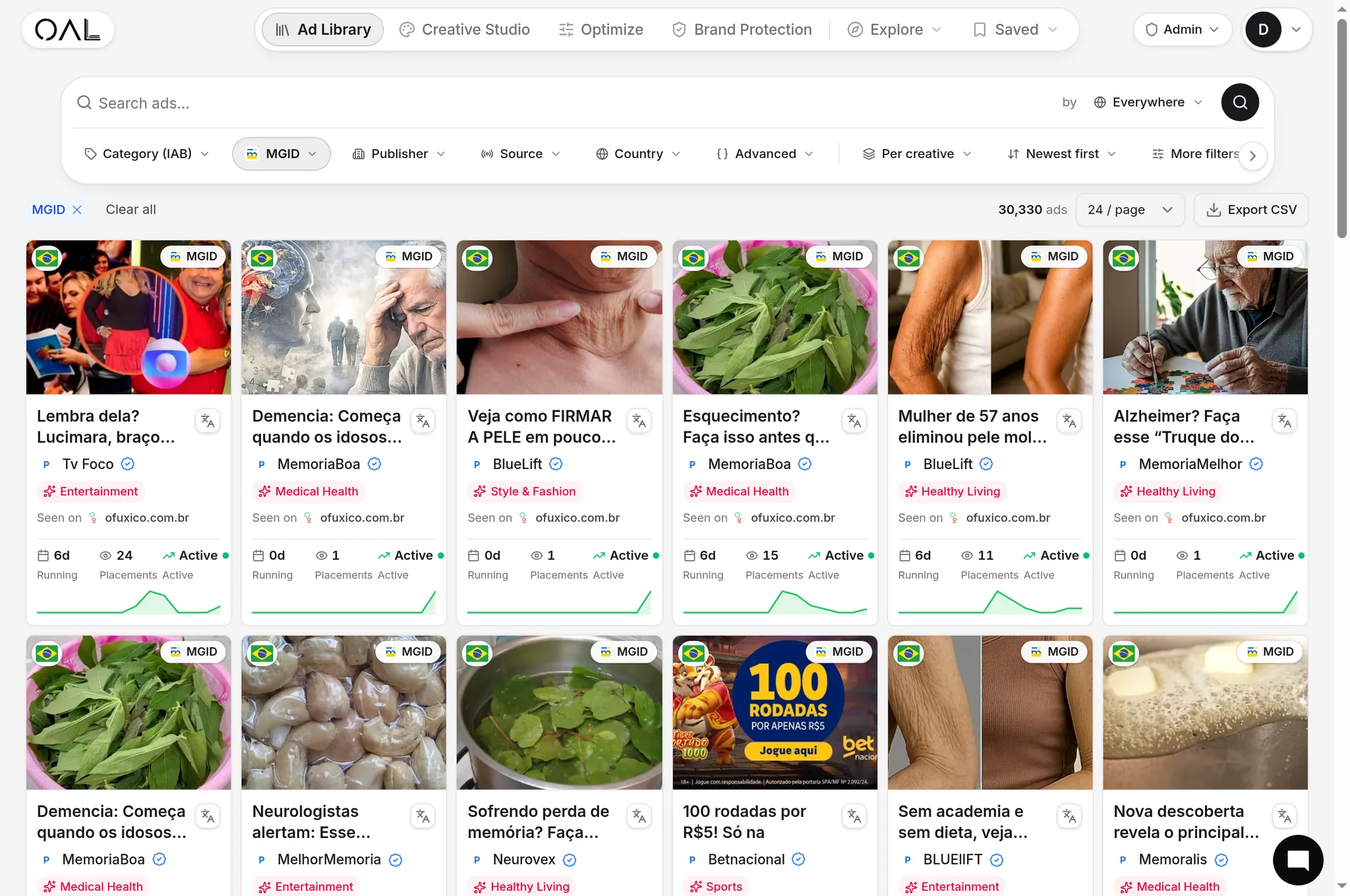
MGID is the classic small-budget entry: minimum deposits have historically been low (check current terms before funding), and its supply skews toward cheaper geos where $500 stretches furthest. The index holds 62,765 live MGID creatives as of June 2026 — a real market, not a leftover. How MGID works covers formats and setup.
Revcontent is the other natural starting point: self-serve, mid-tier pricing, and a demand mix that leans hard into health — 2,566 health creatives is the network's largest classified vertical in our index. If your offer is health-adjacent, that is your comp set. See how Revcontent works for mechanics.
Taboola and Outbrain hold the deepest premium inventory — 206,145 and 108,573 live creatives respectively in the index — but premium Tier-1 supply means $500 disappears quickly at broad settings. Viable if you constrain hard: one geo, one device, capped daily budget. The trade-offs are laid out in MGID vs Taboola.
Everything else — MediaGo, Yahoo, the Microsoft feed — is better treated as expansion territory after something works. Entry friction and minimums vary; check each network's current documentation rather than assuming.
The $500 test plan#
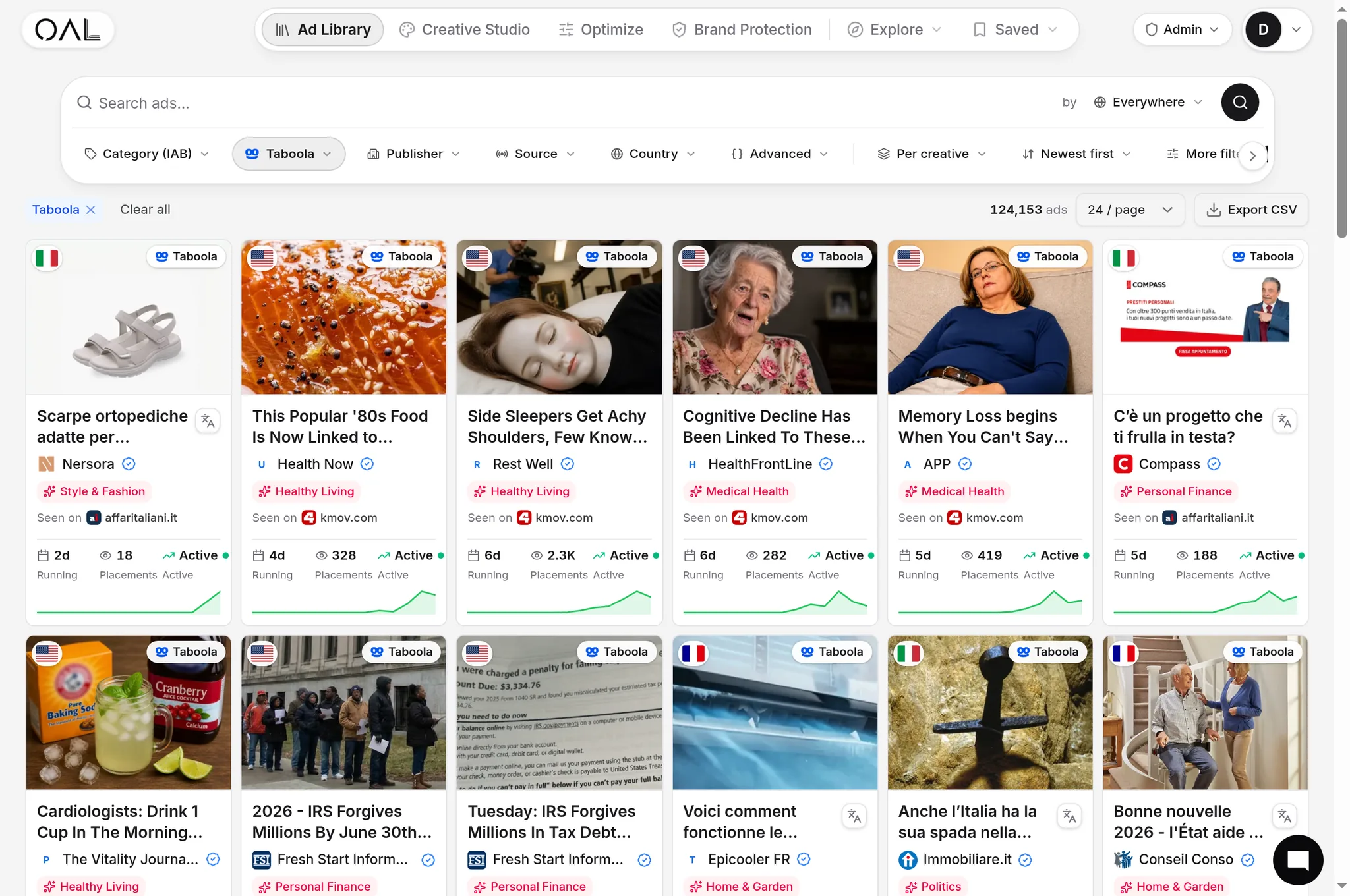
Phase 0 — research, $0. Do not pay the network to teach you what an ad library shows free. Before spending, find the angles, creatives and landers already running three-plus weeks in your vertical and geo — longevity is the closest public proxy for profitability. Browse the live MGID feed for your niche, and note the pre-lander patterns behind persistent ads. A free OpenAdLibrary account covers this entire phase.
Phase 1 — breadth, ~$150. One network, one geo, one device. Five to eight creatives built from proven angles (variations, not clones), one landing page, a conservative bid. Daily cap around $30–50 so the phase lasts several days. Your only goals: find which two creatives earn clicks, and confirm the tracker fires end to end.
Phase 2 — pruning, ~$200. Kill the bottom creatives. Blacklist placements that spent with zero engagement — a weekly site blacklist pass matters at any budget, and at $500 it matters most, because two burner placements can quietly eat a third of the money. Nudge bids up only where the placement report justifies it. Goal: a stable creative + lander combination with a believable cost per click-through or lead.
Phase 3 — confirmation, ~$150. One creative, one lander, the surviving placements. Measure the full funnel on your cheapest meaningful conversion event. You end the $500 with either a validated candidate for real budget or a documented dead end — both are wins at this price.
Tracking and measurement on a $500 budget#
Small budgets cannot afford measurement gaps, because every wasted click is a bigger share of the total. Three non-negotiables before launch:
- Pass the network's sub-IDs into your tracker. Placement, creative and geo IDs travel on the click URL; without them, Phase 2's pruning decisions are guesses. Every serious native network supports this — wire it up on day one.
- Fire a server-side postback for conversions. Pixel-only tracking undercounts, and at 1,000 clicks the difference between four recorded conversions and six changes your verdict. Use the network's S2S postback so conversion credit lands on the right placement and creative.
- Define the "meaningful event" in advance. If real conversions are too rare to measure at this budget, pick the deepest event you can afford statistically — lander click-through, lead form start, add-to-cart — and write down the pass/fail threshold before spending. Deciding the bar after seeing the data is how sunk-cost tests get extended into $1,500 failures.
A walk-through of the arithmetic, with illustrative numbers: at a $0.15 average CPC in a mid-tier geo, Phase 1's $150 buys about 1,000 clicks across eight creatives. Two creatives with clearly stronger CTR emerge; the lander passes 30% of visitors through to the offer. Phase 2's $200 concentrates on those two, cuts three placements that spent $20 each with zero engagement, and produces leads at $9 against a $12 target. Phase 3 confirms it end to end. None of those specific numbers will be yours — but that is the shape of a test that worked.
Kill, iterate, or fund: reading the results#
- Clicks but no landing-page engagement → angle problem. The headline is writing a check the lander can't cash. Iterate creative against lander message match before blaming the network.
- Engagement but no conversions → offer or funnel problem. Fix the lander or swap the offer; more traffic will not rescue it.
- Conversions near target CPA at small volume → fund it. Treat the next $500–1,000 as validation spend inside a proper scaling framework, not as license to 5x the budget.
Frame every judgment in multiples of target CPA, not absolute dollars: a placement or creative that has spent two to three times target CPA with nothing to show is cut; anything below one target CPA of spend has not been judged yet.
Five mistakes that torch small budgets#
- Spreading across networks. $125 on four networks answers nothing. One network, answered properly, beats four guesses.
- Launching broad Tier-1, both devices. The most expensive clicks in native, bought with the least data. Constrain geo and device from the first dollar.
- Testing one creative. You are not testing the channel, you are testing one guess. Five to eight variants is the minimum for a real read.
- Skipping the tracker. Without click-level tracking from day one, your $500 buys anecdotes. Set up postbacks before launch, not after.
- Judging the channel on profit. A $500 test that loses $300 but proves an angle with a 1.2% lander conversion rate is a success. The media buying guide for native ads covers how these stage metrics ladder into a real campaign.