Español
 Português (Brasil)
 Français
 Deutsch
 Italiano
 Nederlands
 Polski
 Svenska
 Türkçe
 Русский
 日本語
日本語 한국어
한국어 简体中文
简体中文 Bahasa Indonesia
 繁體中文
繁體中文 Čeština
 Suomi
Suomi Ελληνικά
 Română
 Magyar
 Українська
 ไทย
ไทย हिन्दी
 العربية
 עברית
עבריתNutra Ad Examples: Live Creatives, Hooks & Advertorial Funnels
Eight live nutra creatives from the index, reduced to a six-family hook taxonomy — plus the advertorial funnel anatomy and the compliance line that decides how long an account survives.


Nutra ads — supplements, skin and hair offers, joint-pain and blood-sugar products — are the most aggressive creative laboratory in native advertising, and the fastest place to learn what hooks actually move people. Below are live nutra ad examples captured in OpenAdLibrary's index, the hook taxonomy behind them, and the advertorial funnel that turns those clicks into buyers — plus the compliance line that separates advertisers who last from advertisers who rotate accounts.
What counts as nutra#
Nutra is affiliate shorthand for nutraceuticals and their neighbors: supplements, anti-aging and skin-care offers, hair regrowth, dental, joint pain, blood sugar, weight loss. The offers are typically sold on straight sale, subscription or trial models, and the vertical lives mostly on native traffic because feed environments reward curiosity hooks that health platforms with stricter review would never approve. The economics, offer structures and network policies are covered in our nutra on native ads guide — this article is about the creatives themselves.
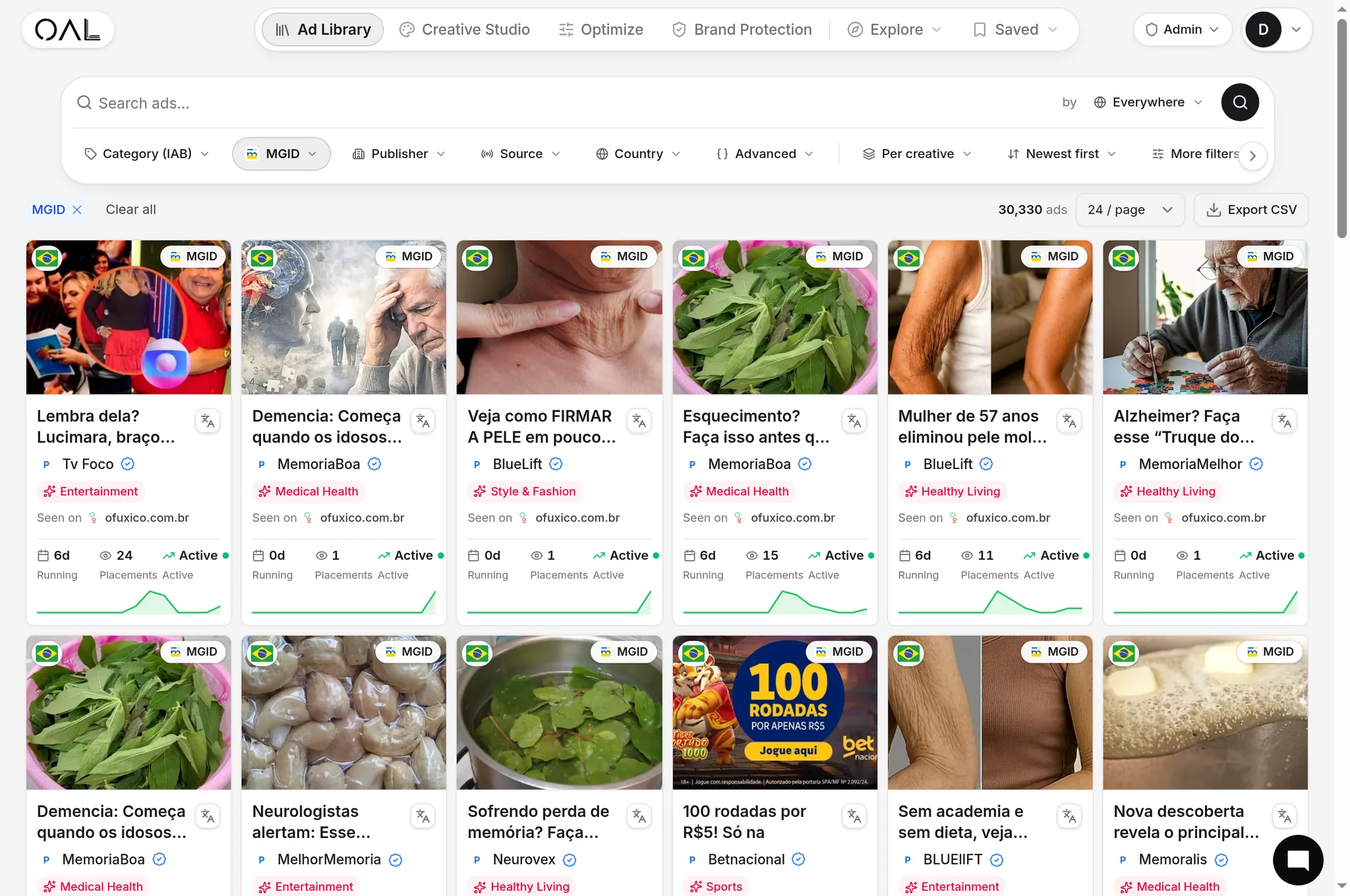
Live nutra ad examples from the index#
Each example lists the advertiser, network and observed run time at capture. Multi-week delivery is the signal worth studying: on native, ads that keep running are ads that keep paying.
1. The ban hook — health-headline.com (Outbrain, 3 days observed)
"Will This "Brain-Boosting" Supplement Be Banned?"
Scarcity applied to information: the product might disappear, so the reader must find out now. The question mark and quote marks do heavy deniability work — the ad asserts nothing, it only asks.
2. The authority + specifics hook — Health Weekly (Outbrain, 22 days observed)
"Cardiologist: 2 Veggies Will Kill Your Belly Fat Overnight! (Try It)"
The classic nutra template: named specialist, small concrete number, compressed timeframe. Three weeks of observed delivery says it still converts; its claim profile also makes it a walking compliance violation — more on that below.
3. The removal threat — Health Weekly (Revcontent, recurring captures)
"Endocrinologist: If You Have Diabetes, Read This Before It's Removed!"
Authority plus urgency about the information itself. Note the advertiser: the same operation runs authority hooks across Outbrain and Revcontent simultaneously — cross-network replication is how proven nutra angles scale.
4. The natural-alternative reframe — Healthy66 (MGID, 16 days observed)
"Doctors Call It "Nature's Morphine" - Pain Relief Without A Prescription"
Positions the product against pharmaceuticals on access ("without a prescription") rather than efficacy — the friction the audience actually resents.
5. The establishment-was-wrong arc — RejuvaCare (MGID, 16 days observed)
"Dentists Said Gums Can't Grow Back. Red Light Proves Them Wrong"
Authority said impossible; a named mechanism proves otherwise. Naming the mechanism ("red light") lends scientific texture without making a measurable claim.
6. The household item — Halogrow (Taboola, 31 days observed)
"The Surprising Household Item People Are Using for Hair Regrowth"
Native's most durable curiosity structure, and at 31 observed days one of the longest-running nutra-style ads in the index. The promise is embedded in the framing: the solution is cheap, familiar and already in your house.
7. The cultural secret — Tri-Lift (Taboola, 12 days observed; MGID, captured live)
"Wrinkles: Most People Use Lotions. Koreans Do This Instead (It's Genius)" · "Everyone Lotions Crepe Skin. Koreans Do This Instead (It's Genius!)"
One advertiser, one hook skeleton, two networks and two body parts. This is what a whitelisted angle template looks like from outside: swap the condition, keep the structure. The "cultural secret" frame implies a proven method your market simply has not heard about yet.
8. The avoid-list — Shampoos (Taboola, 21 days observed)
"Top 5 Shampoos To Avoid"
Negative hooks flip the promise from gain to threat-removal. Everyone uses shampoo, so everyone is potentially harmed — the broadest possible qualification combined with list-format clickability.
The nutra hook taxonomy#
The eight examples reduce to six repeatable structures:
| Hook family | Mechanism | Risk level |
|---|---|---|
| Authority contrarian ("Cardiologist: …") | Borrowed credibility + concrete specifics | High — implied medical claims |
| Ban / removal urgency | Scarcity of the information or product | High — fabricated urgency |
| Household item / weird trick | Curiosity gap + cheapness promise | Moderate |
| Cultural secret ("Koreans do this") | Proven-elsewhere implication | Moderate |
| Natural-alternative reframe | Access friction, not efficacy | Moderate |
| Avoid-list negative | Threat removal + list format | Lower |
The structures at the top convert hardest and burn accounts fastest. The ones at the bottom run longer on stricter networks. Where a hook sits on this table should inform which network you run it on — and how long you expect the account to live.
Two practical notes on using the taxonomy. First, hooks combine: "Doctors Call It Nature's Morphine" stacks authority onto the natural-alternative reframe, and stacked hooks generally outperform single ones. Second, the taxonomy is a diagnosis tool for your own tests — when a nutra campaign dies, the first question is whether the hook family was wrong for the network, not whether the image needed another variation.
The advertorial funnel behind the click#
Almost no nutra ad sends traffic straight to a checkout. The standard funnel is ad → pre-lander → offer page, where the pre-lander is an advertorial — a story-format bridge page that does the actual selling: a discovery narrative, a mechanism explanation, social proof, then the product reveal. Listicle variants ("5 reasons…") and quiz funnels serve the same warming function. The craft of these pages is dissected in our advertorial landing page examples and the full path design in landing page funnels for native traffic.
The funnel is where nutra campaigns are actually won — the same ad can be profitable or dead depending on the bridge page behind it. That is why researching only creatives misses half the picture: OpenAdLibrary traces the redirect chain behind each captured ad to the real landing page (over 1.3 million landing captures alongside 725,000+ creatives, July 2026), so you can reverse-engineer the whole funnel, not just admire the headline.
Where nutra runs#
Volume concentrates where review tolerance and audience meet. In the index, Revcontent carries 440 explicitly nutra-classified live creatives plus 2,566 in the broader health vertical; MGID holds 1,220 health creatives; and Taboola's 11,982-creative health corpus contains plenty of nutra-adjacent material running under softer claims. The mid-tier networks tolerate more aggressive angles at lower CPCs, which is why nutra affiliates concentrate there — the trade-offs, geos and network-by-network realities are mapped in the MGID and Revcontent ad spy guide. Geo choice follows the same logic: Tier-1 English markets pay the highest payouts and burn accounts fastest, while European and LATAM geos often give an angle a longer, quieter life at lower margins.
The compliance reality#
The FTC requires competent and reliable scientific evidence for health claims — disease-treatment claims ("ends arthritis," "reverses diabetes") are the brightest line, and advertorial pages must be disclosed as advertising rather than dressed as independent journalism. The FTC's advertorial disclosure rules cover what disclosure actually requires; the FTC's health products guidance is the primary source. Networks enforce on top: the aggressive end of the taxonomy above gets accounts banned on Taboola and Outbrain quickly, which is precisely why you see those hooks migrate to the mid-tier. If you run nutra as a business rather than a sprint, build angles whose claims you can keep.
Turning examples into a swipe workflow#
A one-off list of examples goes stale; the durable asset is a research loop. Filter the index to health and nutra classifications on the mid-tier networks — the MGID index and Revcontent index are where the vertical concentrates — sort by observed longevity, and pull everything past three weeks into your swipe file grouped by hook family. Then trace each survivor's pre-lander and note the story structure. Re-run weekly: new creative from a long-running nutra advertiser is the single highest-signal event in the vertical, because those operators kill losers within days. The free tier needs no credit card, which makes the first pass free.