 Español
 Português (Brasil)
 Français
 Deutsch
 Italiano
 Nederlands
 Polski
 Svenska
 Türkçe
 Русский
 日本語
日本語 한국어
한국어 简体中文
简体中文 Tiếng Việt
 Bahasa Indonesia
 繁體中文
繁體中文 Čeština
 Dansk
Dansk Norsk (bokmål)
 Suomi
Suomi Ελληνικά
 Română
 Magyar
 Українська
 ไทย
ไทย हिन्दी
 العربية
 עברית
עבריתTraffic Arbitrage With Native Ads: The 2026 Publisher Playbook
Buy cheap native clicks, monetize them at a higher RPM — the arbitrage model has shifted from display listicles to RSOC search feeds. Live examples from the ad index show who is running it and how.


Traffic arbitrage with native ads means buying visits cheaply from native networks and monetizing those visits at a higher rate on your own pages — through display ads, and increasingly through related-search units (RSOC) and search-feed deals that pay per search click. The model is very much alive in 2026: some of the most persistent advertisers in OpenAdLibrary's index of 725,000+ live native creatives are arbitrage publishers, recognizable by keyword-shaped headlines and paginated listicle landers that exist to serve ads.
The arbitrage equation#
Traffic arbitrage is a margin business with exactly one formula: profit = revenue per session minus cost per session. The math is simple to state and brutal to hold. If a click costs $0.04 and a visit reliably produces $0.06 in ad revenue, you keep $0.02 — a margin that one bad traffic day erases. (Illustrative numbers; your own RPM and CPCs decide everything.)
Two levers move the revenue side. First, session depth: a ten-page slideshow shows ten times the ad impressions of a single article, which is why arbitrage pages paginate aggressively. Second, monetization type: a search click from a related-search unit typically pays far more than a display impression, which is why the industry's center of gravity has shifted toward search-feed models.
The three arbitrage models running right now#
1. Listicle and slideshow display arbitrage#
The classic model: buy a native click, land the visitor on a curiosity-driven listicle, and monetize the pagination with display ads. It is easy to find in live data — these creatives were all observed running for weeks in the OpenAdLibrary index (June 2026):
| Headline | Brand | Network | Days observed |
|---|---|---|---|
| "The 15 Most Useless Cars to Ever Be Produced, Ranked in Order" | dailysportx | Revcontent | 22 |
| "Costco Workers Reveal 14 Things They'd Never Buy From The Store" | learnitwise | Revcontent | 24 |
| "[Story] Man Helps Hitchhiking Girl To Get Home…" | Novelodge | Outbrain | 35 |
| "Retirees Are Dropping These 12 Costs" | Silver Penny | Microsoft Audience Network | 38 |

The network mix is telling: MGID's largest classified vertical in the index is entertainment, with 13,987 creatives — a big share of it exactly this kind of content-arbitrage demand. Mid-tier networks price clicks low enough for display margins to exist.
2. RSOC and search-intent arbitrage#
The model that dominates current arbitrage economics: build a page targeting a commercial query, buy a cheap native click to it, and monetize with a related-search unit. When the visitor clicks one of the suggested search terms and then an ad on the results page, the search advertiser pays real money and the publisher keeps a share.
You can spot RSOC arbitrage in the wild by its keyword-shaped headlines. In the MediaGo feed, the advertiser "Loop of Now" has been running creatives like "House Cleaning Rates in New Zealand" and "Term Deposit Rates for Seniors in New Zealand" — observed for two to three weeks straight in our index. Those headlines are not editorial; they are queries, chosen because search advertisers bid well on them.
The dependency risk is structural: the whole model rides on a monetization partner's terms. Google has repeatedly tightened its policies for search-feed and related-search products — review the current AdSense program policies before building anything, and assume the rules will keep moving.
3. Direct search-feed arbitrage#
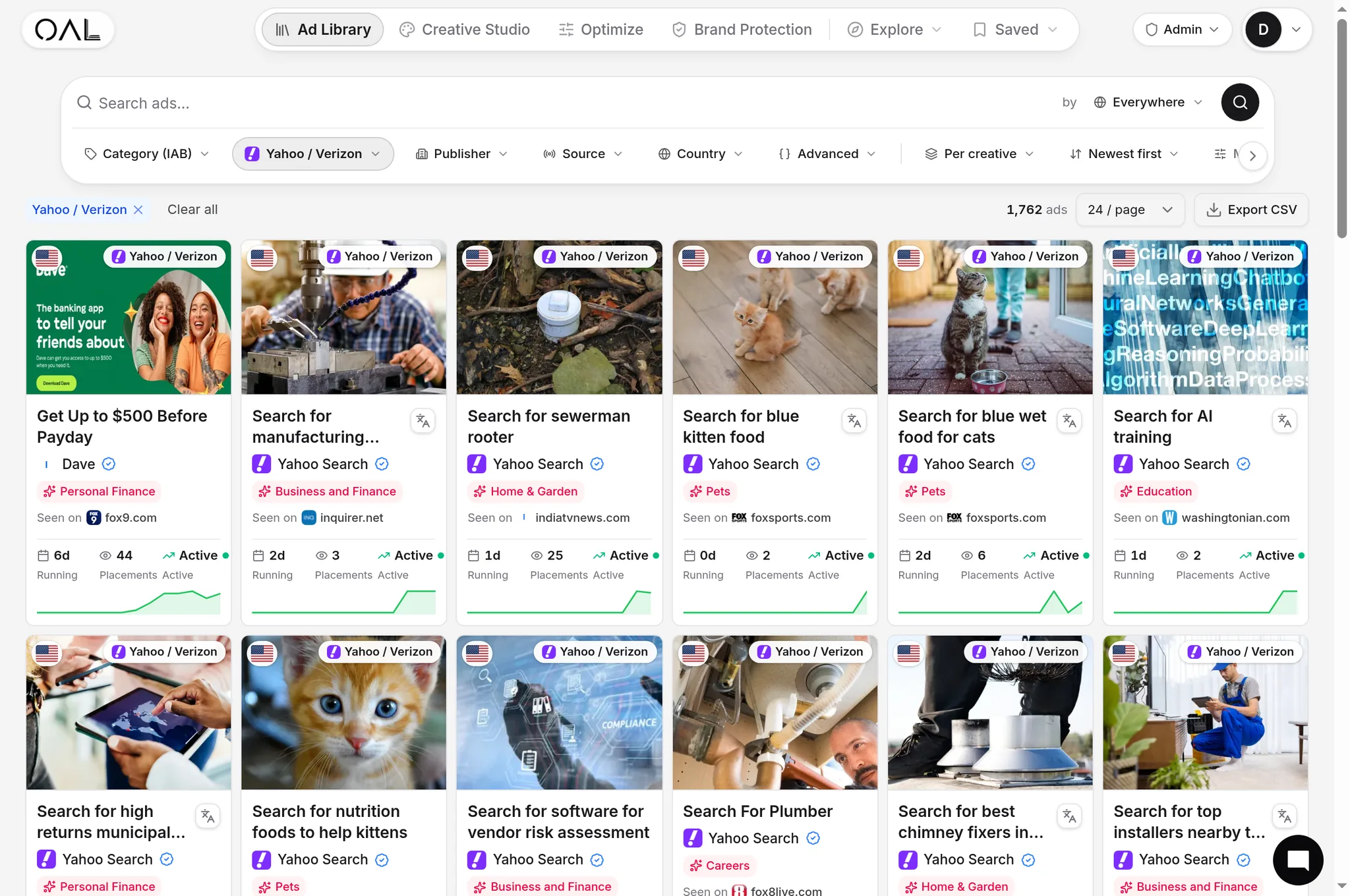
The bluntest version skips the content page: native creatives that send the click straight to a search results page. In the Yahoo native feed, the advertiser label "Yahoo Search" runs creatives like "Search for business insurance" and "Search for digital trading platforms" — observed running for up to three weeks in the index. The visitor lands on a monetized results page, and the arbitrage closes in one hop. How Yahoo native ads work explains the supply side of that feed.
Longevity is the profitability tell#
Arbitrage margins are thin, and nobody subsidizes a losing arbitrage campaign for weeks — there is no brand budget behind it. That makes run duration the strongest public profitability signal in this niche: the listicle and RSOC examples above have been observed for 22 to 38 days, which in a margin business means the math is clearing. When you research the space, filter for long-running ads first; a 30-day arbitrage creative is a working blueprint, while a 2-day one is just a test. The same logic underpins ad arbitrage analysis generally.
The publisher playbook, step by step#
- Secure monetization before buying traffic. Approval is the bottleneck, not traffic. For search-feed models you need a relationship with an approved partner; for display you need an ad stack that pays real RPMs. No monetization deal, no business.
- Build the page for the model. Listicle arbitrage needs pagination and fast loads; RSOC needs pages genuinely relevant to the target query — mismatched intent gets flagged and kills conversion anyway.
- Buy the cheapest qualifying clicks. Mid-tier native networks and Tier-2/3 geos are the classic entry: media buyers commonly report mid-tier native CPCs of just a few cents in Tier-2 and Tier-3 geos on mobile — check current native ads CPC benchmarks for the landscape. Your monetization geo must match your traffic geo, or RPM collapses.
- Measure session RPM per campaign and placement, daily. Arbitrage lives and dies on the spread. A campaign that is profitable in aggregate usually hides placements that are badly negative.
- Kill fast, scale slowly. Margins are too thin to "wait and see" on losers, and scaling a winner too fast degrades traffic quality — the same click sources that worked at $50/day get diluted at $500/day.
- Rotate headlines constantly. Arbitrage creatives fatigue like any other; rising CPC on a stable bid is the early warning.
The three numbers on an arbitrage dashboard#
Operators who survive in this business watch three numbers daily, per traffic source:
- Cost per session, not cost per click. Networks bill clicks; you monetize sessions. Misclick-heavy placements can leak 30–40% of paid clicks before the page renders (an illustrative gap — measure your own), and that leakage silently converts a profitable CPC into a losing cost per session.
- Session RPM by source and placement. Aggregate RPM hides everything that matters. A campaign that is profitable overall usually contains placements running badly negative, and the fix — blacklist or bid down — only appears at placement granularity.
- Margin percentage, tracked as a trend. Arbitrage margins compress from both ends: CPCs drift up as creatives fatigue, and RPMs sag when advertiser demand softens. A margin that shrank three days in a row is a decision, not an observation.
Volatility is structural, so buffer for it. Ad-revenue RPMs swing across the week and dip when advertiser budgets reset, while your traffic costs stay flat — a model that only works at peak RPM does not work. Price your margins off the weak days.
Risks: policy, MFA pressure, and margin compression#
Be honest about the fragility. The industry now labels much arbitrage inventory MFA — "made for advertising" — and agencies and DSPs increasingly blacklist those domains, compressing display RPMs. Native networks score landing-page quality and can throttle or reprice arbitrage campaigns. Search-feed policies change with little notice, and a single-partner revenue stream can be repriced overnight. And deceptive headline styles that once fueled the model attract regulatory and network enforcement — the line between clickbait and misrepresentation is enforced more aggressively every year. Build the model assuming your margin gets squeezed annually, because it has.
Study working arbitrageurs before you build#
The cheapest research in this niche is watching operators who are already profitable. Search an ad library for keyword-shaped headlines in your target geo, track the brands behind them, and note which creatives persist for weeks — then study the landing captures to see the page templates behind them (OpenAdLibrary has traced 1.3 million+ landing pages). The live feeds for MGID and Revcontent are dense with arbitrage demand and a practical place to start.