Español
 Português (Brasil)
 Français
 Deutsch
 Italiano
 Nederlands
 Polski
 Svenska
 Türkçe
 Русский
 日本語
日本語 한국어
한국어 简体中文
简体中文 Tiếng Việt
 Bahasa Indonesia
 繁體中文
繁體中文 Čeština
 Dansk
Dansk Norsk (bokmål)
 Suomi
Suomi Ελληνικά
 Română
 Magyar
 Українська
 ไทย
ไทย हिन्दी
 العربية
 עברית
עבריתTier 1 vs Tier 3 Geos: Where Should a New Buyer Start?
Should a new media buyer start in Tier 1 or Tier 3? Here's the budget-based framework experienced buyers actually use, plus how to scale between tiers once an angle proves out.


If you're deciding where to run your first native campaign, the honest answer is to start in a Tier 3 geo unless you already have a proven, localized offer and a testing budget north of a couple thousand dollars. Tier 3 traffic costs a fraction of what Tier 1 does, competition is thinner, and the mistakes every beginner makes cost less to learn from. Tier 1 countries (the US, UK, Canada, Australia, Germany and similar) pay more per conversion but punish weak creative and undersized budgets fast. Which tier is right has less to do with ambition and more to do with what you can afford to burn through while you're still learning the mechanics.
What "tier" actually means in native advertising#
The tier system groups countries by purchasing power, ad rates and traffic quality, not by any official standard. Tier 1 usually means the US, UK, Canada, Australia, and a handful of Western European markets: high buying power, high CPCs, and heavy competition from advertisers with bigger budgets and tighter tracking. Tier 2 covers markets like parts of Eastern Europe, the Gulf states and upper-middle-income Latin American countries, sitting in between on cost and competition. Tier 3 spans much of South and Southeast Asia, Africa, and lower-income Latin America: cheaper clicks, less saturated inventory, and audiences that convert at lower average order values or payouts. Our geo tiers glossary entry breaks the boundaries down network by network, since the exact country list shifts depending on who you ask.
None of this is fixed. A country can behave like a Tier 2 market for a finance offer and a Tier 3 market for an ecommerce one, because the classification is really shorthand for how much competition and buying power exists for a given vertical in a given country, not a fixed property of the country itself.
The case for starting in Tier 3#
Cheaper clicks mean you can run more tests per dollar of budget, and testing volume is what actually teaches you the job. A beginner needs to see how bid caps interact with a network's auction, how quickly a losing angle burns through a daily budget, and how creative fatigue actually looks in a dashboard rather than in a course video. Tier 3 lets you fail at low cost while you build that pattern recognition.
Competition is also genuinely lower. Fewer sophisticated buyers run granular geo, device and dayparting tests in Tier 3 markets, which means a mediocre creative can still get meaningful traffic instead of getting outbid before it has a chance to prove itself. The tradeoff is real, though: payouts per lead or sale are usually lower, some offers don't have Tier 3 versions at all, and you'll often need translated or localized creative to get anywhere.
The case for starting in Tier 1#
If you already have a creative or offer that's converted somewhere else, or you're coming in with a larger budget and can absorb a few expensive losing tests, Tier 1 has real advantages. Volume is higher, so you hit statistical significance on a test faster. Tracking and attribution tools are built with Tier 1 traffic in mind, and network account managers pay more attention to accounts spending Tier 1 budgets. Media buyers commonly report Tier 1 desktop CPCs running noticeably higher than Tier 3 equivalents on the same network, sometimes several times over, though this varies a lot by network, vertical and season, so treat any specific figure you see quoted online as a rough heuristic rather than a rate card.
The catch is that Tier 1 inventory is where the best-funded, most experienced buyers concentrate. A first campaign with an untested angle and a small budget will usually get outbid or burn out before you learn anything useful.
Comparing the two directly#
| Factor | Tier 1 | Tier 3 |
|---|---|---|
| Typical CPC | Higher | Lower |
| Competition | Heavy, well-funded | Thinner |
| Payout per conversion | Higher | Lower |
| Volume needed to reach significance | Faster to hit | Slower per dollar, but cheaper tests |
| Tracking and tooling maturity | Best supported | Sometimes patchy |
| Forgiveness for a weak first test | Low | Higher |
How to decide with the budget you actually have#
A rough framework holds up across most verticals: if your total test budget is a few hundred dollars, Tier 3 is close to the only sensible choice, since a Tier 1 test at that size usually ends before it has enough data to read. With a few thousand dollars to work with, splitting a test across one Tier 3 and one Tier 1 geo lets you compare how the same angle performs at different price points. Once you have a genuinely proven offer, meaning you've seen it convert consistently rather than once, Tier 1 becomes worth the higher entry cost because the payout difference starts to outweigh the extra risk.
Vertical matters too. Some categories, nutra among them, have historically found more room to breathe in Tier 2 and Tier 3 markets, while several high-payout affiliate verticals often need Tier 1 volume to hit meaningful payout thresholds. Check native ad CPC patterns and general budgeting guidance before committing to either.
Scaling from one tier to the next#
The buyers who move fastest treat Tier 3 as a proving ground, not a permanent home. Once an angle is reliably profitable at small scale, the next step is testing the same core hook, adapted and re-localized rather than copy-pasted, into a Tier 2 or Tier 1 market to see if the audience response holds up at a higher price point. Our guide to scaling into new geos covers the practical sequencing: which signals justify the move, how much budget to commit to the first Tier 1 test, and what usually needs to change (typically the hook, even when the underlying offer doesn't).
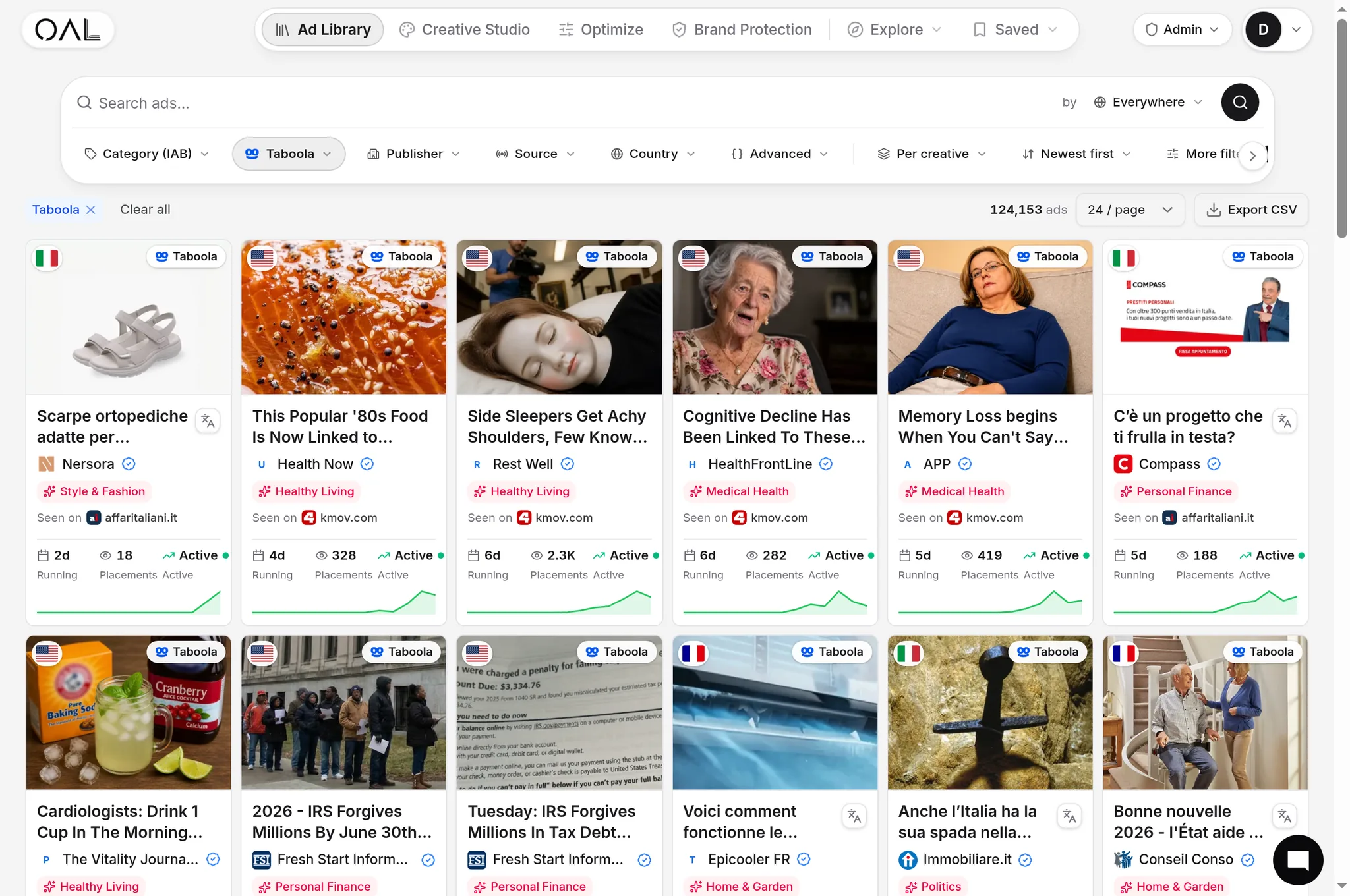
Before scaling into a new tier, it's worth checking what's actually running there. OpenAdLibrary's native ad spy tool lets you filter live creatives by geo and network, so you can see whether an angle you're planning to move into Tier 1 is already saturated there, or whether the format that works in Tier 3 needs a different creative approach entirely for a Western audience. That's a five-minute check that can save a wasted test.
Common mistakes when picking a starting geo#
The most frequent beginner mistake isn't picking the wrong tier, it's picking a tier and then not adjusting the rest of the campaign to match it. Running Tier 1 creative, built around US cultural references and pricing, unchanged into a Tier 3 market almost guarantees a weak result, and the buyer usually blames the geo instead of the mismatch. The reverse happens too: a Tier 3 winner gets pushed into Tier 1 without adjusting for a more skeptical, ad-saturated audience, and burns through budget before anyone notices the creative needed a harder-hitting hook to compete.
A second common error is treating "Tier 3" as one undifferentiated bucket. A Tier 3 country with strong mobile penetration and an active ecommerce culture behaves very differently from one where card payments are rare and cash-on-delivery dominates checkout. The tier label is a starting filter, not a substitute for checking what a specific country's audience actually does once they land on your offer.
A third mistake is under-funding the test itself. Cheap CPCs in Tier 3 tempt buyers into running tiny daily budgets for weeks, hoping volume accumulates slowly. It's usually better to concentrate a modest budget over a few days so you reach a readable sample size before creative fatigue or a competitor's copycat angle catches up.
The bottom line#
There's no universally correct starting tier, only a correct starting tier for your budget and your offer's maturity. Tier 3 is the more forgiving classroom for beginners with small budgets and unproven creative. Tier 1 rewards buyers who've already done the learning elsewhere and can afford the entry price. Most experienced buyers end up running both, at different points in an offer's lifecycle, once they've built the general media buying skills that make the tier choice a tactical decision instead of a gamble. A full plan with geo, network and longevity filters makes that decision a lot less blind.