Español
 Português (Brasil)
 Français
 Deutsch
 Italiano
 Nederlands
 Polski
 Türkçe
 Русский
 日本語
日本語 한국어
한국어 简体中文
简体中文 Tiếng Việt
 Bahasa Indonesia
 繁體中文
繁體中文 Čeština
 Dansk
Dansk Suomi
Suomi Ελληνικά
 Română
 Magyar
 Українська
 ไทย
ไทย हिन्दी
 العربية
 עברית
עבריתDo Ad Blockers Block Native Ads? How Widgets Slip Through
Ad blockers catch a real share of native ad traffic, but not all of it. Here's why widget domains get filtered while publisher-rendered native content often doesn't.


Ad blockers block some native ads and let others through, and the split depends on how the widget is served, not on whether the format is "native." Widgets loaded from a network's own script domain (like a Taboola or Outbrain tag) are on popular filter lists such as EasyList, so a meaningful share of ad-blocker users never see them. Content that a publisher serves natively, in its own markup, without a third-party script call, usually isn't caught by anything, because there's no ad-serving domain for a filter list to match against.
Why ad blockers work the way they do#
Most consumer ad blockers (uBlock Origin, AdBlock Plus, and the built-in blockers in Brave and some mobile browsers) work by matching network requests and page elements against community-maintained filter lists. EasyList is the largest and most widely subscribed. These lists work at the level of domains, subdomains, and CSS selectors: if a script is requested from a known ad-serving hostname, or an element matches a known ad-container class name, it gets blocked or hidden before it renders.
This approach was built for traditional display advertising, where the ad clearly comes from a separate ad server (a DoubleClick or AppNexus call, for example) that's easy to fingerprint. Native widgets complicate that model because the request often comes from the network's own branded domain (taboola.com, outbrain.com, mgid.com), which filter list maintainers have had years to identify and add. So it's not accurate to say native advertising is invisible to blockers; the major networks' standard widget domains are, in fact, on EasyList and similar lists, and a real share of ad-blocker traffic never loads the native ad widget at all.
Where native still slips through#
The gap that keeps native's effective block rate lower than banner or video formats comes from a few places:
- Publisher-side rendering. Some publishers integrate a recommendation widget's output directly into their own page templates rather than loading it as an obvious third-party iframe, which makes it harder for a generic filter rule to isolate cleanly from surrounding editorial content.
- Visual camouflage even when the request loads. A native unit that does get through renders as an image and headline matching the page's grid. Even users who don't have a blocker, and see the ad, frequently don't register it as an ad the way they would a banner, which is a related but separate phenomenon from ad-blocking (often called banner blindness, and native was designed specifically to reduce it).
- CNAME cloaking and first-party proxying. Some ad tech uses a publisher's own subdomain (via a CNAME DNS record) to route what is technically third-party ad-serving traffic through what looks like a first-party request. This is a known, actively contested practice: several filter-list maintainers and browser vendors have built specific countermeasures against CNAME-based tracking, so its effectiveness against blockers has been shrinking, not growing.
What this means for advertisers and publishers#
If you're an advertiser, the practical implication is that native's exposure to ad blocking is real but partial. It's lower than display and dramatically lower than pre-roll video, which explains part of native's durability as a channel, but you shouldn't assume every impression an ad server reports actually rendered in front of a human who could see it, a concept covered more broadly in our breakdown of viewability. If you're a publisher relying on native recommendation revenue, the same logic cuts the other way: a chunk of your traffic with ad blockers enabled will never load the widget at all, which is worth factoring into RPM expectations rather than treating reported impressions as the full audience.
| Format | Typical exposure to filter-list blocking |
|---|---|
| Banner/display | High, well-established ad-server domains and container patterns |
| Pre-roll video | High, plus separate video-specific blocker tooling |
| Native widget (standard script) | Partial, major network domains are on common lists |
| Native content served natively by publisher, no third-party script | Low to none, nothing for a filter list to match |
The compliance angle nobody talks about#
There's a second reason native ads sometimes appear to "slip through" that has nothing to do with ad blockers: mismatched or missing ad tags and inconsistent disclosure labeling. A widget that isn't clearly marked "Sponsored" can look, to a casual reader, like it dodged detection entirely, when really it just wasn't labeled well in the first place. That's a policy and brand-safety issue for the network and advertiser, separate from anything a browser extension is doing, and a distinct problem from the ad fraud that outright violates network policy. It's also one of the things that shows up when auditing a competitor's native ad supply chain: whether disclosure labeling is consistent across the geos and publishers an advertiser is running in, and how that compares with how Taboola ads work at the placement level.
How blocking rates differ by platform and browser#
The picture also isn't uniform across devices. Desktop browsers have the deepest extension ecosystems, so desktop ad-blocker adoption tends to run meaningfully higher than mobile, where installing a blocker usually means a dedicated app or a browser with built-in filtering (Brave, some privacy-focused mobile browsers) rather than a simple extension install. That asymmetry is one reason native campaigns targeting mobile-heavy inventory often report different effective viewability than the same creative running on desktop placements, even before any difference in creative performance is considered. It's also part of why geo mix matters here: ad-blocker adoption varies significantly by country, generally skewing higher in markets with strong privacy-tool awareness and lower where mobile-first browsing dominates.
The revenue-side pressure that shapes all of this#
Publishers depend on native recommendation revenue enough that some have quietly pushed back against blocking in ways beyond CNAME tricks, including "acceptable ads" style whitelisting programs some blockers run, where certain ad formats (including some native placements) get allowed through by default if they meet stated non-intrusiveness criteria. This is a genuinely contested area: some users see it as a reasonable compromise, others see it as blockers monetizing exemptions. Either way, it's a second reason a given native placement's real-world block rate is closer to "it depends on the specific blocker's policy" than a single universal number.
What this means if you're trying to research competitor native ads#
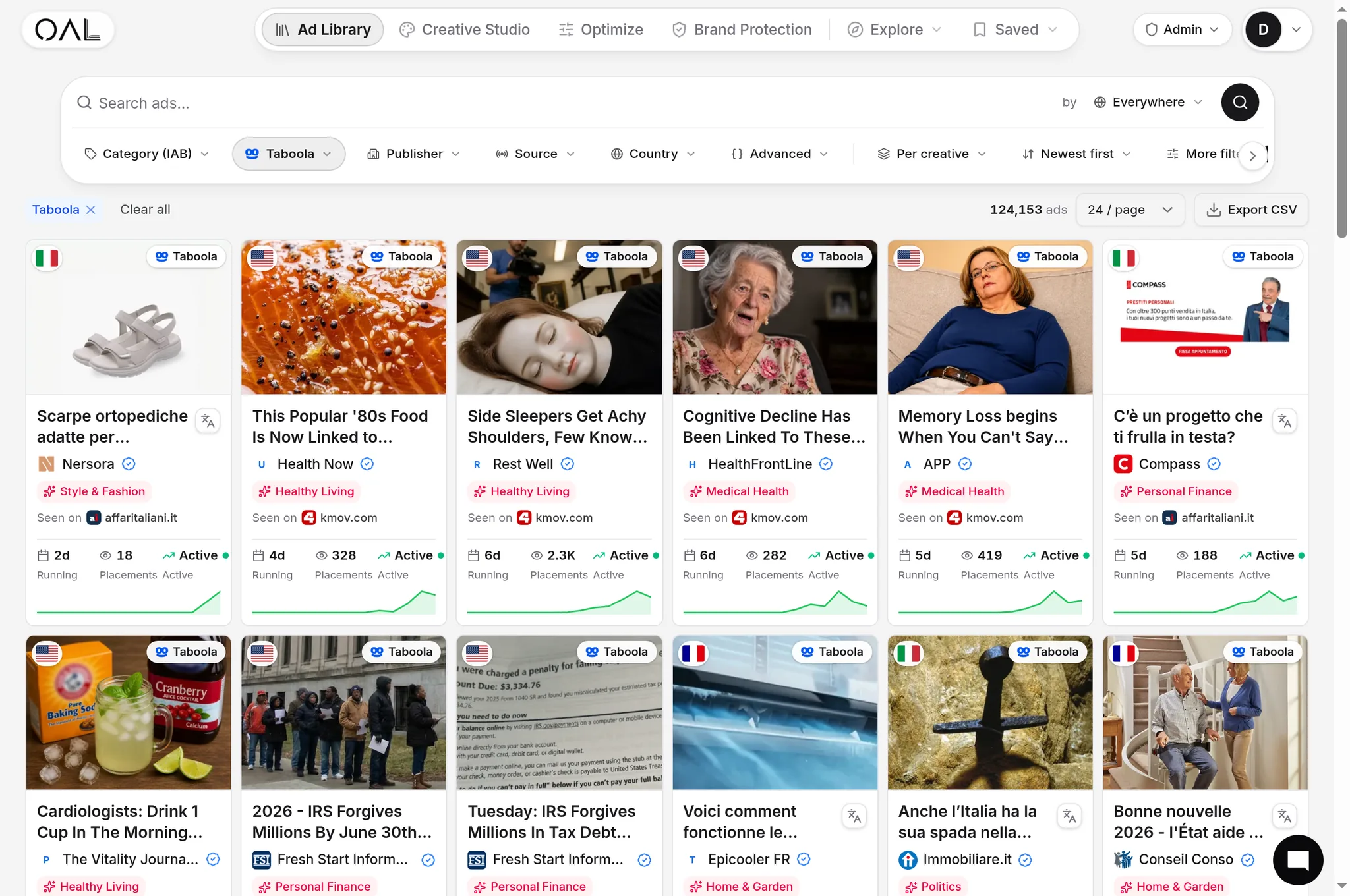
If you're auditing what's actually running, don't rely on browsing with a blocker disabled in one browser profile and assuming that's representative; capture across device types and, ideally, without relying on live browsing at all, since manually toggling blockers geo-by-geo doesn't scale and still misses server-side rendering differences between publishers. This is part of why independent indexes exist: rather than manually disabling extensions and re-crawling by hand, OpenAdLibrary's native ad spy tool captures native creatives directly at the source across networks and publishers, so what you see in the index reflects what's actually being served, not what one browser configuration happened to let through.
A quick test you can run yourself#
If you want to see this firsthand, load the same page with a mainstream blocker enabled and disabled, and watch what happens to the recommendation widget at the bottom of an article. On many mid-size publishers running a standard Taboola or Outbrain integration, the widget disappears entirely with the blocker on, sometimes leaving a visible gap in the layout where the placeholder didn't get a chance to fill in. On other publishers, particularly ones that have customized the integration or blended it more tightly with their own content-recommendation system, the difference is far less obvious. That inconsistency across publishers, not any single technical trick, is the real reason "does adblock stop native ads" doesn't have one clean answer.
The bottom line#
Ad blockers do block a real slice of native ad traffic, specifically the standard widget scripts from major networks that are on popular filter lists. What they don't reliably catch is content rendered natively within a publisher's own template, or the visual camouflage that keeps native ads from registering as ads even when they load. If you're budgeting or reporting against native, treat "impressions served" and "impressions actually seen by a human" as two different numbers, because for this format specifically, the gap between them is real.