Español
 Português (Brasil)
 Français
 Deutsch
 Italiano
 Nederlands
 Polski
 Svenska
 Türkçe
 Русский
 日本語
日本語 한국어
한국어 简体中文
简体中文 Tiếng Việt
 Bahasa Indonesia
 繁體中文
繁體中文 Čeština
 Dansk
Dansk Norsk (bokmål)
 Suomi
Suomi Ελληνικά
 Română
 Magyar
 Українська
 ไทย
ไทย हिन्दी
 العربية
 עברית
עבריתNative Ads on $10/Day: What's Actually Possible
Ten dollars a day on native ads buys a small trickle of clicks, enough to check your tracking and rough CPC, but not enough to declare an offer dead or profitable on day one.


Yes, you can run native ads on $10 a day, and it can genuinely teach you something, but only if you set expectations correctly first. At that budget you're buying a small trickle of clicks, not a statistically meaningful test of a whole campaign. Ten dollars a day is enough to confirm your tracking works, see whether a single creative gets any engagement at all, and learn the mechanics of a network's dashboard. It is not enough to declare an offer dead, compare two angles reliably, or judge a new geo.
What $10 a Day Actually Buys#
Media buyers commonly report native CPCs somewhere from a few cents up to around a dollar, depending on network, geo, device and vertical. At the cheaper end of that range, a $10 daily budget might buy you 50 to 100 clicks. At the expensive end, in a competitive Tier-1 vertical like finance or insurance, that same $10 might only buy you 10 to 20 clicks. Either way, you're working with a sample size too small to draw a confident conclusion about conversion rate after a single day.
What you can learn from day one: whether your tracking and pixel fire correctly, whether the creative gets approved and starts serving without a policy flag, and roughly what CPC you're actually being charged versus what you expected. Those are real, useful things to confirm before you commit more budget, even if they're not the "is this profitable" answer you actually want.
Minimum Daily Budgets Differ by Network#
Not every native network treats a $10 daily budget the same way. The larger networks with deeper inventory pools, Taboola chief among them, tend to have higher effective minimums for a campaign to spend meaningfully and get real delivery, simply because the auction is more competitive and a tiny budget gets outbid more often. Mid-tier networks like MGID and Revcontent are generally known in the industry for being more accessible to small test budgets, in part because their inventory pools are smaller and the auction floor is lower.
That doesn't make one network objectively better for a $10/day test. It means the same $10 buys a different experience depending on where you spend it: fewer, more expensive clicks on a premium network with better-quality inventory, or more, cheaper clicks on a mid-tier network with a wider quality range. Check current documentation and account minimums directly on each platform before committing, since these change over time.
The Better Use of a Small Test Budget#
If $10 a day is genuinely your ceiling, the single highest-leverage move is narrowing everything else so that $10 goes as far as possible. Run one creative, not three. Target one tier-2 or tier-3 geo where CPCs run meaningfully cheaper than Tier-1, rather than the most competitive market for your vertical. Pick a single, specific angle rather than a broad one, so the small number of clicks you do get are at least concentrated on one hypothesis instead of spread thin across variables.
Run that narrow test for longer than a single day before judging it. A week of $10/day, roughly $70 total, gives you a far more reliable read than a single $10 day, because it smooths out the noise of any one unusually good or bad hour. This is also the same logic behind watching ad longevity as a signal in competitive research: a single day tells you almost nothing, a sustained run over weeks tells you the economics actually work.
Realistic Budget Tiers for Native Testing#
| Daily budget | What it realistically tests | What it can't tell you |
|---|---|---|
| $10/day | Tracking works, ad gets approved, rough CPC | Whether the offer converts profitably |
| $25 to $50/day | Early signal on CTR and conversion rate, one geo | Whether the result holds across geos or devices |
| $100+/day | A real read on unit economics within about a week | Long-term creative fatigue and scaling ceiling |
When to Walk Away, and When to Scale#
Walk away from a $10/day test if, after a full week, you've seen zero clicks convert and your tracking has confirmed the pixel is firing correctly. That's a real signal, not a budget problem. Also walk away if your CPC on that network and geo is so high that even a perfect conversion rate wouldn't clear your break-even CPA; that's a math problem no amount of patience fixes.
Scale up from $10/day once you've confirmed the pixel works, seen at least a handful of conversions, and calculated a CPA that's in the neighborhood of viable for your offer. At that point, the constraint usually isn't the network anymore, it's your own confidence, so the move is a modest budget increase (doubling, not 10x'ing) while watching whether your CPA holds steady or drifts as volume grows. That's the core discipline behind scaling affiliate campaigns without accidentally scaling your losses along with your spend.
The Cost You're Not Counting#
A $10/day media budget looks like the whole cost of the test, but it usually isn't. If you're running a dedicated landing page or pre-lander, hosting and page-builder costs keep running whether or not the campaign converts. If you're paying for a tracker or attribution tool, that subscription cost is fixed regardless of how small your media spend is. At $10/day, $70 a week in media spend, a $30/month tracking subscription can quietly represent a bigger share of your true cost than the ads themselves.
This matters because it changes the math on when to walk away. A campaign that's technically break-even on media spend alone might still be a net loss once you count the fixed costs running alongside it, including whatever tracker or attribution subscription you're running to measure it in the first place. Before you commit to a run of small-budget tests, map out what else is on the meter besides the daily ad spend, not just the number on the network's dashboard.
Common Mistakes at This Budget Level#
A few patterns show up repeatedly with very small test budgets. The first is testing too many variables at once: three creatives, two geos and a broad audience all at $10/day total means each individual variable gets almost no data. Narrow to one variable at a time.
The second is judging a test by total spend rather than total volume. Ten dollars over one day and ten dollars spread thinly over a broad targeting setting produce very different amounts of usable signal even though the dollar amount is identical. Tighter targeting concentrates your limited budget into a smaller, more comparable pool of impressions.
The third is expecting a small-budget test to behave like a scaled campaign. Auction dynamics, approval speed and even the type of inventory you get access to can shift once you increase budget, so don't assume a $10/day result predicts exactly what happens at $200/day. Treat the small test as a go/no-go filter, not a forecast.
A Word on Realistic Expectations#
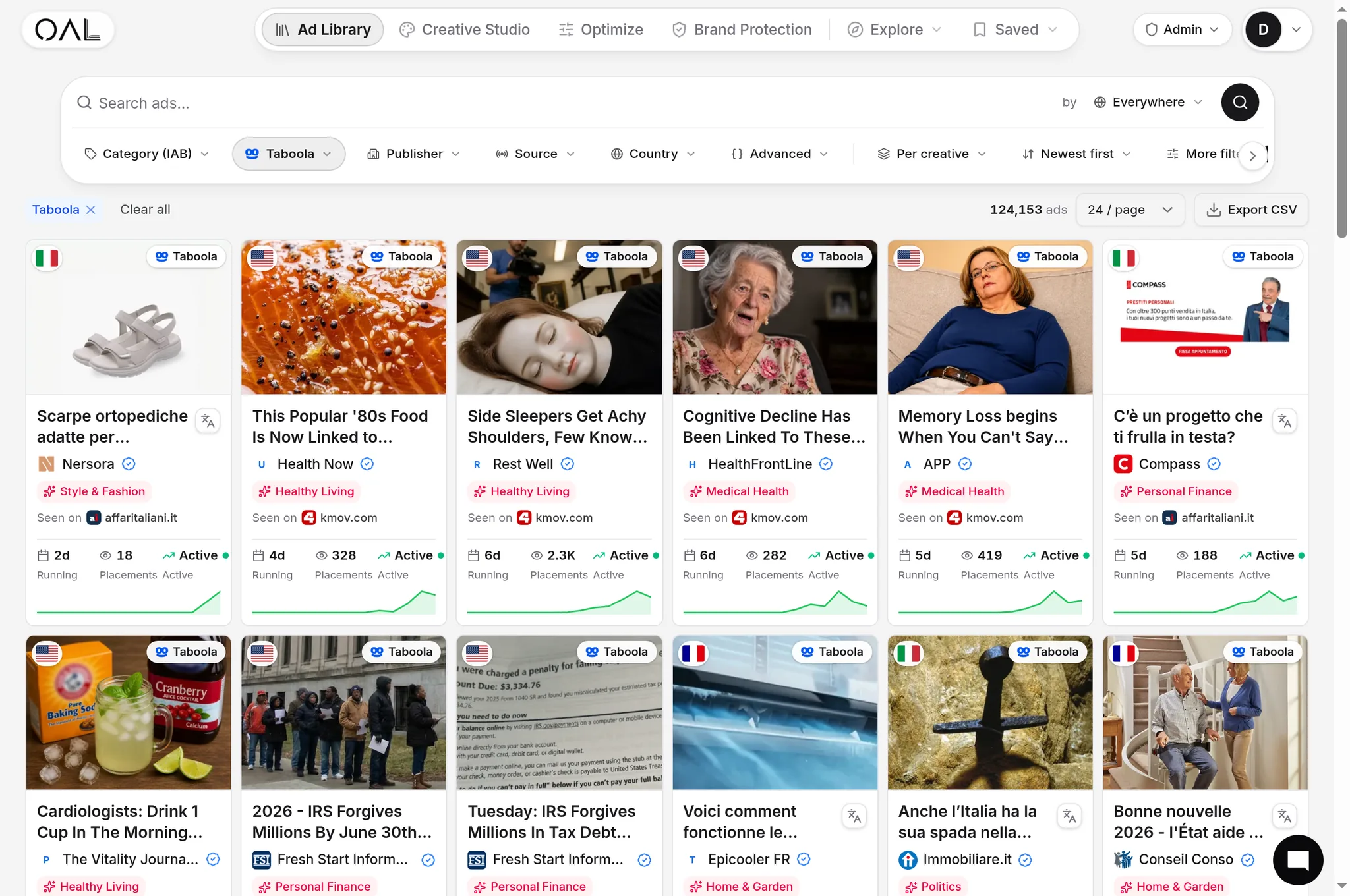
Ten dollars a day is a legitimate way to start, not a shortcut around the fact that native advertising takes real budget to properly test and scale. It's most useful as a mechanical check before you commit meaningful spend, and as a way to learn one network's dashboard and auction behavior before deciding whether it's worth expanding into others. Before you set even that first $10 test, it helps to see what similar advertisers in your vertical are actually running and for how long. OpenAdLibrary's free native ad research tools let you check live creative examples and run duration by network and vertical, so your first small test is at least informed by what's already working elsewhere rather than a total guess.
For a broader breakdown of what native ads cost across budget levels, see our full native ad cost guide.