Español
 Português (Brasil)
 Français
 Deutsch
 Italiano
 Nederlands
 Polski
 Svenska
 Türkçe
 Русский
 日本語
日本語 한국어
한국어 简体中文
简体中文 Tiếng Việt
 Bahasa Indonesia
 繁體中文
繁體中文 Čeština
 Dansk
Dansk Suomi
Suomi Ελληνικά
 Română
 Magyar
 Українська
 ไทย
ไทย हिन्दी
 العربية
 עברית
עבריתCan You Promote Crypto on Native Ads? Network Rules
Crypto advertising is allowed on every major native network, but all of them gate it behind pre-approval and stricter creative rules. Here's what to expect and how to stay compliant.


Yes, you can promote crypto on native ad networks, but with real restrictions. Every major native network, Taboola, Outbrain (now part of Teads), MGID and Revcontent, allows crypto advertising in some form, but all of them gate it behind pre-approval, geo restrictions and stricter creative rules than a typical ecommerce or content offer gets. None of the big native networks ban crypto outright the way some social platforms have at various points; the practical barrier is a compliance review process, not a blanket policy against the vertical.
Why crypto is treated differently than other verticals#
Crypto sits at the intersection of financial-offer risk and regulatory attention, which makes networks cautious for reasons that have nothing to do with whether the underlying business is legitimate. A network hosting misleading crypto claims, fake celebrity endorsements or unlicensed exchange promotion faces real reputational and legal exposure, so the review process exists to filter that out before it becomes the network's problem. This is the same underlying logic covered in our piece on brand safety: the network is protecting its relationship with publishers and its own regulatory standing, not just gatekeeping for its own sake.
The result is that crypto approval tends to look less like a yes or no gate and more like an ongoing compliance relationship. Accounts that pass initial review can still get flagged later if creative language drifts toward guaranteed-return claims or if a geo's regulatory posture changes mid-campaign.
What advertisers generally need to expect#
Exact rules shift often enough, and differ enough between networks, that the only reliable move is checking each network's current documentation before you build a campaign around assumptions. That said, a few patterns hold broadly true across the major players: expect a pre-approval application specifically for financial or crypto-related offers, expect certain geos to be restricted or excluded entirely regardless of your general account standing, and expect creative review to reject language implying guaranteed returns, "get rich" framing, or anything that could be read as unlicensed investment advice. Exchange advertising, promoting a named, established platform, tends to clear review more easily than presale, ICO or lesser-known token promotion, which draws heavier scrutiny industry-wide.
| Native network | General crypto stance |
|---|---|
| Taboola | Allowed with pre-approval; check current policy for geo and creative limits |
| Outbrain / Teads | Allowed with pre-approval; financial-offer review applies |
| MGID | Allowed, historically more accessible for finance-adjacent offers; still reviewed |
| Revcontent | Allowed with pre-approval; smaller inventory means slower review turnaround |
Compliance patterns that keep crypto accounts alive#
The advertisers who stay in good standing tend to follow a consistent set of habits: they avoid guaranteed-return or "you'll definitely profit" language entirely, include a visible risk disclosure on the landing page, never impersonate or imply affiliation with a specific exchange they don't represent, and keep the ad's claims and the landing page's claims matched, since a mismatch between ad copy and landing content is one of the most common triggers for account suspension across every performance-based ad network. Our guide to FTC disclosure rules for advertorial-style ads covers the disclosure language that keeps a review process from flagging a creative as misleading, and it applies to crypto creative just as much as to health or finance offers.
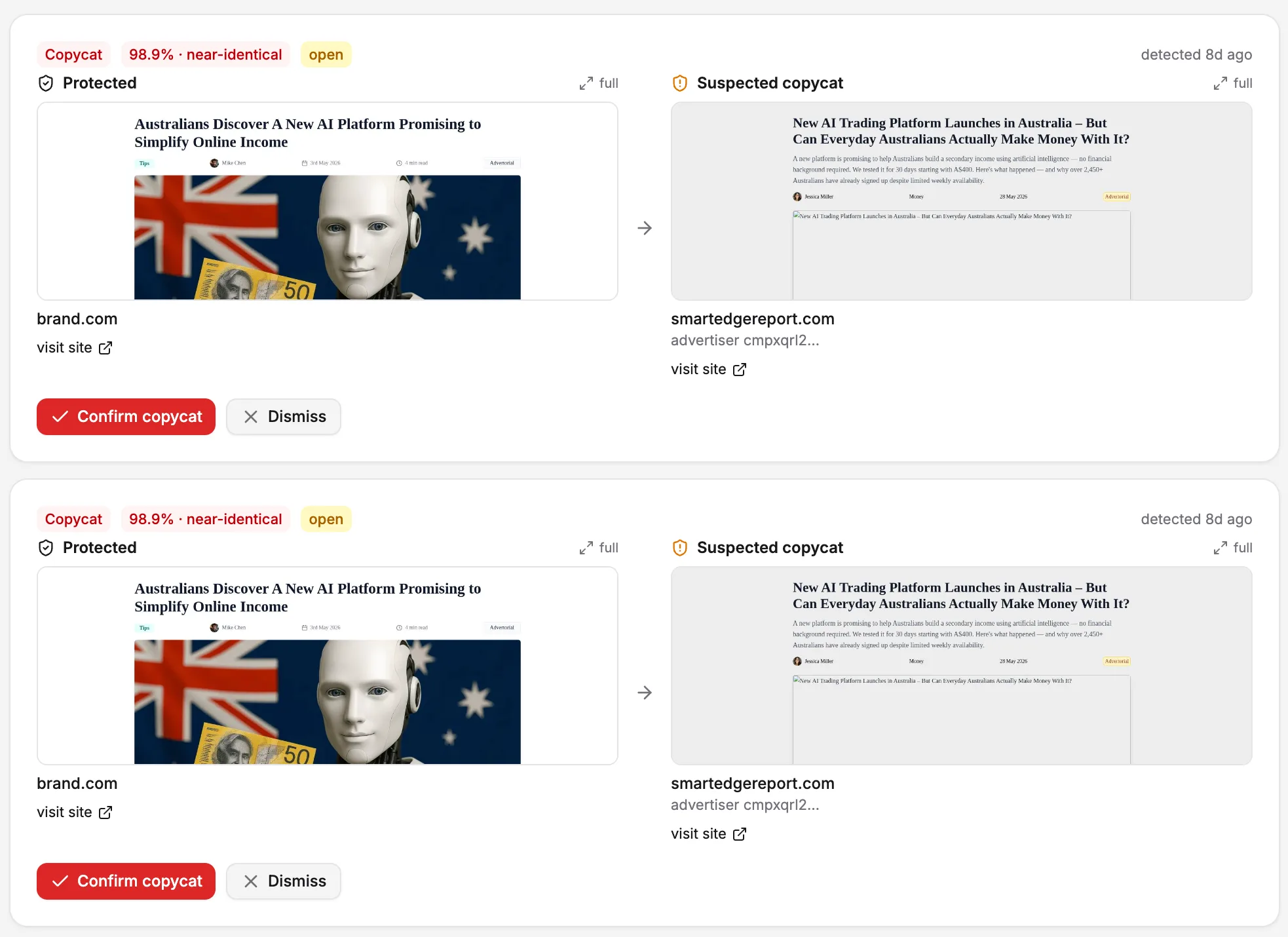
Crypto is also a frequent target for brand impersonation and copycat landing pages cloning legitimate exchanges, part of why networks review the vertical closely; a scam operation cloning a real brand's name creates exactly the reputational exposure a network is trying to screen out. Our broader guide to brand protection in native advertising covers how this plays out beyond crypto specifically. If you're running a legitimate crypto offer, expect some of that scrutiny to land on your account too, simply because the vertical has a documented fraud problem that predates any individual advertiser.
Checking what's actually running before you launch#
There's no crypto-specific creative count published by any network, and estimates vary too much to treat as reliable, so the more useful check is looking at what's currently live and how long it's stayed up. Observed longevity is a solid public proxy for which creative approaches are surviving ongoing review, not just clearing it once. OpenAdLibrary's ad spy tool lets you browse live finance-adjacent creative by network, so you can get a feel for the tone, disclosure language and format that's actually staying approved before you submit your own campaign for review. Our look at the longest-running native ads overall is also a useful reference for the kind of compliant, evergreen framing that tends to survive network scrutiny long-term.
Stablecoins, NFTs and other sub-categories get treated differently too#
Crypto isn't reviewed as a single monolithic category internally, even though advertisers often treat it that way when planning a campaign. Stablecoin and payment-rail advertising tends to sit closer to conventional fintech in how it's reviewed, since the pitch is usually about payments or savings rather than speculative return. NFT and token-launch advertising, by contrast, tends to draw the same heightened scrutiny as presale and ICO promotion, for similar reasons: newer, less-established assets carry a higher documented rate of misrepresentation, so review teams apply more caution by default. Wallet and exchange app-install offers sit somewhere in the middle, generally treated as financial-app promotion with standard app-install requirements layered on top of the financial-offer review.
Knowing which sub-category your offer falls into before you apply for approval saves a round of back-and-forth. An advertiser pitching a stablecoin savings product who submits creative that reads like a token-launch hype piece will usually get pulled into a more intensive review than the underlying offer actually requires, simply because the creative language triggered the wrong bucket.
Why some accounts get flagged even after approval#
Initial approval isn't a permanent pass. Native networks run ongoing creative review, and a crypto account that was approved with conservative, disclosure-heavy creative can still get flagged months later if a new batch of ads drifts toward more aggressive claims, a common pattern when a media buyer optimizing for click-through rate gradually tests bolder and bolder headlines without re-checking them against the original compliance standard. Geo-level regulatory changes are the other frequent trigger: a country tightening its financial promotion rules can retroactively affect an account's standing in that market even though nothing about the advertiser's own creative changed.
The practical takeaway is to treat your initial approval as a baseline to maintain, not a hurdle you've cleared permanently. Re-reading your own creative against the original disclosure standard every few weeks, especially after any headline or claim change, catches drift before a network's own review does.
Landing pages and disclosure language matter as much as the ad#
Reviewers, whether human or automated, tend to weigh the landing page at least as heavily as the ad creative itself, since the landing page is where a specific return claim, an implied endorsement, or a missing risk disclosure is most likely to appear. A conservative native ad paired with an aggressive, hype-heavy landing page is a common way accounts get flagged, because the mismatch itself reads as an attempt to slip past creative review with one message and convert with another. Keeping the tone consistent end to end, ad, pre-lander if you use one, and final landing page, is one of the simpler things advertisers can control directly, and it tends to matter more than any single word choice in the headline.
The bottom line#
Crypto advertising on native networks is possible and reasonably common, but it's not a self-serve category the way most ecommerce or content offers are. Budget time for a pre-approval process, write creative that would survive a skeptical compliance reviewer's read, and check each network's current policy directly rather than assuming last year's rules, or another network's rules, still apply. A full account with historical creative data across networks is the fastest way to see which compliance patterns have actually held up over time. The advertisers who treat compliance as an ongoing relationship rather than a one-time hurdle are the ones who keep their crypto campaigns live.