Español
 Português (Brasil)
 Français
 Deutsch
 Italiano
 Nederlands
 Polski
 Svenska
 Türkçe
 Русский
 日本語
日本語 한국어
한국어 简体中文
简体中文 Tiếng Việt
 Bahasa Indonesia
 繁體中文
繁體中文 Čeština
 Dansk
Dansk Suomi
Suomi Ελληνικά
 Română
 Magyar
 Українська
 ไทย
ไทย हिन्दी
 العربية
 עברית
עבריתWhen to Raise or Lower Bids: An Optimization Cadence
Most bid mistakes come from moving too often on too little data. Here's the cadence, thresholds and signals that separate a real trend from normal auction noise.


Raise a bid when a campaign has already cleared the learning phase, is converting at or better than target, and is capped on delivery or impression share, not on conversion quality. Lower or pause a bid when cost-per-conversion has been trending above target for a real sample size, not a handful of clicks. The mistake most media buyers make isn't picking the wrong direction, it's changing bids too often, on too little data, before the campaign has told them anything reliable.
The review cadence that avoids overreacting to noise#
Glance at spend and delivery daily so nothing runs away unnoticed, but reserve actual bid changes for a weekly (or, for high-spend campaigns, twice-weekly) review once there's enough data to separate signal from normal auction variance. Native ad performance is noisy day to day even on a stable campaign; a single bad day is rarely a reason to touch a bid, and a single good day isn't a reason to scale one either.
This cadence matters more early in a campaign's life. During the first stretch after launch, delivery and CPC are inherently unstable while the algorithm is still gathering signal, and a bid change made in response to that instability just adds another variable the algorithm has to recalibrate around, extending the very volatility you're trying to fix.
The instinct to check and adjust constantly is understandable, since native dashboards refresh in near real time and it feels productive to be doing something with that data. But a campaign checked hourly and a campaign checked weekly tend to land on similar bids over any reasonable time horizon, the difference is that the hourly checker has usually made three or four unnecessary changes along the way, each one adding noise the algorithm has to work around. Treat the dashboard like a thermometer, not a steering wheel: useful for monitoring, not for constant correction.
Data thresholds before you touch a bid#
There's no universal number of clicks or conversions that guarantees statistical confidence, but a useful practical floor is this: don't make a bid decision off fewer than roughly 20 to 30 conversions, or several hundred clicks if conversions aren't tracked yet, for that specific ad set or campaign. Below that, you're mostly reacting to variance rather than a real trend, and a bid change based on 4 conversions can easily reverse itself in the next batch of data for no reason related to your bid at all.
If your spend is too low to reach that threshold within a reasonable window, the fix is usually budget, not bid tinkering: a campaign that can't accumulate enough data to make a confident bid decision is underfunded for the question you're asking it.
It's also worth separating a threshold for pausing a clear loser from a threshold for optimizing a borderline performer. If a segment is burning spend with zero conversions after a genuinely large number of clicks relative to your expected conversion rate, that's a pause decision and doesn't need the full weekly cadence, obvious failures don't need to wait for Friday. The weekly cadence and data thresholds above are really for the harder calls: segments that are neither clearly winning nor clearly failing, where the temptation to react to a good or bad day is strongest and the cost of overreacting is highest.
Signals to raise a bid#
- Impression share is capped and conversion metrics are healthy. If delivery is throttled but your cost-per-conversion sits comfortably under target, you have room to bid up and capture more volume before profitability erodes.
- CTR and conversion rate have stabilized above your baseline expectations. A creative and landing page combination that's clearly outperforming gives you margin to pay more per click and still hit target CPA.
- You're consistently losing auctions to competitors in a vertical you know converts. If longevity data shows other advertisers running steadily in your space while your own delivery lags, your bid may simply be under the market-clearing level for that inventory.
Raise incrementally, typically in the range of 10 to 20% at a time, rather than doubling a bid outright. Large jumps can push a campaign back into learning-phase-like volatility even outside the initial launch window.
Signals to lower or pause#
- Cost-per-conversion has trended above target across a real sample, not a rough day. Once you've cleared the data threshold above and the trend holds, lowering the bid (or pausing the specific underperforming ad set) protects margin.
- Creative fatigue is setting in. A falling CTR on a creative that used to perform well usually means the audience has seen it too many times, and the fix is often a creative refresh rather than a bid change, since lowering the bid on fatigued creative just slows the bleeding without addressing the cause.
- A specific segment (geo, device, placement) is dragging blended performance down. Rather than lowering the whole campaign's bid, cutting or reducing bid on the weak segment specifically preserves delivery on the segments that are actually working.
Day-parting and geo-level adjustments#
Once a campaign has enough history, hour-of-day and day-of-week patterns usually become visible in the data, certain windows convert better or cost less than others. Where a network supports day-parting or geo-level bid modifiers, use them to shift budget toward the windows and geos that are already proving out rather than applying one flat bid across all of them. This is a more surgical version of the same raise-or-lower logic applied at the segment level instead of the whole campaign.
Scaling into new geos is a related but separate decision from bid adjustment: a new geo needs its own learning window and its own data threshold before you judge it, even if the parent campaign is well past that stage.
Reading bid signals alongside creative signals#
A bid decision made without checking creative health first is incomplete. If cost-per-conversion is climbing, the underlying cause could be a bid that's genuinely too aggressive for current competition, or it could be a creative that's simply worn out and no longer earning the CTR it used to. Lowering the bid on a fatigued creative treats the symptom: delivery slows, CPA looks marginally better on the smaller remaining volume, but the campaign never recovers its previous scale because the actual problem, tired creative, was never addressed.
A quick diagnostic before any bid cut: has CTR on this specific creative fallen over the review period even as the bid stayed flat? If yes, that points to fatigue rather than a pricing problem, and the fix is a new creative variant, not a lower bid. If CTR has held steady but cost-per-conversion still climbed, that's more likely a genuine competitive pricing shift, and adjusting the bid is the more appropriate response.
A simple weekly routine#
- Pull the week's data at the campaign and ad-set level, not just the account level.
- Filter out any segment below your minimum data threshold, don't make decisions on it yet.
- For segments above threshold, sort by cost-per-conversion against target.
- Raise bids incrementally on segments comfortably beating target with capped delivery.
- Lower or pause segments trending meaningfully worse than target.
- Check creative age against known fatigue signals before assuming a bid problem is really a creative problem.
- Leave everything else untouched until next week's review.
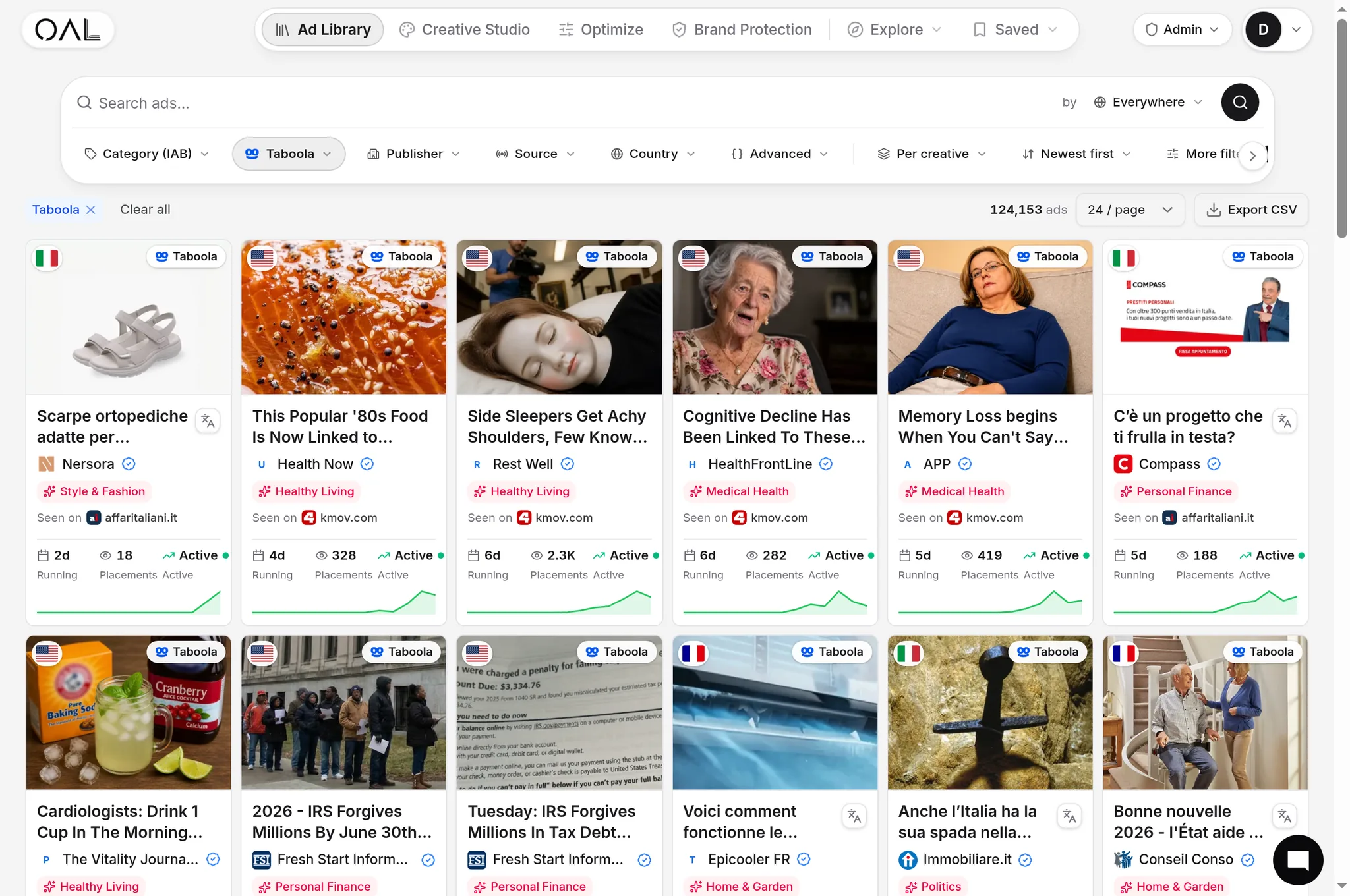
This cadence is deliberately boring. The buyers who scale native campaigns successfully over horizontal or vertical expansion are usually the ones who resist the urge to react to every daily fluctuation, not the ones checking bids three times a day. If you want a reference point for what a stable, mature campaign's bid and delivery pattern looks like before you start adjusting your own, OpenAdLibrary's native ad spy tool shows which creatives in your vertical have been running steadily for weeks, a reasonable signal that their underlying bid and cadence have already settled.