

Ad Creative & Funnels
Track Competitor Creative Iterations to Reverse-Engineer Their Tests
One look at a competitor's ad is a photograph. Watching it change over weeks is a video, and the video is what actually shows you their test results.
One look at a competitor's ad is a photograph. Watching it change over weeks is a video, and the video is what actually shows you their test results.
Native ads don't live in one searchable place the way Meta or Google ads do. Here's how keyword search actually works across networks, and what it can and can't tell you.

Every ad spend estimate you've seen from a competitive intelligence tool is a model's guess, not an observed fact. Here's how that guess is built, and what to trust instead.

Not seeing an ad this week doesn't mean a competitor stopped running it. Here's how to check last-seen dates and creative volume properly, and what a confirmed stop usually signals.

Reading ten competitor ads one at a time gives you ten opinions. Pulling hundreds and tagging by hook type gives you an actual market signal. Here's the method.

Most swipe files die within a month because they're just screenshots with no context. Here's how to build one organized by pattern, with metadata attached, that you'll actually reopen.
Knowing your competitor runs an ad tells you nothing about why it works. Creative intelligence breaks the ad apart to find the mechanic actually driving performance.

Finding out about a new competitor by accident means you're already weeks behind. A fixed weekly check on your category's ad inventory closes that gap.

There's no master archive of native ads going back years. Historical ad data is only as deep as a tool's own continuous capture, and knowing that changes how you should research.

Copying a competitor's ad word for word teaches you nothing and can get you flagged. Here's how to extract the angle that's working and rebuild it in your own voice.

You can't see a competitor's real conversion data, but longevity, angle reuse, and placement spread reliably indicate which of their ads are actually winning. Here's how to read the signals.

Nobody publishes real competitor ad spend, on any channel. Here's what Google Ads, Meta's Ads Library, and native networks actually show you instead, and how to build a defensible estimate from the proxies that remain.

Google's Ads Transparency Center is the free, official way to see a competitor's Google ads. Here's how to search it properly, and the entire ad category it doesn't cover at all.

Ecommerce, finance and travel dominate MSN's native feed. Here's the advertiser and vertical breakdown from an index of 281,839 live MSN creatives, plus who's actually buying there.
MediaGo and Taboola draw from very different supply. Here's how their inventory, cost and targeting compare, and which advertisers fit each one.

Analyzing one competitor ad with AI tells you almost nothing. Here's the batch-based prompt sequence that actually surfaces which hooks and claims a competitor is leaning on.

The Meta Ad Library is free, official — and silent on performance, spend, history, targeting and the entire open web. The seven limitations that matter, and the workaround for each.

Agencies need different things from an ad spy tool than solo buyers: multi-vertical coverage, client-ready evidence, shared boards and sane seat pricing. Here are the five workflows where the tool earns its fee, and the checklist to buy against.

Adbeat still owns the deepest display supply-path data in the category — but it's enterprise-priced, native feeds sit outside its center of gravity, and the research output that built its reputation has gone dormant. Who it's still for.
BigSpy wins on price and loses on noise. Where the budget multi-platform ad spy genuinely earns its cost, where the database-size marketing misleads, and a 20-minute protocol to test it in your own niche.
Minea answers one question well: which product should I sell next? If your question is which advertiser is scaling, on what placements, into what funnel — you need a different tool. The alternatives, grouped by job.

Nearly every PowerAdSpy review online carries an affiliate link. This one doesn't. What the social-first ad spy tool genuinely does well, where it falls short for performance buyers, and how to pressure-test it in thirty minutes.

Connect Claude or ChatGPT to a live native ad index over MCP and competitor research becomes a conversation: teardowns, angle mining, geo scouting and watchlist monitoring — five workflows, with the prompts.

A five-step hook-analysis method: sample at scale, classify with an eight-type taxonomy, score with longevity data, and extract mechanisms instead of copying copy.
A swipe file only works if every saved ad carries proof and context. The entry criteria, nine capture fields, angle-first taxonomy, and weekly routine that keep one alive.

No vendor PR, no unverifiable ROAS: 12 live native campaigns — Domain.com.au, Flight Centre, Fisher Investments, search-arbitrage farms and more — decoded from observable capture data: longevity, creative sets, networks and funnels.

Taboola holds 206,145 live creatives in OpenAdLibrary's independent index — more than Outbrain, MGID and Revcontent combined. Thirty statistics on scale, verticals, and creative longevity, all from observed live captures.

AI has already taken the mechanical middle of media buying. What's genuinely automated, what structurally isn't, and how the role is being reshaped.
A practical 20-minute check across Meta, Google and the native ad networks that publish no libraries at all — plus how to monitor continuously and escalate.

Ideas, angles, and offers are free to borrow; expression is not. Where the legal lines sit when you copy a competitor's ad — and the workflow that beats copying anyway.

A spy tool competes against your testing budget, not your software budget. Here is the break-even math, the cases where it clearly pays, and the cases where you should keep your money.

Official ad libraries won't tell you when a competitor launches something new — you have to keep checking. Alerts flip that: continuous observation, diffed daily, delivered to you.

Insurance, finance and health dominate Outbrain — 108,000+ live creatives say so. What the live vertical data shows, why the ranking holds, and how to pick a vertical you can win.

Taboola doesn't publish its publisher list — but the network is mappable. The site tiers, the page placements, and three ways to check any website in under a minute.

What a live index of 725,000+ native creatives shows about the channel right now: network volume, vertical concentration, platform consolidation, and a repeatable routine for tracking trends yourself.

A corpus-backed way to score native ad headlines: the structural patterns behind long-running ads, a two-minute rubric, and how to check any draft against 725,000+ live creatives.
SpyOver is one of the longer-standing native ad spy tools. A competing ad library reviews what it does well, where it falls short, and the 20-minute trial test to run before you pay.

A swipe file is only as good as its evidence. Real native creatives organized by vertical — each with observed run time — plus the tagging and refresh system that keeps a swipe file useful.
Live capture data on the advertiser mix across MGID, Revcontent and MediaGo: the verticals, the named advertisers, and the five archetypes that dominate mid-tier native networks.

Brands, performance advertisers and arbitrage players: the three layers of Outbrain's advertiser base, mapped with live index data and real running creatives.
No RevContent ad library exists — official or otherwise — until now. Inside the 14,735-creative RevContent index: the health-offer marketplace, the advertorial economy measured, and the angles that keep paying.
Baidu's MediaGo DSP publishes no ad library — official or otherwise. Inside the 6,551-creative MediaGo index: the most balanced vertical mix in mid-tier native, the MSN overlap, and the angles the algorithm let live.

Ten real Taboola creatives pulled live from a 171,050-ad index — with the advertiser behind each, how long it's been running, and the headline mechanism doing the work: eligibility hooks, casting-call angles, editorial blends, geo-personalization and offer-led cards.
The Microsoft Audience Network is the largest fresh source of native creatives we track — 257,553 new ads in 30 days — yet it has no ad library and almost no coverage. Here's how the MSN feed works, how its demand is resold through msft-ssp and adnxs wrappers, and how to research it.
Foreplay claimed the ad library MCP for Meta ads. Native networks now have theirs: a hosted MCP server exposing 43 tools over 1,041,637 native creatives across 50 networks — here's what agents can do with it and how to set it up.

BigSpy wins on price, but it barely sees Taboola, Outbrain or MGID. We priced and compared 7 alternatives — from $29.99 to $249/month — on native depth, landing-page tracing and API access.
Meta's Ad Library hides spend, targeting and performance outside the EU, and commercial ads vanish when campaigns end. Here are the 8 alternatives that patch each gap — priced, verified, and matched to the job.
No MGID ad library exists — official or otherwise — until now. Inside the 54,585-creative MGID index: the entertainment-arbitrage economy, the direct-response layer, and the most international footprint in native.
Outbrain — owned by Teads since 2025 — publishes no ad library. We maintain the independent one: 92,290 live Outbrain creatives with advertisers, longevity and landing pages, and the workflow to use them.

No official Taboola ad library exists anywhere. Here is the independent one: 171,050 live Taboola creatives with advertisers, longevity, geo and landing pages, and how to use it for real competitive research.

No tool can hand you a competitor's exact native ad budget, but ad volume, placement breadth, creative longevity and geo spread are observable proxies that get you to a defensible spend tier.

Spend charts only update after the race is over, so to see what advertisers are scaling right now you read live native ad capture for longevity, spread, and variant signals. Here is the method, with real numbers from 589,000+ captured creatives.

DTC brands quietly buy native ads next to the arbitrage and nutra crowd, and here is a repeatable, data-backed method for surfacing which ones are live on Taboola, Outbrain, MGID and Revcontent this week, by category.
CPC and CTR benchmarks you can't verify are worthless; this study benchmarks the three signals you can observe from outside any ad account (creative volume, ad longevity, and category mix) using live capture of 589,000+ public native ads, and shows you how to reproduce every measure yourself.

You can't see a competitor's native spend, but you can count their live creatives and measure how long each one survives, and that gives you a defensible way to rank advertisers by share of voice in any vertical.

Native ads recycle a small set of recurring angles, and this is a working taxonomy of them plus a repeatable, results-weighted method for measuring which ones actually win, built from real captured creatives.

An ad that keeps spending week after week is telling you something a one-off scrape never can: here is how to rank native ads by lifespan, why longevity is the cleanest profitability signal on the open web, and how to run the analysis yourself.

Folklore says nutra and crypto own native, but across 589,000+ live-captured creatives finance, insurance and health actually lead; here's the method to measure native ads by vertical and network yourself.
Most "top advertiser" lists are guesses; this one is rebuilt from 589,000 live native creatives, classified by real advertiser, network and vertical, then ranked by spread and longevity.
There's no public list of Taboola advertisers, so here's the exact method we use to reconstruct one from 157,000+ captured Taboola creatives, click-trace landing pages, and supply-chain classification.
Most native ad intelligence is locked behind a dashboard, so here is how analysts and data teams pull live creatives, the real advertiser, supply-chain hops, and landing pages as structured records over an API.

The "Sponsored" widget hides a real roster of advertisers; here's how to surface who actually buys placements on any site, and what their longevity tells you.

Every native ad leaves fingerprints in its click URL, loader script, and tracker domains that name the network serving it, and here's how to read them by hand or at scale.
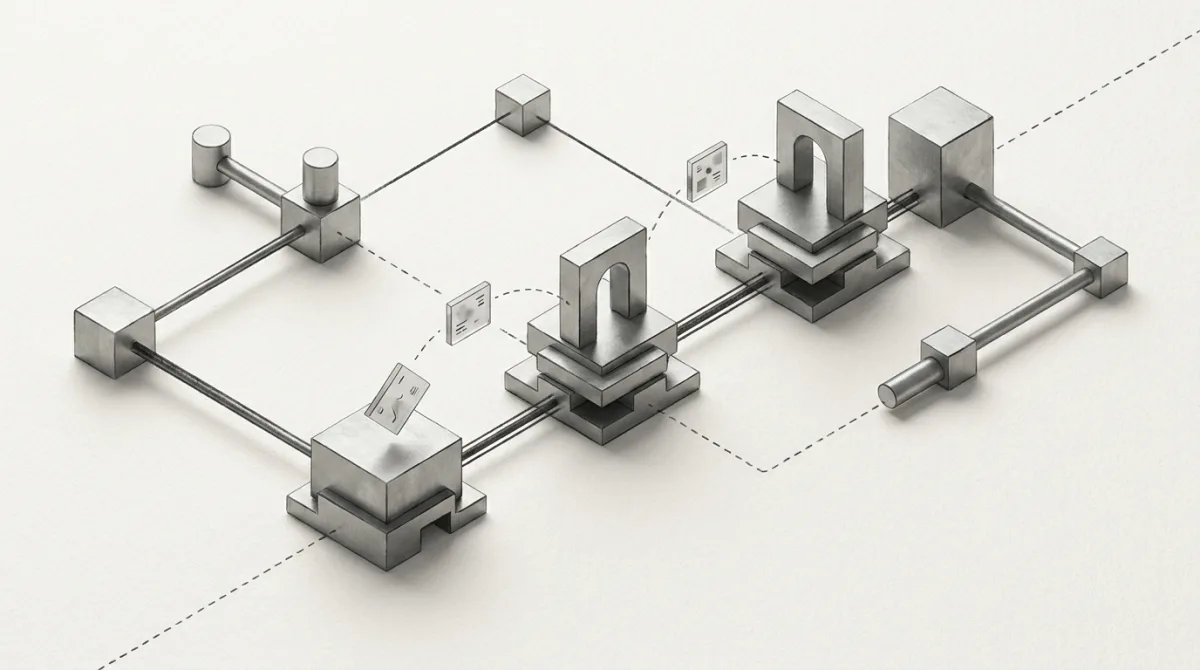
Follow one native impression from a publisher's "you may also like" box to the advertiser's checkout, reading the SSP, the auction macros, the click trackers, and the redirect chain straight off the captured data.

Ad intelligence turns the public ads running across the web into structured competitive data: the creative, the network behind it, the advertiser, the landing page, and the spend signals, and here's the full pipeline plus why native is the hard part.

Ad transparency tools let anyone see who is running which ads and where, and here is how the category works, why native ads were the blind spot, and what separates an open ad library from a $300-a-month spy tool.

Meta and Google run public ad libraries; Taboola, Outbrain and MGID never did, so here is what an open native ad library has to capture, and why that gap sat empty for a decade.
The image and headline patterns that actually move click-through on Taboola, Outbrain and the rest of the native feed, pulled from the 589,000+ live creatives we've captured and sorted by the verticals where each one wins.

Most ecommerce ads fail at the angle, not the artwork, so here's a practical library of the hooks that convert on native traffic and a simple way to tell a proven angle from a hopeful guess.

Native traffic doesn't convert on the click, it converts on the chain, so here's how the ad, pre-lander, and offer fit together and why message continuity decides your margins.
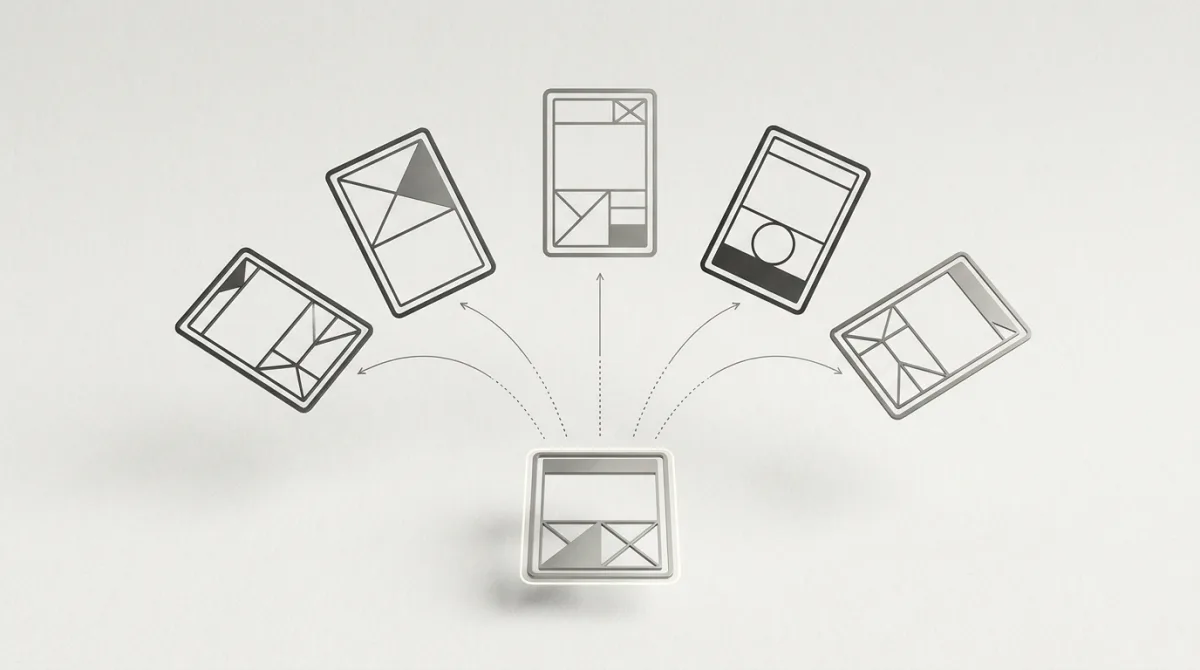
The six pre-lander formats that actually convert cold native clicks, mapped to traffic temperature and offer complexity, with real captured ads showing each one in the wild.

Advertorials convert when the page resolves the exact tension the ad created, so here's the seven-section anatomy with teardowns pulled from live native captures, not stale swipe files.
If Meta is 90% of your spend, you don't have a marketing channel, you have a single point of failure; here's how to add native as a second engine and use competitive recon to de-risk every step.

Native advertising wins for a narrow slice of dropshipping products, and here's the data-backed case for when it beats social, drawn from live native ad captures.

Nutra is the loudest, most heavily policed vertical on native, and this is how its winning offers, angles, networks, and click destinations actually work in 2026, shown through real captured creatives.

Most "best vertical" lists are opinion, so we ranked native-ad verticals using three things you can actually see in live ad data: advertiser density, creative volume, and how long ads keep running.

Geo expansion is the cheapest scaling lever in native media buying, and here is how to duplicate a proven campaign into a new market using geo-tagged capture that shows where offers already run and where the whitespace sits.

Vertical scaling pushes more budget into a proven ad set while horizontal scaling clones the winner across new geos, networks, and angles, and reading competitor expansion patterns tells you the exact order to do it in.

Native networks are where advertisers test products first, so reading new entrants, creative ramps, and persistent offers there spots winners weeks before they saturate the Meta libraries everyone else watches.

We read the public signals behind 589,000+ live native creatives to show which hooks, images and headline structures actually survive, and how to run the same pattern analysis on real running ads instead of guessing.
Hook, angle, and claim get used interchangeably and it quietly wrecks your tests; here's the creative ladder that separates them, why the angle is the unit that scales, and how to read one advertiser running a single angle across a stack of hooks in live native-ad data.

A repeatable scoring rubric for hook, angle, proof, format and CTA, applied to real native ads we captured this month, so you copy the method instead of the creative.

A repeatable five-step method for tearing down native ad creatives, from hook and angle to advertorial, using real captured ads and longevity data instead of guesswork.
You can't see another affiliate's ROI, but you can see what they keep paying to run; here is how to turn ad longevity and creative saturation into a repeatable offer-validation checklist.

Winning products leave a trail in native ad data: ads that keep running for weeks, multiple affiliates piling onto one offer, and creatives that get refreshed instead of killed. Here is how to read those signals and trace the click to the offer page.

An ad that keeps running is an ad that keeps paying, and our first-seen/last-seen data on the live index shows just how few native creatives survive long enough to count.
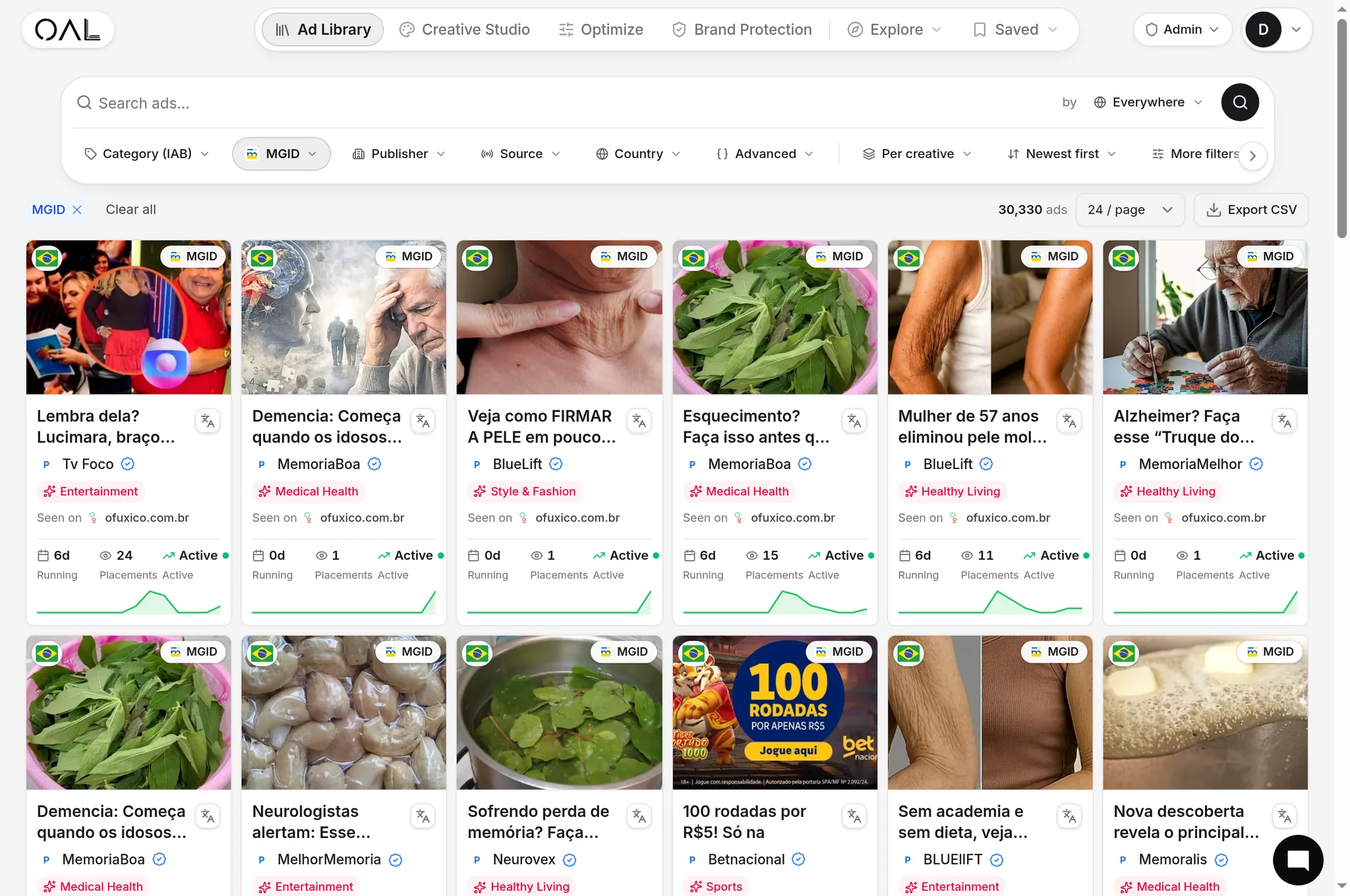
MGID and Revcontent are where smart media buyers diversify after Taboola and Outbrain, and here is how to spy on both properly using real captured longevity, geo, and advertiser data.
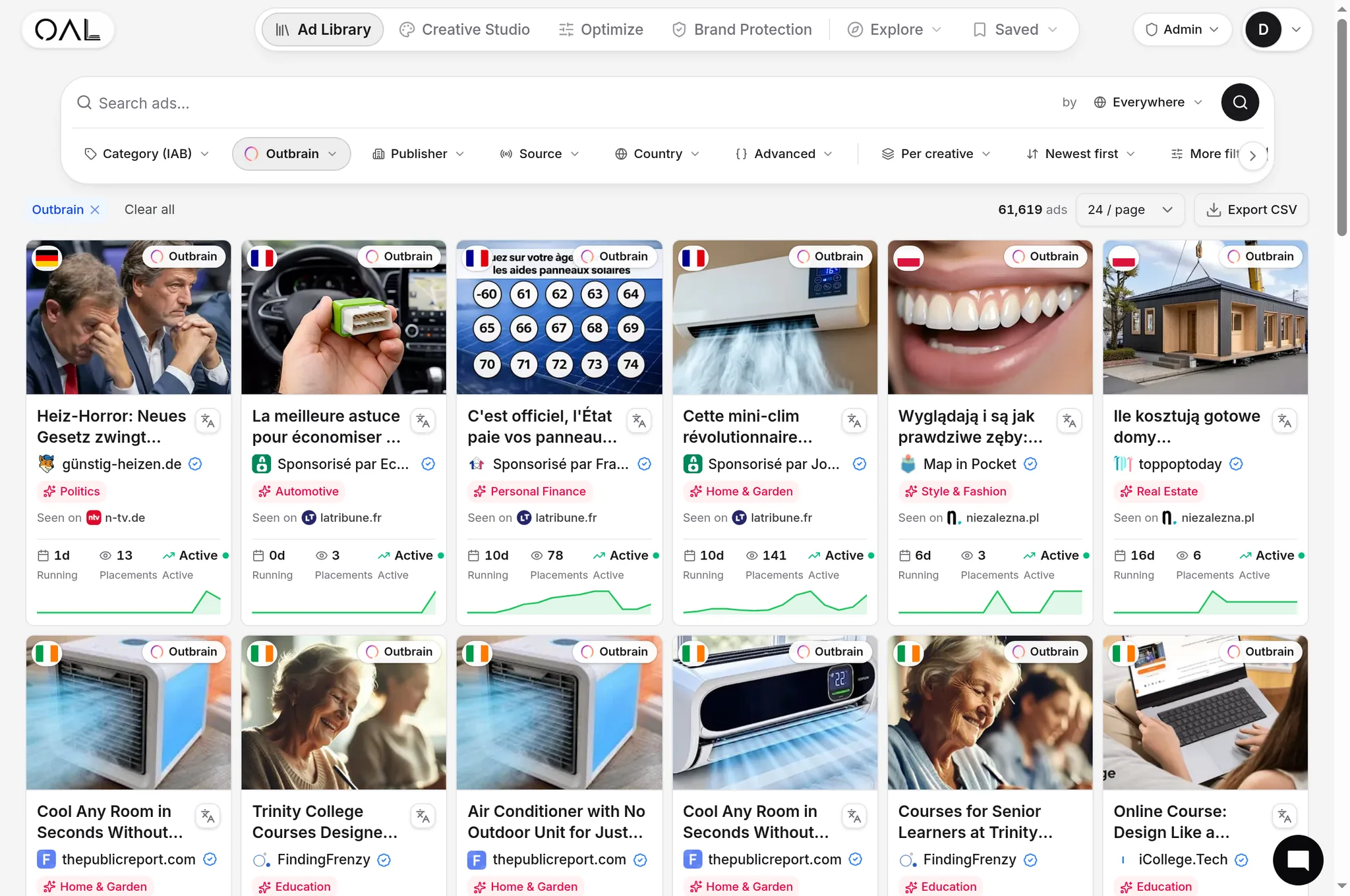
The Teads merger killed off Outbrain's per-creative competitive data, so here is how to capture live Outbrain/Teads ads from publisher pages instead: find rivals' creatives, trace each click to its landing page, and read longevity instead of fake spend numbers.
Taboola has no public ad library, so here's how to reconstruct one: filter live captures by network, vertical and geo, rank advertisers by volume and days live, then pull the full creative and the click-to-landing trace.
Taboola, Teads (Outbrain), MGID, and Revcontent each reward different ecommerce categories and margins, and our June 2026 capture data shows exactly where your product type actually has demand before you spend a dollar.
Published CPC ranges for Taboola, Teads, MGID, and Revcontent only tell half the story; here is how to read live advertiser density and longevity to know what a click is really worth before you fund a test.
MGID lets you test from $100; Taboola realistically needs ~$300/day to clear its learning phase, and our capture index shows Taboola running three times the creatives MGID does.
A data-led comparison of MGID and Revcontent using the real advertiser mix, vertical breakdown, and ad longevity we've captured from each network's live creatives.
Outbrain bought Teads and the parent now trades as Teads, so here is how to compare the two networks using live ad data instead of vendor claims.
A media buyer's honest comparison of native ads and Facebook ads for DTC in 2026, covering CPC, iOS signal loss, creative, and intent, backed by the live native volume OpenAdLibrary tracks across Taboola, Outbrain, MGID, and Revcontent.
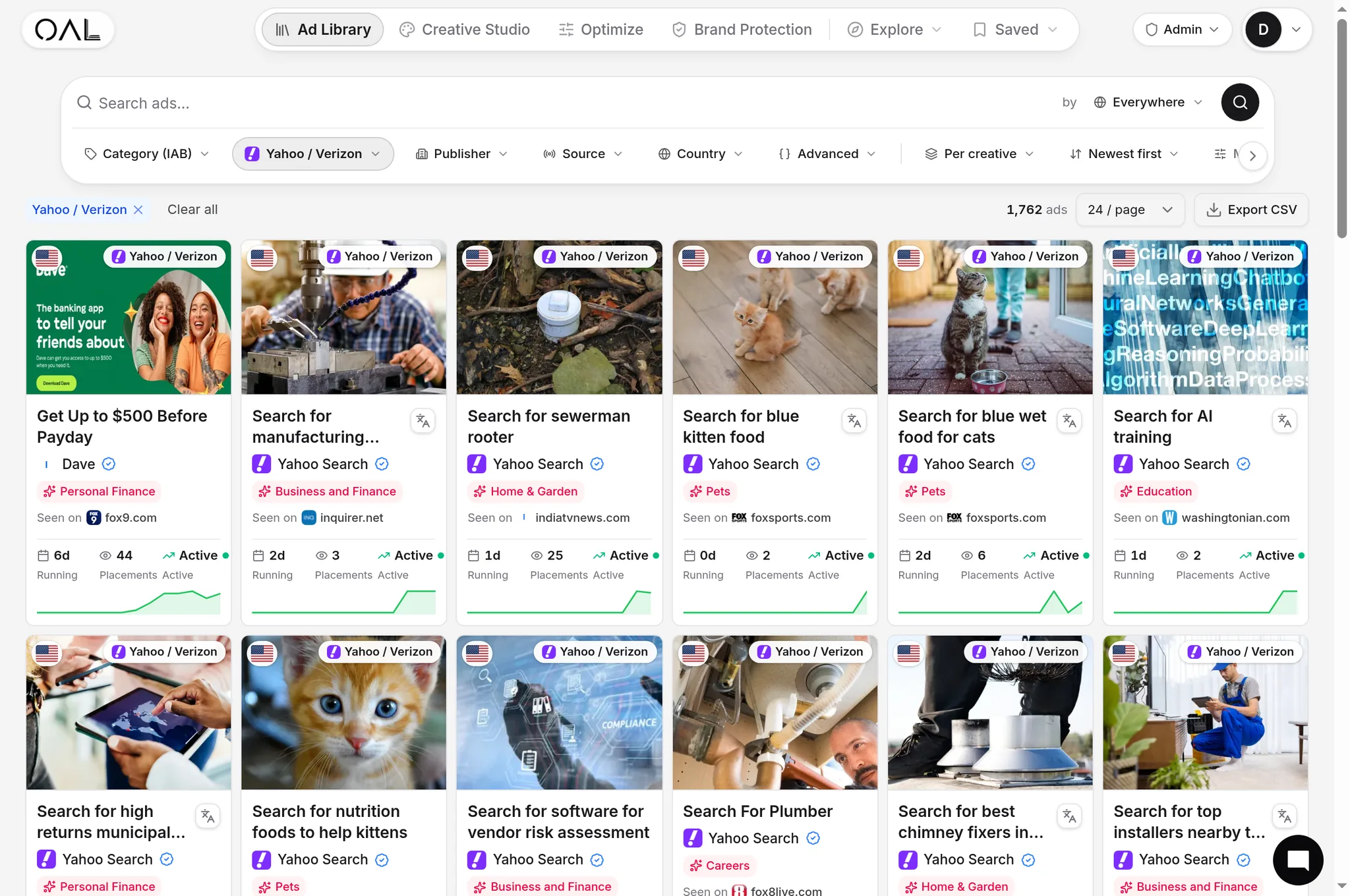
Yahoo Gemini was retired in 2023, and Yahoo native didn't die with it: demand moved to the Yahoo DSP and the supply is now run exclusively by Taboola, so here's the timeline and how to spy on live Yahoo creatives today.
Outbrain bought Teads, then took its name and Nasdaq ticker, and our live capture data shows the Outbrain engine still serves nearly all the volume.
Thirty real native ads captured live off Taboola, Outbrain and MGID in June 2026, each labeled with the actual advertiser, the network, and how long it has been running.
Yahoo Gemini is gone, but "Yahoo native" still trips up buyers: here is who really serves the ads in 2026, how to buy them, where MSN fits, and how to study live creatives.
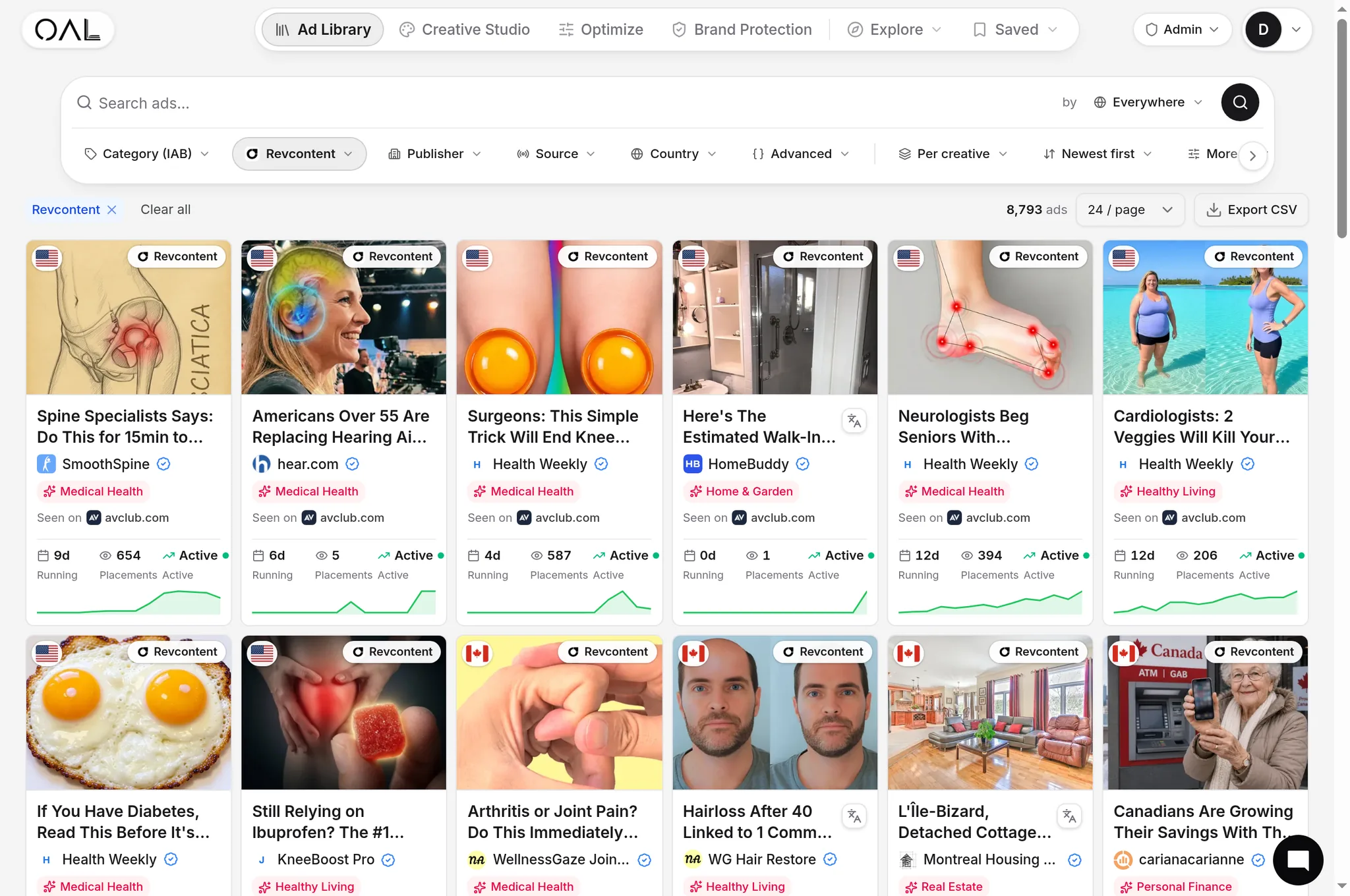
Revcontent serves native ads through publisher widgets you bid on one by one, and here is how its delivery, site-level targeting, CPC bidding and optimization levers actually work, with real captured ads.
A working media buyer's breakdown of how Taboola native ads actually run in 2026: the auction, the widget, CPC pricing, and the tracker chain behind every click, shown with live creatives we captured instead of vendor mockups.

A watchlist is only useful if it tiers competitors by threat and feeds continuous monitoring, so here is how to build one and wire every advertiser into native-ad tracking and alerts.

The buyers who consistently find winners do not spy when they are stuck, they run a 45-minute weekly routine that turns scattered ad-checking into pattern recognition you can act on.

Most teams check competitor ads once a quarter and call it research; a real intelligence workflow runs every week with a scoped watchlist, a fixed cadence, a creative scoring rubric, and a clean handoff into media buying.
A practitioner's walkthrough for finding the ads a competitor is actively running: search by brand or domain to surface live native creatives, the networks behind them, and the landing page each ad points to, plus exactly where Meta and TikTok go dark.
Most ad intelligence platforms look identical on a feature grid, so score them on what actually matters: freshness, coverage, auditable evidence, click-to-landing capture, and pricing.

Adbeat and Anstrex both get called "ad spy tools," but one maps enterprise display spend and the other rips native landers for affiliates; here's the honest head-to-head, plus where an open native-first index changes the math.

A practitioner's head-to-head on AdPlexity, Anstrex, SpyOver and OpenAdLibrary, judged on price, network coverage, geos, landing-page capture, history and the supply-chain data each one actually exposes.

Most "free ad spy tools" are seven-day trials with a card form attached; here are seven that are genuinely free, including the only one that covers Taboola and Outbrain with click-traced landing-page evidence.

We ranked the ad spy tools DTC and ecommerce teams actually use in 2026 on the three things that decide outcomes, data freshness, native coverage, and price, including a $29.99/mo option that traces every click to the landing page.

A working media buyer's ranking of the best native ad spy tools for affiliate marketers in 2026, scored on landing-page access, network filters, geo, and price, with the real captured creatives to prove the point.

The best native ad spy tools don't screenshot pages; they read the same JSON feed the widget calls, store the full-quality creative, and trace the click to the landing page without ever spending an advertiser's budget. Here's exactly how.

"Free native ad spy tool" gets searched far more than it gets answered honestly, so here is what is genuinely free for researching Taboola, Outbrain, MGID and Revcontent ads, and exactly where the limits bite.

A native ad spy tool turns the scattered, public-but-invisible world of Taboola and Outbrain into a searchable record: the real creative, the advertiser behind it, and the landing page the click actually leads to.

A media buyer's guide to native advertising: what it is, the formats and supply chain behind it, real captured examples, FTC disclosure rules, and how to spy on the native ads actually winning right now.

A practitioner's read on native advertising in 2026, built from 589,000+ live-captured creatives: who is advertising, which verticals dominate, and what ad longevity really tells you about the winners.
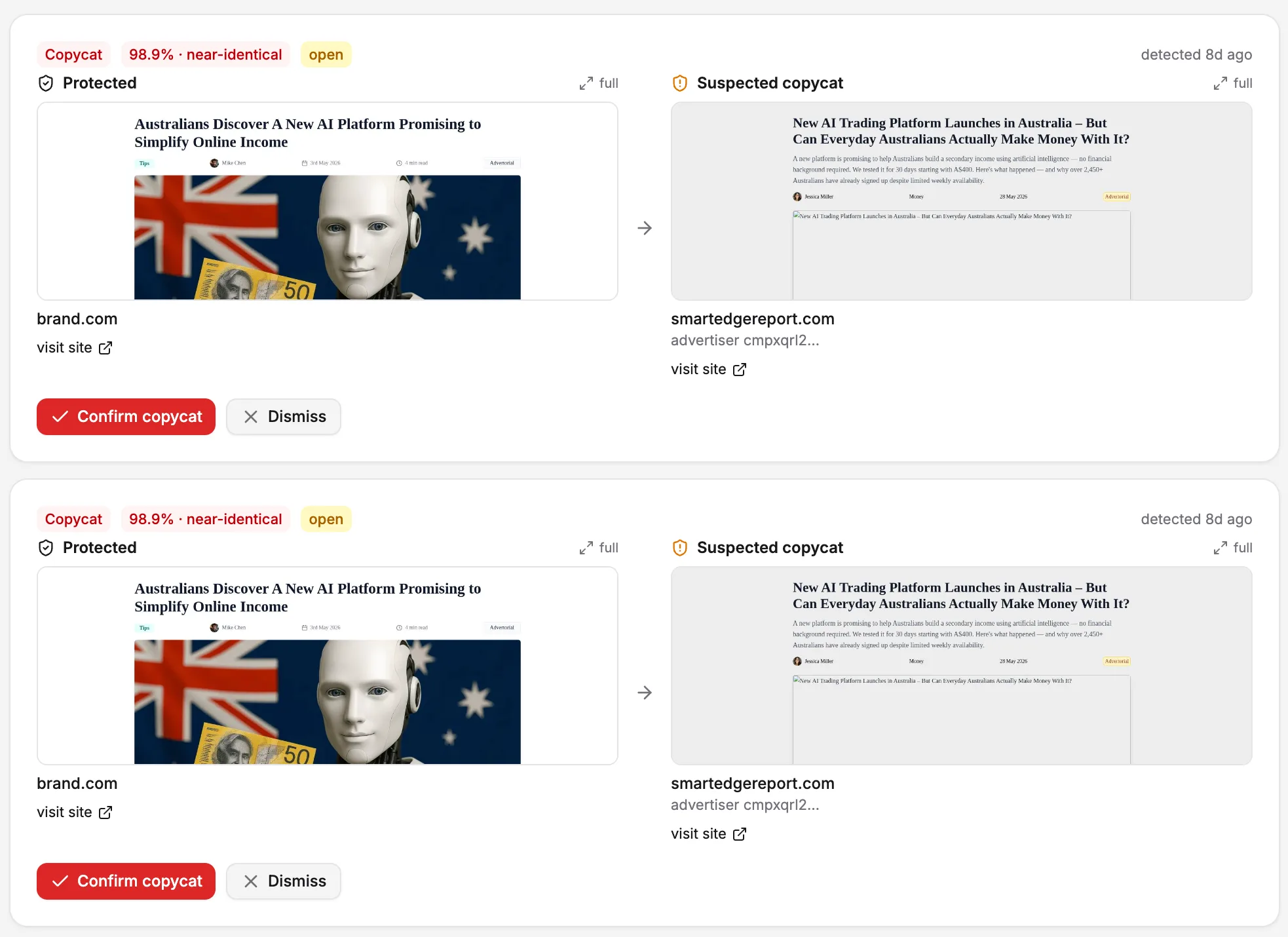
Native ad networks are where brand impersonation, copycat landing pages, and cloaked offers thrive, because the creative blends into the article and the real advertiser hides behind redirect chains; here is how to monitor, detect, document, and escalate brand abuse with evidence that holds up.

Ad transparency means anyone can see which ads are running, who paid for them, and where they appear, and here is how the libraries work, the laws that built them, and the native blind spot none of them fill.

The pre-lander is the page between a native ad and the offer, and on cold traffic it does the persuasion the ad can't: here's how advertorial funnels work and how to reverse-engineer the ones that win.
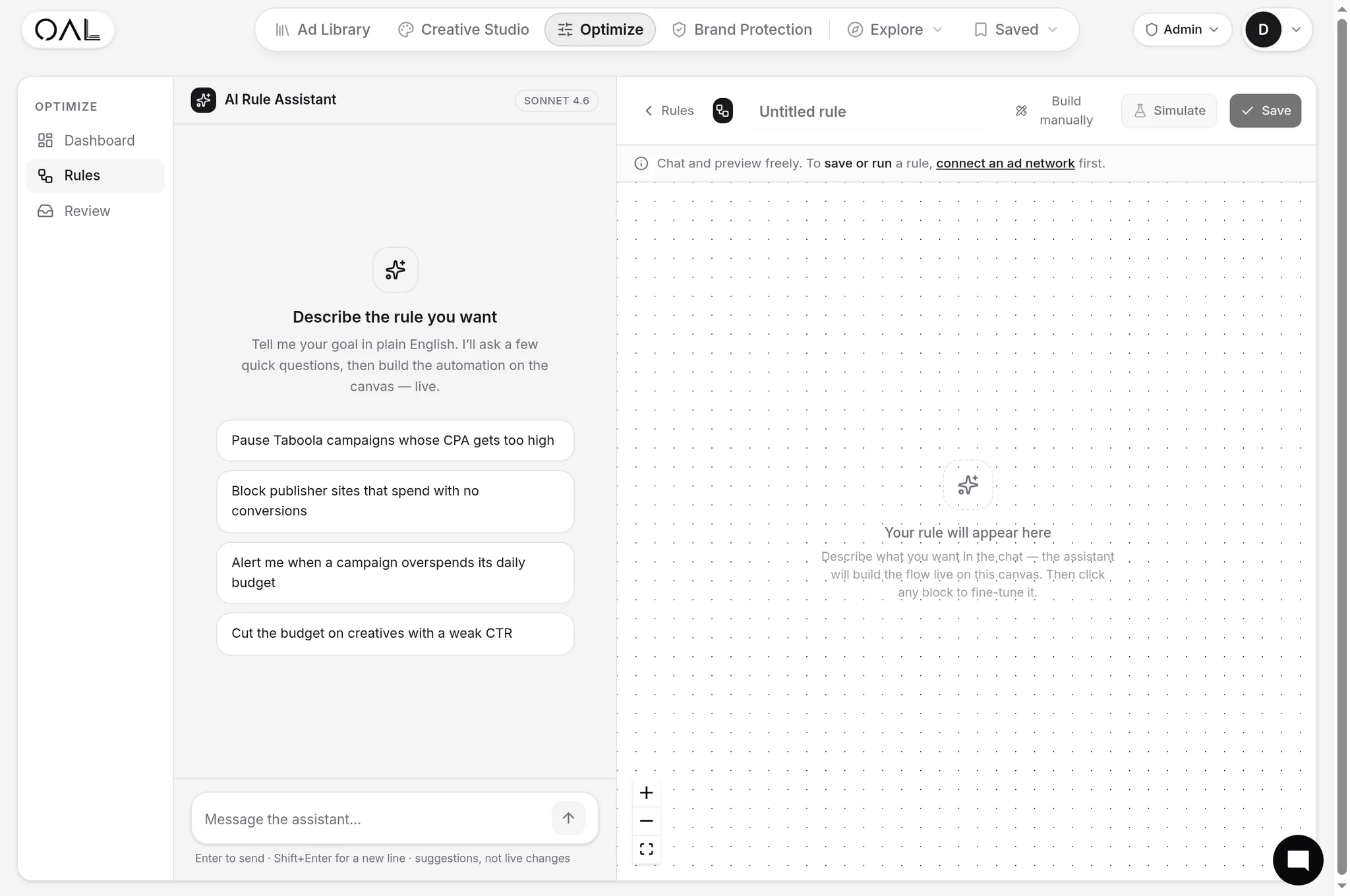
A practitioner's playbook for running native profitably as an affiliate in 2026: offer selection, creative angles, pre-landers, the test loop, and using live competitor ads to find proven winners and new geos.

A winning ad isn't the prettiest one in the feed, it's the one an advertiser keeps paying to run, and this is the framework for reading the signals that prove it.

We ranked the major native ad networks by the only metric that predicts where your money goes: how many live ads each one is actually running right now, pulled straight from OpenAdLibrary's index of 589,000+ captured creatives.
A practitioner's guide to native advertising in 2026: the formats, the networks, how the auction really works, and how to read winning ads straight off the live market.
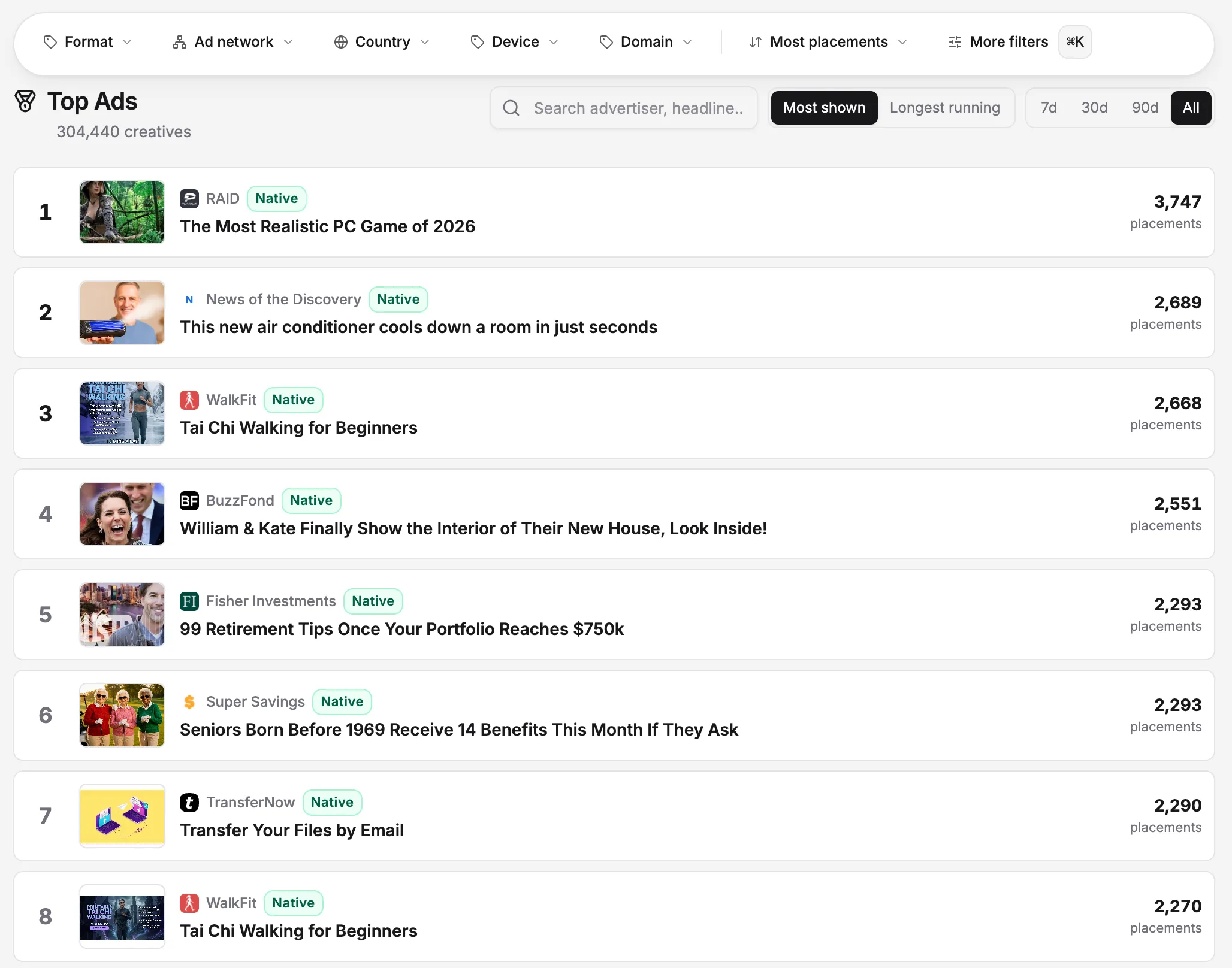
A practitioner's guide to spying on competitor ads across native, display and social: what to capture, how to tell real winners from noise, where the legal lines sit, and a weekly workflow that turns scattered screenshots into decisions.

We priced and ranked the native ad spy tools that matter in 2026, from $29.99 to $249-plus, on what actually wins campaigns: real coverage depth, full-quality creatives, and where the click goes.

Competitive intelligence in advertising is gathering and analyzing rivals' ads, channels, and spend signals to sharpen your own creative and media strategy.
In advertising, a spy tool, or ad spy, is software that captures competitors' live ads and landing pages so marketers can research winning creatives and offers.
An ad spy tool captures and archives competitors' live ads across networks so you can study their creatives, offers, and landing pages in one searchable database.
Ad intelligence is the collection and analysis of competitors' live ads, creatives, and landing pages to inform creative and media-buying decisions.
Ad transparency is the practice of making the ads an advertiser runs, and who is behind them, publicly visible through searchable libraries and disclosures.
An ad library is a searchable, public database of ads that have run on a platform or network, showing the creative, advertiser, and run details.

Share of voice (SOV) is a brand's portion of total advertising presence in a market relative to all competitors.
Ad spend is the total amount of money an advertiser pays to run its ads across channels over a given period.
Click-trace follows an ad's click through every redirect to its final landing page, revealing the real advertiser and offer behind it.
A click tracking domain is the dedicated domain a tracker uses to log and redirect ad clicks before the user reaches the landing page.

An advertiser ID is the unique identifier an ad network assigns to each advertiser account, tying every campaign and creative back to one entity.
An advertiser is the brand, business, or marketer that pays to place ads in front of an audience to drive awareness, clicks, leads, or sales.