Español
 Português (Brasil)
 Français
 Deutsch
 Italiano
 Nederlands
 Polski
 Svenska
 Türkçe
 Русский
 日本語
 한국어
 简体中文
 Tiếng Việt
 Bahasa Indonesia
 繁體中文
 Čeština
 Dansk
 Norsk (bokmål)
 Suomi
 Ελληνικά
 Română
 Magyar
 Українська
 ไทย
 हिन्दी
 العربية
 עברית
MGID Ad Library: Browse Captured MGID Ads
Research captured MGID creatives by advertiser and language: 54,585 records as of July, with observation dates, available destinations and the collection and classification limits behind the counts.

An MGID-focused archive can help locate captured creatives and available destination records. Compare sources by coverage, dates and evidence fields. The existence of competing paid tools means this article should not claim that no third-party MGID archive exists.
We fill it. As of July 2026, the OpenAdLibrary index holds 54,585 live MGID creatives — 54,391 of them (99.6%) first captured in the last 30 days — each with the advertiser behind it, observed longevity, geo and device data, and a traced landing page. This guide covers why no official MGID library exists, what our index captures, what the data says about the network, and how to use it. The workflow-level companion is our MGID & Revcontent ad spy guide and the /spy/mgid tool page.
Why there is no official MGID library#
Public-repository obligations depend on the service and applicable law. This article does not establish MGID's full obligations, its reasons for repository decisions or whether it will launch one. An independent archive remains a source of observed examples rather than a complete census.
For MGID specifically the gap stings more, because the network's reputation questions make independent data unusually valuable. MGID's own transparency materials describe policy and moderation, not inventory — you can read what the network says it allows, but not what it is actually serving today. Buyers asking "is MGID legit," publishers vetting the demand, and brands checking whether their name is being abused in MGID placements all need to see the actual ads. An outside-in archive is the only way anyone gets that view.
What the MGID index captures#
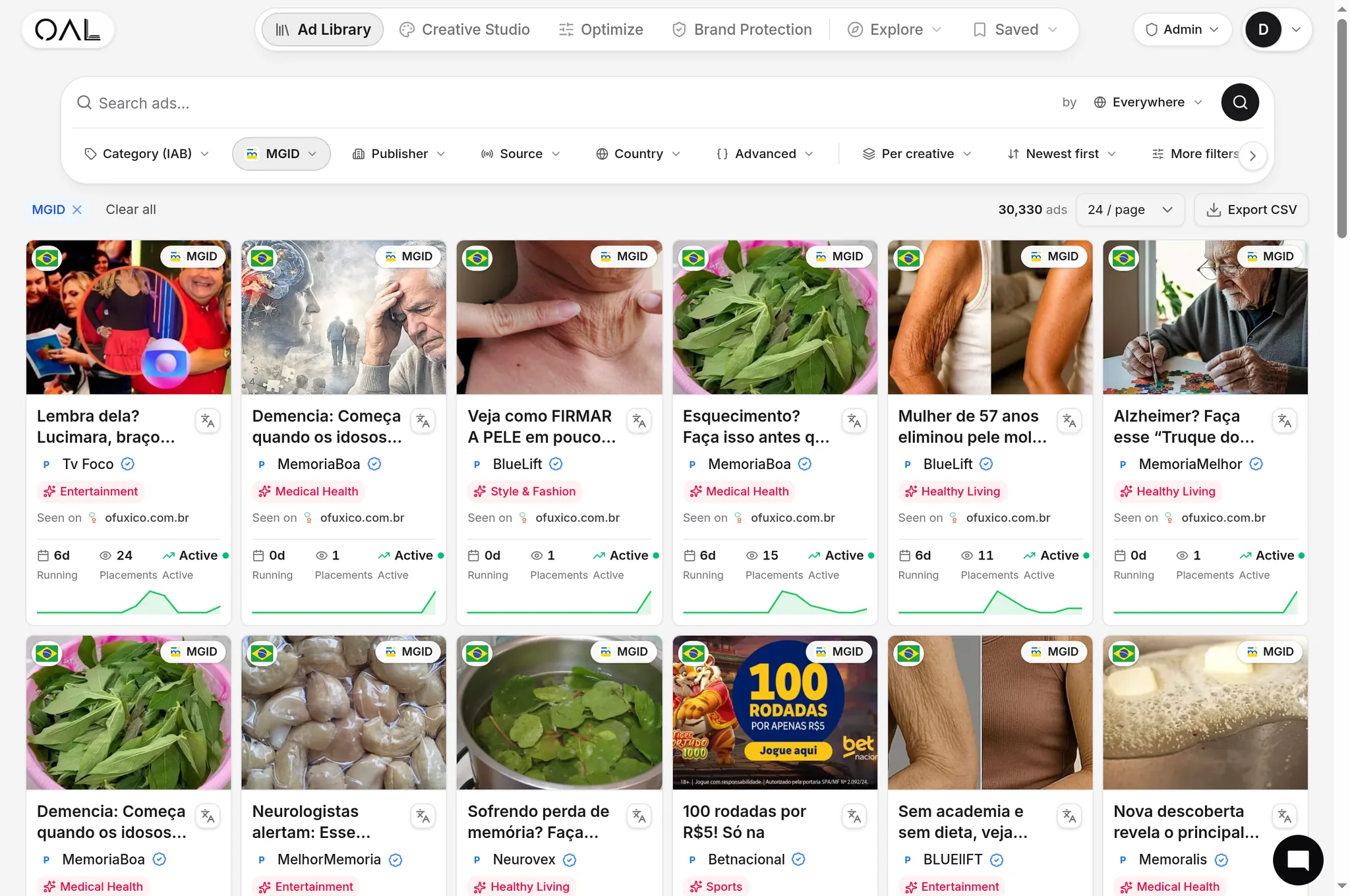
For each of the 54,585 MGID creatives in the index (July 2026):
Review the available creative, displayed advertiser, observation dates, collection language and context, classification and destination. Record missing fields and uncertain identities. Observation spans do not establish targeting, continuous delivery or profit.
The following StopWatt creative has a cited observation history. That does not validate its electricity-saving claim or demonstrate campaign profitability.

And the other side of MGID's demand — mainstream content-arbitrage buyers like The Penny Hoarder, this creative at 16 days observed:

What the data says about MGID#
MGID's vertical mix looks nothing like Taboola's or Outbrain's. The classified creative counts as of July 2026:
| Vertical | Live MGID creatives (July 2026) |
|---|---|
| Entertainment | 10,225 |
| Health | 696 |
| Insurance | 433 |
| Software | 182 |
| Ecommerce | 159 |
| Real estate | 144 |
The 10,225 entertainment labels are about 18.7% of the reported 54,585 total MGID records, and about 14.7 times the listed health count. They do not establish that most inventory is entertainment: many records are outside this table or unclassified, and classification errors may affect the distribution.
The advertiser-level data confirms the two-sided character. The largest MGID advertisers in our index are content-arbitrage domains — itsvividleaves.com with 3,088 distinct creatives and factripple.com with 3,071 — followed by direct-response offers like Insulux Diabetic Support (1,807 creatives) and content mills like Brainberries (1,762). And the geography is genuinely global: Betnacional, a Brazilian betting brand, runs 1,287 creatives; Greek (yupiii.gr, 1,149) and Polish (swiatgwiazd.pl, 511) publishers rank among the top buyers. Across our whole index, 61,469 creatives are German, 40,955 Spanish and 20,236 Portuguese — and MGID contributes disproportionately to the non-English share. If your market is outside the US, MGID's library depth in your language is exactly the kind of thing to check before committing budget; our guide to the best affiliate verticals for native ads pairs well with that check.
A searchable archive can support brand monitoring on MGID. This article does not establish that impersonation occurs more often on this network tier than elsewhere; verify each suspected example separately.
The two economies of MGID, visible in one archive#
Spend an hour in the MGID index and you stop thinking of it as one network. There are two economies running on the same rails, and the library lets you quantify both.
Some captured destinations appear to use content or gallery formats. Describe the observed pages and separate that observation from an unverified business model, traffic quality or auction-price conclusion.
Other records advertise products, services or offers. Their presence and observation duration do not reveal whether the advertiser is profitable or whether the funnel survives on positive unit economics.
The practical read: judge MGID's fit for your offer by economy two, not by the headline creative counts. A health advertiser should look at the 696 health creatives and who is behind them — not be dazzled or deterred by ten thousand celebrity galleries. And when a direct-response angle shows up in both economies (an arbitrage page warming traffic for an offer funnel), you have found the network's favorite trick: the two-step monetization that pre-lander economics are built on.
A worked example: mapping a non-English market#
MGID's international depth is its most under-used research surface, so here is the workflow on a concrete case: suppose you run betting or finance offers and are considering Brazil.
Filter the library to Portuguese-language MGID creatives and the market structure appears immediately. Betnacional alone accounts for 1,287 distinct creatives in the index — hyper-localized down to city-name headlines ("Ei São Domingos do Maranhão!"), which tells you geo-granular creative is table stakes in that market, not a nice-to-have. Sort by longevity and you see which bonus framings and price points ("less than 1 real") persist versus churn. Trace the landing pages and you get the local funnel conventions: registration flows, payment methods referenced, compliance disclaimers used.
Language-filtered examples can support a preliminary research brief. They do not establish a complete competitive set, legal compliance or local suitability. Have a qualified speaker review meaning and market context before adapting material for a language you do not understand.
How to use the MGID ad library#
Search a relevant advertiser, language or category; inspect available records and destinations; and preserve collection dates and gaps. Group observed patterns for research, not as proven winners. Verify local requirements and offer economics independently before spending.
Freshness, and what this replaces#
The cited first-seen statistic describes when the collector first observed records, not when advertisers launched them or how often they replace creative. Collection expansion can also produce many newly seen records. Keep historical captures dated rather than treating older evidence as automatically wrong.
Before independent libraries, MGID visibility meant either manual fieldwork — browsing publisher sites across geos and devices, screenshotting widgets that vanish on refresh — or the paid spy-tool tier, where native coverage starts around $79.99/month (Anstrex) and runs to $249/month (AdPlexity Native). Those tools cover MGID among other networks and we rate them fairly in Best Native Ad Spy Tools in 2026, but the price wall kept systematic mid-tier network research out of reach for exactly the solo buyers and small teams most likely to profit from MGID's cheaper traffic. The open-library model — browse free with no card, $29.99/month for full access across all 46 indexed networks — removes that gate.
Honest limitations#
Coverage is incomplete and uneven across markets. First and last seen dates describe capture history, not campaign lifespan or profit. Automated classification can bias aggregate proportions as well as individual labels. Preserve the snapshot and query behind any reported count, and leave spend unknown.
We publish these edges because a library you cannot calibrate is a library you cannot trust. Every number in this article is a measurement of what we captured, stated with its method — never an extrapolation dressed up as a census.
Library vs. spy tool#
The library is the archive — search it, cite it, browse it. The MGID ad spy tool is the workflow on top: watchlists on competitors, alerts on new creatives, and export into your own creative pipeline. Both read from the same index. The free tier needs no credit card — start free and run your first MGID advertiser search in about a minute.
The bottom line#
The MGID archive supports research into captured creatives, messages and available destinations. Its sample counts and observation histories do not predict an official repository, establish a network-wide business mix or identify profitable offers.