
 Español
 Português (Brasil)
 Français
 Deutsch
 Italiano
 Nederlands
 Polski
 Svenska
 Türkçe
 Русский
 日本語
 한국어
 简体中文
 Bahasa Indonesia
 繁體中文
 Čeština
 Dansk
 Norsk (bokmål)
 Suomi
 Ελληνικά
 Română
 Magyar
 Українська
 ไทย
 हिन्दी
 العربية
 עברית
Outbrain Ad Library: How to Research Captured Outbrain (Teads) Ads
We found no public Outbrain ad library. Our independent archive held 92,290 Outbrain (Teads) creative records in an early July snapshot, with advertiser labels, observation dates, traced landing pages and the archive's limits.
We could not find an official Outbrain ad library. Outbrain's help-center pages cover managing your own campaigns, not looking up ads that others run on the network. Meta, Google and TikTok publish searchable ad archives; Outbrain, which acquired Teads in February 2025 and now operates as Teads Holding Co., does not appear to publish one.
We maintain an independent alternative. In the early July 2026 snapshot this page describes, the OpenAdLibrary collection held 92,290 Outbrain creative records, 91,341 of them first captured in the preceding 30 days, which largely reflects a collection window that had opened about a month earlier. This guide explains what is and is not known about an official library, what our Outbrain records contain, how to research advertisers on the network, and the limits of any outside-in archive. For the hands-on competitor workflow, see the Outbrain ad spy guide and the /spy/outbrain tool page.
First, get the corporate picture right#
Most content about Outbrain is working from a pre-2025 map. Outbrain completed its acquisition of the video and CTV company Teads on February 3, 2025, changed its corporate name to Teads Holding Co. on June 6, 2025, and began trading on Nasdaq as TEAD on June 10, 2025. The combined company operates under the Teads name. This archive still labels the recommendation-widget records it collects as Outbrain. We covered the merger in detail in Did Outbrain Become Teads? and profiled the combined platform in What Is Teads?.
Why it matters for an ad library: in our collection, recommendation-widget records are labelled Outbrain (92,290 in early July 2026) and only 86 were tagged Teads. That imbalance reflects how and where we collect, not where the combined company's demand or revenue sits.
What is known about an official Outbrain library#
Outbrain has not said why it publishes no library, and this article does not determine all of its legal obligations. Under the EU's Digital Services Act, the public ad-repository duty applies to platforms and search engines designated as very large (about 45 million or more EU users), such as Facebook, Instagram and TikTok. Neither Outbrain/Teads nor Taboola appears on the Commission's list of designated services (updated August 31, 2026). We cover Taboola's position in our Taboola ad library guide.
So outside-in transparency comes from independent observers that capture public placements, archive the creatives and resolve who is behind them. That is what we do, across Outbrain and other networks.
What the Outbrain index contains#
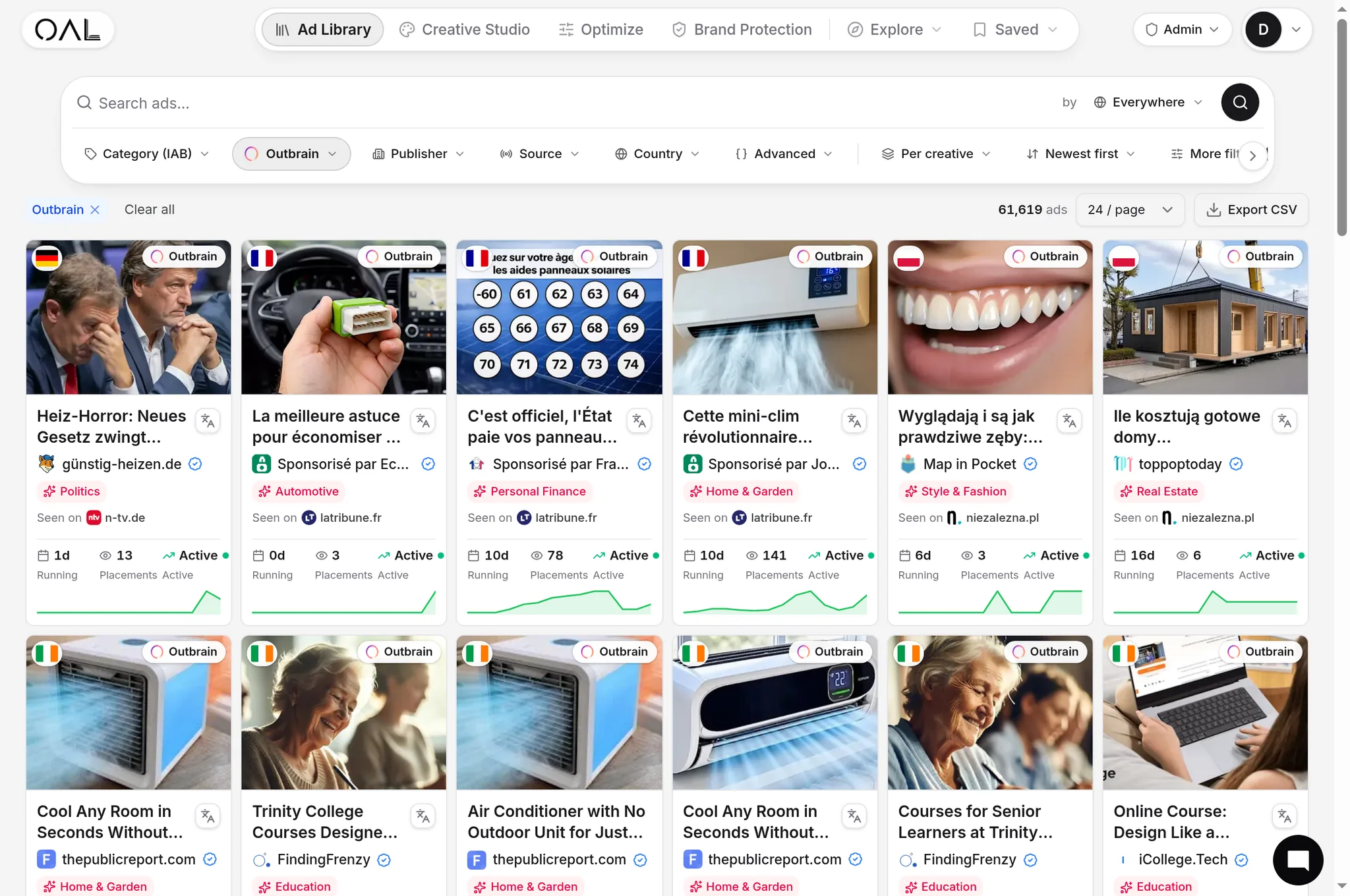
For each Outbrain creative record, the archive can include the following; fields can be missing or uncertain:
Full-quality creative and headline as served, not a thumbnail. The resolved advertiser behind the placement, important on Outbrain, where the widget byline is often a vague publisher-style name like "Health Weekly" that does not tell you who is paying; resolution can be uncertain. Observed history: first-seen to last-seen dates from repeated capture. These show when a creative was seen, not continuous delivery, spend or profit; see what ad longevity can and cannot show. Traced landing page: we follow the redirect chain to the destination without clicking live ads. Geo and device context, and a category label where the record has been classified.
Two real entries. First, SmartAsset's IRA angle, the longest-observed finance creative in our early July 2026 Outbrain records, seen across 30 days:

Second, a classic curiosity-gap format: this kitchenware advertorial hook had been observed over 17 days at capture. The capture does not verify its claim:

The longest-observed Outbrain creative in that early July 2026 snapshot was a home-and-garden advertorial ("Retiree Was Tired of Cyclists Cutting Through His Yard—So He Designed the Perfect Trap") at 31 days. That shows repeated observation, not how much it was tested or whether it worked.
Outbrain records by category (early July 2026)#
Classified Outbrain records by category in the early July 2026 snapshot. These are counts of collected records with a category label, not shares of Outbrain's demand or spend:
| Category | Classified Outbrain records (early July 2026) |
|---|---|
| Insurance | 2,998 |
| Finance | 2,912 |
| Health | 2,224 |
| Ecommerce | 1,629 |
| Software | 1,328 |
| Home & garden | 1,201 |
Insurance and finance were the largest classified categories in these Outbrain records, nearly tied, while health led among our Taboola records. That is a difference in the collection, which can reflect coverage as well as demand; it does not show that Outbrain attracts more financial-services demand, that its demand concentrates where payouts are highest, or that an insurance buyer has a complete competitive map. Advertisers with many Outbrain records included EpiCooler (1,203 distinct creatives) and Weedmaps (893), and the snapshot included 441 creatives labelled "Anzeige" (German for "advertisement") and 1,139 with Hebrew labels, so the collection includes non-English placements. Record counts are not spend. For the cross-network advertiser view, see Top Native Advertisers on Taboola, Outbrain & MGID.
How to research advertisers on Outbrain#
Look up an advertiser. With the Founders plan, search a brand and see the Outbrain creatives we have captured from it, with dates, geos and landing pages. This is the query an official library would answer, and one Outbrain's help docs cannot. Sort a category by observation history. Filter to your category and geo and sort by days observed to find examples worth inspecting. Long-observed creatives such as SmartAsset's 30-day IRA ad are leads, not proven angles: observation history does not show profit. Follow the click. Outbrain funnels may use advertorials and pre-landers, and the captured landing page shows the offer, price and compliance language. Our funnel reverse-engineering guide covers reading these end to end. Compare against Taboola. The same advertiser may run different creative sets on both networks. Comparing both sides of the archive shows where its creatives were observed, not where its budget sits, and missing records can be capture gaps. The method is laid out in Taboola vs Outbrain. Automate it. On the Founders plan, the REST API and hosted MCP server let your scripts or AI agents query the Outbrain records directly.
If you first need grounding in how the network works — the DSP side, publisher placements, bidding — start with How Outbrain Works in 2026.
A worked example: reading an Outbrain advertorial funnel#
Here is what one archive lookup produces in practice. Start from the SmartAsset creative above, the "Ask a Pro" IRA-tax angle observed across 30 days.
First, the advertiser view: searching SmartAsset returns its captured Outbrain creative set, and the headlines follow a familiar financial-services pattern: question-format hooks ("How Can I Avoid..."), age- and asset-bracket qualifiers, and an authority frame ("Ask a Pro") that presents the advisory service before the click. A longer observation span for one variant than for its siblings tells you which formulation was seen longest, not which one won.
Second, the funnel trace: the captured landing path shows whether the click lands on a direct offer page or an advertorial pre-lander that warms the reader before the conversion form. Reading three or four competitors' funnels side by side shows common structures in the category: how long the pre-landers run, where the form sits, what compliance language appears and which trust signals they lead with. That is useful research, but the archive does not show which structure performed or what the advertisers paid to reach it.
Third, the cross-network check: the same search on the Taboola side of the archive shows whether the advertiser was observed running the same angle there, a different one, or nothing. An angle seen on both networks is worth testing; an angle seen only on Outbrain may reflect a deliberate choice or a capture gap. Neither tells you how it performed.
First-seen dates in the early July 2026 snapshot#
Of the 92,290 Outbrain creative records in the early July 2026 snapshot, 91,341 (99%) were first captured within the preceding 30 days. That figure says more about the collection than about the network.
The collection window opened on June 2, 2026, about a month before this snapshot, so nearly every record was bound to be first seen within 30 days. The figure therefore does not measure how fast Outbrain advertisers replace creatives. Native creatives do rotate, but this snapshot cannot show how fast; the trade-off is that the archive covers recent history, not multi-year archaeology.
The same applies to comparisons: Outbrain's 99% and Taboola's 98% first-seen-within-30-days shares mainly reflect the shared collection window, not similar churn on the two networks.
What this replaces (and what it costs)#
Before independent libraries, seeing Outbrain at this resolution meant either manual fieldwork, browsing publisher sites in different geos on different devices behind VPNs and screenshotting widgets, or a paid spy-tool subscription. Established native tools list monthly prices from $79.99 (Anstrex Native) to $249 (AdPlexity Native), checked October 7, 2026. We discuss them in Best Native Ad Spy Tools in 2026; OpenAdLibrary sells a competing product, so read that comparison with that interest in mind.
OpenAdLibrary's free plan ($0, no card) shows the 20 newest Meta, TikTok and native ads, plus ad detail with the supply chain, redirect trail and captured landing pages for native ads. Searching and filtering the Outbrain records, saved research and the API require the Founders plan ($29.99/month), which covers the other networks in the archive too, so the Outbrain view is not sold as a separate product.
The brand-side use case#
Media buyers are the obvious audience for an Outbrain archive, but brands can use it defensively. Outbrain widgets appear on many news sites, which makes them a place where a brand's reputation problems can become visible. Three searches worth running if you manage a brand (search requires the Founders plan):
Your brand name. Surfaces affiliates running unauthorized angles on your product, review-style advertorials trading on your name, and possible impersonation. Because the archive keeps creatives with dates and landing traces, what you find is dated evidence, not just a sighting. Your product category plus your claims. Competitors' advertorials sometimes benchmark against the category leader by name. If that is you, you want to know the framing before your customers quote it back to you. Your executives or spokespeople. If someone fabricates an endorsement from them, finding it early, with the landing page captured, gives you material for a takedown request; this article has no evidence on how often that happens on Outbrain compared with other networks.
None of these searches is possible against the network itself, because we found nothing official to search. That asymmetry, more than any media-buying edge, is the public-interest case for independent ad libraries.
Honest limitations#
A deep window, not omniscience. We observe public placements repeatedly across publishers, geos and devices, but no outside observer sees every Outbrain impression everywhere, and thin geos and niche publishers mean blind spots. The early July 2026 count of 92,290 records is a sample, not a census. Observation history is a floor. "Observed 30 days" means the collection saw it across that period; the ad may predate our first capture, and the window available in early July 2026 was about a month. No spend, no performance metrics. We do not display CTRs, conversions or budget estimates, because we do not have them and will not fabricate them. What we show is captured, not modeled. English-heavy, not English-only. The archive includes many non-English creatives, but coverage depth varies by market and language.
Library vs. spy tool#
The library answers "what was observed on Outbrain": browse, search, cite. The Outbrain ad spy tool layered on top answers "how do I act on it": saved competitor groups, new-advertiser and spike detection, and Creative Studio for building your own creative. Both read from the same archive. The free plan (no card) shows the 20 newest captured Meta, TikTok and native ads; searching for an Outbrain advertiser requires the Founders plan.
The bottom line#
Outbrain, now operating as Teads, offers no public ad library that we could find, so transparency comes from independent observation instead. In the early July 2026 snapshot, our archive held 92,290 Outbrain creative records, most first seen in the preceding month because collection had begun on June 2, 2026, each with a resolved advertiser where available, observation dates, geo and device facets and a traced landing page. That is a useful research surface for mapping an advertiser's observed creatives, finding examples to inspect and reading the funnel behind a headline; it does not show which angles were profitable, so test before you spend.