Español
 Português (Brasil)
 Français
 Deutsch
 Italiano
 Nederlands
 Polski
 Svenska
 Türkçe
 Русский
 日本語
日本語 한국어
한국어 简体中文
简体中文 Tiếng Việt
 Bahasa Indonesia
 繁體中文
繁體中文 Čeština
 Dansk
Dansk Suomi
Suomi Ελληνικά
 Română
 Magyar
 Українська
 ไทย
ไทย हिन्दी
 العربية
 עברית
עבריתOutbrain for Ecommerce: Formats, Costs & Category Data
Outbrain can work for ecommerce, but it's a discovery channel built for curiosity-driven creative, not purchase-intent traffic. Here's what formats, angles, and tracking setups actually hold up.

Outbrain works for ecommerce, but it's a discovery and retargeting-adjacent channel, not a direct-response search replacement, and the products that do best on it are ones with a strong visual hook and a story angle rather than a straightforward "buy now" pitch. If you're moving budget from Meta or Google Shopping and expecting the same purchase-intent behavior, you'll be disappointed; if you go in understanding the format is native discovery, it can be a genuinely profitable addition to the mix.
Where Outbrain fits in an ecommerce media plan#
Outbrain places your ad as a recommended-content widget on premium publisher sites, usually below an article or alongside other "you might also like" content. The person clicking wasn't looking to buy anything. They were reading news, sports, or entertainment content, and something in your headline or image interrupted that.
That changes what "works" means. High-intent bottom-funnel product ads (think a simple product-shot-plus-price creative) tend to underperform on Outbrain relative to how they'd do on a shopping-intent channel like Google Shopping. What tends to work better is a curiosity-driven or advertorial-style angle: a headline built around a problem, a story, or a surprising claim, that leads into content (often a pre-lander) before the product pitch. Ecommerce brands running Outbrain well usually treat it more like a top-of-funnel or mid-funnel channel and build their attribution windows accordingly, rather than expecting last-click ROAS parity with paid search.
Across the OpenAdLibrary index, ecommerce sits well behind Outbrain's largest verticals: insurance, finance, and health lead the platform with 4,345, 3,990, and 3,102 classified live creatives respectively, while ecommerce holds 2,277. That's not a warning sign so much as a description of where the marketplace's gravity is: Outbrain is publisher inventory dominated by finance and health advertorial content, and ecommerce is a smaller but real slice of it.
Formats that work for product ads on Outbrain#
Image + headline widgets are the default and still the most common format advertisers use. The image needs to survive being shown at thumbnail size next to a dozen competing headlines, which means product-on-white-background shots (fine for a marketplace listing) usually underperform lifestyle or in-context shots.
Video widgets exist on Outbrain inventory and can work for ecommerce, particularly for products that benefit from a demonstration (how something is used, assembled, or worn). Video creative takes longer to produce, so it's usually a second-phase investment after image creative has proven the offer works.
Motion or carousel-style units are available on some inventory and give you more visual real estate than a static image, which helps for products where a single frame doesn't do the job.
Whichever format, the headline carries most of the weight. Native headline formulas that lean on curiosity, specificity, or a mild claim tend to outperform generic promotional copy; our native ad headlines piece breaks down the patterns that show up repeatedly across live creatives if you want a starting point.
Costs: what to actually expect#
Outbrain doesn't publish a rate card, and costs move a lot by geo, vertical, and device. Media buyers commonly report Tier-1 desktop CPCs somewhere in the range of a few tens of cents up to around a dollar for competitive ecommerce categories, with mobile often running cheaper but converting at a lower rate. Treat any number you read (including this one) as a starting assumption to test against, not a guarantee; your specific product, creative, and geo will move it substantially. For a broader view across networks, how much do native ads cost covers budgeting more generally, and native ads CPC benchmarks puts Outbrain next to Taboola, MGID, and Revcontent.
Because native traffic isn't purchase-intent traffic the way search is, plan your unit economics around a longer attribution window and a lower immediate conversion rate than you'd budget for on Google Shopping. Some ecommerce advertisers run Outbrain explicitly as a top-of-funnel driver that feeds retargeting on other channels, rather than expecting it to close the sale on the first click.
Which ecommerce products tend to do well#
Products with a visual transformation or before/after story (skincare, home organization, fitness gear) translate naturally into native creative because the format rewards a hook. Products that solve an obvious, relatable annoyance (a gadget, a household fix) also do well because the headline can be built around the problem rather than the product.
Straightforward commodity products with no differentiated story, sold mostly on price, are a harder fit. Someone scrolling news content isn't in comparison-shopping mode, so a generic "20% off" creative has to work much harder than it would in a Google Shopping result where the person already searched for that exact item.
Tracking and attribution for Outbrain ecommerce campaigns#
Set up your conversion tracking before you spend meaningfully, and make sure your pixel or postback captures both purchase value and time-to-conversion, since native traffic often converts on a delay rather than same-session. If your platform only reports last-click, same-session conversions, you'll systematically undercount Outbrain's actual contribution and pull budget prematurely.
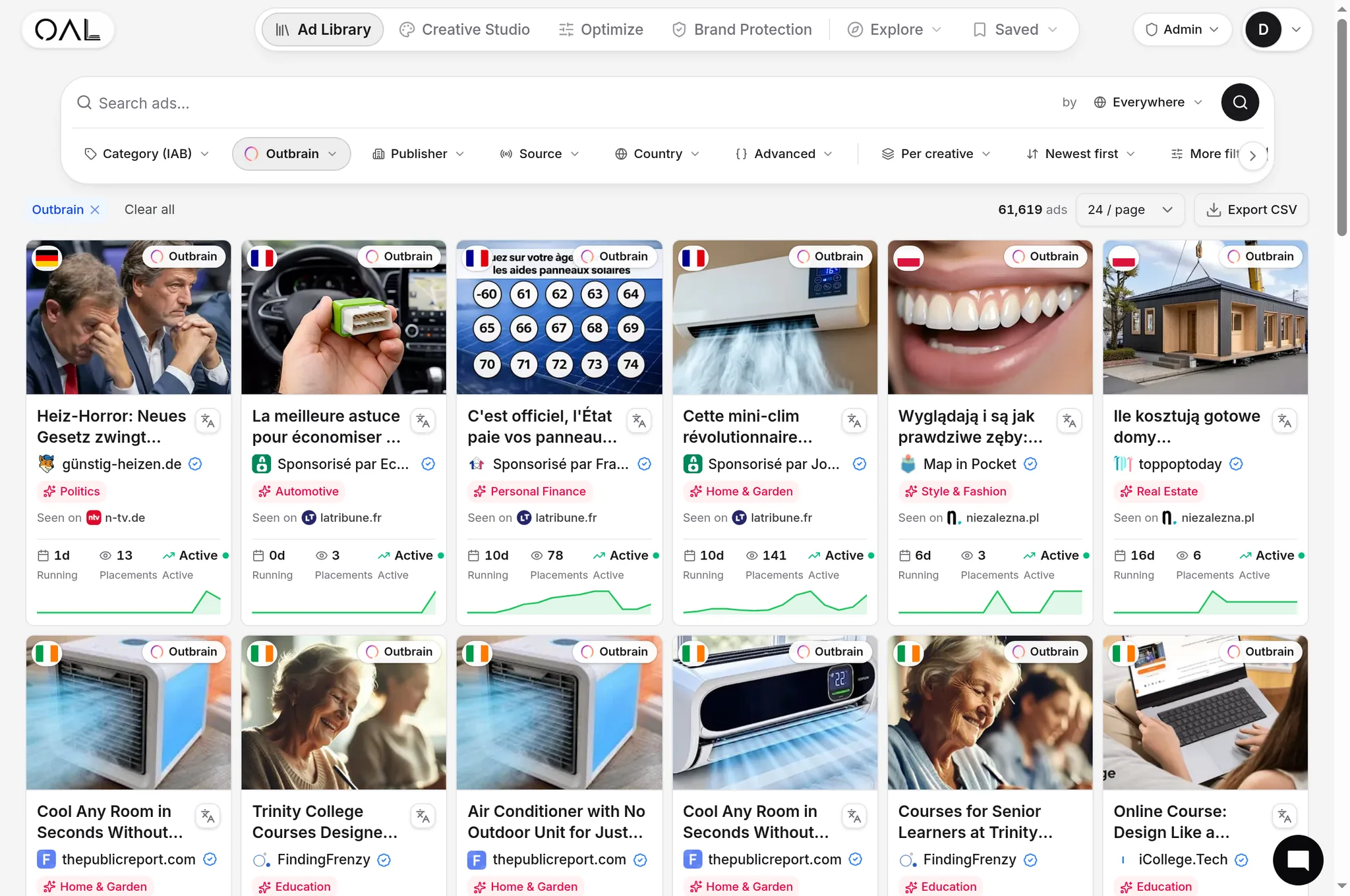
It's also worth checking what else is running in your category before you launch. Seeing which ecommerce advertisers are already active on Outbrain, and for how long, tells you whether the format is proven in your specific niche or genuinely untested there.
A testing framework that respects the format#
Start with 3-5 creative concepts built around distinct angles (a problem, a curiosity hook, a transformation story, a straightforward offer) rather than 3-5 variations of the same angle with different colors. Outbrain's algorithm needs signal to differentiate winners, and near-identical creative variants just split your data thin without telling you anything about which angle actually works.
Give each concept enough spend to reach a meaningful sample before judging it. A few dozen clicks tells you almost nothing about conversion rate; wait for enough volume that the difference between your best and worst performer isn't just noise. This is slower than most advertisers want it to be, especially coming from platforms with faster feedback loops, but rushing the read is the single most common way ecommerce advertisers write off Outbrain as "not working" when the real problem was judging results too early.
Once you have a working angle, resist the urge to scale it by simply raising budget. Native inventory has a ceiling; push spend past what the available publisher inventory can absorb at your bid and your effective CPC climbs while volume plateaus. Scaling on Outbrain usually means adding new creative variations of the winning angle and, where available, new geos, rather than just turning up one campaign's budget.
Common mistakes ecommerce advertisers make on Outbrain#
Treating it like a Google Shopping feed. Product-only creative with no angle gets buried next to editorial content it doesn't resemble. The ad needs to look like it belongs on the page, at least enough to earn the click, before it can sell anything.
Judging performance on same-day numbers. As covered above, native conversions often lag the click by hours or days. A campaign that looks dead on day one can be perfectly healthy once the delayed conversions land.
Skipping the pre-lander. Sending native clicks straight to a standard product page usually converts worse than routing through a short piece of content, or a pre-lander, that bridges the curiosity of the ad to the commercial intent of the product page. This is especially true for higher-consideration products where a cold click benefits from some context before being asked to buy.
Ignoring device split. Outbrain inventory spans desktop and mobile, and ecommerce conversion behavior often differs sharply between the two. Reviewing performance by device, not just in aggregate, usually surfaces optimization opportunities that a blended view hides.
How OpenAdLibrary helps#
OpenAdLibrary's index tracks live Outbrain creatives by vertical, so before committing budget you can check whether ecommerce brands similar to yours are running (and for how long) on the network. Long-running creative is a reasonable proxy for profitability, since nobody keeps paying for an ad that loses money. The /spy/outbrain tool lets you filter by vertical and see actual live examples rather than guessing from general best-practice advice.
If Outbrain doesn't end up being the right fit for your specific product, it's worth comparing against other networks rather than assuming native as a category doesn't work; our best native ad networks for ecommerce roundup and native advertising for ecommerce guide both cover the wider landscape, and pricing plans for deeper research tooling are on our pricing page.