Native Ads for Small Blogs: What They Actually Pay
Most premium display networks won't take a blog under 100k monthly views. Here's what native widget networks pay instead, and what actually moves the RPM needle before your traffic does.


Most premium display networks won't take a blog under 100k monthly views. Here's what native widget networks pay instead, and what actually moves the RPM needle before your traffic does.

Tier-2 native networks are generally smaller than Taboola or Outbrain, which cuts both ways. How that looks in our capture counts (not an inventory measure), when a smaller network may pay off, and how to test one safely.

There's no published Revcontent rate card. Here's how the bid auction, floors and geo tiers shape what you pay, with commonly reported, unofficial CPC ranges to plan around.

Revcontent isn't a smaller Taboola. It's a different audience with its own prominent verticals, its own review quirks, and its own budget math for affiliates.

Revcontent's published policies and denial reasons point to recurring, fixable problems: restricted imagery such as before-and-after images, missing disclosures, or a landing page that doesn't match the ad. Here's how to fix them.

Revcontent traffic quality is inconsistent by placement and vertical: some placements may convert well, others deliver volume with weak intent. Here is how to tell them apart in your own data before you spend.

An illustrative $500 test plan for native ads: one network, one geo, one device, measured as data rather than profit. What $500 can and cannot measure, what to check per network, and kill-or-fund rules.

How to compare native ad costs on a $500 budget: deposits, daily minimums, actual CPC and conversion economics by network. No network is cheapest for every account, so here is how to spend a small budget without burning it.

The join key between your ad spend and your conversions is a macro. Here are the Taboola macros most buyers use, the Outbrain, MGID and Revcontent equivalents, and the template mistakes that quietly break tracking.

Native ad rejections often happen at the landing page, not just the creative. Here is what reviewers on Taboola, Outbrain, MGID and Revcontent actually check, and a pre-submission checklist to reduce first-review rejections.

Is Revcontent worth a test? What the 15,789 Revcontent ads we had captured by July 2026 and the network's published terms show about its advertisers, pricing, strengths and weak spots, with the limits of captured ads.

Revcontent publishes no rate card, and its auction weighs your creative's click performance alongside your bid. Here are the deposit mechanics, hypothetical CPC inputs for planning, and budget math for a test that can conclude.

Taboola and Outbrain are graduation targets, not starting points. Here are the native ad networks that realistically accept small publishers, what demand you'll actually serve, and the checks to run before you embed a widget.

Native networks restrict deceptive health claims on paper, and how they treat nutra offers differs by network. A guide to comparing nutra rules; captured health ads are examples, not proof an ad was approved or compliant.

Revcontent's documented publisher requirements (no published traffic minimum), what drives RPM, disclosure and payment terms, and the vertical mix in a July 2026 snapshot of 15,789 captured Revcontent ads.

Taboola, Outbrain (Teads), Revcontent, MediaGo, Microsoft Audience Network, Yahoo, Dianomi and TripleLift: eight MGID alternatives compared by captured-ad counts (July), entry bars and fit guidance.

Distinguish deposits, billing thresholds and campaign floors, then verify account terms and budget a test separately.

Your first native bid should buy data, not margin. How to plan an initial bid on Taboola, Outbrain, MGID or Revcontent from your allowable acquisition cost, current account guidance and explicit assumptions, then adjust.

A guide to the main native advertising platforms (Taboola, Outbrain (Teads), MGID, Revcontent, Microsoft Audience Network, MediaGo, Yahoo), the buying questions to ask each, and what public creative counts cannot establish.

Revcontent's minimum is now $50 a day per campaign, down from $100, and it works as a filter, not a fee. What the minimum covers, the arithmetic of a meaningful test, and when to start where entry costs fit your budget.

Revcontent's current budget minimum, targeting and CTR guidance, what historical ad captures can and cannot show, and who should test it or skip it.

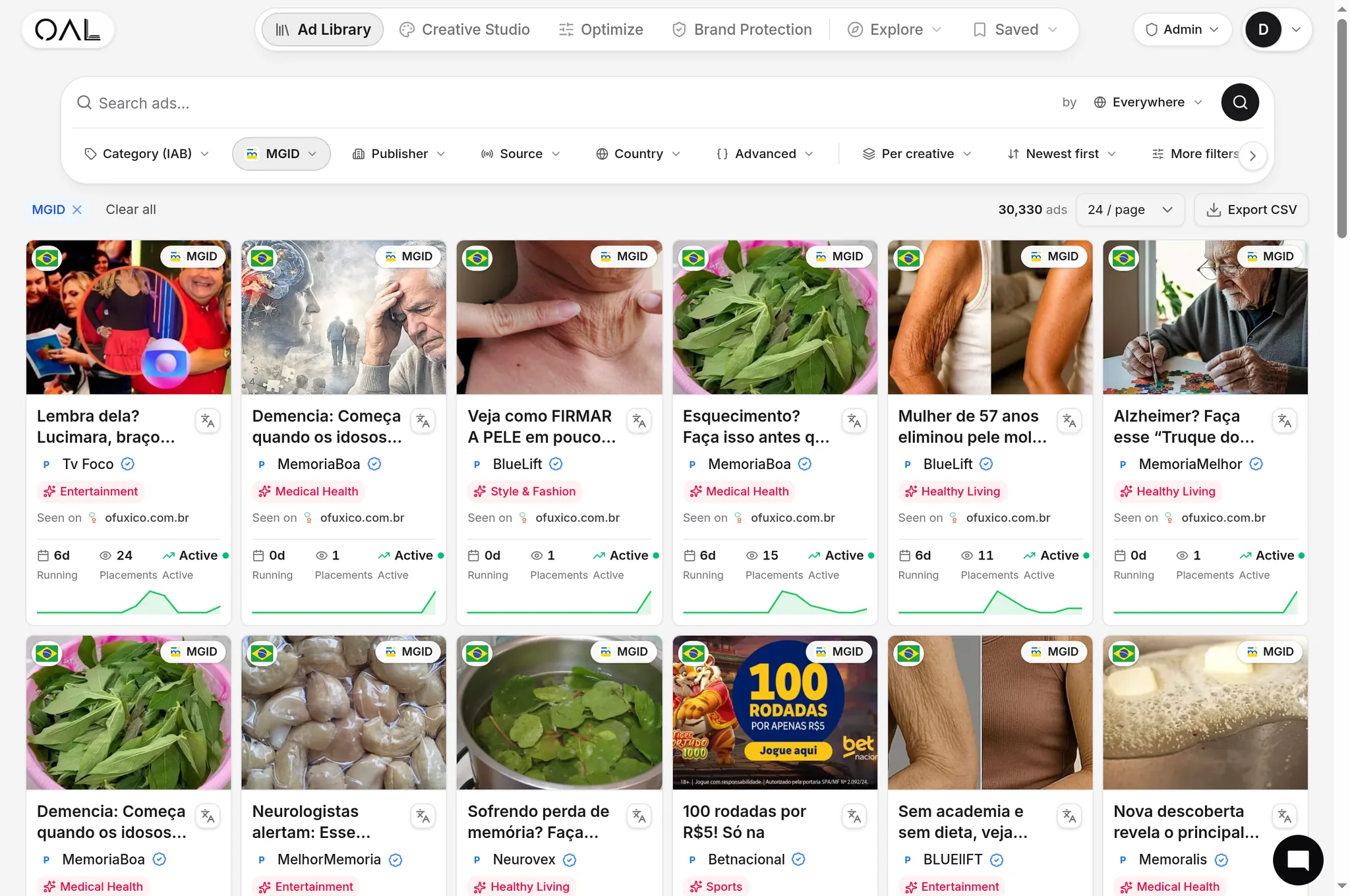
Live capture data on the advertiser mix across MGID, Revcontent and MediaGo: the verticals, the named advertisers, and the five archetypes that dominate mid-tier native networks.

Outbrain (now Teads), MGID, Revcontent, MediaGo, the Microsoft Audience Network and five more Taboola alternatives: what each offers, what each network documents about access and cost, and what to check before testing.

We found no first-party RevContent ad library. What a July 2026 snapshot of 14,735 captured RevContent creatives showed by vertical label, the advertorial funnels in the captures, and what the counts cannot show.

Research that stops at Taboola and Outbrain can miss campaigns on MGID and Revcontent. How to record captured ads, check any tool's coverage, and read run time, geo and landing pages without overclaiming.

How to evaluate Taboola, Teads (Outbrain), MGID and Revcontent for ecommerce by eligibility, inventory, measurement and your own product economics. Captured ads show examples, not where your product type has proven demand.

This guide supplies no network CPC averages. It shows how to judge a reported native CPC benchmark by its source, period and sample, and how to build your own baseline from cost per outcome.

Published minimum budgets for Taboola, Outbrain, MGID and Revcontent, plus break-even CPC and CPA math and test sizing without invented averages.

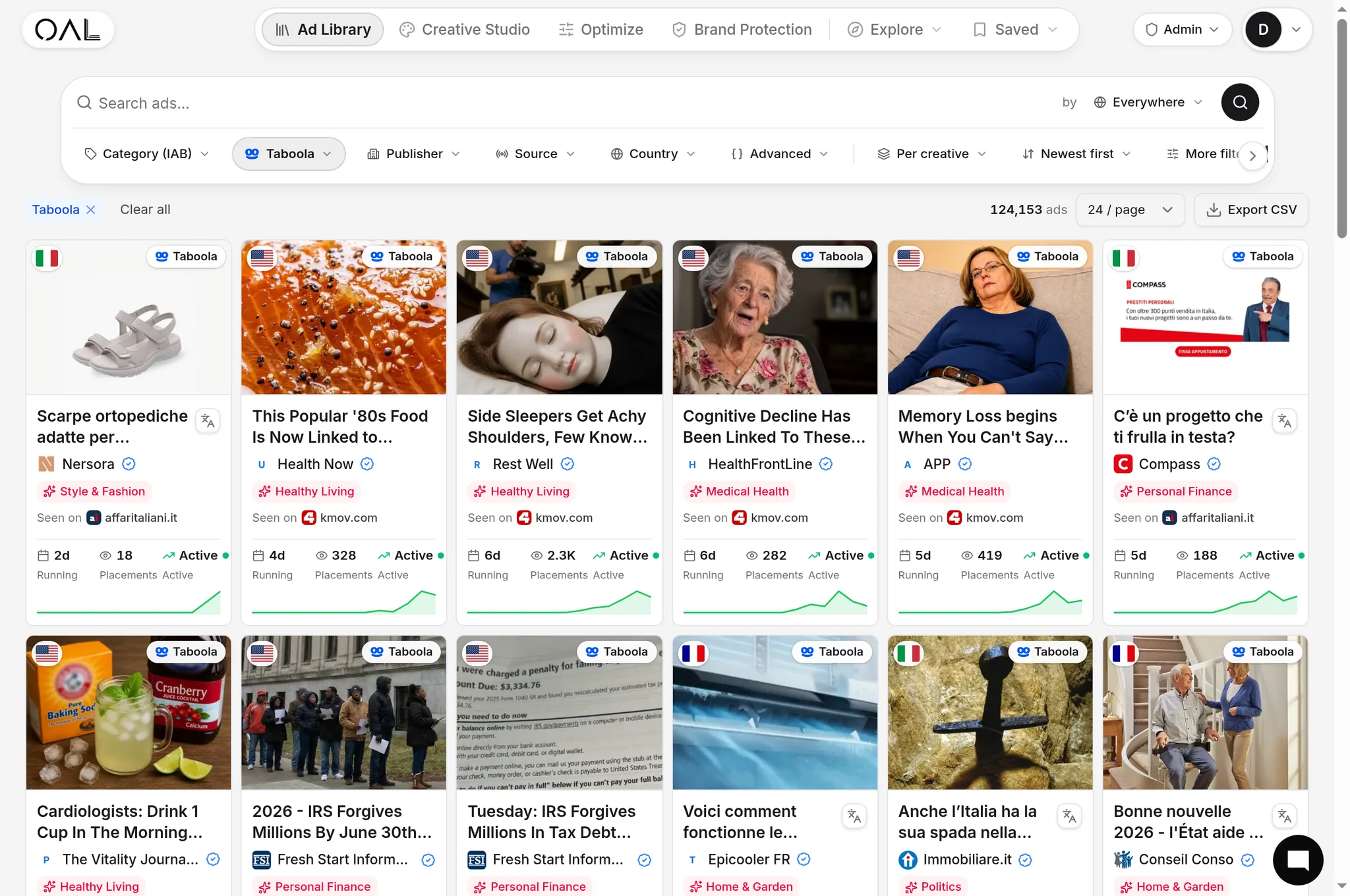
Self-reported reach, documented entry budgets and advertiser mix for Revcontent and Taboola, using a June 2026 snapshot of captured ads (157,727 Taboola creatives vs 11,478 Revcontent; coverage, not market size).

A comparison of MGID and Revcontent for affiliates, built on each network's own published terms and the largest classified categories in our June captures, with steps to check both networks yourself.

Revcontent serves native ads through publisher widgets you bid on one by one, and here is how its delivery, site-level targeting, CPC bidding and optimization levers actually work, with real captured ads.

How to compare native ad networks on eligibility, available inventory, measurement and your own campaign economics. Captured creative counts describe our coverage and do not predict campaign results.