Español
 Português (Brasil)
 Français
 Deutsch
 Italiano
 Nederlands
 Polski
 Svenska
 Türkçe
 Русский
 日本語
日本語 한국어
한국어 简体中文
简体中文 Tiếng Việt
 Bahasa Indonesia
 繁體中文
繁體中文 Čeština
 Dansk
Dansk Norsk (bokmål)
 Suomi
Suomi Ελληνικά
 Română
 Magyar
 Українська
 ไทย
ไทย हिन्दी
 العربية
 עברית
עבריתThe Cheapest Native Ad Networks for a $500 Starter Budget
MGID and Revcontent will take your $500 seriously; Taboola mostly won't notice it. Where starter budgets actually go furthest in native — and how to spend one without burning it.


MGID and Revcontent are usually the cheapest native ad networks to start on: entry deposits in the low hundreds of dollars, low CPC floors, and self-serve onboarding — against the larger commitments and higher clearing prices media buyers commonly report on Taboola and Outbrain. But the bigger cost lever is not the network, it is the geo: the same offer can cost several times more per click in the US than in Tier-2 markets. Here is how to pick the right cheap network for a $500 starter budget, and how to spend that budget without simply donating it.
What "cheapest" actually means#
Four different price tags hide behind the word:
- Minimum deposit — what it takes to open an account and fund it.
- CPC floors and clearing prices — the minimum bid the network accepts, and what winning traffic actually costs in your geo and vertical.
- Minimum daily budget per campaign — small on its own, but it multiplies across the campaign-per-geo-per-device structure you actually need.
- Effective cost per real click — what you pay per human, converting visitor after junk placements take their cut.
Networks compete on the first number because it is the one on the pricing page. You should optimize for the fourth. For the broader budgeting picture, start with how much native ads cost; for current market pricing patterns, the native CPC benchmarks piece covers the majors.
The cheap tier: MGID and Revcontent#
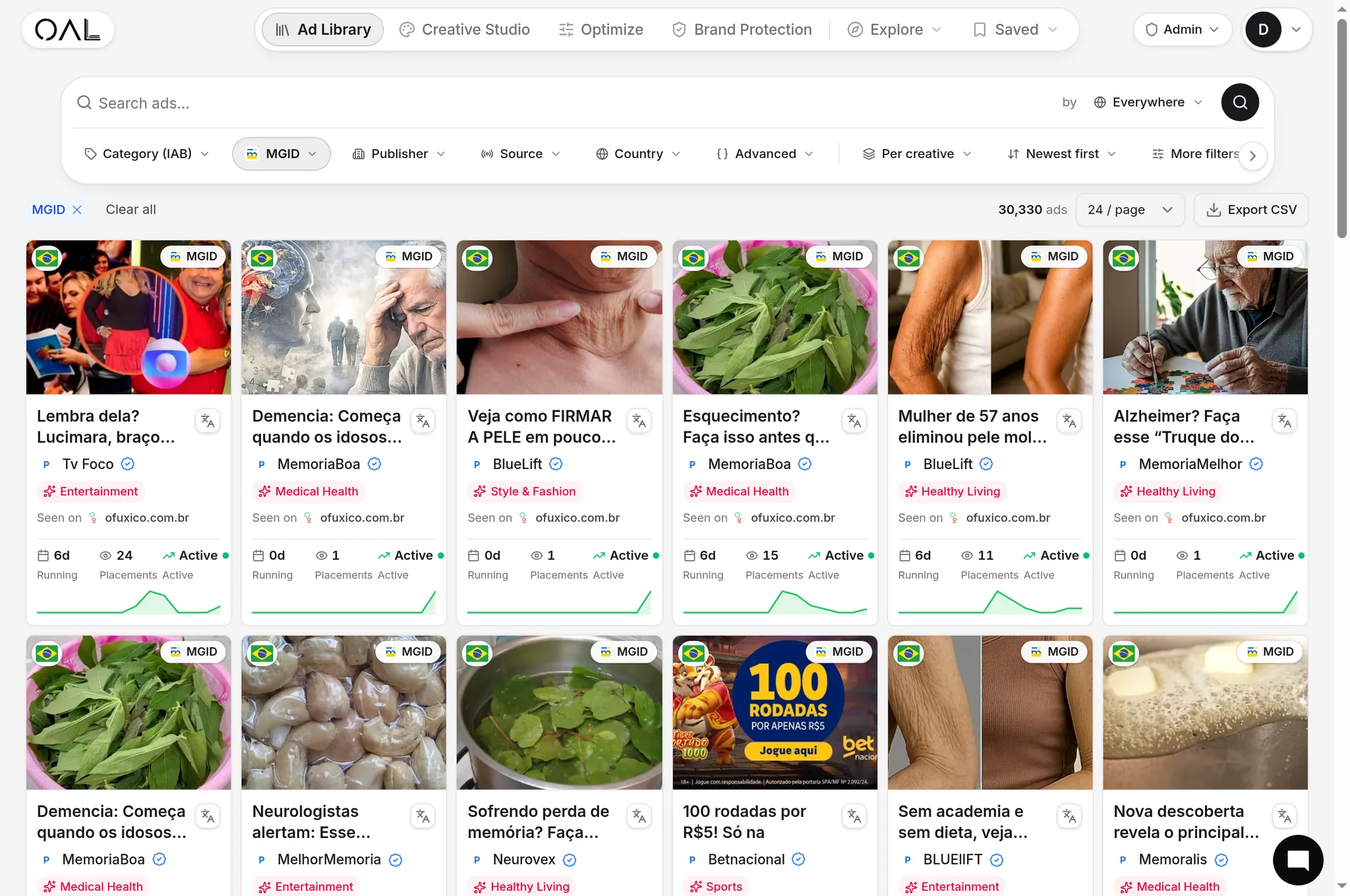
MGID is the default answer to "cheapest native network that is still a real network." Deposits in the low hundreds of dollars are typical (current promotions change — check the network's terms), campaign minimums are forgiving, and CPC floors sit in the low cents for many geos, by common report. The demand on it is real: OpenAdLibrary observes 62,765 live MGID creatives (July 2026), with entertainment dominating the classified mix at 13,987 creatives, followed by health. That mix tells you what converts there — curiosity-driven, mass-audience offers rather than premium B2B. How MGID works covers formats and targeting.
Revcontent runs a similar starter-friendly model with a smaller but more health-weighted demand pool — 15,789 live creatives in our index, with health its largest classified vertical. Buyers commonly report Tier-1 CPCs meaningfully below Taboola's for comparable placements. See how Revcontent works, and the direct comparison in MGID vs Revcontent.
Both networks give you widget-level reporting and blocking, which is non-negotiable at this end of the market. And before depositing anywhere, look at what is actually running: browse the live MGID ads and live Revcontent ads in your vertical. If nobody is sustaining spend on offers like yours, that absence is information.
Why Taboola and Outbrain usually are not starter networks#
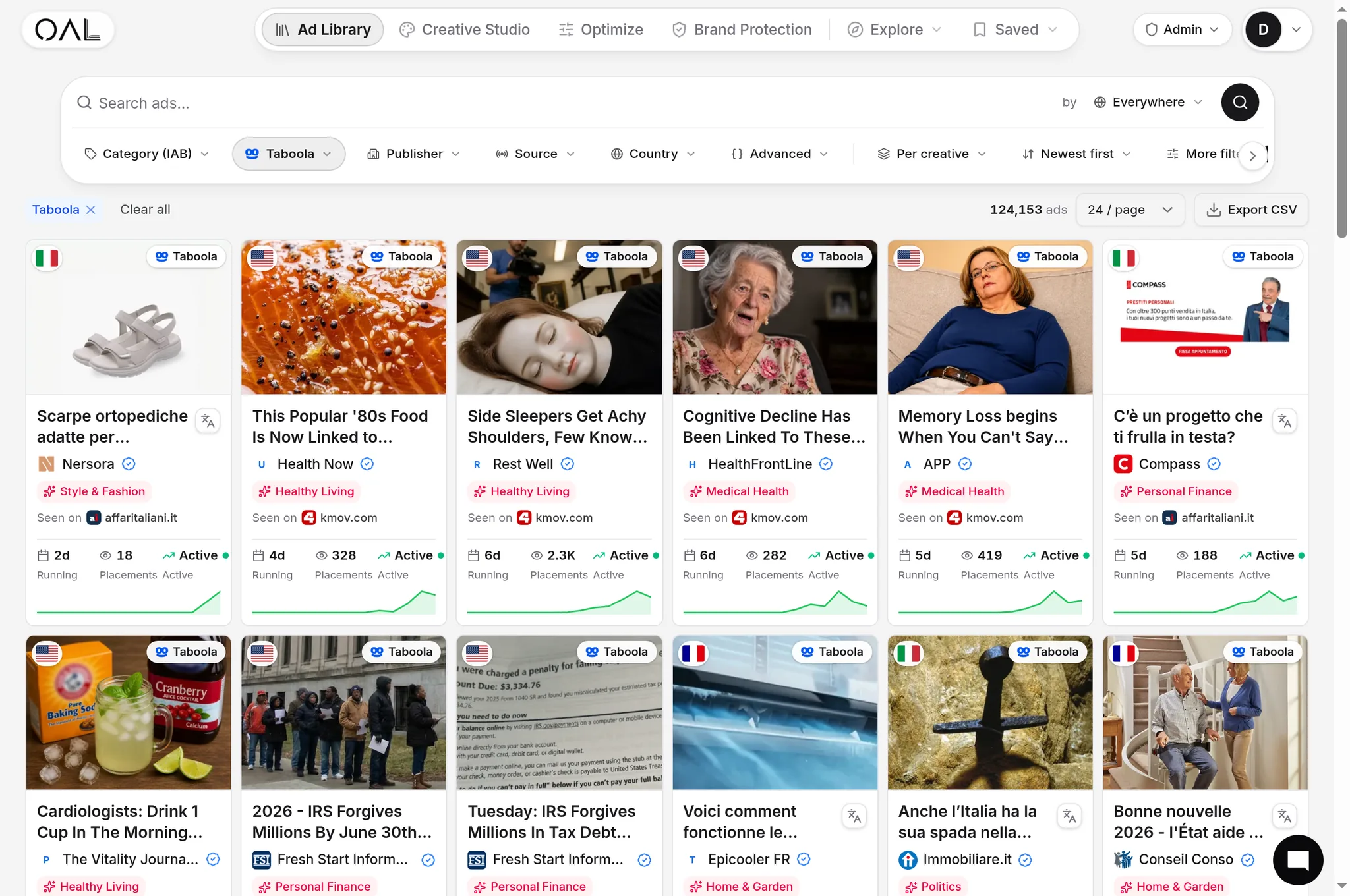
Not because they are bad — because their economics assume budget. Both commonly expect larger initial commitments, their minimum daily budgets add up across the campaigns you actually need, and their Tier-1 clearing prices run higher: media buyers commonly report Tier-1 desktop CPCs from roughly $0.30 to $0.90 on the majors, with mid-tier networks often clearing at a third to half of that. Your vertical and geo move these numbers a lot — treat them as practitioner anecdotes, not rate cards.
The arithmetic is what matters. On $500, a $0.60 CPC buys you roughly 800 clicks — not enough to test placements and creatives and geos simultaneously. At $0.15 you get about 3,300 clicks, which is a real dataset. Learning per dollar favors the cheap networks even when their traffic converts worse, and you can graduate later with proven creative. MGID vs Taboola breaks down when that graduation makes sense.
The geo lever is bigger than the network lever#
Every network prices by geography, and the spread across geo tiers is wider than the spread between networks. Tier-2 markets commonly clear at a fraction of US prices and Tier-3 clicks can cost single cents, by common report. Cheap clicks only help if your offer monetizes there — payouts scale down with the geo too.
Two starter patterns work reliably:
- Cheap network, Tier-1 geo. Take the US, UK or Australia traffic on MGID or Revcontent and prune placements hard. Higher CPC, but your offer's full payout applies.
- Proven offer, Tier-2 geo. Find an offer that explicitly accepts a cheaper geo and buy that geo's traffic at a fraction of the price. Scaling to new geos covers how to find the underpriced pockets.
What does not work is cheap network plus Tier-3 geo plus an offer built for Americans — the clicks cost pennies and are worth less.
What $500 realistically buys#
Using the commonly reported ranges above — anecdotes, not rate cards — the arithmetic per scenario looks like this:
| Scenario | Illustrative CPC | Clicks per $500 | What that can actually test |
|---|---|---|---|
| Major network, Tier-1 desktop | ~$0.60 | ~800 | One offer, one or two creatives — thin |
| Mid-tier network, Tier-1 | ~$0.15–0.30 | ~1,700–3,300 | A placement spread plus 3–5 creatives |
| Mid-tier network, Tier-2 | ~$0.05–0.10 | ~5,000–10,000 | Placements, creatives and a pre-lander split |
The lesson is not "cheaper is always better." Your budget's job is to buy statistically usable data, and click count is the sample size. A test that cannot afford enough clicks per placement to judge anything honestly ends as a coin flip that cost $500 — which is the real argument against starting on the expensive networks, independent of their quality.
The $500 playbook#
- Spend research time before money. The cheapest part of your budget is the part you replace with someone else's spend: study which angles have already survived in your vertical — finding winning native ad angles is the method.
- One network, one geo, one offer. Every additional variable divides your data until none of it means anything.
- Launch 3–5 creatives from proven angle families, not blind guesses.
- Bid just above the floor. Raise bids only on placements that convert, never account-wide.
- Prune placements daily. A common heuristic: cut any widget that has spent two to three times your target CPA with nothing back. This is where the budget actually gets saved.
- Track from the first click. A tracker with click-ID macros wired up, or your $500 teaches you nothing — the media buying for native ads guide covers the setup.
- Expect data, not profit. The realistic win at $500 is one placement-creative-offer combination near breakeven. Scaling it is the next budget's job.
The hidden costs of the cheapest clicks#
Every network's cheap end carries junk — widgets with accidental-click layouts, incentivized-traffic sites, and worse. The junk has recognizable signatures: placements with unusually high CTR and zero conversions, traffic spikes at odd hours from a single widget, and sessions that bounce faster than a human could read your headline. None of this is unique to cheap networks, but its share grows as the price falls, which is why the placement report — not the campaign report — is where cheap-traffic buying is won.
You pay for the junk either way: in the spread between raw clicks and real sessions, or in the daily minutes spent pruning. Budget for a tracker subscription and treat aggressive placement blacklisting as part of the click price. The cheapest network with no tracking attached is the most expensive education in media buying.
The bottom line#
Start on MGID or Revcontent, in one geo, with one offer and a tracker wired before the first click. Let the leaderboard of what already runs — not the pricing page — pick your vertical and angle. One more habit separates buyers who graduate from those who quit: write down what each placement, creative and geo taught you before moving budget. The campaigns that later scale are built from those notes, not from memory. Cheap networks are where you buy your education; make sure $500 buys the full course rather than the first lesson repeated ten times.