Español
 Português (Brasil)
 Français
 Deutsch
 Italiano
 Nederlands
 Polski
 Svenska
 Türkçe
 Русский
 日本語
日本語 한국어
한국어 简体中文
简体中文 Tiếng Việt
 Bahasa Indonesia
 繁體中文
繁體中文 Čeština
 Dansk
Dansk Norsk (bokmål)
 Suomi
Suomi Ελληνικά
 Română
 Magyar
 Українська
 ไทย
ไทย हिन्दी
 العربية
 עברית
עבריתRevcontent for Affiliate Marketing: Verticals That Still Work
Revcontent isn't a smaller Taboola. It's a different audience with its own winning verticals, its own review quirks, and its own budget math for affiliates.


Revcontent works for affiliate marketing in a narrower band of verticals than Taboola or Outbrain. Health and beauty offers, home and garden leads, and select finance angles perform consistently on Revcontent's premium publisher footprint, while broad ecommerce, low-margin dropshipping, and generic "make money" offers tend to struggle against tighter creative review and a smaller inventory pool than the bigger two networks.
Why Revcontent Plays Differently Than Taboola or Outbrain#
Revcontent runs its widgets on a tighter roster of premium lifestyle, news, and entertainment publishers rather than chasing the broadest possible reach. That means less raw volume than Taboola or Outbrain, but it also means the traffic tends to skew toward engaged readers on desktop-heavy sites, which several affiliate verticals convert well against.
The policy posture matters too. Revcontent has historically been more willing than the two majors to run advertorial-style creative and pre-lander funnels, provided the landing experience discloses what it is and doesn't misrepresent the product. That tolerance has narrowed over the past couple of years as the network has tightened review to protect publisher relationships, so treat "Revcontent is looser" as a starting assumption to test, not a guarantee. Check the network's current policy documentation before you build a campaign around it.
The Verticals That Actually Perform#
Across the OpenAdLibrary index, Revcontent carries roughly 15,789 live creatives as of June 2026. The vertical mix tells you where the real advertiser demand sits:
| Vertical | Live creatives in the index |
|---|---|
| Health | 2,566 |
| Finance | 816 |
| Home & Garden | 789 |
| Insurance | 638 |
| Nutra | 440 |
| Fashion | 247 |
Health dominates by a wide margin, which lines up with what most affiliates already assume about Revcontent: it's a strong fit for nutra offers, joint pain and mobility angles, hearing aids, and similar categories that thrive on advertorial-style storytelling. Home and garden is the network's other quiet strength, home security, gutter guards, foundation repair and similar local-service-adjacent offers do well here because the publisher base skews toward homeowners.
If your niche isn't in that top six, don't assume it won't work, but budget for a real test rather than a token one. Thin categories on Revcontent usually mean thin publisher inventory for that content type, not that the audience doesn't exist.
Setting Up a Campaign That Survives Review#
A few things consistently separate affiliate campaigns that clear Revcontent review from ones that get rejected or shadow-throttled:
- Match the ad hook to a real product claim. Curiosity headlines still work, but the pre-lander or advertorial needs to substantiate what the ad promises within the first screen.
- Disclose the relationship. Sponsored content labeling and a visible disclaimer on the landing page reduce review friction and protect you if the FTC's advertorial disclosure rules ever become relevant to your funnel.
- Use direct-response imagery, not stock photos. Revcontent's review team and its human moderators tend to flag generic stock imagery faster than a distinct, specific creative.
- Keep claims inside what the offer page can support. Overreach in the ad copy relative to the landing page is the single most common cause of pulled campaigns across every native network, not just this one.
What Budget and Bidding Actually Look Like#
Revcontent runs a bid-based auction similar to the rest of the native ad ecosystem, and there's no official published rate card. Media buyers commonly report entry-level widget placements clearing at noticeably lower CPCs than equivalent Taboola or Outbrain placements, often in the range of a few cents to around thirty cents on Tier 2 and Tier 3 geos, with Tier 1 traffic running higher. Treat any number like this as a rough heuristic, not a rate card: your vertical, creative quality, and landing page relevance will move it a lot.
Budget in test increments you can actually read. A single day's spend rarely tells you whether a vertical works; give a new campaign enough budget to generate a meaningful sample of clicks across at least two or three days before you judge it.
Reading Longevity as a Signal#
One of the more reliable ways to judge whether a vertical is genuinely working on Revcontent, versus just present, is ad longevity, how long a given creative keeps running without being pulled or replaced. Advertisers don't keep paying for a losing campaign for weeks on end, so a creative still live after 20 or 30 days is a reasonable signal that it's clearing its target return for whoever's running it. This is a much cheaper way to validate a vertical than running your own blind test, since you're reading a real advertiser's implied decision rather than guessing.
Common Mistakes Affiliates Make Here#
The most frequent error is treating Revcontent like a smaller version of Taboola and running the exact same creative and landing page across both. The publisher mix and audience behavior differ enough that copy-pasting a Taboola winner onto Revcontent usually underperforms. The second most common mistake is under-testing: because Revcontent's inventory is smaller, buyers sometimes give up on a vertical after a few hundred clicks when the sample simply wasn't large enough to draw a conclusion.
Creative and Landing Page Format Notes#
Revcontent's widget renders a thumbnail image and a headline, styled to sit inside the publisher's content feed, which means the image does most of the work before anyone reads a word. Affiliates who succeed here tend to favor a few consistent patterns:
- Faces and before/after framing for health and beauty. A close-cropped photo tends to outperform a wide product shot in the widget's small thumbnail size.
- Home exterior shots for home and garden offers. A recognizable house, yard, or fixture reads faster than an abstract icon or logo at thumbnail size.
- Short, specific headlines over broad curiosity hooks. "Retiree Finds a Simple Fix for Gutter Overflow" tends to hold up better under review, and often performs better, than a vague "You Won't Believe This Trick."
On the landing side, a pre-lander that bridges the ad's claim to the offer usually converts better than sending Revcontent traffic straight to a hard-sell page, particularly in health and nutra, where the audience is coming from an editorial context and expects a similar tone on arrival.
Tracking and Attribution Setup#
Revcontent supports the standard postback and tracking pixel integrations most affiliate trackers expect, passing click identifiers through to your landing page so you can tie conversions back to the specific creative, widget, and placement that generated them. Set this up before you launch, not after your first test, since without a click ID passed through the funnel, you're stuck optimizing off network-reported numbers alone, which rarely match your affiliate network's own tracking closely enough to make confident bid decisions.
A common setup mistake is passing the click ID to the pre-lander but not carrying it through to the final offer page, which breaks attribution exactly at the step that matters most. Test the full click path end to end before you put real budget behind a campaign.
Scaling a Campaign That Works#
Once a Revcontent campaign clears your target return, resist the urge to jump the bid aggressively. Because the network's inventory pool is smaller than Taboola's or Outbrain's, a large bid increase can burn through the available impressions for your targeting faster than it can find new ones, which shows up as rising costs rather than more volume. Widening geo or device targeting first, then adjusting bid, tends to hold performance more consistently than pushing bid alone. The same logic that applies to horizontal vs vertical scaling on bigger networks applies here, just with a smaller ceiling before you hit diminishing returns.
How OpenAdLibrary Helps You Validate a Vertical Before You Spend#
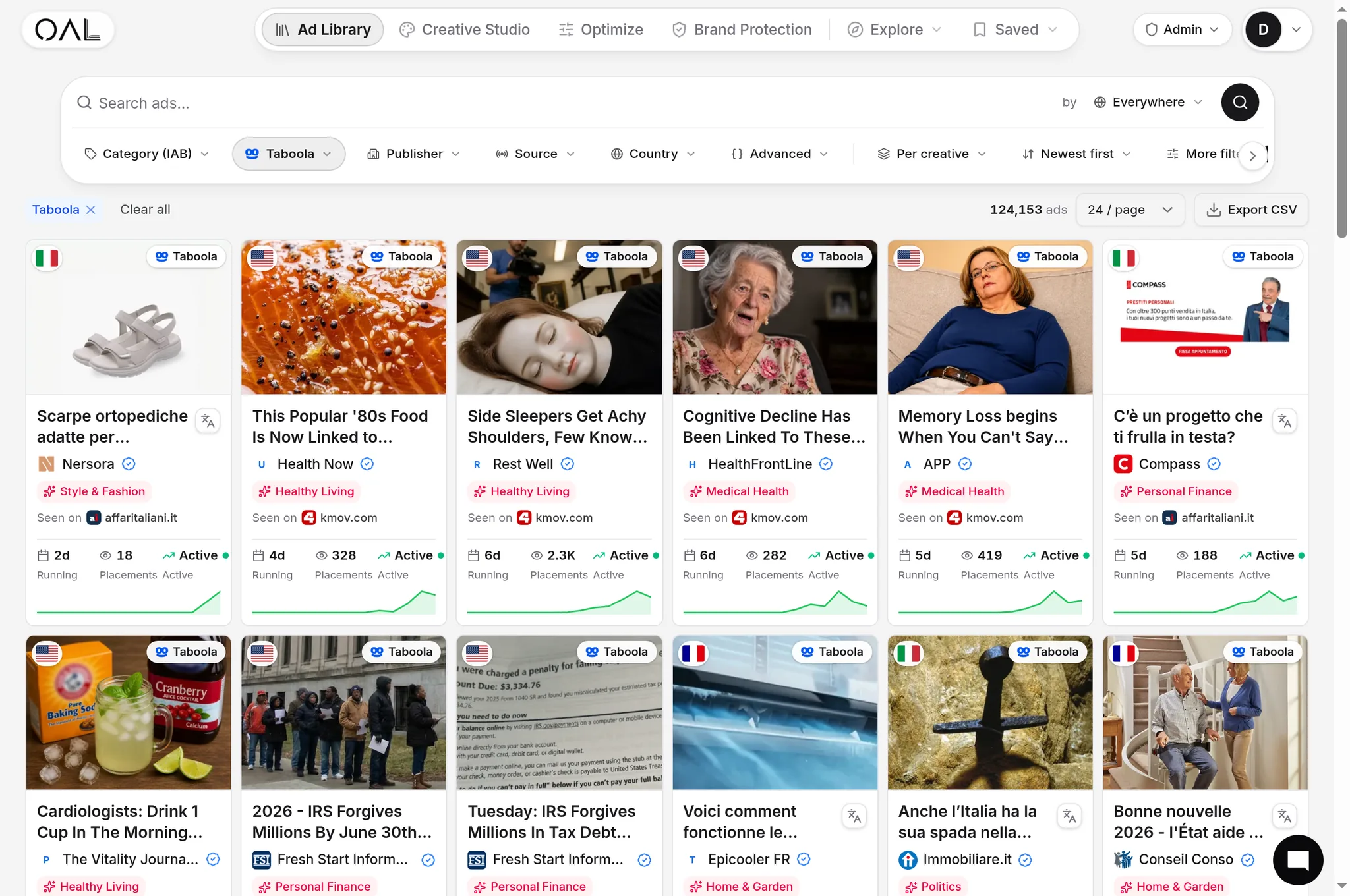
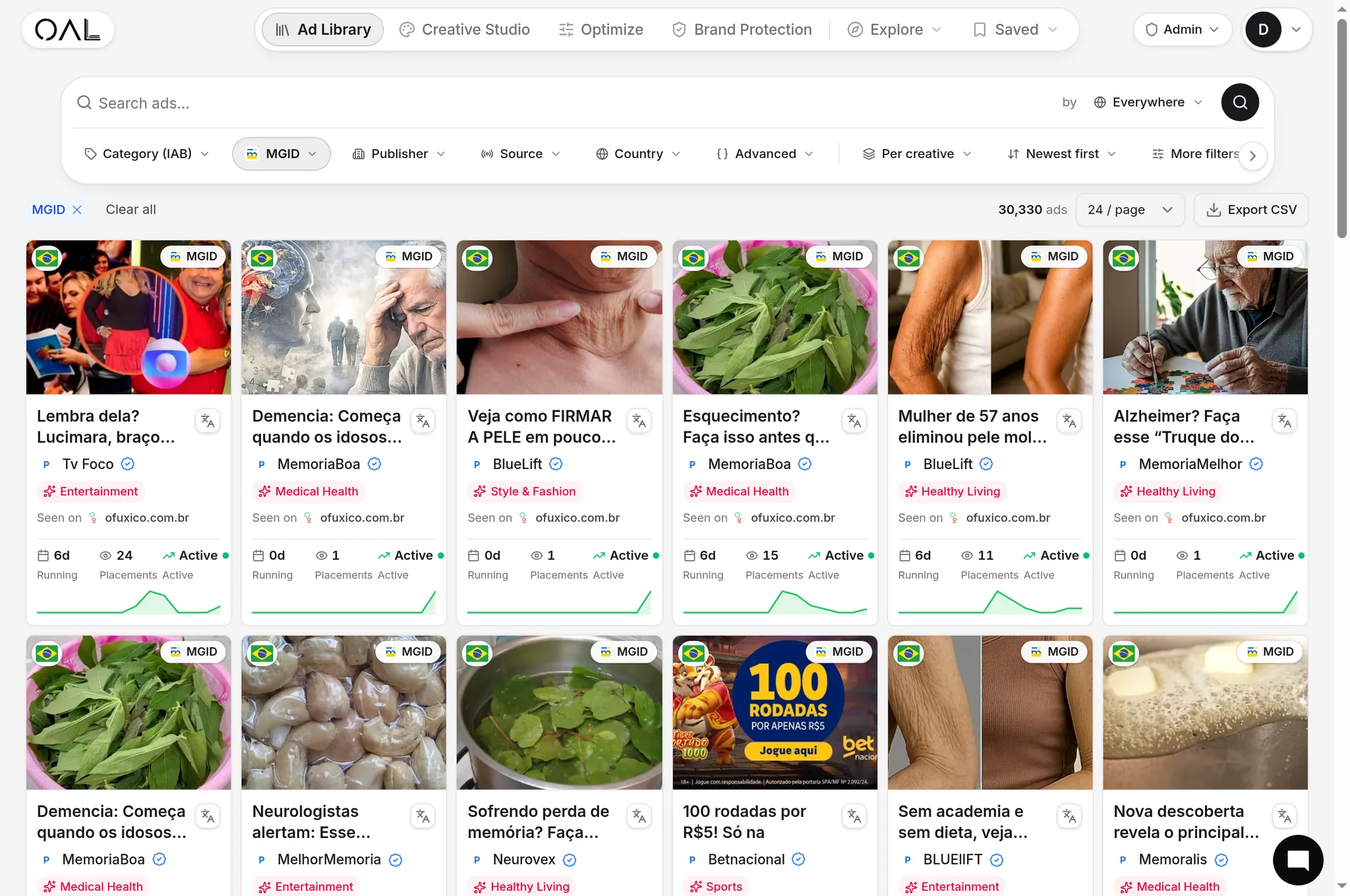
Before committing budget to a new Revcontent campaign, it helps to see what's actually running and for how long. OpenAdLibrary's Revcontent index lets you filter live creatives by vertical and see how long each one has been running, which is a reasonable proxy for whether it's still converting. Cross-referencing that against how Revcontent's mechanics compare to Taboola's or against MGID's overlapping mid-tier audience can save you a test cycle before you ever touch the platform.